Many custom options...


And formats...



Not what you want?
Try other similar-meaning words, fewer words, or just one word.
Shinobi Ninja Outcast Only in Chinese / Japanese...
Buy a Shinobi Ninja Outcast Only calligraphy wall scroll here!
Personalize your custom “Shinobi Ninja Outcast Only” project by clicking the button next to your favorite “Shinobi Ninja Outcast Only” title below...
Switched to secondary search mode due to lack of results using primary.
These secondary results may not be very accurate. Try a different but similar meaning word or phrase for better results. Or...
Look up Shinobi Ninja Outcast Only in my Japanese Kanji & Chinese Character Dictionary(My dictionary is a different system then the calligraphy search you just tried)
If you want a special phrase, word, title, name, or proverb, feel free to contact me, and I will translate your custom calligraphy idea for you.
2. 5. Right Living / Right Livelihood / Perfect Livelihood
3. Acupuncture
5. Aiki Budo
6. Aikikai
7. Alive
8. Alone with only your shadow for company
9. No man knows what he owes to his parents until he comes to have children of his own
10. Archer
11. 1000 good moves ruined by 1 bad
12. Ayaka
14. Benevolent Heart
15. Better to be Happy than Rich
17. Big Wave
18. Rank Holder
19. Body / Karada
23. Brevity: Fewer Words are Best
24. Brotherly and Sisterly Love
25. Buddha Seeking
27. Buddhism
29. The Buddha is in Each Sentient Being
30. Captain
31. Chan
32. Cherry Blossom
33. Control of Power
34. Crazy / Mad
36. Crisis equals Danger plus Opportunity?
37. Dana: Almsgiving and Generosity
38. Danger
39. Demon
40. Destiny / Fate
41. Diligence
42. Discipline
44. Opportunity Knocks Only Once
45. Double Happiness Guest Book
46. Drain the pond to get all the fish
47. Dynamic
48. Echo
49. First Born Son
50. Empress
51. Dynamic Energy / Enthusiasm
52. Eternal Love
53. Sky / Ether / Void / Emptiness / Unreality
55. Daddy / Father
56. Fear God
58. Five Elements Tai Chi Fist
60. Four Noble Truths: Elimination of Desire or Attachment
61. Four Noble Truths: Path Leading Away From Suffering
62. Friendship
63. Geisha
64. Geisha / Geigi
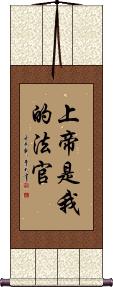
65. God is my Judge
68. 50th Golden Wedding Anniversary
69. Goldfish
70. Good Health / Healthy / Vigor
71. Grace from Heaven / Grace from God
72. Guanxi
73. Hanawa
74. Hapkido
75. Happy Birthday
76. He
79. Hell / Kingdom of the Underworld
80. Hello / Ni Hao
81. Hiro
82. Hitori
83. Holy Bible
84. Feel at Ease Anywhere / The World is My Home
86. Polo
87. Hua Mulan
88. Hyakuren-Jitoku
89. Iaido
91. Innovation
92. Itosu
93. Christ
95. John 3:16
96. Joshua 24:15
97. Joy
Ten perfect Mahayana rules
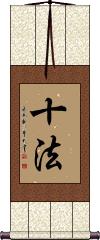
十法 is the title of the ten perfect or perfecting Mahāyāna rules.
The order of rules is as follows:
1. right belief.
2. right conduct.
3. right spirit.
4. the joy of the bodhi mind.
5. joy in the dharma.
6. joy in meditation.
7. pursuing the correct dharma.
8. obedience to, or accordance with dharma.
9. departing from pride, desire, etc.
10. comprehending the inner teaching of Buddha and taking no pleasure in attaining such knowledge or noting the ignorance of others.
This title is only used in the context of Buddhism. Japanese and Chinese people who are not familiar with Buddhism will not recognize this title.
5. Right Living / Right Livelihood / Perfect Livelihood
Samyag Ajiva / Samma Ajiva
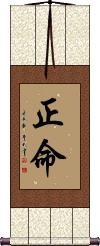
正命 (right living) is one of the Noble Eightfold Paths of Buddhism.
Right Living, along with Right Speech and Right Action, constitute the path to Virtue.
Right Living means that a Buddhist should only take a job or pursue a career in a field that does no harm. Buddhists should not work in the arms trade, as pimps or in the field of prostitution, as a butcher or in a shop that kills or sells meat, in a laboratory that does animal research, or in any other business that involves scheming or unethical behavior.
Another definition: Avoidance of professions that are harmful to sentient beings, such as slaughterer, hunter, dealer in weaponry or narcotics, etc.
This term is exclusively used by devout Buddhists. It is not a common term, and is remains an unknown concept to most Japanese and Chinese people.
See Also: Buddhism | Enlightenment | Noble Eightfold Path
Acupuncture
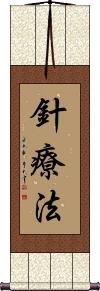
針療法 is one of two ways to write acupuncture in Chinese and Japanese.
The first character means “needle” or “pin.” The second character means “to treat” or “to cure.” The last character means “method” or “way.”
This is the only reasonable selection if your audience is Japanese. This is the formal way to express acupuncture in Chinese, so this version is universal in most of Asia (the best all-around choice in most cases).
Adapt Oneself
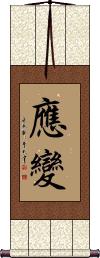
應變 means “to meet a contingency,” “to adapt oneself to changes,” or “to adapt to changes” in Chinese.
It's also used in Japanese but usually only in the context of Buddhism. 應變 is probably the shortest way to express the idea of adapting and overcoming whatever circumstances present themselves.
Aiki Budo
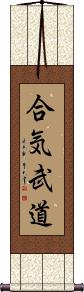
合気武道 is the title Aiki-Budo or “Aiki Martial Arts” in Japanese Kanji.
合 means “union” or “harmony.”
気/氣 means “universal energy” or “spirit.”
武 means “martial” or “military.”
道 means “way” or “method.”
合気武道 is the modern Japanese way to write this. You may also see 合氣武道, where the second character is written in the older traditional (pre-1945) form. If you want this written 合氣武道, just include a note or email with your order.
合氣武道 are all Chinese characters as well, so I included the Chinese pronunciation above. However, while it can be understood in Chinese, this is not a common term in that language and is not used in any Chinese martial arts. Also, 気 is only used in Japan - Chinese will understand 気 to be the Japanese form of 氣.
See Also: Martial Arts | Hapkido
Aikikai
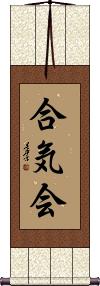
合気会 or “Aikikai” is the original school of Aikido.
Several organizations use this title. The first was established in Japan in 1940 (The Aikikai Foundation or 財団法人合気会).
The only difference between this title and Aikido is the last character, “kai” which means club, group, fraternity, organization, or assembly.
Note: 合気会 may be romanized with a dash like this: Aiki-Kai.
Alive
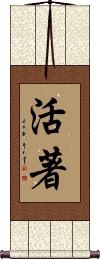
活著 is the word that means alive, as in the state of living or being alive (Chinese only).
Alone with only your shadow for company
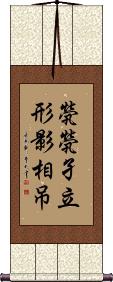
煢煢孑立形影相吊 is a Chinese proverb about the state of being as alone as you possibly can be.
It can be translated as “Alone with only your shadow for comfort/company.”
See Also: I Miss You
No man knows what he owes to his parents until he comes to have children of his own
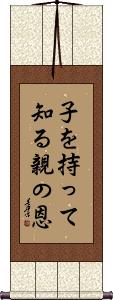
子を持って知る親の恩 literally translates as: Only after you have a baby, you would appreciate your parents (feel the way they do, etc).
This is a bit like the “walk a mile in another man's shoes” saying. Basically, it's about you cannot fully understand the plight of others until you experience it yourself. It also shows appreciation for the plight of parents.
This Japanese proverb can also be translated a few more ways:
No man knows what he owes to his parents till he comes to have children of his own.
One knows not what one owes to one's parents till one comes to have children of one's own.
Only after you have a baby, you will appreciate your parents or feel the way they do.
Only after becoming a parent yourself do you realize how much you owe [how indebted you are] to your own parents.
Note: Because this selection contains some special Japanese Hiragana characters, it should be written by a Japanese calligrapher.
Archer
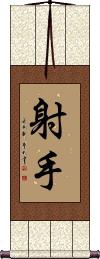
射手 means archer, shooter, or marksman in Chinese, Japanese Kanji, and old Korean Hanja.
Depending on the context, it can also mean “goal-getter” in Chinese. This would also be the word for a bowman.
射手 is modern in Asia, meaning that it's only been in use for a few hundred years. However, the more ancient version of the archer is often not even recognized by the current generation of Chinese and Japanese people.
The first character means “shoot” or “fire” (in the context of a gun or bow). It's also a suffix for radioactive things (in the context of chemistry) - radioactive things “fire off” electrons. In Japanese, the first Kanji is a short name and suffix for archery.
The second character means “hand,” but the hand can also mean a person, in the same way, that a “farmhand” is a person in English.
1000 good moves ruined by 1 bad
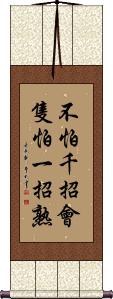
不怕千招会只怕一招熟 is a Chinese proverb that literally translates as: Do not worry about making a thousand clever moves; what [one has to] fear is one bad move.
Figuratively, this means: Even if you have made many clever moves before, one wrong move will ruin the whole game.
I compare this to the English saying, “It takes only one Aw-shit to wipe out a thousand Attaboys.”
Ayaka
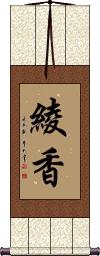
綾香 is the Japanese female given name Ayaka.
It can also be Ryouko, Ryoko, Ryouka, or Ayako.
This can be pronounced in Chinese, but it's only a name in Japanese. There are several other names that romanize as Ayaka, so make sure it's the right one.
Beautiful Princess
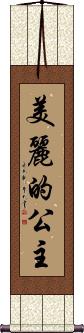
美麗的公主 is how to write beautiful princess in Chinese.
The first two characters mean feminine beauty or rather a way to say beautiful that only applies to women. The middle character is just a connecting character. The last two characters mean princess.
See Also: Queen
Benevolent Heart
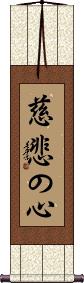
慈悲の心 means benevolent heart, compassionate heart, or merciful heart in Japanese.
This is a Japanese-only phrase and should be ordered from our Japanese master calligrapher. This is because the third character is unique Hiragana.
Chances are you are into Inuyasha and are seeking the title of chapter 471 which is often translated as “Merciful Heart.”
Better to be Happy than Rich
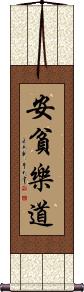
安貧樂道 means “It's better to be happy than rich” in Chinese.
Even if you are poor, you should still feel satisfied in your life...
...Satisfaction, happiness and the meaning of your life come from within yourself and not from money or riches of the world.
In Chinese, there are a lot of four-character proverbs which express some very old philosophies.
Though there are only four characters on this scroll, in Chinese, the meanings often surpass the dictionary definition of each character.
In this case, you should not set your expectations too high for the money or riches you wish to have. One who sets their expectations too high is almost always disappointed. Instead, you should cherish what you have, seek to improve yourself from within, and not measure your worth by the size of your bank account.
Beware of the Lawyers
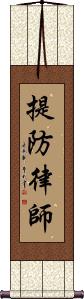
提防律師 is a kind of Chinese joke about lawyers.
The first two characters mean “guard yourself against (an attack)” or “beware.”
The last two characters can be translated as lawyer, attorney, or solicitor.
Separately, those characters mean law/regulation/control and master/expert/teacher. Here, you can see the attorney meaning is pretty clear in the individual characters.
Please note this is Chinese only (it won't make sense in Japanese, and the last two characters are sometimes translated together as “Buddhist Priest” in Japanese).
Big Wave
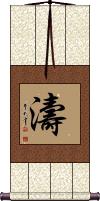
濤 is the Chinese character for “Big Wave.”
It suggests a wave unlike most, strong and powerful.
濤 is technically also a Japanese Kanji, and Korean Hanja but it's not commonly used in those Asian languages. Pronunciation in Japanese and Korean is provided above for reference only. Just order this if your audience is Chinese.
Rank Holder
The one who has achieved rank in martial arts
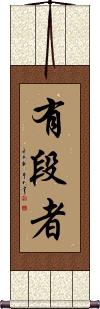
有段者 is a Japanese term for someone who holds rank in karate, judo, etc.
This term theoretically applies to anyone with rank (above a white belt). However, some schools or dojos may reserve this title for a holder of a black belt.
I'd suggest that you only order this phrase if you have honestly reached this level.
This title does kind of make sense in Chinese but only to those Chinese who practice “kong shou dao” (karate) or when used in the context of martial arts.
Body / Karada
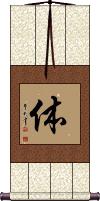
体 is used in Japanese to mean “body.”
体 can also refer to the form, style, corporeal existence, appearance, identity, or state of something or someone. 體 is also used in Buddhism in regard to the corporeal existence of someone (their earthy vessel). It's kind of a broad term that can be used in a lot of different ways.
As a single character, it's usually pronounced “karada” but it can also be pronounced “tai” or “te” (Japanese pronunciation borrowed from the original Chinese).
體 is not a common Kanji to use for a wall scroll. Only select this if you have a personal and meaningful reason to do so. Also, consider this version to be “Japanese only” - see below...
 In Chinese and old Korean Hanja, this character is written in the traditional form shown to the right. If you want this version, click on the character to the right instead of the button above.
Body and Earth in Unity
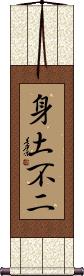
身土不二 (Shindofuni) is originally a Buddhist concept or proverb referring to the inseparability of body-mind and geographical circumstances.
This reads, “Body [and] earth [are] not two.”
Other translations or matching ideas include:
Body and land are one.
Body and earth can not be separated.
Body earth sensory curation.
You are what you eat.
Indivisibility of the body and the land (because the body is made from food and food is made from the land).
Going further, this speaks of our human bodies and the land from which we get our food being closely connected. This phrase is often used when talking about natural and organic vegetables coming directly from the farm to provide the healthiest foods in Japan.
Character notes: 身(shin) in this context does not just mean your physical body but a concept including both body and mind.
土 (do) refers to the soil, earth, clay, land, or in some cases, locality. It's not the proper name of Earth, the planet. However, it can refer to the land or realm we live in.
Japanese note: This has been used in Japan, on and off, since 1907 as a slogan for a governmental healthy eating campaign (usually pronounced as shindofuji instead of the original shindofuni in this context). It may have been hijacked from Buddhism for this propaganda purpose, but at least this is “healthy propaganda.”
Korean note: The phrase 身土不二 was in use by 1610 A.D. in Korea, where it can be found in an early medical journal.
In modern South Korea, it's written in Hangul as 신토불이. Korea used Chinese characters (same source as Japanese Kanji) as their only written standard form of the language until about a hundred years ago. Therefore, many Koreans will recognize this as a native phrase and concept.
See Also: Strength and Love in Unity
Bojutsu / Bojitsu
The art of using a stick as a weapon
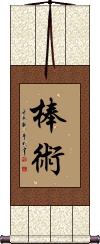
棒術 is the title Bōjutsu (though some use the romanization Bojitsu).
棒術 is a martial art centered around using a “bō” or staff as a weapon.
This title is a combination of the Japanese word “bō” (which means staff, stick, club, rod, pole, or cudgel) with the Japanese word “jutsu” (which means art or technique).
While this word can be pronounced in Chinese (bang shu), it's not a common term in China. Please consider this title to be “Japanese only.”
Love Binds Us Together
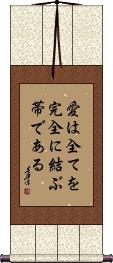
愛は全てを完全に結ぶ帯である is a Japanese phrase that suggests we (or a couple) are bound together by love.
I searched the web and found all of these English translation variations for this phrase:
Have love; The only way in which you may be completely joined together.
Love is the sash that perfectly binds us together.
Love is what binds us together
Love binds all things together in perfect unity.
This same Japanese phrase is used as part of Colossians 3:14 in at least one version of the Japanese Bible.
A few Biblical versions include:
...Charity, which is the bond of perfectness. (KJV)
...Love, which binds them all together in perfect unity. (NIV)
Note: Because this selection contains some special Japanese Hiragana characters, it should be written by a Japanese calligrapher.
Brevity: Fewer Words are Best
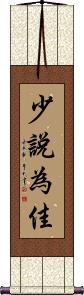
Getting to the point quickly with the fewest words possible is the suggestion of this 少說為佳 Chinese proverb.
But taking it more profound, there is a warning that using too many words may act to “tip your hat” or “show your hand” (to use two American idioms).
It can also be said that using many words does not make the message have more value.
This is really about the art of brevity.
My only hope is that I did not use too many words to explain this proverb.
Brotherly and Sisterly Love
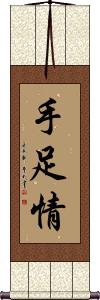
手足情 is the love between siblings.
When you love, protect, care for, and have a deep bond that only brothers or sisters can.
The actual translation is “Hand and Foot,” but the relationship between brothers or sisters is like that of hands and feet. They belong together and complete the body. Even though this says “hand and foot,” it will always be read with the brotherly and sisterly love meaning in Chinese.
Note: During the past 20 years, the “One child policy” in China is slowly making this term obsolete.
Buddha Seeking
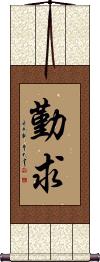
勤求 is a complex word that means inquiring in the Buddha way.
To put it another way, it is seeking something in the right way, at the right time, and diligently seeking only truth or the good.
Buddhism / Buddha
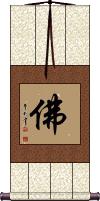
佛 is the essence of the Buddha or Buddhism.
Depending on the context, this word and character can be used to refer to the religion and lifestyle of Buddhism, or in some cases, the Buddha himself.
It is interesting to note that this word is separate from all others in the Chinese language. The sound of “fo” has only this meaning. 佛 is in contrast to many sounds in the Chinese language, which can have one of four tones, and more than 20 possible characters and meanings. This language anomaly shows how significantly Buddhism has affected China since ancient times.
More about Buddhism
佛 is also used with the same meaning in Korean Hanja.
It's used in the very religious context of Buddhism in Japan. It should be noted that there are two forms of this Kanji in use in Japan - this is the more formal/ancient version, but it's rarely seen outside of religious artwork and may not be recognized by all Japanese people.
It also acts as a suffix or first syllable for many Buddhist-related words in Chinese, Japanese, and Korean.
See our Buddhism & Zen page
See Also: Bodhisattva | Enlightenment
Buddhism
(2 characters)
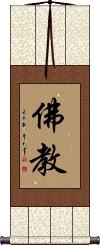
佛教 is the more exact way to express the religion or lifestyle of Buddhism.
It can also be read as “Buddha's Teachings.” 佛教 is Chinese only, as a different character is more commonly used in Japanese to express Buddhism. The same first character is used in Korea, but a slight variation exists in the second character in Korean Hanja. However, it would be fully recognized by any Korean person who can read Hanja.
Bushi-Ryu Jujutsu
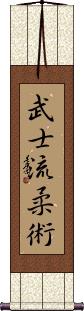
武士流柔術 is a special title added for a customer's specific school/style of Jujutsu.
Please only order this if you are a member/practitioner of this style.
The Buddha is in Each Sentient Being
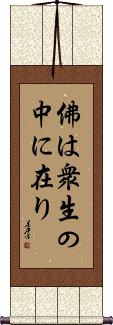
佛は衆生の中に在り is “Butsu wa shujo no naka ni ari” and means that the Buddha (potential for Buddhahood) exists in all beings in the universe.
So yes, your dog has the potential to be a Buddha (but only in a future reincarnation as a human). But all things, from the tiny cricket to the humpback whale have Buddha nature within them. If one takes the time to look and contemplate, one will see the Buddha in all things.
In Japan, sometimes the Buddha character is written 仏 instead of 佛, so you might see the whole phrase written as 仏は衆生の中に在り.
Note: Because this selection contains some special Japanese Hiragana characters, it should be written by a Japanese calligrapher.
Captain
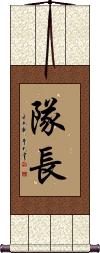
隊長 is a Chinese and Japanese word that means captain, team leader, or commanding officer.
This is an odd title for a calligraphy wall scroll, so it's really here for educational purposes only.
Chan
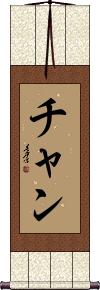
チャン is the name Chan in Japanese Katakana.
This should only be used if your English name is Chan. This is different than any variant of the Chinese surname Chan.
Note: Because this title is entirely Japanese Katakana, it should be written by a Japanese calligrapher.
Cherry Blossom
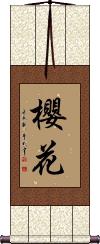
櫻花 is how to write “cherry blossom” in Chinese and traditional Japanese Kanji.
The first character means “cherry” or sometimes “cherry tree.”
The second character means “flowers” or “blossoms.”
Oddly, my Chinese dictionary also defines these two characters as “Japanese oriental cherry tree” or “Oriental cherry blossom.” However, the first character is the only one that means “cherry,” so it can refer to any cherry blossoms in the whole world (not just those in Asia).
 There is an alternate version of the first character, which has become the standard for Japanese Kanji. If you want this version, instead of the one shown to the upper left, please click on the Kanji shown to the right instead of the button above. Although this is an alternate form in Chinese, most Chinese people will think this is just the Japanese version (Chinese people
don’t
necessarily know the history and all alternate forms of Chinese characters from the past). Therefore, this version shown to the right is best if your audience is Japanese (though most Japanese will recognize the form shown in the upper left).
There is an alternate version of the first character, which has become the standard for Japanese Kanji. If you want this version, instead of the one shown to the upper left, please click on the Kanji shown to the right instead of the button above. Although this is an alternate form in Chinese, most Chinese people will think this is just the Japanese version (Chinese people
don’t
necessarily know the history and all alternate forms of Chinese characters from the past). Therefore, this version shown to the right is best if your audience is Japanese (though most Japanese will recognize the form shown in the upper left).
Control of Power
Him Cho Chung
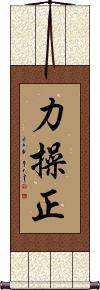
力操正 is a Korean martial arts title meaning “Power Control.”
It's most often cited as one of the 8 key concepts from Tang Soo Do.
This can be pronounced in Chinese but will only be recognized by those familiar with martial arts terms.
Crazy / Mad
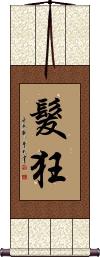
髮狂 is the nicest/coolest way to write “crazy” in Chinese.
There are several other ways to express “insane” or “mentally disturbed,” but they are either clinical terms or very serious afflictions.
髮狂 is not a great or normal selection for a wall scroll. Please only order this if you want this idea for some personal reason.
To put it another way: It's a little crazy to have a “crazy” wall scroll.
Crazy / Mad / Wild
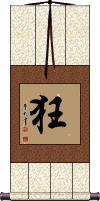
狂 is a single character that means “crazy” in Chinese, Japanese Kanji, and old Korean Hanja.
狂 means crazy, unrestrained, lunatic, insane, confused, deranged, wild, or mad.
This can also refer to an extreme enthusiast (like a football fan). But then, it can also refer to a person possessing a mental abnormality.
In some contexts, this can mean conceited (it probably won't be read that way on a wall scroll).
A warning: 狂 is an odd selection for a wall scroll. You should only order this if you plan to bewilder or confuse those who see it. It kind of says something about you, something that most native Asian people will not view in a good light.
Crisis equals Danger plus Opportunity?
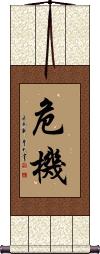
危機 means crisis in Chinese and Japanese.
Separately, the first character here does mean “danger” or “to endanger,” and the second character can mean “opportunity.”
However, I want to debunk a myth that was propagated by some westerners who did not have a clear understanding of Asian languages...
While often, Chinese/Japanese/Korean compound words (words of two or more characters) are the sum of their parts, this is not always the case. The compound is often understood with a completely different meaning than the two characters individually.
Many have said that the Chinese/Japanese/Korean word for Crisis is made up of the characters for “danger” and “opportunity.” 危機 is true when phrased this way.
However, it's not absolutely correct to say that “danger + opportunity = crisis” in Asian cultures.
English example:
If I tell you that...
Bovine creature + Guy behind the plate in baseball = Locomotive train protection

...you would think I was mad. But consider that “cow + catcher = cowcatcher,” which is the device that used to be found on steam engines to protect them if they hit an animal on the tracks. When we hear the word “cowcatcher,” we don't separate the words into their individual meanings (necessarily).
The same is true with the word for crisis in Chinese/Japanese/Korean. While you can separate the characters, few Asian people would automatically do so in their minds.
The final answer:
It is a half-truth to say, “danger plus opportunity equals crisis” in Chinese/Japanese/Korean. Use this statement and concept with caution.
Also, the second character can mean “secret” or “machine,” depending on context so I guess you have to say “a dangerous machine = crisis” or “danger + a secret = crisis.” Both of these are only slightly more ridiculous than the first premise.
PS: 危機 is probably not a great word for a scroll unless you have a special use for it.
Dana: Almsgiving and Generosity
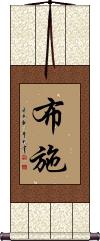
布施 is the Buddhist practice of giving known as Dāna or दान from Pali and Sanskrit.
Depending on the context, this can be alms-giving, acts of charity, or offerings (usually money) to a priest for reading sutras or teachings.
Some will put Dāna in these two categories:
1. The pure or unsullied charity, which looks for no reward here but only in the hereafter.
2. The sullied almsgiving whose object is personal benefit.
The first kind is, of course, the kind that a liberated or enlightened person will pursue.
Others will put Dāna in these categories:
1. Worldly or material gifts.
2. Unworldly or spiritual gifts.
You can also separate Dāna into these three kinds:
1. 財布施 Goods such as money, food, or material items.
2. 法布施 Dharma, as an act to teach or bestow the Buddhist doctrine onto others.
3. 無畏布施 Courage, as an act of facing fear to save someone or when standing up for someone or standing up for righteousness.
The philosophies and categorization of Dāna will vary among various monks, temples, and sects of Buddhism.
Breaking down the characters separately:
布 (sometimes written 佈) means to spread out or announce, but also means cloth. In ancient times, cloth or robs were given to the Buddhist monks annually as a gift of alms - I need to do more research, but I believe there is a relationship here.
施 means to grant, to give, to bestow, to act, to carry out, and by itself can mean Dāna as a single character.
Dāna can also be expressed as 檀那 (pronounced “tán nà” in Mandarin and dan-na or だんな in Japanese). 檀那 is a transliteration of Dāna. However, it has colloquially come to mean some unsavory or unrelated things in Japanese. So, I think 布施 is better for calligraphy on your wall to remind you to practice Dāna daily (or whenever possible).
Danger
A dangerous character in every way
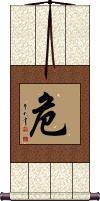
危 means danger, peril, or “to endanger” in Chinese, Japanese, and old Korean.
If you live a dangerous life or want to subtly warn others that you are a dangerous person, this may be the selection for you.
This also means “danger” and sometimes “fear” in Japanese and Korean but is seldom seen outside of compound words in those languages (as a single character, it's kind of like an abbreviation for danger in Japanese and Korean). 危 is also a rather odd selection for a wall scroll anyway. It's only here because people search for danger on our website.
Demon
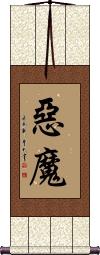
惡魔 is a common way to say demon, fiend, evil spirit, devil, or Satan in Chinese, Japanese Kanji, and old Korean Hanja.
This is a strange choice for a wall scroll, so consider this entry for reference only.
Destiny / Fate
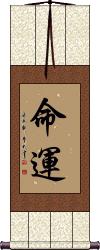
These two characters contain the ideas of fate, destiny, fortune, and luck.
You can also say that it means “what life throws at you” or “your lot in life” because the first character contains the idea of life or living.
This version is really only used in Chinese. There's another version with just the characters reversed that is more universal. In fact, skip this one. The opposite character order is better.
Diligence
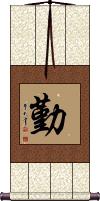
勤 is a single character that means diligence or “sense of duty” in Chinese and Korean (also understood in Japanese but not commonly seen as a stand-alone Kanji).
As a single character on a wall scroll, this will only be seen with this meaning. However, it can also mean industrious, hardworking, frequent, regular, constant, energy, zeal, fortitude, or virility.
In Buddhism, this can represent vīrya (viriya), the idea of energy, diligence, enthusiasm, or effort. It can be defined as an attitude of gladly engaging in wholesome activities, and it functions to cause one to accomplish wholesome or virtuous actions. Some Buddhists may even define this as “manliness” (a definition from a hundred years ago, before equality).
If you or someone you know is a hard worker (or needs a reminder to be diligent), then this is the wall scroll to have in your/their office.
Discipline

鍛練 is the Japanese Kanji and Korean Hanja word used for discipline.
This has a meaning like “forging or creating something from lots of training and practice.” My Japanese dictionary translates this as “tempering, forging, hardening, disciplining, training.”
This is for Japanese and Korean only. In Chinese, these characters might be translated as (physical) “exercise.”


The modern form of the second Japanese Kanji looks like the first image to the right. There’s also an alternate modern form after that, and finally, an alternate traditional form. Because calligraphy is an art, the calligrapher could choose any of these possible forms. Let us know if you have a preference.
See Also: Self-Control | Will-Power
Divine Protection
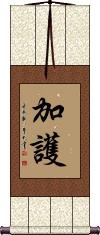
加護 is Japanese for “divine protection” or “the saving grace of God.”
Please consider this blessing to be Japanese only. This can have the same meaning in the context of Buddhism in Chinese, but it's also a nickname for “intensive care” at Chinese hospitals.
Note: My Japanese translator says this is not commonly used in Japanese. I added this because a customer asked for it. There is no better Japanese phrase to express this idea - so this is it if you want it.
Opportunity Knocks Only Once
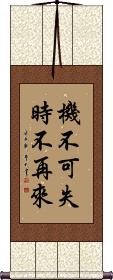
機不可失, 時不再來 is often translated as Opportunity Knocks Only Once in Chinese.
The more literal meaning is, “This chance is not to be lost, it won't come again.”
Double Happiness Guest Book
Customize a special Asian guest book for your wedding
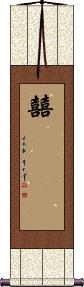
Start customizing a “Double Happiness Guest Book Wall Scroll” Here!
The paper panel length can be whatever you choose from 68cm to 135cm (27” to 53”).
If you don't mention what paper length you want in the special instructions tab (on the next page), we'll make it about 100cm (40”).
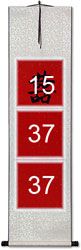
The medium-size scroll with a 33cm x 100cm (13” x 40”) paper panel can usually handle up to 89 signatures. That breaks down to 37 signatures per empty square and 15 signatures around the 囍 character. If you switch to a 135cm paper panel, add another 37 potential signatures.
We can splice two 135cm papers together, but that would be a crazy-long scroll. These are only estimates, your mileage may vary.
With silk panels, this will yield a wall scroll about 155cm (61”) long. That's enough for up to 89 signatures. Of course, that depends on if your guests just sign a brief salutation and name, or more verbose good wishes. Customer feedback is that 126 people can sign the 135cm long paper on a medium-sized scroll. If we go bigger than that, there will be a minor paper seam and an extra charge. Email me with your specifications if you need something special.
Most customers pick the festive red paper with gold flecks and white or ivory silk. Red is a good luck color in Chinese culture, thus the most popular choice. But, you can do any color combination that you want.
There is a long history of Chinese-character-use outside of mainland China. This Double Happiness character is also seen at weddings in Korea, Vietnam, Hong Kong, and Taiwan, as well as in Chinese communities in Thailand, Indonesia, and elsewhere. While Japan borrowed Chinese characters into their language, you won't see 囍 as often at Japanese weddings.
Drain the pond to get all the fish
Kill the goose that lays the golden eggs
In 632 BC, Duke Wen of the Kingdom of Jin was about to lead an army against the forces of the Kingdom of Chu.
The Duke asked one of his advisers, Jiu Fan, how they could win the impending battle, as they were drastically outnumbered.
Jiu Fan said, “All is fair in war,” and suggested a plan of dishonorable tactics (cheating).
The Duke was unsure of this advice, so he asked another adviser, Yong Ji, who replied, “If you catch fish by draining the pond, you can certainly get all the fish. But there will be no fish the following year. You can cheat this one time in battle, but such tactics can only be used once, as the enemy will be wise in future encounters.”
The Duke heard the words of his wiser adviser but cheated to gain victory in the battle. However, he rewarded Yong Ji more than Jiu Fan at the victory celebration, stating that while Jiu Fan's advice gained one victory, the wise words of Yong Ji would last forever.
This Chinese idiom/proverb is still used, over 2600 years later to remind people not to burn bridges, cheat, or dishonor themselves in exchange for a short-term gain while sacrificing the future.
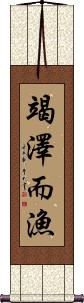
竭澤而漁 is very similar to the meaning of the English phrase, “Kill the goose that lays the golden eggs.”
Dynamic
Moving / Motion / Ever-Changing
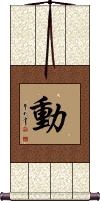
動 is the only Chinese/Japanese/Korean word that can encompass the idea of “dynamic” into one character.
動 can also mean:
to use; to act; to move; to change; motion; stir.
In the Buddhist context, it means: Movement arises from the nature of wind which is the cause of motion.
The key point of this word is that it represents motion or always moving. Some might say “lively” or certainly the opposite of something that is stagnant or dead.
Note: In Japanese, this can also be a female given name, Yurugi.
Echo
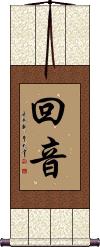
回音 is the word echo in Chinese.
It can also mean reply or turn (ornament in music).
In Japanese, this just has the meaning of turn (melodic ornament) or gruppetto. Only select this if your audience is Chinese.
First Born Son
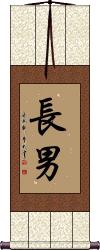
長男 is a Chinese, old Korean Hanja and Japanese Kanji title for eldest son (may be the only son), firstborn son.
This can also be the Japanese personal name “Nobuo.”
Empress
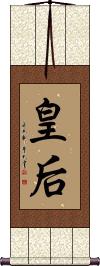
皇后 is the title of empress/emperess, the female form of the emperor.
皇后 is used in Chinese, Japanese Kanji, and old Korean Hanja.
While the emperor's reign was for life, if he died, his wife would hold his power. In this case, a woman was the ultimate ruler of the greater part of East Asia (now China) until her death and the succession of the emperor's firstborn son to lead the empire. Numerous times in various Chinese dynasties, an empress took power in this way.
The first character means emperor by itself.
The second character alone can mean “wife of an emperor or king” (the first character clarifies that we are talking about an empress and not a queen). It can also mean sovereign or last offspring, depending on context.
Note: In some books, this word is translated as queen. While only incorrect if you get technical (because an empress is theoretically a higher level than a queen), the meaning is very similar.
皇后 is sometimes used for the title of queen, but more technically, this is the wife of the emperor (a higher level than a queen).
Dynamic Energy / Enthusiasm
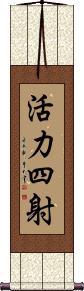
活力四射 is a Chinese word that can be defined as dynamic; enthusiastic; energetic; vitality.
This is the more robust 4-character version of this word. The short version consists of the first two characters: 活力. This 4-character version is commonly used only in Chinese.
Eternal Love
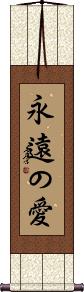
永遠の愛 is a great way to write “Eternal Love” in Japanese.
The first two characters mean eternal, eternity, perpetuity, forever, immortality, and permanence.
The third character is a possessive article which sort of makes this selection mean “Love, of the eternal kind.”
The last character is “love.”
Cultural note: Most of the time, it is taboo to use the word “love” in Japanese. For instance, a Japanese man will say, “I like you,” rather than, “I love you,” to his spouse/girlfriend. However, this entry for eternal love is acceptable because of the way it is composed.
This entry is only appropriate if your audience is Japanese. We also have a Chinese version of this eternal love.
Sky / Ether / Void / Emptiness / Unreality
(Used in Japanese version of five elements)
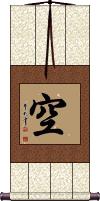
空 is a single character that means empty, void, hollow, vacant, vacuum, blank, nonexistent, vacuity, voidness, emptiness, non-existence, immateriality, unreality, the false or illusory nature of all existence, and being unreal.
In the Buddhist context, this relates to the doctrine that all phenomena and the ego have no reality but are composed of a certain number of skandhas or elements, which disintegrate. The void, the sky, space. The universal, the absolute, complete abstraction without relativity. The doctrine further explains that all things are compounds, or unstable organisms, possessing no self-essence, i.e. are dependent, or caused, come into existence only to perish. The underlying reality, the principle of eternal relativity, or non-infinity, i.e. śūnya, permeates all phenomena making possible their evolution.
From Sanskrit and/or Pali, this is the translation to Chinese and Japanese of the title śūnya or śūnyatā.
In Japanese, when pronounced as “ron” (sounds like “roan”) this can be a given name. It should be noted that this Kanji has about 5 different possible pronunciations in Japanese: kuu, kara, sora, ron, and uro. 空 is also an element in the Japanese version of the five elements.
Failure in Not an Option
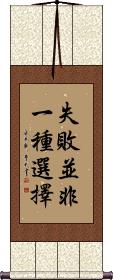
失敗並非一種選擇 is probably the best way to say, “Failure is not an option,” in Chinese.
Just don't forget that some ancient Chinese proverbs suggest that failure is a learning opportunity that leads to success or innovation. So don't plan to fail but failure is only a waste if nothing is learned from the failure.
See Also: Failure is a Stepping Stone to Success | Failure is the Mother of Success
Daddy / Father
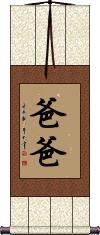
爸爸 is the colloquial way to say “Daddy” in Chinese.
Sometimes Chinese people will refer to their father with just one of these characters, “Ba,” which would be like “Dad.” With both characters, “Baba,” it's more like “Daddy.”
爸爸 is really a weird selection for a wall scroll, so consider this entry to be for educational purposes only (don't order this).
Fear God
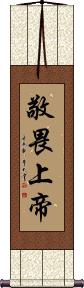
敬畏上帝 is probably the best way to translate the Christian English phrase “Fear God” into Chinese.
The first two characters mean to revere, be in awe of, or a general term of reverence. It can mean fear, but only in the context of respect or fear of authority.
Fight / Beat Someone
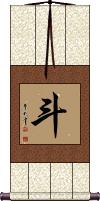
斗 is how to express the act of fighting in Chinese.
Generally, this means fighting against someone or some force whether physically or metaphorically.
Note: There is more than one way to write this character. You will notice variations on the next page after you click “Select and Customize.” If you have a preference, please let us know when you place your order.
Please note that there is a secondary pronunciation and meaning of this character. It can also mean “measuring cup” or in Japanese “sake dipper” or even “The Big Dipper.” In Japanese and Korean, this does not have the fighting meaning associated with it. You should, therefore, select this character only if your audience is Chinese, or you are a big fan of sake dippers or The Big Dipper (as that is how it will be read by Japanese and Korean people).
Five Elements Tai Chi Fist
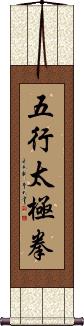
五行太極拳 is a certain school or style of Tai Chi (Taiji).
The characters literally mean “Five Elements Tai Chi Fist.”
Notes:
In Taiwan, it would be Romanized as “Wu Hsing Tai Chi Chuan” - see the standard Mandarin method above in the gray box (used in mainland China and the official Romanization used by the Library of Congress).
The last three characters are sometimes translated as “Grand Ultimate Fist,” so the whole thing can be “Five Elements Grand Ultimate Fist” if you wish.
I have not confirmed the use of this title in Korean but if it is used, it's probably only by martial arts enthusiasts. The pronunciation is correct, as shown above for Korean.
Fortune Favors The Brave
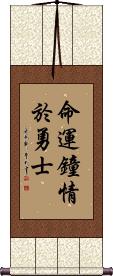
命運鐘情於勇士 means “Fortune favors the brave” in Chinese.
This is not the only way to express the idea of fortune favoring the bold or brave.
It's not originally a Chinese phrase, so it's been translated into Chinese in various ways.
Four Noble Truths: Elimination of Desire or Attachment
Nirodha
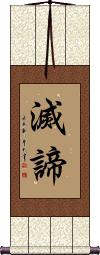
滅諦 suggests that once you eliminate desire or attachment to worldly things, only then can you achieve enlightenment.
Realize that things are impermanent. That fancy car, beautiful spouse, big house, and impressive career are things you can't take with you. These things are a flash in the pan compared to the infinite span of history, generations to come, time, and space.
This term is exclusively used by devout Buddhists. It is not a common term, and is remains an unknown concept to most Japanese, Korean, and Chinese people.
See Also: Buddhism | Enlightenment
Four Noble Truths: Path Leading Away From Suffering
Magga
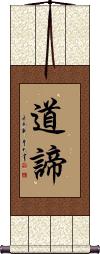
道諦 is the idea that once you have dealt with your desires and left all desire and attachment behind, only then are you on the path away from suffering (and on your way to enlightenment).
道諦 is also called the path to liberation in some English texts on Buddhism.
This term is exclusively used by devout Buddhists. It is not a common term, and is remains an unknown concept to most Chinese, Japanese and Korean people.
See Also: Buddhism | Enlightenment
Friendship
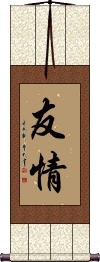
友情 can be translated as “camaraderie” or “fellowship.”
But this character combination is only used commonly in Japanese Kanji and Korean Hanja.
Geisha
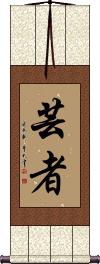
芸者 is the real basis for the way we spell geisha.
However, there are many more ways to refer to a woman that fills the role that westerners think of when they hear the word geisha.
In Japanese, these characters literally mean “artful person.” But in English, it might be better translated as “a person (woman) highly trained/accomplished in the arts.”
However, my Japanese dictionary says “a singing and dancing girl.”
Many will argue as to whether “geisha” = “prostitute” or not. My Japanese friends seem to have the opinion that a geisha is so highly trained in the art of playing musical instruments and dancing that the fact she might also be a prostitute is secondary to her performance on stage.
芸者 is a “Japanese only” term, they use a slightly different first character to express “geisha” in Chinese. Since this is a Japanese term, I have not included the Chinese version.
Geisha / Geigi
(Danger: Means prostitute in Japanese and Chinese!)
NOT APPROPRIATE FOR
CUSTOM CALLIGRAPHY
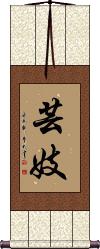
芸妓 is how to refer to a geisha that offers “special services.”
Please don't order this, it's only here for reference. 芸妓 is not appropriate for custom calligraphy!
God is my Judge
Godai / Five Elements
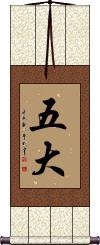
五大 is the Japanese title for the five elements.
In Japan, the five elements differ slightly from the original Chinese. Therefore, in Japanese philosophy, you have earth, water, fire, wind, and void (space).
The meaning of the first character is 5, but the second character means great or large. Some translate this as the five majors. 大 is only understood as “elements” when you have 五 in front of it.
In Buddhism, this can be short for 五大明王, or the five great and wise kings.
Goddess of Compassion
Long or more formal Japanese version of this title
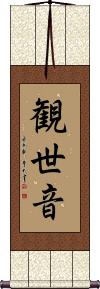
観世音 is the more extended and more formal Japanese version of Bodhisattva of Compassion or Guan Yin.
In Japanese, this is pronounced Kanzeon. The Chinese version is a bit more common in Asia, but in Japanese, they use a slight variation of the first character. Choose this version only if your intended audience is specifically Japanese.
50th Golden Wedding Anniversary
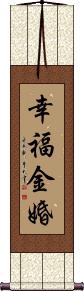
幸福金婚 means “Happy Golden Anniversary” and is a great gift for a couple who is celebrating 50 years together.
The first two characters mean happy, blessed, or happiness.
The last two characters mean “couple's golden anniversary.” It means “golden wedding” or “golden marriage,” but this is only used for the 50-year-mark of a marriage (the same way we use gold to represent 50 years in the west).
幸福金婚 is a nice title to use with an inscription. You could request something like, “Happy 50th Anniversary, Mr. and Mrs. Smith,” to be written down the side of this title in smaller Chinese characters.
Please note: This can be pronounced and understood in Japanese but not as commonly used in Japan. Japanese people who read this will understand it but might tend to feel it’s of Chinese origin.
Goldfish
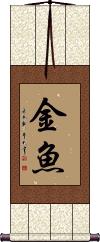
金魚 is the title for goldfish in Chinese and Japanese.
There was a time in ancient China when only the Emperor could possess the actual yellow-gold colored fish. This is why alternate coloration such as orange, black, red, and white was bred. Many believe this is why colors other than yellow-gold are more common for “goldfish” in pet shops today.
Good Health / Healthy / Vigor
Also suggests being at peace
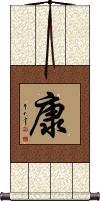
康 is a single character that means good health or vigor in Chinese, Japanese Kanji, and old Korean Hanja.
康 can also mean peaceful, at ease, or abundant in some contexts.
Please note that this is rarely seen alone in Japanese Kanji. In Japanese, it is used both for health-related compound words and to denote the kouhou through koushou eras of Japan.
In Korean, this can also be the family name “Kang” (caution: not the only family name romanized as Kang in Korean).
Grace from Heaven / Grace from God
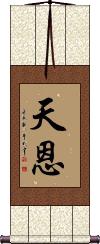
天恩 is the deepest way to say “Heaven's Grace” or “God's Grace” in Chinese.
The first character means Heaven or sky (referring, in this case, to the domain of God).
The second character means grace, blessings, benevolence, favor/favour, acts of kindness, merits, or beneficial influence.
This title can also be defined as:
Blessings of Heaven, Favor of the Emperor, Divination's luckiest day, or blessings of nature. Note: When you see “Emperor” above, remember that the Emperor, like the Pope, is theoretically chosen by God or seen as an emissary or conduit of God in ancient Asian culture. It would only be read that way in a certain context, such as “The Emperor, in his mercy, bestowed upon him Heaven's Grace, and the prisoner was set free.”
Note: Technically, this is a Japanese word too (pronounced "ten-on") but it’s rarely used in Japan anymore. Therefore, this title is best if your audience is Chinese.
Guanxi
The Chinese Concept of Relationship and Exchange of Favors
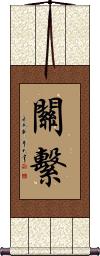
The dictionary definition is:
Relations/relationship, to concern, to affect, to have to do with, or connection.
But there's more to it...
In China, the relationship that you have with certain people can open doors for you. Having guanxi with someone also means they would never defraud you but are honor-bound to treat you fairly (of course, this goes both ways). Sometimes it is suggested that guanxi is the exchange of favors. 關繫 / 関繫 / 關係 is more about having a relationship that allows you to ask for and expect favors without shame.
There is no concept in western culture that exactly matches guanxi, but perhaps having a social or professional network is similar.
Note that there are some variations common within Chinese, Japanese Kanji, and Korean Hanja for this word... Japanese tend to use a Chinese alternate form as shown to the right for
the first character.
 There's also another alternate form of that first character (currently used as the official Simplified form in mainland China) which looks like the character shown to the right. It's basically the central radical of the alternate version shown above but without the “door radical” around it. In more free-flowing calligraphy styles, this version would be the likely choice for a calligrapher.
 In Modern Japanese, they use the character shown to the right.
They also tend to use this same form in Korean Hanja (I've only checked this word in my Korean dictionary, but it has not been confirmed by a translator's review).
 If that was not confusing enough, there is another alternate form of that second character. See right.
An Asian calligrapher of any nationality may use these forms at their discretion. However, They would tend to stick to the most common form used in their respective languages.
If you have any preference on any of these issues, please give us a special note with your order, and we'll make sure it's done the way you want.
Hanawa
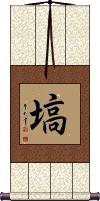
This is the most common Kanji for a surname that romanizes as Hanawa.
This is not the only Kanji that romanizes as Hanawa in Japanese, so make sure you are getting the right one.
The meaning of this character is originally something like truly (has this meaning currently in Chinese and old Korean). This can also be romanizes several other ways in Japanese for other names such as Ban, Han, Hane, Haniwa, Hani, Kou, Kasa, or Kaku. Names are kind of complicated in Japanese, as there are often many ways to pronounce the same Kanji.
Hapkido
Korean Martial Art of re-directing force
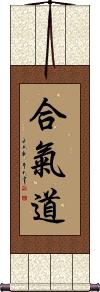
Hapkido or 合氣道 is a mostly-defensive martial art in Korea.
Hapkido has some connection to the Aikido of Japan. They are written with the same characters in both languages. However, it should be noted that the Korean Hanja characters shown here are the traditional Chinese form - but in modern Japan, the middle character was slightly simplified.
Note: You can consider this to be the older Japanese written form of Aikido. Titles on older books and signs about Aikido use this form.
The connection between Japanese Aikido and Korean Hapkido is muddled in history. The issue is probably due to the difficult relationship between the two countries around WWII. Many Koreans became virtual slaves to the Japanese during that period. After WWII, many things in Korea were disassociated from having any Japanese origin. The relationship has greatly mellowed out now.
Looking at the characters, the first means “union” or “harmony.”
The second character means “universal energy” or “spirit.”
The third means “way” or “method.”
One way to translate this into English is the “Harmonizing Energy Method.” This makes sense, as Hapkido has more to do with redirecting energy than fighting strength against strength.
More Hapkido info
More notes:
1. Sometimes Hapkido is Romanized as “hap ki do,” “hapki-do” “hab gi do” or “hapgido.”
2. Korean Hanja characters are actually Chinese characters that usually hold the same meaning in both languages. There was a time when these characters were the standard and only written form of Korean. The development of modern Korean Hangul characters is a somewhat recent event in the greater scope of history. There was a time when Chinese characters were the written form of many languages in places known in modern times as North Korea, South Korea, Japan, Vietnam, Singapore, Hong Kong, Taiwan, Mainland China, and a significant portion of Malaysia. Even today, more people in the world can read Chinese characters than English.
3. While these Korean Hanja characters can be pronounced in Chinese, this word is not well-known in China and is not considered part of the Chinese lexicon.
Happy Birthday
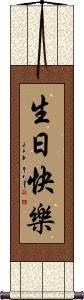
生日快樂 is how to write “Happy Birthday” in Chinese.
The first two characters mean “birthday,” and the second two characters mean “happiness,” or rather a wish for happiness.
Because a birthday only lasts one day per year, we strongly suggest that you find an appropriate and personal calligraphy gift that can be hung in the recipient's home year-round.
Happy Birthday
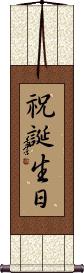
祝誕生日 is the shortest way to write “Happy Birthday” in Japanese.
The first Kanji means “wish” or “express good wishes,” and the last three characters mean “birthday.”
Because a birthday only lasts one day per year, we strongly suggest that you find an appropriate and personal calligraphy gift that can be hung in the recipient's home year-round.

何 is an ancient Chinese surname that romanizes as He.
This is not the only surname that romanize as He, please note these others:
賀 (celebrate/congratulate).
和 (peace, harmony, together).
赫 (bright/glorious).
河 (river).
Heart / Mind / Spirit
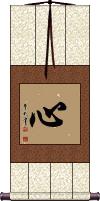
心 would often be translated as “heart.”
However, because it was believed in Chinese culture for thousands of years that your consciousness and thoughts came from the big red organ in the middle of your chest, it also means “mind” or “spirit” and sometimes even “soul.”
In Korean, beyond heart, mind, and spirit, this character can mean moral, nature, mind, affections, intentions, core, and center. In fact, it is used in Chinese to mean “center” as well but only with another character in front of it. For instance, “medical center” or even “shopping center.” Separately and alone, it will not be read with that “center” meaning unless thought of as “the center of your soul.”
Soul Mates at Heart
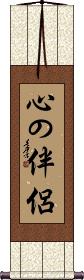
心の伴侶 is a Japanese-only title for soulmates.
心 means heart, soul, mind, core, or center. In ancient times, the heart was believed to be the mind or center of your soul and being.
の is a possessive article that connects everything here.
伴侶 means mates, companions, partners, and spouses.
This Japanese version of soulmates is about two partners, coupled or joined by their hearts.
Hell / Kingdom of the Underworld
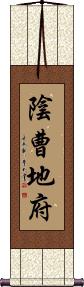
陰曹地府 can mean Hell, Hades, Kingdom of the Underworld, or the Netherworld.
When Chinese people talk about Hell, this is usually the term they use. Please note that this is a somewhat oral and informal word.
This is a really weird selection for a wall scroll, so consider this for educational purposes only.
Hello / Ni Hao
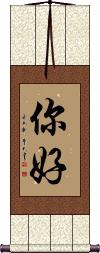
你好 is the day-to-day way to say hello in Chinese.
The characters literally mean, “You good?” It's the equivalent of “What's up?” in English, where nobody expects an actual answer.
This explanation is here for educational purposes only. 你好 is an oral word that is not appropriate for a scroll (not a bad meaning, just very odd for a wall scroll).
Hiro
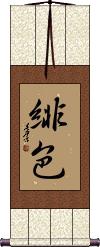
緋色 means brilliant red or scarlet in Japanese.
This is often romanized as Hiro or Hiiro and can be a given name (more often for females than males).
This is not the only Japanese word or name that romanizes as Hiro, so be sure you have the right one before you order.
Hitori
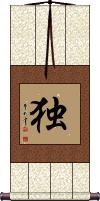
This is the Japanese given name 独 which romanizes as Hitori or Doku.
Originally this was written as 獨 but was simplified/modernized in Japan at some point.
独 can also be an abbreviation for Germany.
The actual meaning is alone, independent, single, sole, only, or solitary.
This is also a Simplified Chinese character, but most Chinese calligraphers would prefer to write the Traditional Chinese of 獨 instead of 独.
Holy Bible
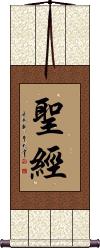
聖經 is how to write Bible in Chinese.
The first character means Holy, sacred, saint, or sage.
The second character means sacred book or scripture.
Each Sunday morning, if you are near a Catholic or Protestant Church, you will see plenty of Chinese people carrying their Bibles. Virtually every large or medium city in China has at least one Christian church. Beijing has about 14 Christian churches of Catholic and various Protestant denominations. That number doubles if you count all the church services that are for foreigners only and doubles again if you count all of the underground Christian Churches. Many Embassies (Canadian, Italian, French, etc.) offer Protestant and Catholic services. However, the U.S. Embassy is the most unfriendly in all of China, offering no such religious services, regularly denying entry, and kicking out Americans and others, whether or not they have official business.
Feel at Ease Anywhere / The World is My Home
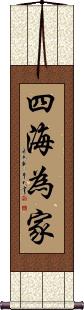
四海為家 literally reads, “Four Seas Serve-As [my/one's] Home.”
Together, 四海 which literally means “four seas” is understood to mean “the whole world” or “the seven seas.” It's presumed to be an ancient word from back when only four seas were known - so it equates to the modern English term, “seven seas.”
This can be translated or understood in a few different ways:
To regard the four corners of the world all as home.
To feel at home anywhere.
To roam about unconstrained.
To consider the entire country, or the world, to be one's own.
Honor and Integrity
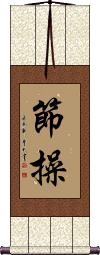
節操 means honorable, integrity of principle, constancy, honor, and in a certain context, chastity.
Please note that there are a few ways to relay the idea of integrity in Asian languages and more than one way to define honor in English. 節操 is far from the only way to express “honor and integrity.”
Polo
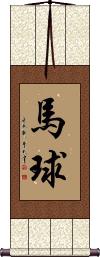
馬球 is the Chinese title for the ancient game of polo.
During the Tang Dynasty (618-907 AD), the elite and rich would mount their horses and engage in this rigorous sport. It was the only sport of that period that women were also known to play.
The original polo came from Persia and may have been played in China hundreds of years before the Tang popularized it.
The characters “馬球” literally mean “horse ball.”
Hua Mulan
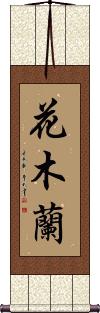
花木蘭 is the name of the famous Chinese woman warrior Hua Mulan.
She was made famous in the west by Disney's animated movie, “Mulan.”
Most of the historical information about her comes from an ancient poem. It starts with a concerned Mulan, as she is told a man from each family is to serve conscription in the army. Her father is too old, and her brother is too young. Mulan decides to take the place of her father. After twelve years of war, the army returns, and the best warriors are awarded great posts in the government and riches. Mulan turns down all offers and asks only for a good horse for the long trip home. When Mulan greets visiting comrades wearing her old clothes, they are shocked to find the warrior they rode into battle with for years is actually a woman.
Hyakuren-Jitoku
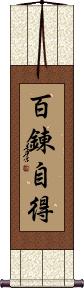
百錬自得 is a Japanese proverb that means only if you practice something 100 times will it become a part of yourself.
Some translate it in a short form like “Well train, self-gain.”
The first two characters are a word that means “100 forges” (or to forge 100 times). It translates more naturally as well-tempered, well-drilled, or well-trained.
The last two characters mean “self-benefit” or “self-gain.” It can also be translated into English as contented, self-satisfaction, realizing (through one's ability), or being paid back for one's deeds.
Iaido
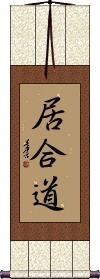
居合道 is the Japanese Kanji title for the martial art of Iaidō, which emphasizes the smooth and elegant draw of the sword from its scabbard.
These same characters are used in Chinese and old Korean but not with the same meaning as read in Japanese. Therefore, this should be considered a “Japanese only” title.
Indomitable Spirit
Korean Only
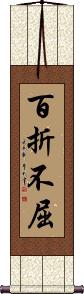
百折不屈 is a Korean proverb that means “indomitable spirit,” at least, that is the way it is commonly translated in martial arts circles (Taekwondo, Hapkido, etc.).
The literal translation is “[one] hundred [times] broken [still] don't succumb.”
Or more naturally translated, “Even if attacked/beaten one hundred times, still be undaunted/indomitable.”
Notes:
Some will say this is one long word rather than a proverb.
This is also a proverb/word in Chinese though rarely used in modern times.
Innovation
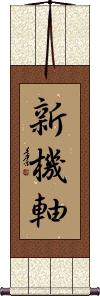
新機軸 is a Japanese word that is used to mean: innovation, new departure, new way, milestone, or breakthrough.
The literal meaning is, “new axis” or “new axle.” It's almost like saying a new wheel (like coming up with a round wheel when the previous version was square).
Please note that this also has meaning in Chinese but only would mean “new axle” without the meaning of “innovation” being associated with it. Consider this to be “Japanese only.”
Itosu
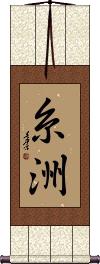
糸洲 is a Japanese surname and placename, Itosu.
糸洲 is not the only surname that romanizes as Itosu, so be sure this is the correct Kanji for your name.
Christ
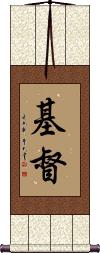
基督 is how to write “Christ” in Chinese characters, Korean Hanja, and Japanese Kanji.
This is the word used in the Chinese Union Bible (the only readily-available translation of the Bible into Chinese that I know of - published about 100 years ago). For Chinese Christians, this is the most common way to refer to Jesus Christ.
This is also the way that “Christ” is written in Japanese. But since the Japanese language is very flexible about the sounds that can be assigned to various Kanji, these characters have been assigned a pronunciation that sounds a lot like “Christ” or actually closer to the original “Christos.” In Japanese (if you don't know how the Romaji shown above in the gray box works), it sounds like “key ree sue toe” using English words/sounds. Say those four words fast, and you'll get it.
It should be noted that only Japanese Christians will be familiar with this word.
This is best defined, read, and understood with the characters together, but if you take this word for Christ apart, the first character means “fundamentals” or “foundation.” The second character can mean “leader” or “boss.”
Jing Mo / Jing Wu
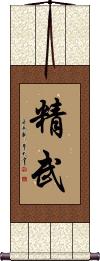
精武 is the title used for a certain type of martial arts. You can translate this roughly as “Excellent Martial Arts” or “Excellence in Martial Arts.” You will notice that the second character is “wu” as in wushu (martial arts) and wushi (warrior).
More information can be found at the Jing Mo website. You should probably only order this if you are a member of this association.
Note that “jing mo” is the Cantonese pronunciation of these characters. In Mandarin, they are “jing wu.”
Also used in Korean but only by those involved with martial arts who can also read Korean Hanja (a small percentage of the population).
John 3:16

神愛世人甚至將他的獨生子賜給他們叫一切信他的不至滅亡反得永生 is the full translation of John 3:16 into Chinese.
This is from the Chinese Union Bible which comes from a revised version of the King James. This Chinese Bible was originally translated and printed in 1919 (several revisions since then).
Because of the origin being the KJV, I'll say that in English, this would be, “For God so loved the world, that he gave his only begotten Son, that whosoever believeth in him should not perish but have everlasting life.”
As with any translation, there are interesting cultural and linguistic issues. For instance, the word used for “world” in Chinese can also mean “common people.” So you could say that it means “For God so loved the common people...”
This does not take away from the text, as it will be understood with the same meaning and connotation.
There is no direct Greek-to-Chinese translation in print (that I know of), so this is the best available. Of course, you can ask any Greek person of faith, and they will claim that a bit is lost from the original Greek of the New Testament to any of the English versions of the Bible in print.
John 3:16
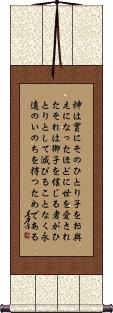
Here is the full translation of John 3:16 into Japanese.
This translation comes from the Shinkaiyaku Bible (a preferred translation by many Japanese Christians).
Just for reference, from the KJV, this reads, “For God so loved the world, that he gave his only begotten Son, that whosoever believeth in him should not perish but have everlasting life.”
Note: Because this selection contains some special Japanese Hiragana characters, it should be written by a Japanese calligrapher.
John 3:16 (first half)
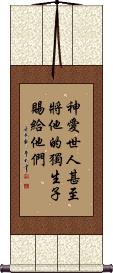
神愛世人甚至將他的獨生子賜給他們 is the first half of John 3:16 in Chinese.
It reads roughly, “For God so loved the world, that he gave his only begotten Son.”
This came directly from the Chinese Union Bible first printed in 1919.
Joshua 24:15
This House Serves the LORD
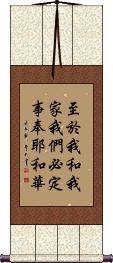
至於我和我家我們必定事奉耶和華 is the last sentence of Joshua 24:15 in Chinese.
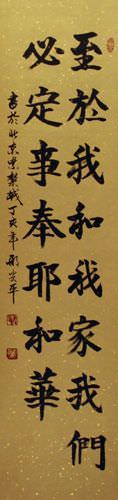
What your
calligraphy
might look like
from our
Chinese Master
Calligrapher
Joshua 24:15 (KJV) ...as for me and my house, we will serve the LORD.
Joshua 24:15 (NIV) ...as for me and my household, we will serve the LORD.
We used the only official Christian Chinese Bible that I know of so that the translation would be as accurate and standard as possible. Any Chinese Christian worth their salt will easily be able to identify this verse from the Chinese words on this scroll.
I think it is a bit like having a secret code on your wall that quietly expresses to whom you are faithful.
A great gift for your devout Christian or Jewish friend if they happen to be fond of Asian art.
Or perhaps a wonderful “conversation starter” for your own home.
Note: If you are curious, the last three characters represent the way “LORD” is used in most English Bibles. In Chinese, this is actually the phonetic name from Mandarin Chinese for “Jehovah.”
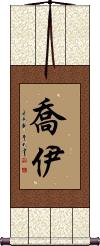
喬伊 is the transliteration to Mandarin Chinese for the name Joy.
If your name is Joy, I recommend that you pick a character that means “joy” rather than this version which only sounds like “Joy.”
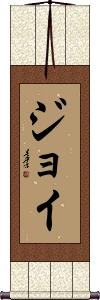
ジョイ is the name Joy in Japanese.
If your name is Joy, I recommend that you pick a character that means “joy” rather than this version which only sounds like “Joy.”
Note: Because this title is entirely Japanese Katakana, it should be written by a Japanese calligrapher.
This in-stock artwork might be what you are looking for, and ships right away...

Successful Chinese Character and Japanese Kanji calligraphy searches within the last few hours...



