Many custom options...


And formats...



Shame in Chinese / Japanese...
Buy a Shame calligraphy wall scroll here!
Personalize your custom “Shame” project by clicking the button next to your favorite “Shame” title below...
Sense of Shame / Sense of Honor / Integrity / Modesty (Korean)
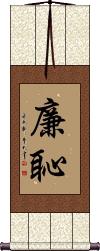
廉恥 simultaneously means “sense of honor” and “sense of shame” in Korean.
This term is often used as a tenet of Taekwondo, where the English terms “integrity” and “modesty” are applied.
廉恥 is also a Chinese word, though it is usually read with the “sense of shame” meaning, and is a poor choice for a wall scroll if your audience is Chinese.
Learning leads to Knowledge, Study leads to Benevolence, Shame leads to Courage
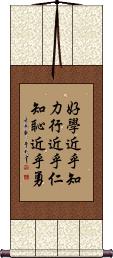
好學近乎知力行近乎仁知恥近乎勇 is a Saying from Confucius which relates certain actions to virtues.
A more verbose translation:
To love learning is akin to knowledge,
to study diligently is akin to benevolence,
to know shame is akin to courage.
Beautiful Woman Proverb
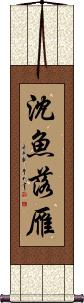
沈魚落雁 is an old proverb that literally means “fish sink, goose alights.”
...But this takes some explaining. This is a proverb from Zhuangzi (莊子), who lived in the late 4th century BC.
This figuratively refers to female beauty that is so captivating that even the birds and beasts take notice.
Perhaps a better and more accurate way to describe this is to say that it speaks of the charms of a uniquely beautiful woman who is so beautiful that fish stay on the bottom of the water and flying wild geese fall from the sky in shame.
This proverb is so famous that it is also known and used in Japan (same characters, different pronunciation).
Note: This can also be written 沉魚落雁 instead of 沈魚落雁 (just the first character varies slightly).
Death Before Dishonor
Better to be broken jade than unbroken pottery
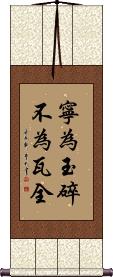
寧為玉碎不為瓦全 is the long version of a Chinese proverb that means “rather be shattered piece of jade than an unbroken piece of pottery.”
A little more explanation:
Death is implied with the “broken” meaning. Jade is one of the most precious materials in Chinese history, and in this case, is compared with one's honor and self-worth. Pottery is just something you eat off of, it has no deep value, just as a person who has lost their honor, or had none to begin with.
Thus, this means “better to die with honor than to live in shame” or words to that effect.
寧為玉碎不為瓦全 is often translated in English as “Death Before Dishonor,” the famous military slogan.
I would also compare this to the English proverb, “Better to die on your feet than to live on your knees.”
This is an idiom. It therefore doesn’t directly say exactly what it means. If you think about the English idiom, "The grass is always greener," it does not directly say "jealousy" or "envy" but everyone knows that it is implied.
Death Before Dishonor
Better to be broken jade than unbroken pottery
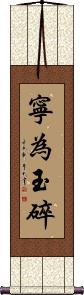
寧為玉碎 is the short version of a longer Chinese proverb which means “rather be shattered piece of jade than an unbroken piece of pottery.”
寧為玉碎 says the “rather be a broken piece of jade” part (the second half is implied - everyone in China knows this idiom).
A little more explanation:
Death is implied with the “broken” meaning. Jade is one of the most precious materials in Chinese history, and in this case, is compared with one's honor and self-worth. Pottery is just something you eat off of; it has no deep value, just as a person who has lost their honor or had none to begin with.
Thus, this means “better to die with honor than to live in shame” or words to that effect.
This is often translated in English as “Death Before Dishonor,” the famous military slogan.
I would also compare this to the English proverb, “Better to die on your feet than to live on your knees.”
Guanxi
The Chinese Concept of Relationship and Exchange of Favors
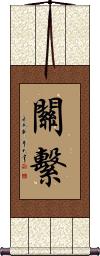
The dictionary definition is:
Relations/relationship, to concern, to affect, to have to do with, or connection.
But there's more to it...
In China, the relationship that you have with certain people can open doors for you. Having guanxi with someone also means they would never defraud you but are honor-bound to treat you fairly (of course, this goes both ways). Sometimes it is suggested that guanxi is the exchange of favors. 關繫 / 関繫 / 關係 is more about having a relationship that allows you to ask for and expect favors without shame.
There is no concept in western culture that exactly matches guanxi, but perhaps having a social or professional network is similar.
Note that there are some variations common within Chinese, Japanese Kanji, and Korean Hanja for this word... Japanese tend to use a Chinese alternate form as shown to the right for
the first character.
 There's also another alternate form of that first character (currently used as the official Simplified form in mainland China) which looks like the character shown to the right. It's basically the central radical of the alternate version shown above but without the “door radical” around it. In more free-flowing calligraphy styles, this version would be the likely choice for a calligrapher.
 In Modern Japanese, they use the character shown to the right.
They also tend to use this same form in Korean Hanja (I've only checked this word in my Korean dictionary, but it has not been confirmed by a translator's review).
 If that was not confusing enough, there is another alternate form of that second character. See right.
An Asian calligrapher of any nationality may use these forms at their discretion. However, They would tend to stick to the most common form used in their respective languages.
If you have any preference on any of these issues, please give us a special note with your order, and we'll make sure it's done the way you want.
These search terms might be related to Shame:
Not the results for Shame that you were looking for?
Below are some entries from our dictionary that may match your Shame search...
| Characters If shown, 2nd row is Simp. Chinese |
Pronunciation Romanization |
Simple Dictionary Definition |
廉恥 廉耻 see styles |
lián chǐ lian2 chi3 lien ch`ih lien chih renchi れんち |
More info & calligraphy: Sense of Shame / Sense of Honor / Integrity / Modesty (Korean)sense of honour (honor) |
沈魚落雁 沉鱼落雁 see styles |
chén yú luò yàn chen2 yu2 luo4 yan4 ch`en yü lo yen chen yü lo yen chingyorakugan ちんぎょらくがん |
More info & calligraphy: Beautiful Woman Proverb(yoji) charms of a uniquely beautiful woman; (so beautiful that) fish stay on the bottom of water and flying wild geese fall from the sky in shame |
忝 see styles |
tiǎn tian3 t`ien tien |
to shame |
恥 耻 see styles |
chǐ chi3 ch`ih chih hatsuru はつる |
(bound form) shame; humiliation; disgrace shame; embarrassment; disgrace; (given name) Hatsuru to be ashamed |
愧 see styles |
kuì kui4 k`uei kuei gi |
ashamed Ashamed, intp. as ashamed for the misdeeds of others. v. 慚. |
慙 惭 see styles |
cán can2 ts`an tsan zan |
variant of 慚|惭[can2] shame |
慚 惭 see styles |
cán can2 ts`an tsan zan |
ashamed Shame, ashamed; i.e. for one's own faults, cf. 愧. |
羞 see styles |
xiū xiu1 hsiu |
shy; ashamed; shame; bashful; variant of 饈|馐[xiu1]; delicacies |
耻 see styles |
chǐ chi3 ch`ih chih chi はじ |
shame; embarrassment; disgrace 恥 Shame; ashamed. |
臊 see styles |
sào sao4 sao sō |
shame; bashfulness; to shame; to humiliate Rancid, rank; shame; translit. su, in臊陀 intp. as śuka, parrot; more correctly 叔迦. |
謑 see styles |
xì xi4 hsi |
shame; disgrace |
赧 see styles |
nǎn nan3 nan |
blushing with shame |
辱 see styles |
rǔ ru3 ju joku はじ |
disgrace; dishonor; to insult; to bring disgrace or humiliation to; to be indebted to; self-deprecating; Taiwan pr. [ru4] (out-dated or obsolete kana usage) shame; embarrassment; disgrace shame |
醜 丑 see styles |
chǒu chou3 ch`ou chou muneyuki むねゆき |
shameful; ugly; disgraceful (noun or adjectival noun) (1) ugliness; (2) shame; disgrace; (personal name) Muneyuki Ugly, shameful, shame, disgraceful. |
七聖 七圣 see styles |
qī shèng qi1 sheng4 ch`i sheng chi sheng nanasei / nanase ななせい |
(male given name) Nanasei v.七賢, 七聖, 七聖財, saptadhana. The seven sacred graces variously defined, e.g. 信 faith, 戒 observation of the commandments, 聞hearing instruction, 慙 shame (for self), 愧 shame (for others); 捨 renunciation; and慧 wisdom. |
上塗 see styles |
uwanuri うわぬり |
(noun/participle) (1) (final) coat (of paint, plaster, glazing, etc.); finish; (2) adding more of the same (e.g. shame) |
俯く see styles |
utsumuku うつむく |
(Godan verb with "ku" ending) (kana only) to hang one's head in shame; to look downward; to cast one's eyes down |
八纏 八缠 see styles |
bā chán ba1 chan2 pa ch`an pa chan hachiden |
The eight entanglements, or evils: to be without shame; without a blush; envious; mean; unregretful; sleepy (or indolent); ambitious; stupid (or depressed). |
写メ see styles |
shame しゃメ |
(noun/participle) (1) (abbreviation) (colloquialism) (See 写メール・1) email with attached photos sent from a mobile phone; (noun/participle) (2) (abbreviation) (colloquialism) photo taken with a mobile phone; taking a photo with a mobile phone |
十德 see styles |
shí dé shi2 de2 shih te jittoku |
The ten virtues, powers, or qualities, of which there are several groups, e.g. in the 華嚴經,十地品 there are 法師十德 the ten virtues of a teacher of the Law, i.e. he should be well versed in its meaning; able widely to publish it; not be nervous before an audience; be untiring in argument; adaptable; orderly so that his teaching can be easily followed; serious and dignified; bold and zealous; unwearied; and enduring (able to bear insult, etc.). The 弟子十德 ten virtues or qualities of a disciple according to the 大日經疏 4, are faith; sincerity; devotion to the trikāya; (seeking the) adornment of true wisdom; perseverance; moral purity; patience (or bearing shame); generosity in giving; courage; resoluteness. |
十心 see styles |
shí xīn shi2 xin1 shih hsin jisshin |
The ten kinds of heart or mind; there are three groups. One is from the 止觀 4, minds ignorant and dark; affected by evil companions; not following the good; doing evil in thought, word, deed; spreading evil abroad; unceasingly wicked; secret sin; open crime; utterly shameless; denying cause and effect (retribution)―all such must remain in the flow 流 of reincarnation. The second group (from the same book) is the 逆流 the mind striving against the stream of perpetual reincarnation; it shows itself in devout faith, shame (for sin), fear (of wrong-doing), repentance and confession, reform, bodhi (i.e. the bodhisattva mind), doing good, maintaining the right law, thinking on all the Buddhas, meditation on the void (or, the unreality of sin). The third is the 眞言 group from the 大日經疏 3; the "seed" heart (i.e. the original good desire), the sprout (under Buddhist religious influence), the bud, leaf, flower, fruit, its serviceableness; the child-heart, the discriminating heart, the heart of settled judgment (or resolve). |
四維 四维 see styles |
sì wéi si4 wei2 ssu wei yotsui よつい |
the four social bonds: propriety, justice, integrity and honor; see 禮義廉恥|礼义廉耻[li3 yi4 lian2 chi3]; the four directions; the four limbs (Chinese medicine); four-dimensional (1) (See 四隅・2) four ordinal directions; (2) (しい only) (from Guanzi) four cardinal principles of the state (propriety, justice, integrity, sense of shame); (surname) Yotsui The four half points of the compass, N. E., N. W., S. E., S. W. |
大恥 大耻 see styles |
dà chǐ da4 chi3 ta ch`ih ta chih oohaji おおはじ |
great shame; great disgrace; harsh humiliation; deep embarrassment; unbearable loss of face greatly ashamed |
尤詬 尤诟 see styles |
yóu gòu you2 gou4 yu kou |
shame; disgrace |
恥じ see styles |
haji はじ |
(irregular okurigana usage) shame; embarrassment; disgrace |
恥辱 耻辱 see styles |
chǐ rǔ chi3 ru3 ch`ih ju chih ju chijoku ちじょく |
disgrace; shame; humiliation disgrace; shame; insult |
恥部 see styles |
chibu ちぶ |
(1) private parts; privates; genitalia; secret place; (2) disgraceful thing; shame; embarrassment; underbelly |
感愧 see styles |
gǎn kuì gan3 kui4 kan k`uei kan kuei |
to feel gratitude mixed with shame |
愧恨 see styles |
kuì hèn kui4 hen4 k`uei hen kuei hen |
ashamed and sorry; suffering shame and remorse |
愧死 see styles |
kishi きし |
(n,vs,vi) (See 慙死) dying of shame; being so ashamed one wants to die |
Click here for more Shame results from our dictionary
The following table may be helpful for those studying Chinese or Japanese...
| Title | Characters | Romaji (Romanized Japanese) | Various forms of Romanized Chinese | |
| Sense of Shame Sense of Honor Integrity Modesty (Korean) | 廉恥 廉耻 | ren chi / renchi | lián chǐ / lian2 chi3 / lian chi / lianchi | lien ch`ih / lienchih / lien chih |
| Learning leads to Knowledge, Study leads to Benevolence, Shame leads to Courage | 好學近乎知力行近乎仁知恥近乎勇 好学近乎知力行近乎仁知耻近乎勇 | hào xué jìn hū zhī lì xíng jìn hū rén zhī chǐ jìn hū yǒng hao4 xue2 jin4 hu1 zhi1 li4 xing2 jin4 hu1 ren2 zhi1 chi3 jin4 hu1 yong3 hao xue jin hu zhi li xing jin hu ren zhi chi jin hu yong | hao hsüeh chin hu chih li hsing chin hu jen chih ch`ih chin hu yung hao hsüeh chin hu chih li hsing chin hu jen chih chih chin hu yung |
|
| Beautiful Woman Proverb | 沈魚落雁 沈鱼落雁 | chin gyo raku gan chingyorakugan | chén yú luò yàn chen2 yu2 luo4 yan4 chen yu luo yan chenyuluoyan | ch`en yü lo yen chenyüloyen chen yü lo yen |
| Death Before Dishonor | 寧為玉碎不為瓦全 宁为玉碎不为瓦全 | níng wéi yù suì bù wéi wǎ quán ning2 wei2 yu4 sui4 bu4 wei2 wa3 quan2 ning wei yu sui bu wei wa quan ningweiyusuibuweiwaquan | ning wei yü sui pu wei wa ch`üan ning wei yü sui pu wei wa chüan |
|
| Death Before Dishonor | 寧為玉碎 宁为玉碎 | níng wéi yù suì ning2 wei2 yu4 sui4 ning wei yu sui ningweiyusui | ning wei yü sui ningweiyüsui |
|
| Guanxi | 關繫 / 関繫 / 關係 关系 / 関係 | kankei | guān xì / guan1 xi4 / guan xi / guanxi | kuan hsi / kuanhsi |
| In some entries above you will see that characters have different versions above and below a line. In these cases, the characters above the line are Traditional Chinese, while the ones below are Simplified Chinese. | ||||

Successful Chinese Character and Japanese Kanji calligraphy searches within the last few hours...



