Many custom options...


And formats...



Setback in Chinese / Japanese...
Buy a Setback calligraphy wall scroll here!
Switched to secondary search mode due to lack of results using primary.
These secondary results may not be very accurate. Try a different but similar meaning word or phrase for better results. Or...
Look up Setback in my Japanese Kanji & Chinese Character Dictionary(My dictionary is a different system then the calligraphy search you just tried)
If you want a special phrase, word, title, name, or proverb, feel free to contact me, and I will translate your custom calligraphy idea for you.
Undaunted After Repeated Setbacks
Persistence to overcome all challenges
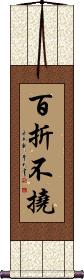
百折不撓 is a Chinese proverb that means “Be undaunted in the face of repeated setbacks.”
More directly translated, it reads, “[Overcome] a hundred setbacks, without flinching.” 百折不撓 is of Chinese origin but is commonly used in Japanese and somewhat in Korean (same characters, different pronunciation).
This proverb comes from a long, and occasionally tragic story of a man that lived sometime around 25-220 AD. His name was Qiao Xuan, and he never stooped to flattery but remained an upright person at all times. He fought to expose the corruption of higher-level government officials at great risk to himself.
Then when he was at a higher level in the Imperial Court, bandits were regularly capturing hostages and demanding ransoms. But when his own son was captured, he was so focused on his duty to the Emperor and the common good that he sent a platoon of soldiers to raid the bandits' hideout, and stop them once and for all even at the risk of his own son's life. While all of the bandits were arrested in the raid, they killed Qiao Xuan's son at first sight of the raiding soldiers.
Near the end of his career, a new Emperor came to power, and Qiao Xuan reported to him that one of his ministers was bullying the people and extorting money from them. The new Emperor refused to listen to Qiao Xuan and even promoted the corrupt Minister. Qiao Xuan was so disgusted that in protest, he resigned from his post as minister (something almost never done) and left for his home village.
His tombstone reads “Bai Zhe Bu Nao” which is now a proverb used in Chinese culture to describe a person of strong will who puts up stubborn resistance against great odds.
My Chinese-English dictionary defines these 4 characters as “keep on fighting despite all setbacks,” “be undaunted by repeated setbacks,” and “be indomitable.”
Our translator says it can mean “never give up” in modern Chinese.
Although the first two characters are translated correctly as “repeated setbacks,” the literal meaning is “100 setbacks” or “a rope that breaks 100 times.” The last two characters can mean “do not yield” or “do not give up.”
Most Chinese, Japanese, and Korean people will not take this absolutely literal meaning but will instead understand it as the title suggests above. If you want a single big word definition, it would be indefatigability, indomitableness, persistence, or unyielding.
See Also: Tenacity | Fortitude | Strength | Perseverance | Persistence
This in-stock artwork might be what you are looking for, and ships right away...

Gallery Price: $162.00
Your Price: $89.88
These search terms might be related to Setback:
Not the results for Setback that you were looking for?
Below are some entries from our dictionary that may match your Setback search...
| Characters If shown, 2nd row is Simp. Chinese |
Pronunciation Romanization |
Simple Dictionary Definition |
受挫 see styles |
shòu cuò shou4 cuo4 shou ts`o shou tso |
thwarted; obstructed; setback |
失風 失风 see styles |
shī fēng shi1 feng1 shih feng |
trouble; damage; setback; something goes wrong |
岔子 see styles |
chà zi cha4 zi5 ch`a tzu cha tzu |
branch road; setback; accident; hiccup |
挫折 see styles |
cuò zhé cuo4 zhe2 ts`o che tso che zasetsu ざせつ |
setback; reverse; check; defeat; frustration; disappointment; to frustrate; to discourage; to set sb back; to blunt; to subdue (n,vs,vi) setback; failure (e.g. plans, business); frustration; discouragement |
挫敗 挫败 see styles |
cuò bài cuo4 bai4 ts`o pai tso pai |
to thwart; to foil (sb's plans); a setback; a failure; a defeat |
敗北 败北 see styles |
bài běi bai4 bei3 pai pei haiboku はいぼく |
(literary) to be routed (in a war); to suffer defeat (in sports etc) (n,vs,vi) (ant: 勝利) defeat; loss; reverse; setback |
翻船 see styles |
fān chuán fan1 chuan2 fan ch`uan fan chuan |
to capsize; (fig.) to suffer a setback or defeat |
落馬 落马 see styles |
luò mǎ luo4 ma3 lo ma rakuba らくば |
(lit.) to fall from a horse; (fig.) to suffer a setback; to come a cropper; to be sacked (e.g. for corruption) (n,vs,vi) falling from a horse |
跟斗 see styles |
gēn dou gen1 dou5 ken tou |
somersault; fall; tumble; (fig.) setback; failure |
蹉跌 see styles |
cuō dié cuo1 die2 ts`o tieh tso tieh satetsu さてつ |
(n,vs,vi) failure; stumbling; setback to fall down |
躓き see styles |
tsumazuki つまずき |
(1) (kana only) stumbling; (2) (kana only) failure; misstep; setback |
躓く see styles |
tsumazuku(p); tsumazuku つまずく(P); つまづく |
(v5k,vi) (1) (kana only) to trip (over); to stumble; (v5k,vi) (2) (kana only) to fail; to suffer a setback |
退步 see styles |
tuì bù tui4 bu4 t`ui pu tui pu |
to do less well than before; to make a concession; setback; backward step; leeway; room to maneuver; fallback |
重挫 see styles |
zhòng cuò zhong4 cuo4 chung ts`o chung tso |
devastating setback; slump (in stock market etc); crushing defeat; to cause a serious setback; to plummet |
頓挫 顿挫 see styles |
dùn cuò dun4 cuo4 tun ts`o tun tso tonza とんざ |
a transition (stop and change) in spoken sound, music or in brush strokes; a cadence; punctuated by a transition; with syncopated cadence (brush stroke in painting) (n,vs,vi) setback; deadlock; standstill; impasse; miscarriage |
摔跟頭 摔跟头 see styles |
shuāi gēn tou shuai1 gen1 tou5 shuai ken t`ou shuai ken tou |
to fall; fig. to suffer a setback |
一蹶不振 see styles |
yī jué bù zhèn yi1 jue2 bu4 zhen4 i chüeh pu chen |
one stumble, unable to rise (idiom); a setback leading to total collapse; ruined at a stroke; unable to recover after a minor hitch |
中箭落馬 中箭落马 see styles |
zhòng jiàn luò mǎ zhong4 jian4 luo4 ma3 chung chien lo ma |
lit. to be struck by an arrow and fall from one's horse; to suffer a serious setback (idiom) |
吸取教訓 吸取教训 see styles |
xī qǔ jiào xun xi1 qu3 jiao4 xun5 hsi ch`ü chiao hsün hsi chü chiao hsün |
to draw a lesson (from a setback) |
安史之亂 安史之乱 see styles |
ān shǐ zhī luàn an1 shi3 zhi1 luan4 an shih chih luan |
An-Shi Rebellion (755-763) of 安祿山|安禄山[An1 Lu4 shan1] and 史思明[Shi3 Si1 ming2], a catastrophic setback for Tang dynasty |
破罐破摔 see styles |
pò guàn pò shuāi po4 guan4 po4 shuai1 p`o kuan p`o shuai po kuan po shuai |
lit. to smash a pot just because it has a crack (idiom); fig. to give up altogether after a setback; to throw one's hands up in frustration and let it all go to hell |
重整旗鼓 see styles |
chóng zhěng qí gǔ chong2 zheng3 qi2 gu3 ch`ung cheng ch`i ku chung cheng chi ku |
lit. to reorganize flags and drums (idiom); to regroup after a setback; to prepare for new initiatives; to attempt a comeback |
鼻青眼腫 鼻青眼肿 see styles |
bí qīng yǎn zhǒng bi2 qing1 yan3 zhong3 pi ch`ing yen chung pi ching yen chung |
a black eye (idiom); serious injury to the face; fig. a setback; a defeat |
大意失荊州 大意失荆州 see styles |
dà yi shī jīng zhōu da4 yi5 shi1 jing1 zhou1 ta i shih ching chou |
lit. to lose Jingzhou due to carelessness (idiom); fig. to suffer a major setback due to negligence |
Variations: |
sada さだ |
(n,adv-to,adj-t) (1) (rare) (form) setback; impediment; (n,adv-to,adj-t) (2) (rare) (form) adversity; misfortune; hardship; decline |
セットバック see styles |
settobakku セットバック |
setback (land use) |
以失敗而告終 以失败而告终 see styles |
yǐ shī bài ér gào zhōng yi3 shi1 bai4 er2 gao4 zhong1 i shih pai erh kao chung |
to succeed through failure; to achieve one's final aim despite apparent setback |
Variations: |
kechigatsuku(kechiga付ku); kechigatsuku(kechiga付ku) ケチがつく(ケチが付く); けちがつく(けちが付く) |
(exp,v5k) (kana only) (See ケチ・4) to be jinxed; to suffer a stroke of bad luck; to suffer a setback; to have a damper put on one; to have cold water thrown on one |
Variations: |
ketsumazuku(蹴躓ku, 蹴tsumazuku); ketsumazuku(蹴躓ku, 蹴tsumazuku) けつまずく(蹴躓く, 蹴つまずく); けつまづく(蹴躓く, 蹴つまづく) |
(v5k,vi) (1) (kana only) to stumble (over); to trip; (v5k,vi) (2) (kana only) to fail; to suffer a setback |
Variations: |
haiagaru はいあがる |
(v5r,vi) (1) to creep up; to crawl up; (v5r,vi) (2) to overcome (a bad situation); to rise (after a setback) |
Click here for more Setback results from our dictionary
The following table may be helpful for those studying Chinese or Japanese...
| Title | Characters | Romaji (Romanized Japanese) | Various forms of Romanized Chinese | |
| Undaunted After Repeated Setbacks | 百折不撓 百折不挠 | hyaku setsu su tou hyakusetsusutou hyaku setsu su to | bǎi zhé bù náo bai3 zhe2 bu4 nao2 bai zhe bu nao baizhebunao | pai che pu nao paichepunao |
| In some entries above you will see that characters have different versions above and below a line. In these cases, the characters above the line are Traditional Chinese, while the ones below are Simplified Chinese. | ||||

Successful Chinese Character and Japanese Kanji calligraphy searches within the last few hours...



