Many custom options...


And formats...



Sense in Chinese / Japanese...
Buy a Sense calligraphy wall scroll here!
Personalize your custom “Sense” project by clicking the button next to your favorite “Sense” title below...
1. Sense of Shame / Sense of Honor / Integrity / Modesty
4. Kansei Engineering / Sense Engineering
6. Perception
Sense of Shame / Sense of Honor / Integrity / Modesty (Korean)
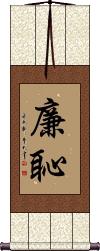
廉恥 simultaneously means “sense of honor” and “sense of shame” in Korean.
This term is often used as a tenet of Taekwondo, where the English terms “integrity” and “modesty” are applied.
廉恥 is also a Chinese word, though it is usually read with the “sense of shame” meaning, and is a poor choice for a wall scroll if your audience is Chinese.
Sense of Humor
Funny Bone
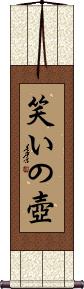
笑いの壺 is the Japanese way to say “sense of humor” (humour), or colloquially a way to say “funny bone.”
Note: Because this selection contains some special Japanese Hiragana characters, it should be written by a Japanese calligrapher.
Sixth Sense / Intuition
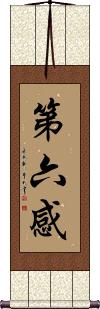
第六感 is literally “The Sixth Sense” in Chinese and Japanese Kanji.
This can also be translated as intuition, premonition, telepathy, or hunch.
Kansei Engineering / Sense Engineering
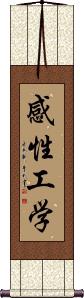
In short, 感性工學 or Kansei engineering involves collecting data on human experiences with a product and then designing or engineering improvements based on those experiences or “senses.”
Some may define Kansei as “engineering around the human experience.”
There is a lot more to know about Kansei, but if you are looking for this word, you probably already know the big picture.
Note: This term is very new in China and is only used by businesses, factories, and engineers that are implementing TQM principles. While the characters have the same base meaning in both languages, this is a Japanese title that flows back into the Chinese language (in history, most things flowed from China to Japan). To a Chinese person unfamiliar with this concept, they may interpret this as “sense vocational studies,” which doesn't make much sense. You may have to explain the intended meaning to some Chinese viewers. But that can make it a great conversation piece.
Kansei is also a newer term in Korean and is only used in certain parts of the industry, with the definition of “Sensory Engineering.” Not yet in widespread use in Korea.
Above is the modern Japanese version of this title. The last character has a Traditional Chinese version, making this 感性工學 instead of 感性工学. If you want the Traditional Chinese version, please include special instructions or email me so that I make sure the calligrapher writes the version you want.
See Also: Kaizen
Perception of Knowledge
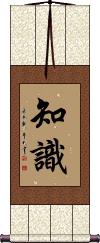
知識 has the very strong meaning of “knowledge” and, in some contexts, “learning.”
The first character represents “to know” or “to realize.”
The second character alone refers to the ability to “recognize” or “realize” and can also be used to mean “knowing.”
See Also: Wisdom | Learn From Wisdom
Perception
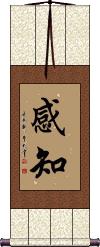
感知 is the Chinese, Japanese Kanji, and old Korean Hanja for perception, awareness, or the act of sensing and noticing.
This in-stock artwork might be what you are looking for, and ships right away...
Gallery Price: $178.00
Your Price: $98.88
These search terms might be related to Sense:
Awareness
Door of Great Wisdom
Each Time You Stumble and Fall, You Gain Experience and Wisdom
Experience is the Mother of Wisdom
Feel at Ease Anywhere / the World is My Home
Feeling of Bliss
Fudo Myo-O / Wisdom King
Gist
Great Illumination of Wisdom
Great Lotus Wisdom - Samadhi Wisdom
Great Wisdom
Idea / Thought / Meaning
Inner Beauty / Inner Wisdom
Inner Light / Intelligence
Inner Wisdom
Intelligence / Information-Gathering
Intelligence / Intellect
Introspection / Self-Awareness
Intuitive Wisdom / Inner Light
Learn From Wisdom
Make Guests Feel at Home
Military Intelligence
Mystic Lotus Wisdom of Amitabha
Pleasant Feeling
Power of Understanding and Wisdom
Seeker of Wisdom
Seeking Wisdom
Self Awareness Becomes a Buddha
Sorrow / Feeling Sorry
Sorry / Feel Apologetic / Regret
The Wisdom of the Many
When Three People Gather, Wisdom is Multiplied
Wisdom
Wisdom / Brilliance
Wisdom / Intelligence
Wisdom and Insight of the Buddha
Wisdom Comes From Experience
Wisdom From Hard Knocks
Wisdom Lotus
You Are Only as Old as You Feel
Not the results for Sense that you were looking for?
Below are some entries from our dictionary that may match your Sense search...
| Characters If shown, 2nd row is Simp. Chinese |
Pronunciation Romanization |
Simple Dictionary Definition |
佛 see styles |
fú fu2 fu hotoke ほとけ |
More info & calligraphy: Buddhism / Buddha(surname) Hotoke Buddha, from budh to "be aware of", "conceive", "observe", "wake"; also 佛陀; 浮圖; 浮陀; 浮頭; 浮塔; 勃陀; 勃馱; 沒馱; 母馱; 母陀; 部陀; 休屠. Buddha means "completely conscious, enlightened", and came to mean the enlightener. he Chinese translation is 覺 to perceive, aware, awake; and 智 gnosis, knowledge. There is an Eternal Buddha, see e.g. the Lotus Sutra, cap. 16, and multitudes of Buddhas, but the personality of a Supreme Buddha, an Ādi-Buddha, is not defined. Buddha is in and through all things, and some schools are definitely Pan-Buddhist in the pantheistic sense. In the triratna 三寳 commonly known as 三寳佛, while Śākyamuni Buddha is the first "person" of the Trinity, his Law the second, and the Order the third, all three by some are accounted as manifestations of the All-Buddha. As Śākyamuni, the title indicates him as the last of the line of Buddhas who have appeared in this world, Maitreya is to be the next. As such he is the one who has achieved enlightenment, having discovered the essential evil of existence (some say mundane existence, others all existence), and the way of deliverance from the constant round of reincarnations; this way is through the moral life into nirvana, by means of self-abnegation, the monastic life, and meditation. By this method a Buddha, or enlightened one, himself obtains Supreme Enlightenment, or Omniscience, and according to Māhāyanism leads all beings into the same enlightenment. He sees things not as they seem in their phenomenal but in their noumenal aspects, as they really are. The term is also applied to those who understand the chain of causality (twelve nidānas) and have attained enlightenment surpassing that of the arhat. Four types of the Buddha are referred to: (1) 三藏佛the Buddha of the Tripiṭaka who attained enlightenment on the bare ground under the bodhi-tree; (2) 通佛the Buddha on the deva robe under the bodhi-tree of the seven precious things; (3) 別佛the Buddha on the great precious Lotus throne under the Lotus realm bodhi-tree; and (4) 圓佛the Buddha on the throne of Space in the realm of eternal rest and glory where he is Vairocana. The Hīnayāna only admits the existence of one Buddha at a time; Mahāyāna claims the existence of many Buddhas at one and the same time, as many Buddhas as there are Buddha-universes, which are infinite in number. |
念 see styles |
niàn nian4 nien nen ねん |
More info & calligraphy: Mindfulness(1) (esp. 〜の念) sense; idea; thought; feeling; (2) desire; concern; (3) (esp. 念に〜、念の/が〜) attention; care; (personal name) Nen smṛti. Recollection, memory; to think on, reflect; repeat, intone; a thought; a moment. |
意 see styles |
yì yi4 i kokoro こころ |
More info & calligraphy: Idea / Thought / Meaning(1) feelings; thoughts; (2) meaning; (personal name) Kokoro Manas, the sixth of the ṣaḍāyatanas or six means of perception, i.e. sight, hearing, smell, taste, touch, and mind. Manas means "mind (in its widest sense as applied to all the mental powers), intellect, intelligence, understanding, perception, sense, conscience, will". M.W. It is "the intellectual function of consciousness", Keith. In Chinese it connotes thought, idea, intention, meaning, will; but in Buddhist terminology its distinctive meaning is mind, or the faculty of thought. |
法 see styles |
fǎ fa3 fa minori みのり |
More info & calligraphy: Dharma / The Law(n,n-suf) (1) law; act; principle; (n,n-suf) (2) method; (n,n-suf) (3) {gramm} mood; (n,n-suf) (4) {Buddh} dharma; law; (female given name) Minori Dharma, 達磨; 曇無 (or 曇摩); 達摩 (or 達謨) Law, truth, religion, thing, anything Buddhist. Dharma is 'that which is held fast or kept, ordinance, statute, law, usage, practice, custom'; 'duty'; 'right'; 'proper'; 'morality'; 'character'. M. W. It is used in the sense of 一切 all things, or anything small or great, visible or invisible, real or unreal, affairs, truth, principle, method, concrete things, abstract ideas, etc. Dharma is described as that which has entity and bears its own attributes. It connotes Buddhism as the perfect religion; it also has the second place in the triratna 佛法僧, and in the sense of 法身 dharmakāya it approaches the Western idea of 'spiritual'. It is also one of the six media of sensation, i. e. the thing or object in relation to mind, v. 六塵. |
火 see styles |
huǒ huo3 huo hi ひ |
More info & calligraphy: Firefire; flame; blaze Fire, flame. Śikhin 尸棄; 式棄, which means fire in the sense of flame, is the name of the 999th Buddha of the kalpa preceding this. |
無 无 see styles |
wú wu2 wu non のん |
More info & calligraphy: Nothing / Nothingness(1) nothing; naught; nought; nil; zero; (prefix) (2) un-; non-; (prefix) (1) un-; non-; (2) bad ...; poor ...; (female given name) Non Sanskrit a, or before a vowel an, similar to English un-, in- in a negative sense; not no, none, non-existent, v. 不, 非, 否; opposite of 有. |
西 see styles |
xī xi1 hsi nishihama にしはま |
More info & calligraphy: West(1) {mahj} west wind tile (chi: xī); (2) {mahj} winning hand with a pung (or kong) of west wind tiles; (surname) Nishihama paścima, 跛室制麽; west; it is largely used in the limited sense of Kashmir in such terms as 西方 the west, or western regions; but it is also much used for the western heavens of Amitābha; 西天 is India, the western 天竺國. |
香 see styles |
xiāng xiang1 hsiang yuka ゆか |
More info & calligraphy: Fragrant / Good Smell(See 御香) incense; (female given name) Yuka (竹; 象) Incense made in coils and burnt to measure the time; also 香盤; 香印.; gandha. Fragrance; incense; the sense of smell, i.e. one of the ṣaḍāyātana, six senses. Incense is one of the 使 Buddha's messengers to stimulate faith and devotion. |
乞灑 乞洒 see styles |
qǐ sǎ qi3 sa3 ch`i sa chi sa kisha |
More info & calligraphy: Ksaya / Omega / Finality |
人情 see styles |
rén qíng ren2 qing2 jen ch`ing jen ching ninjou / ninjo にんじょう |
More info & calligraphy: Empathy / Humanity(1) humanity; empathy; kindness; sympathy; (2) human nature; common sense; customs and manners human emotions |
侘寂 see styles |
wabisabi わびさび |
More info & calligraphy: Wabi Sabi |
善心 see styles |
shàn xīn shan4 xin1 shan hsin yoshinaka よしなか |
More info & calligraphy: Good Heartvirtue; moral sense; conscience; (given name) Yoshinaka A good heart, or mind. |
廉恥 廉耻 see styles |
lián chǐ lian2 chi3 lien ch`ih lien chih renchi れんち |
More info & calligraphy: Sense of Shame / Sense of Honor / Integrity / Modesty (Korean)sense of honour (honor) |
感知 see styles |
gǎn zhī gan3 zhi1 kan chih kanchi かんち |
More info & calligraphy: Perception(noun, transitive verb) perception; sensing; noticing |
放心 see styles |
fàng xīn fang4 xin1 fang hsin houshin / hoshin ほうしん |
More info & calligraphy: No Worries(n,vs,vi) (1) absentmindedness; preoccupation; being in a daze; (n,vs,vi) (2) (dated) setting one's mind at ease; ceasing to worry; relief; (n,vs,vi) (3) (archaism) (Mencian philosophical term; contrast with 良心) loss of one's moral sense; straying from virtue absentmindedness |
智恵 see styles |
norie のりえ |
More info & calligraphy: Wisdom / Intelligence |
智慧 see styles |
zhì huì zhi4 hui4 chih hui tomoe ともえ |
More info & calligraphy: Wisdom(1) wisdom; wit; sagacity; sense; intelligence; (2) (Buddhist term) prajna (insight leading to enlightenment); (female given name) Tomoe jñāna as 智 knowledge and prajñā as 慧 discernment, i.e. knowledge of things and realization of truth; in general knowledge and wisdom; but sometimes implying mental and moral wisdom. |
知恵 see styles |
tomoe ともえ |
More info & calligraphy: Wisdom |
義理 义理 see styles |
yì lǐ yi4 li3 i li yoshimasa よしまさ |
More info & calligraphy: Giri(noun - becomes adjective with の) (1) duty; sense of duty; honor; honour; decency; courtesy; debt of gratitude; social obligation; (can be adjective with の) (2) in-law; relation by marriage; (given name) Yoshimasa reason |
虛空 虚空 see styles |
xū kōng xu1 kong1 hsü k`ung hsü kung kokū |
More info & calligraphy: Nothingness / Empty / Voidśūnya; empty, void, space; ākāśa, in the sense of space, or the ether; gagana, the sky, atmosphere, heaven; kha, space, sky, ether, 虛 is defined as that which is without shape or substantiality, 空 as that which has no resistance. The immaterial universe behind all phenomena. |
第六感 see styles |
dì liù gǎn di4 liu4 gan3 ti liu kan dairokkan だいろっかん |
More info & calligraphy: Sixth Sense / Intuitionthe sixth sense; intuition; hunch |
侘び寂び see styles |
wabisabi わびさび |
More info & calligraphy: Wabi Sabi |
物の哀れ see styles |
mononoaware もののあわれ mononoahare もののあはれ |
More info & calligraphy: Mono no Aware |
笑いの壺 see styles |
warainotsubo わらいのつぼ |
More info & calligraphy: Sense of Humor |
假 see styles |
jià jia4 chia ke |
vacation To borrow, pretend, assume, suppose; unreal, false, fallacious. In Buddhism it means empirical; nothing is real and permanent, all is temporal and merely phenomenal, fallacious, and unreal; hence the term is used in the sense of empirical, phenomenal, temporal, relative, unreal, seeming, fallacious, etc. The three fundamental propositions or 三諦 are 空假中 the void, or noumenon; the empirical, or phenomenal; and the mean. |
冥 see styles |
míng ming2 ming mei / me めい |
dark; deep; stupid; the underworld (female given name) Mei Darkness, obscurity; deep. Hades; used chiefly in the sense of 無知 ignorance, profound, secret, invisible, e.g. as opposed to 顯 open, manifest. |
勘 see styles |
kān kan1 k`an kan satoru さとる |
to investigate; to survey; to collate perception; intuition; the sixth sense; (given name) Satoru To investigate, examine, collate. |
匂 see styles |
kaoru かおる |
(irregular okurigana usage) (1) odour; odor; scent; smell; stench; (2) aura; whiff; smacks of ...; sense; flavour; flavor; (m,f) Kaoru |
味 see styles |
wèi wei4 wei mi み |
taste; smell; (fig.) (noun suffix) feel; quality; sense; (TCM) classifier for ingredients of a medicine prescription (1) (sense of) taste; (counter) (2) counter for kinds of food, drink or medicine rasa. Taste, flavour; the sense of taste. One of the six sensations. |
咒 see styles |
zhòu zhou4 chou ju じゅ |
incantation; magic spell; curse; malediction; to revile; to put a curse on sb (1) spell; curse; (2) (Buddhist term) dharani; mantra dhāraṇī 陀羅尼; mantra; an incantation, spell, oath, curse; also a vow with penalties for failure. Mystical, or magical, formulae employed in Yoga. In Lamaism they consist of sets of Tibetan words connected with Sanskrit syllables. In a wider sense dhāraṇī is a treatise with mystical meaning, or explaining it. |
Click here for more Sense results from our dictionary
The following table may be helpful for those studying Chinese or Japanese...
| Title | Characters | Romaji (Romanized Japanese) | Various forms of Romanized Chinese | |
| Sense of Shame Sense of Honor Integrity Modesty (Korean) | 廉恥 廉耻 | ren chi / renchi | lián chǐ / lian2 chi3 / lian chi / lianchi | lien ch`ih / lienchih / lien chih |
| Sense of Humor | 笑いの壺 | warainotsubo | ||
| Sixth Sense Intuition | 第六感 | dairokkan / dairokan | dì liù gǎn di4 liu4 gan3 di liu gan diliugan | ti liu kan tiliukan |
| Kansei Engineering Sense Engineering | 感性工學 感性工学 | kansei kougaku kanseikougaku kansei kogaku | gǎn xìng gōng xué gan3 xing4 gong1 xue2 gan xing gong xue ganxinggongxue | kan hsing kung hsüeh kanhsingkunghsüeh |
| Perception of Knowledge | 知識 知识 | chishiki | zhī shi / zhi1 shi / zhi shi / zhishi | chih shih / chihshih |
| Perception | 感知 | kan chi / kanchi | gǎn zhī / gan3 zhi1 / gan zhi / ganzhi | kan chih / kanchih |
| In some entries above you will see that characters have different versions above and below a line. In these cases, the characters above the line are Traditional Chinese, while the ones below are Simplified Chinese. | ||||

Successful Chinese Character and Japanese Kanji calligraphy searches within the last few hours...



