Many custom options...


And formats...



Not what you want?
Try other similar-meaning words, fewer words, or just one word.
Selflessness- in Chinese / Japanese...
Buy a Selflessness- calligraphy wall scroll here!
Personalize your custom “Selflessness-” project by clicking the button next to your favorite “Selflessness-” title below...
1. Selflessness
2. Self-Restraint / Self-Control
3. Work Unselfishly for the Common Good
4. Unselfish: Perfectly Impartial
5. Impartial and Fair to the Brotherhood and Sisterhood of the World
6. Benevolence
Selflessness
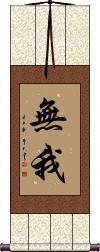
無我 is a more common way to say selflessness in Japanese. This literally means “no self,” or a better translation might be “not thinking of oneself.” 無我 is also understood in Chinese and Korean. 無我 is a very old word in CJK languages.
無我 is the word a Buddhist would use to express the idea of selflessness or unselfishness. For Korean Buddhists, it can mean self-renunciation.
See Also: Altruism
Selflessness
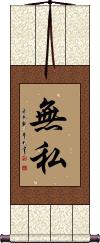
無私 would be literally translated as “none self” in Chinese, Korean, and Japanese.
It is used to express “selflessness” or “unselfish.”
無私 is a popular term for the idea of being selfless or unselfish in modern China and Japan.
This term is not as commonly used in Korea but still has good meaning.
Self-Restraint / Self-Control
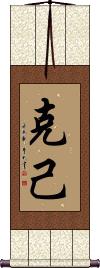
克己 can be translated as “self-denial,” “self-abnegation,” “self-restraint,” “self-discipline,” “self-mastery,” or selflessness.
As a tenet of Korean taekwondo, and other martial arts, this is often used with the title “self-control.”
Work Unselfishly for the Common Good
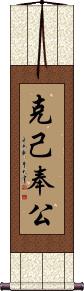
克己奉公 is a Chinese proverb that is often used to express how one should act as a government official. Most of us wish our public officials would hold themselves to higher standards. I wish I could send this scroll, along with the meaning to every member of Congress, and the President (or if I was from the UK, all the members of Parliament, and the PM)
This can also mean: “Place Strict Standards on Oneself in Public Service.”
The story behind this ancient Chinese idiom:
Cai Zun was born in China a little over 2000 years ago. In 24 AD, he joined an uprising led by Liu Xiu, who later became the emperor of the Eastern Han Dynasty.
Later, the new emperor put Cai Zun in charge of the military court. Cai Zun exercised his power in strict accordance with military law, regardless of the offender's rank or background. He even ordered the execution of one of the emperor's close servants after the servant committed a serious crime.
Cai Zun led a simple life but put great demands on himself to do all things honorably. The emperor rewarded him for his honest character and honorable nature by promoting him to the rank of General and granting him the title of Marquis.
Whenever Cai Zun would receive an award, he would give credit to his men and share the reward with them.
Cai Zun was always praised by historians who found many examples of his selfless acts that served the public interest.
Sometime long ago in history, people began to refer to Cai Zun as “ke ji feng gong.”
See Also: Unselfish | Selflessness | Altruism
Unselfish: Perfectly Impartial
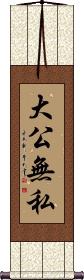
大公無私 is a Chinese proverb that comes from an old story from some time before 476 BC. About a man named Qi Huangyang, who was commissioned by the king to select the best person for a certain job in the Imperial Court.
Qi Huangyang selected his enemy for the job. The king was very confused by the selection, but Qi Huangyang explained that he was asked to find the best person for the job, not necessarily someone that he liked or had a friendship with.
Later, Confucius commented on how unselfish and impartial Qi Huangyang was by saying, “Da Gong Wu Si” which, if you look it up in a Chinese dictionary, is generally translated as “Unselfish” or “Just and Fair.”
If you translate each character, you'd have something like
“Big/Deep Justice Without Self.”
Direct translations like this leave out a lot of what the Chinese characters really say. Use your imagination, and suddenly you realize that “without self” means “without thinking about yourself in the decision” - together, these two words mean “unselfish.” The first two characters serve to drive the point home that we are talking about a concept that is similar to “blind justice.”
One of my Chinese-English dictionaries translates this simply as “just and fair.” So that is the short and simple version.
Note: This can be pronounced in Korean, but it's not a commonly used term.
See Also: Selflessness | Work Unselfishly for the Common Good | Altruism
Impartial and Fair to the Brotherhood and Sisterhood of the World
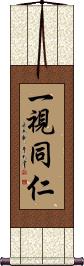
一視同仁 is how to write “universal benevolence.” This is also how to express the idea that you see all people the same.
If you are kind and charitable to everyone, this is the best way to state that virtue. It is the essence of being impartial to all mankind, regardless of social standing, background, race, sex, etc. You do not judge others, but instead, you see them eye to eye on the same level as you.
See Also: Benevolence | Compassion | Equality | Justice | Right Decision | Selflessness | Work Unselfishly for the Common
Benevolence
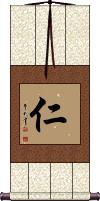
Beyond benevolence, 仁 can also be defined as “charity” or “mercy” depending on context.
The deeper meaning suggests that one should pay alms to the poor, care for those in trouble, and take care of his fellow man (or woman).
仁 is one of the five tenets of Confucius. In fact, it is a subject that Confucius spent a great deal of time explaining to his disciples.
I have also seen this benevolent-related word translated as perfect virtue, selflessness, love for humanity, humaneness, goodness, goodwill, or simply “love” in the non-romantic form.
This is also a virtue of the Samurai Warrior
See our page with just Code of the Samurai / Bushido here
Not the results for Selflessness- that you were looking for?
Below are some entries from our dictionary that may match your Selflessness- search...
| Characters If shown, 2nd row is Simp. Chinese |
Pronunciation Romanization |
Simple Dictionary Definition |
克己 see styles |
kè jǐ ke4 ji3 k`o chi ko chi yoshimi よしみ |
More info & calligraphy: Self-Restraint / Self-Control(n,vs,vi) self-control; self-mastery; self-restraint; self-denial; (given name) Yoshimi |
無我 无我 see styles |
wú wǒ wu2 wo3 wu wo muga むが |
More info & calligraphy: Selflessness(1) selflessness; self-effacement; self-renunciation; (2) {Buddh} anatta; anatman; doctrine that states that humans do not possess souls; (female given name) Muga anātman; nairātmya; no ego, no soul (of an independent and self-contained character), impersonal, no individual independent existence (of conscious or unconscious beings, anātmaka). The empirical ego is merely an aggregation of various elements, and with their disintegration it ceases to exist; therefore it has nm ultimate reality of its own, but the Nirvāṇa Sūtra asserts the reality of the ego in the transcendental realm. The non-Buddhist definition of ego is that it has permanent individuality 常一之體 and is independent or sovereign 有主宰之用. When applied to men it is 人我, when to things it is 法我. Cf. 常 11. |
剋己 克己 see styles |
kè jǐ ke4 ji3 k`o chi ko chi katsumi かつみ |
self-restraint; discipline; selflessness (personal name) Katsumi |
忘我 see styles |
wàng wǒ wang4 wo3 wang wo bouga / boga ぼうが |
selflessness; altruism (noun - becomes adjective with の) trance; ecstasy; enthusiasm |
没我 see styles |
botsuga ぼつが |
selflessness |
滅私 see styles |
messhi めっし |
selflessness; being unselfish |
雷鋒 雷锋 see styles |
léi fēng lei2 feng1 lei feng |
Lei Feng (1940–1962), a soldier celebrated by the Chinese government from 1963 onward as a model of selflessness and devotion to the Communist Party |
二無我 二无我 see styles |
èr wú wǒ er4 wu2 wo3 erh wu wo ni muga |
The two categories of anātman: — 人無我 no (permanent) human ego, or soul; 法無我 no (permanent) individuality in or independence of self or of things. |
人無我 人无我 see styles |
rén wú wǒ ren2 wu2 wo3 jen wu wo nin muga |
Man as without ego or permanent soul; cf. 人我 and 二無我. Other similar terms are 衆生無我; 生空; 人空 and我空. |
人空觀 人空观 see styles |
rén kōng guān ren2 kong1 guan1 jen k`ung kuan jen kung kuan ningū kan |
The meditation on, or insight into the selflessness of person 人空. |
我無性 我无性 see styles |
wǒ wú xìng wo3 wu2 xing4 wo wu hsing ga mushō |
selflessness |
法念處 法念处 see styles |
fǎ niàn chù fa3 nian4 chu4 fa nien ch`u fa nien chu hō nenjo |
The position of insight into the truth that nothing has reality in itself; v. 四念處. |
法空理 see styles |
fǎ kōng lǐ fa3 kong1 li3 fa k`ung li fa kung li hōkū ri |
principle of the selflessness of phenomena |
無我修 无我修 see styles |
wú wǒ xiū wu2 wo3 xiu1 wu wo hsiu muga shu |
cultivation of selflessness |
無我性 无我性 see styles |
wú wǒ xìng wu2 wo3 xing4 wu wo hsing muga shō |
selflessness |
無我想 无我想 see styles |
wú wǒ xiǎng wu2 wo3 xiang3 wu wo hsiang muga sō |
conception of selflessness |
無我智 无我智 see styles |
wú wǒ zhì wu2 wo3 zhi4 wu wo chih muga chi |
cognition of selflessness |
無我理 无我理 see styles |
wú wǒ lǐ wu2 wo3 li3 wu wo li mugari |
principle of selflessness |
無我觀 无我观 see styles |
wú wǒ guān wu2 wo3 guan1 wu wo kuan muga kan |
contemplation of selflessness |
二無我智 二无我智 see styles |
èr wú wǒ zhì er4 wu2 wo3 zhi4 erh wu wo chih ni muga chi |
The wisdom that recognizes the two categories of anātman, v. 四諦. |
二空眞如 see styles |
èr kōng zhēn rú er4 kong1 zhen1 ru2 erh k`ung chen ju erh kung chen ju nikū shinnyo |
thusness of the two kinds of selflessness |
二空眞理 see styles |
èr kōng zhēn lǐ er4 kong1 zhen1 li3 erh k`ung chen li erh kung chen li nikū shinri |
truth of the two kinds of selflessness |
人法二空 see styles |
rén fǎ èr kōng ren2 fa3 er4 kong1 jen fa erh k`ung jen fa erh kung ninbō nikū |
two kinds of selflessness of person and dharmas |
人法無我 人法无我 see styles |
rén fǎ wú wǒ ren2 fa3 wu2 wo3 jen fa wu wo ninbō muga |
selflessness of persons and dharmas |
人無我智 人无我智 see styles |
rén wú wǒ zhì ren2 wu2 wo3 zhi4 jen wu wo chih nin muga chi |
The knowledge, or wisdom, of anātman, cf. 人無我. |
忘己利他 see styles |
moukorita / mokorita もうこりた |
selflessness; selfless devotion to the service of others |
思量無我 思量无我 see styles |
sī liáng wú wǒ si1 liang2 wu2 wo3 ssu liang wu wo shiryō muga |
to contemplate selflessness |
法無我性 法无我性 see styles |
fǎ wú wǒ xìng fa3 wu2 wo3 xing4 fa wu wo hsing hō muga shō |
selflessness of phenomena |
無私無欲 see styles |
mushimuyoku むしむよく |
(noun - becomes adjective with の) (yoji) selflessness; unselfishness |
空無我聲 空无我声 see styles |
kōng wú wǒ shēng kong1 wu2 wo3 sheng1 k`ung wu wo sheng kung wu wo sheng kūmuga shō |
sound of selflessness of person |
Click here for more Selflessness- results from our dictionary
The following table may be helpful for those studying Chinese or Japanese...
| Title | Characters | Romaji (Romanized Japanese) | Various forms of Romanized Chinese | |
| Selflessness | 無我 无我 | muga | wú wǒ / wu2 wo3 / wu wo / wuwo | |
| Selflessness | 無私 无私 | mushi | wú sī / wu2 si1 / wu si / wusi | wu ssu / wussu |
| Self-Restraint Self-Control | 克己 / 剋己 克己 | kokki / koki | kè jǐ / ke4 ji3 / ke ji / keji | k`o chi / kochi / ko chi |
| Work Unselfishly for the Common Good | 克己奉公 | kè jǐ fèng gōng ke4 ji3 feng4 gong1 ke ji feng gong kejifenggong | k`o chi feng kung kochifengkung ko chi feng kung |
|
| Unselfish: Perfectly Impartial | 大公無私 大公无私 | dà gōng wú sī da4 gong1 wu2 si1 da gong wu si dagongwusi | ta kung wu ssu takungwussu |
|
| Impartial and Fair to the Brotherhood and Sisterhood of the World | 一視同仁 一视同仁 | isshidoujin ishidojin | yí shì tóng rén yi2 shi4 tong2 ren2 yi shi tong ren yishitongren | i shih t`ung jen ishihtungjen i shih tung jen |
| Benevolence | 仁 | jin | rén / ren2 / ren | jen |
| In some entries above you will see that characters have different versions above and below a line. In these cases, the characters above the line are Traditional Chinese, while the ones below are Simplified Chinese. | ||||

Successful Chinese Character and Japanese Kanji calligraphy searches within the last few hours...



