Many custom options...


And formats...



Self in Chinese / Japanese...
Buy a Self calligraphy wall scroll here!
Personalize your custom “Self” project by clicking the button next to your favorite “Self” title below...
1. Self-Restraint / Self-Control
3. Prideful Mind / Self-Respecting Heart
6. Introspection / Self-Awareness
7. Inner Strength / Self-Improvement
8. Self-Discipline / Will-Power
11. Self Sacrifice
12. Self-Control
14. Power of Oneself / Self-Sufficient
15. Self-Discipline Martial Arts
16. Jiko no Kansei / Self-Completion
17. Self-Discipline and Martial Virtue
18. Self-Defense
23. Self-Control
24. Changing Oneself / Self Reformation
25. Self Awareness Becomes a Buddha
26. ...And this above all to thine own self be true
Self-Restraint / Self-Control
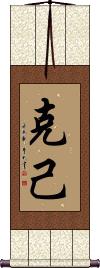
克己 can be translated as “self-denial,” “self-abnegation,” “self-restraint,” “self-discipline,” “self-mastery,” or selflessness.
As a tenet of Korean taekwondo, and other martial arts, this is often used with the title “self-control.”
Self-Respect / Self-Esteem
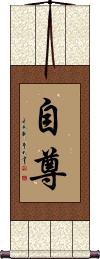
自尊 means self-respect or self-esteem in Chinese, Korean and Japanese. It can also mean “pride in oneself.”
Note: Japanese sometimes put the character for the heart after these two. However, this two-character word is universal between all three languages (which is often better since more than a third of the world's population can read this version as a native word).
Prideful Mind / Self-Respecting Heart
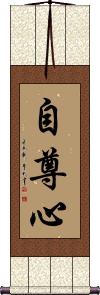
自尊心 is a Japanese and Korean word that means “pride” or “self-respect.”
The first Kanji/Hanja means oneself. The second can mean revered, valuable, precious, noble, or exalted. And the last Kanji/Hanja means heart, mind, and/or spirit.
While these characters make sense and hold the same general meaning in Chinese, this is not a normal Chinese word. This selection should only be used if your audience is Japanese or Korean.
See Also: Respect | Pride | Self-Reliance | Self-Control | Self-Discipline
Self-Reliance
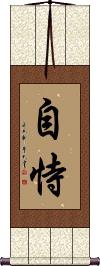
自恃 means self-reliance but is often used to mean self-confidence or the state of being self-assured.
Basically, this means you can rely on yourself (with a slight suggestion that others can rely on you as well).
The first character means “oneself,” while the second means “to rely upon.”
See Also: Confidence | Self-Confidence
Self-Confidence
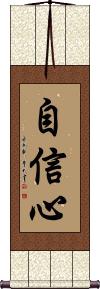
自信心 is the long title for self-confidence.
It differs from the other version, only with the addition of the character for heart or soul at the end. With that addition, you could say this means a self-confident heart.
See Also: Confidence
Introspection / Self-Awareness
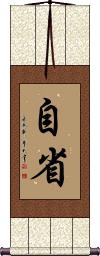
自省 is the Chinese, Japanese Kanji, and old Korean Hanja means: to examine oneself; to reflect on one's shortcomings; introspection; self-awareness; self-criticism; self-examination; reflection.
In Japanese, this can be the given name, Jisei.
Inner Strength / Self-Improvement
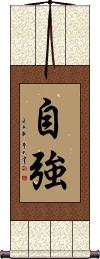
自強 is the kind of inner strength that applies to a person who has will-power and can inspire themselves to do great things.
自強 can also be the creed of a person that always pursues self-improvement.
Other translations: self-strengthening, striving for improvement, self-improvement, striving to become stronger, and self-renewal.
Self-Discipline / Will-Power
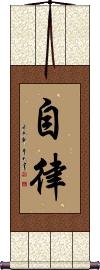
自律 means self-discipline and self-control.
It is doing what you really want to do rather than being tossed around by your feelings like a leaf in the wind. You act instead of reacting. You get things done in an orderly and efficient way. With self-discipline, you take charge of yourself.
Not sure if this one works for a Japanese audience.
See Also: Discipline | Self-Control
Self-Confidence
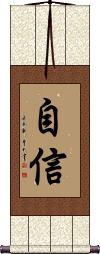
自信 is created by simply putting the character for “faith/believe/confidence” with the character for “oneself” in front of it.
The literal translation holds the same meaning in English, Chinese, and Japanese.
It's like a self-affirmation to say, “you can do it.”
Some may also use this to mean self-esteem or a sense of self-worth. 自信 is also how to say “believe in oneself.”
See Also: Confidence
Self Actualization
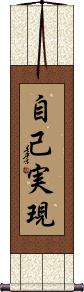
自己実現 is the Japanese title for self-actualization, self-fulfillment, or self-realization.
Self Actualization
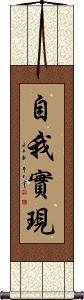
自我實現 is the Chinese and old Korean Hanja title for self-actualization or self-realization.
Self Sacrifice
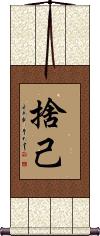
捨己 is a Chinese and Japanese word that means selfless, self-sacrifice (to help others), self-renunciation, or altruism.
Self-Control
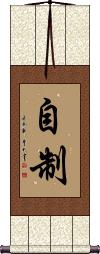
The short and sweet version of self-control.
Note: This can also mean self-restraint.
See Also: Will-Power | Discipline
Unyielding Self-Reliance

不屈自律 can be translated as “Indomitable Self-Discipline,” “Tenacious Self-Control,” or “Unyielding Self-Discipline.”
In martial contexts, this phrase is often used as a motto emphasizing mindset, conduct, or training attitude.
Power of Oneself / Self-Sufficient
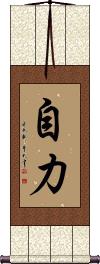
自力 is a word in Chinese, Japanese Kanji, old Korean, and Buddhist term meaning: the power within oneself; self-sufficient; by oneself; self-made; self-power; inner ability.
Self-Discipline Martial Arts

克己武道 can be translated as “Self-Discipline Martial Way,” or “Self-Discipline Martial Arts.”
克己 = Self-mastery, or overcome the self.
武道 = Martial way, suggesting an ethical/lifelong path of training.
Martial way; ethical/lifelong path of training.
Jiko no Kansei / Self-Completion
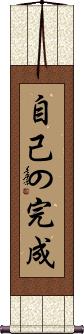
自己の完成 or Jiko no Kansei is a Japanese phrase that means self-completion, self-accomplishment, or self-perfection.
Self-Discipline and Martial Virtue

克己武術 can be translated as “Self-Discipline Martial Arts Techniques,” or “Self-Discipline and Martial Virtue.”
克己 = Self-mastery, or overcome the self.
武術 = Martial techniques/arts, or practical combat methods.
Self-mastery; overcome the self. Martial techniques/arts; practical combat methods.
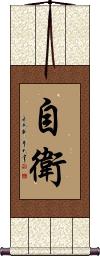
Self-Defense
Consciousness of Self
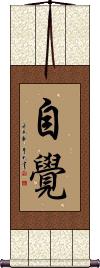
自覺 is the idea of being conscious, self-aware, and sometimes “on one's own initiative.”
 After WWII, they started using a simplified form of the second Kanji for this word in Japan. That version is shown to the right, and you can click on that Kanji if you want the modern Japanese form. Otherwise, the characters shown in the upper left are the correct ones for ancient/old/traditional Chinese, Japanese, and Korean.
Self Consciousness
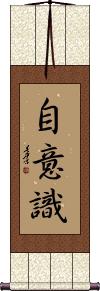
自意識 is the idea of being conscious and self-aware in Japanese Kanji and old Korean Hanja.
This is not a normal word in Chinese.
To thine own self be true
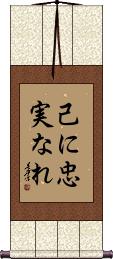
己に忠実なれ is “...to thine own self be true” in Japanese.
This is a small portion of the classic line from Shakespeare's Hamlet.
Note: Because this selection contains some special Japanese Hiragana characters, it should be written by a Japanese calligrapher.
Will-Power / Self-Control
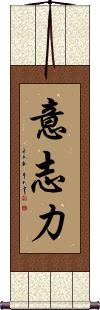
意志力 is a form of willpower or self-control and is about having the determination or tenacity to keep going.
In Japanese, this is the power of will, the strength of will, volition, intention, intent, or determination.
Self-Control
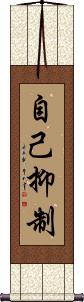
自己抑制 has a meaning like “to restrain oneself” in Chinese, Japanese, and old Korean.
The first two characters mean “regarding oneself,” and the second two mean “to refrain” or “to restrain.”
See Also: Discipline | Will-Power
Changing Oneself / Self Reformation
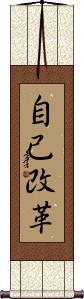
自己改革 is a Japanese title that refers to one who changes themselves or improves themselves by reforming their lives.
Another way to translate it is “A person who changes their attitude or something about themselves.”
Self Awareness Becomes a Buddha
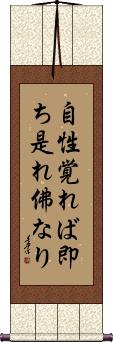
自性覚れば即ち是れ佛なり is a Zen quote that means “If one realizes one's own nature, one becomes a Buddha.”
The inference here is that if you understand who you really are, and become truly aware of yourself and your original nature, you are well on your way to becoming a liberated person (a Buddha).
Note: Because this selection contains some special Japanese Hiragana characters, it should be written by a Japanese calligrapher.
...And this above all to thine own self be true
A line from Shakespeare's Hamlet
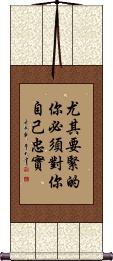
尤其要緊的你必須對你自己忠實 is the classic translation of a line from Shakespeare's Hamlet into Chinese.
Self-Love / Love Yourself / Love Oneself
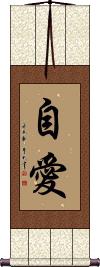
自愛 means self-love, self-regard, regard for oneself, cherishing one's good name, taking care of oneself, or love myself.
In the Buddhist context, this is the cause of all pursuit or seeking, which in turn causes all suffering. All Buddhas discharge themselves from self-love and all pursuits of personal gratification. Such elimination of self-love is a step towards nirvāṇa.
This title can be taken as positive or negative, depending on how you read it. Some will see it as arrogant, and others will read it as a token of self-respect. Because of this ambiguity, I do not recommend this title for a wall scroll.
Know Thy Enemy, Know Thyself
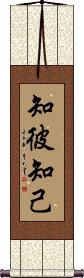
This proverb is from Sun Tzu's (Sunzi's) Art of War.
It means that if you know and understand the enemy, you also know yourself. Four secondary characters come after this in the Art of War (not included here) which suggests you cannot lose a battle when you follow this philosophy.
In a very literal and somewhat-boring way, this can also be translated as “Estimate correctly one's strength as well as that of one's opponent.”
Know Thy Enemy, Know Thyself
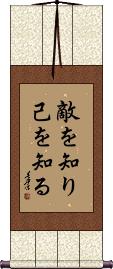
敵を知り己を知る is the Japanese version of “know your enemy, know yourself.”
There is a longer version of this proverb that adds, “...and you can win 100 battles.”
Note: Because this selection contains some special Japanese Hiragana characters, it should be written by a Japanese calligrapher.
This in-stock artwork might be what you are looking for, and ships right away...

Gallery Price: $60.00
Your Price: $36.88

Gallery Price: $60.00
Your Price: $36.88

Gallery Price: $60.00
Your Price: $36.88
These search terms might be related to Self:
A Truly Determined Person Will Find a Solution
A Wise Person Reflecting a Thousand Times Can Still Make a Mistake
Alone / a Lone Person
Beauty of Nature
Character
Discipline / Training / Tempering Character
English / Briton / Person From England
Fortitude / Strength of Character
Human Nature
Kindness and Forgiving Nature
Man of Character
Man of Remarkable Character / Hero
Mother Nature
Nature
Nature in Balance / Balanced Nature
Person of Character
Seeing One’s Nature and Becoming a Buddha
Tathata / Ultimate Nature of All Things
The Nature of Enlightenment in One's Mind
The Nature of Martial Arts
Woman of Strong Character / Woman Hero
The following table may be helpful for those studying Chinese or Japanese...
| Title | Characters | Romaji (Romanized Japanese) | Various forms of Romanized Chinese | |
| Self-Restraint Self-Control | 克己 / 剋己 克己 | kokki / koki | kè jǐ / ke4 ji3 / ke ji / keji | k`o chi / kochi / ko chi |
| Self-Respect Self-Esteem | 自尊 | jison | zì zūn / zi4 zun1 / zi zun / zizun | tzu tsun / tzutsun |
| Prideful Mind Self-Respecting Heart | 自尊心 | ji son shin jisonshin | zì zūn xīn zi4 zun1 xin1 zi zun xin zizunxin | tzu tsun hsin tzutsunhsin |
| Self-Reliance | 自恃 | zì shì / zi4 shi4 / zi shi / zishi | tzu shih / tzushih | |
| Self-Confidence | 自信心 | zì xìn xīn zi4 xin4 xin1 zi xin xin zixinxin | tzu hsin hsin tzuhsinhsin |
|
| Introspection Self-Awareness | 自省 | jisei | zì xǐng / zi4 xing3 / zi xing / zixing | tzu hsing / tzuhsing |
| Inner Strength Self-Improvement | 自強 自强 | zì qiáng / zi4 qiang2 / zi qiang / ziqiang | tzu ch`iang / tzuchiang / tzu chiang | |
| Self-Discipline Will-Power | 自律 | jiritsu | zì lǜ / zi4 lv4 / zi lv / zilv | tzu lü / tzulü |
| Self-Confidence | 自信 | jishin | zì xìn / zi4 xin4 / zi xin / zixin | tzu hsin / tzuhsin |
| Self Actualization | 自己実現 | jikojitsugen | ||
| Self Actualization | 自我實現 自我实现 | zì wǒ shí xiàn zi4 wo3 shi2 xian4 zi wo shi xian ziwoshixian | tzu wo shih hsien tzuwoshihhsien |
|
| Self Sacrifice | 捨己 舍己 | sutemi / suteki | shě jǐ / she3 ji3 / she ji / sheji | she chi / shechi |
| Self-Control | 自制 | jisei | zì zhì / zi4 zhi4 / zi zhi / zizhi | tzu chih / tzuchih |
| Unyielding Self-Reliance | 不屈自律 | fukutsu-jiritsu | bù qū zì lǜ bu4 qu1 zi4 lv4 bu qu zi lv buquzilv | pu ch`ü tzu lü puchützulü pu chü tzu lü |
| Power of Oneself Self-Sufficient | 自力 | jiriki | zì lì / zi4 li4 / zi li / zili | tzu li / tzuli |
| Self-Discipline Martial Arts | 克己武道 | kokki bu dō kokkibudō koki bu dō | kè jǐ wǔ dào ke4 ji3 wu3 dao4 ke ji wu dao kejiwudao | k`o chi wu tao kochiwutao ko chi wu tao |
| Jiko no Kansei Self-Completion | 自己の完成 | ji ko no kan sei jikonokansei | ||
| Self-Discipline and Martial Virtue | 克己武術 | kokki bu jutsu kokkibujutsu koki bu jutsu | kè jǐ wǔ shù ke4 ji3 wu3 shu4 ke ji wu shu kejiwushu | k`o chi wu shu kochiwushu ko chi wu shu |
| Self-Defense | 自衛 自卫 | ji ei / jiei | zì wèi / zi4 wei4 / zi wei / ziwei | tzu wei / tzuwei |
| Consciousness of Self | 自覺 自觉 / 自覚 | jikaku | zì jué / zi4 jue2 / zi jue / zijue | tzu chüeh / tzuchüeh |
| Self Consciousness | 自意識 自意识 | jiishiki / jishiki | ||
| To thine own self be true | 己に忠実なれ | onore ni chuujitsu nare onorenichuujitsunare onore ni chujitsu nare | ||
| Will-Power Self-Control | 意志力 | ishi ryoku / ishiryoku | yì zhì lì yi4 zhi4 li4 yi zhi li yizhili | i chih li ichihli |
| Self-Control | 自己抑制 | jikoyokusei | zì jǐ yì zhì zi4 ji3 yi4 zhi4 zi ji yi zhi zijiyizhi | tzu chi i chih tzuchiichih |
| Changing Oneself Self Reformation | 自己改革 | ji ko kai kaku jikokaikaku | ||
| Self Awareness Becomes a Buddha | 自性覚れば即ち是れ佛なり | Jishou satore ba sunawachi kore butsu nari Jisho satore ba sunawachi kore butsu nari | ||
| ...And this above all to thine own self be true | 尤其要緊的你必須對你自己忠實 尤其要紧的你必须对你自己忠实 | yóu qí yào jǐn de nǐ bì xū duì nǐ zì jǐ zhōng shí you2 qi2 yao4 jin3 de ni3 bi4 xu1 dui4 ni3 zi4 ji3 zhong1 shi2 you qi yao jin de ni bi xu dui ni zi ji zhong shi | yu ch`i yao chin te ni pi hsü tui ni tzu chi chung shih yu chi yao chin te ni pi hsü tui ni tzu chi chung shih |
|
| Self-Love Love Yourself Love Oneself | 自愛 自爱 | ji ai / jiai | zì ài / zi4 ai4 / zi ai / ziai | tzu ai / tzuai |
| Know Thy Enemy, Know Thyself | 知彼知己 | zhí bǐ zhí jī zhi2 bi3 zhi2 ji1 zhi bi zhi ji zhibizhiji | chih pi chih chi chihpichihchi |
|
| Know Thy Enemy, Know Thyself | 敵を知り己を知る | te ki o shi ri o no re o shi ru tekioshirionoreoshiru | ||
| In some entries above you will see that characters have different versions above and below a line. In these cases, the characters above the line are Traditional Chinese, while the ones below are Simplified Chinese. | ||||

Successful Chinese Character and Japanese Kanji calligraphy searches within the last few hours...



