Many custom options...


And formats...



Rules in Chinese / Japanese...
Buy a Rules calligraphy wall scroll here!
Personalize your custom “Rules” project by clicking the button next to your favorite “Rules” title below...
4. Dojo Kun
5. Ritsu
6. Suzaku
8. Discipline
10. Duty to Defend and Protect Country
12. Dignity / Honor / Sanctity / Integrity
13. White Tiger
14. Cooperation / Collaboration
15. Respect
17. Daodejing / Tao Te Ching - Chapter 27
19. Art of War: 5 Points of Analysis
20. Kenpo / Kempo / Quan Fa / Chuan Fa
23. Xuan Wu / Genbu / Black Tortoise God
24. Rule
25. Golden Rule
27. Rule
31. Code Of Silence
32. The Five Tenets of Confucius
33. Confucius: Golden Rule / Ethic of Reciprocity
34. Listen to Both Sides and be Enlightened, Listen to One Side and be in the Dark
Seven Rules of Happiness
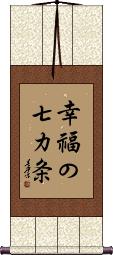
幸福の七カ条 is the title for the 7 rules of happiness in Japanese.
The rules themselves take up a lot of space:
1. 成功や栄誉や勝ち負けを目的に、ことを行ってはいけない。
2. しないではいられないことをし続けなさい。
3. 他人との比較ではない、あくまで自分の楽しさを追及すべし。
4. 好きの力を信じる。
5. 才能と収入は別、努力は人を裏切ると心得よ。
6. 怠け者になりなさい。
7. 目に見えない世界を信じる。
...so this title is probably all you need.
Note: Because this selection contains some special Japanese Katakana characters, it should be written by a Japanese calligrapher.
My Life, My Rules
My life, I call the shots
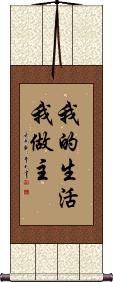
我的生活我做主 is a Chinese phrase that can be translated as “My life, my rules,” or “My life, I call the shots.”
The first four characters say, “my life.”
The fifth character is I, me, and/or my.
The last two characters can be interpreted in a variety of ways, just as to make the decision, to take charge of, to call the shot, or to make the rule.
Ten perfect Mahayana rules
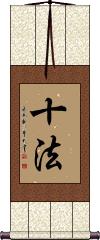
十法 is the title of the ten perfect or perfecting Mahāyāna rules.
The order of rules is as follows:
1. right belief.
2. right conduct.
3. right spirit.
4. the joy of the bodhi mind.
5. joy in the dharma.
6. joy in meditation.
7. pursuing the correct dharma.
8. obedience to, or accordance with dharma.
9. departing from pride, desire, etc.
10. comprehending the inner teaching of Buddha and taking no pleasure in attaining such knowledge or noting the ignorance of others.
This title is only used in the context of Buddhism. Japanese and Chinese people who are not familiar with Buddhism will not recognize this title.
Dojo Kun
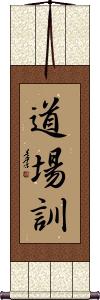
道場訓 or Dōjō-kun is a Japanese martial arts term meaning “training hall rules.”
道場訓 is the rules or doctrine of the dojo.
You will see this often in the form of a list of roles and expectations posted near the front entrance of a dojo.
Ritsu
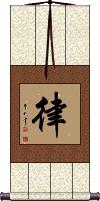
While this character literally means law, regulation or rules, it's also a surname Lü in Chinese and name Ritsu in Japanese.
In more ancient times (and for some people still), this can refer to East Asian criminal code, or vinaya (rules for the monastic community). For Japanese Buddhists, this can be the Ritsu school.
In some context, this can refer to certain musical scales used in Asia.
Suzaku
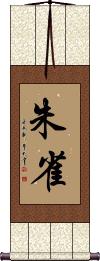
This is a Japanese surname that romanizes as Suzaku.
The meaning in Chinese and Japanese is “Vermilion Bird” or “Red Bird.” This is also the name of a Chinese start constellation (the seven mansions, or the god, who rules the southern sky).
This is not the only Japanese name that romanizes as Suzaku. Make sure you have the right one before you order.
Principles of Life
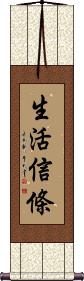
生活信條 is a Chinese proverb that means “principles of life” or “The personal obligations and rules that you live by.”
For instance, if you were a vegetarian, the act of not eating meat fits into this category.
This could also be translated as a “Way of living.”
Discipline
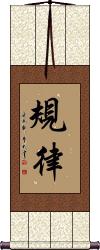
規律 is a Japanese word for discipline that relays the ideas of keeping order, and observance (of rules, laws, regulations).
This is also a word in Chinese and old Korean Hanja where it suggests that you are one who follows a certain law of behavior or has a regular and dependable pattern of behavior, personal regime, or rhythm.
See Also: Self-Control | Will-Power
State of Anarchy
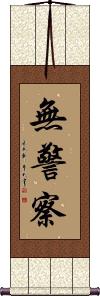
無警察 means the state of anarchy.
More literally it means “without rules or judges.”
This combination of characters makes sense in Korean and Chinese but with a meaning closer to “without police.” 無警察 is kind of a weird selection for a wall scroll and a rather obscure idea (a couple of customers begged for this term, so we added it).
Duty to Defend and Protect Country
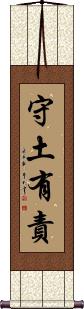
守土有責 is a Chinese proverb that expresses one's duty to defend the country.
守 means to guard, defend, keep watch, abide by the law, and/or observe (rules or ritual).
土 means land, earth, or soil.
有 is a possessive modifier in effect meaning “is a.”
責 means duty or responsibility.
So you get a literal translation of “Protecting [the] land is [a] duty/responsibility.”
American Football
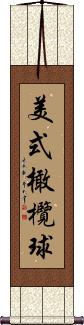
美式橄欖球 is the Chinese title for “American football” (not to be confused with international football known as soccer in the USA).
If you are a player or fan of American football, this will make a great wall scroll for your home.
The first two characters mean “American style.”
The last three characters mean football or rugby (a game involving an oblong or ovoid ball).
The “American” adjective is needed in this title to differentiate between Canadian football, Australian rules football, and rugby.
See Also: Soccer
Dignity / Honor / Sanctity / Integrity
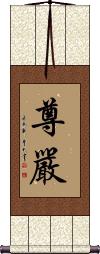
尊嚴 is a form of honor that means showing great respect for yourself, other people, and the rules you live by.
When you are honorable, you keep your word. You do the right thing regardless of what others are doing.
尊嚴 is the kind of personal honor or dignity that is of great value. If you lose this, you have lost yourself and perhaps the reputation of your family as well.
While this is not directly the same thing as “face” or “saving face” in Asian culture, it is associated with the same concept in China.
 In Japan, they currently use a more simplified second character for this word. The ancient Japanese form is the same as China but after WWII some Kanji were changed. If you want the modern Japanese version, just click on the Kanji image shown to the right, instead of the button above.
White Tiger
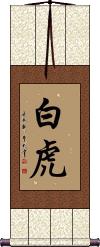
白虎 is the title “White Tiger” in Chinese, Japanese, and old Korean Hanja.
In Chinese folklore, the White Tiger rules or represents the seven mansions (constellations) of the western sky. However, in modern Chinese, a “white tiger” is also slang for hairless female genitalia (be careful about this, as Chinese men might secretly laugh or snicker when they see your white tiger wall scroll).
In Japanese folklore, the White Tiger is a god said to rule over the western heavens. They also know of the Chinese seven mansions of the western heavens. In Japanese, this can also be the given name Byakko.
Cooperation / Collaboration
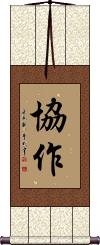
協作 is a Chinese, Japanese, and old Korean word that means cooperation or collaboration.
Cooperation is working together and sharing the load. When we cooperate, we join with others to do things that cannot be done alone. We are willing to follow the rules which keep everyone safe and happy. Together we can accomplish great things.
The first character means “united” or “to coordinate.” The second character means “to do,” “to make,” or “to compose.” Knowing this, you can understand why together, these characters create a word that can be defined as “cooperation” in Chinese, Japanese, and Korean.
It is implied that you are cooperating to create some project or product.
See Also: Partnership
Respect
Politeness, Gratitude and Propriety
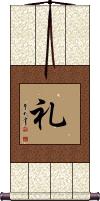
礼 is one of the five tenets of Confucius.
Beyond respect, 礼 can also be translated as propriety, good manners, politeness, rite, worship, or an expression of gratitude.
We show respect by speaking and acting with courtesy. We treat others with dignity and honor the rules of our family, school, and nation. Respect yourself, and others will respect you.
 Please note that Japanese use this simplified 礼 version of the original 禮 character for respect. 礼 also happens to be the same simplification used in mainland China. While 禮 is the traditional and original version, 礼 has been used as a shorthand version for many centuries. Click on the big 禮 character to the right if you want the Traditional Chinese and older Japanese versions.
This is also a virtue of the Samurai Warrior
See our page with just Code of the Samurai / Bushido here
See Also: Confucius
Kenjutsu / Kenjitsu
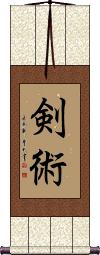
In Japanese, the modern definition, using simple terms, 剣術 is “A martial art involving swords” or “The art of the sword.”
However, in Chinese, this is the word for fencing (as in the Olympic sport).
I will suppose that you want this for the Japanese definition, which comes from skills and techniques developed in the 15th century. At that time, Kenjutsu (or swordsmanship) was a strictly military art taught to Samurai and Bushi (soldiers). The fact that swords are rarely used in military battles anymore, and with the pacification of Japan after WWII, Kenjutsu is strictly a ceremonial practice often studied as a form of martial art (more for the discipline aspect rather than practical purpose).
Language note: The Korean definition is close to the Japanese version described above. However, it should be noted that this can mean “fencing” depending on the context in Japanese, Chinese, and Korean.

 Character variation notes: There are slight variations possible with the second character. Either way is correct and understood by both Japanese and Chinese folks.
Since there are about 5 common ways to write the sword character, if you are particular about which version you want, please note that in the “special instructions” when you place your order.
Romanization note: This term is often Romanized as Kenjitsu; however, following the rules of Japanese Romaji, it should be Kenjutsu.
Daodejing / Tao Te Ching - Chapter 27
The Mastery of Effortless Skill

Chapter 27 of the Daodejing reveals a profound truth about mastery: the highest skill leaves no trace, requires no force, and appears almost invisible.
善行無轍跡,
善言無瑕謫,
善數不用籌策,
善閉無關鍵而不可開,
善結無繩約而不可解。
是以聖人常善救人,
故無棄人;
常善救物,
故無棄物。
是謂襲明。
故善人者,不善人之師;
不善人者,善人之資。
不貴其師,不愛其資,
雖智大迷,
是謂要妙。
The sage moves through life with such natural harmony that nothing seems imposed; doors need no locks, knots require no rope, and actions leave no mark behind.
This is the essence of wúwéi (effortless action), where true ability arises from deep alignment with the Tao rather than deliberate effort.
At its heart, this chapter teaches compassion without exception. The sage “abandons no one and nothing,” recognizing value in all people and all things. Even those who seem flawed or unrefined are not rejected, but understood as part of a greater whole with each person both a student and a teacher in the unfolding of life.
Laozi reminds us that wisdom is not about perfection or control, but about subtle awareness. The truly skilled individual does not rely on tools, rules, or rigid structures; instead, they embody an intuitive understanding that makes their actions naturally complete.
In this way, excellence becomes quiet, effortless, and beyond imitation.
This teaching also reflects a deeper philosophical insight: Opposites are interdependent. The “good” person learns from the “not good,” and the “not good” provides the material for growth. To reject either is to misunderstand the balance of existence itself.
As calligraphy, Daodejing Chapter 27 serves as a reminder to cultivate inner mastery rather than outward display. It is a meditation on refinement, humility, and the quiet power of skill perfected through harmony with the natural order.
Note: The Chinese text used here is based on the early Mawangdui silk manuscript tradition (2nd century BCE). The Guodian manuscripts do NOT preserve Chapter 27 in full form.
Qi Gong / Chi Kung
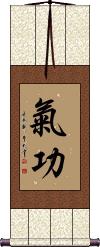
氣功 or Qigong is the title of a technique that is somewhere between medical practice, meditation, and in some cases, religion.
The definition is blurred depending on which school of Qigong you are following. In some cases, it is even incorporated with martial arts.
Some people (even Chinese people) mix this title with Tai Chi (Tai Qi) exercises.
Lately, in China, people will claim to practice Tai Chi rather than Qigong because the Qigong title was recently used as a cover for an illegal pseudo-religious movement in China with the initials F.G. or F.D. (I can not write those names here for fear of our website being banned in China).
You can learn those names and more here: Further info about Qigong
If you are wondering why I wrote “Qi Gong” and “Chi Kung” as the title of this calligraphy entry, I should teach you a little about the various ways in which Chinese can be Romanized. One form writes this as “Chi Kung” or “Chikung” (Taiwan). In the mainland and elsewhere, it is Romanized as “Qi Gong” or “Qigong.” The pronunciation is the same in Taiwan, mainland, and Singapore Mandarin. Neither Romanization is exactly like English. If you want to know how to say this with English rules, it would be something like “Chee Gong” (but the “gong” has a vowel sound like the “O” in “go”).
Romanization is a really confusing topic and has caused many Chinese words to be mispronounced in the west. One example is “Kung Pao Chicken,” which should actually be more like “Gong Bao” with the “O” sounding like “oh” for both characters. Neither the Romanization system in Taiwan nor the Mainland is perfect, in my opinion, and leads to many misunderstandings.
In modern Japan, you may see this written as 気功, but the original 氣功 is still recognized. If you need the Japanese version, please contact me.
Art of War: 5 Points of Analysis
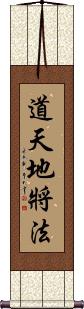
道天地將法 is a list of five key points to analyzing your situation from the first chapter of Sun Tzu's Art of War.
This reads like a 5-part military proverb. Sun Tzu says that to sharpen your skills, you must plan. To plan well, you must know your situation. Therefore, you must consider and discuss the following:
1. Philosophy and Politics: Make sure your way or your policy is agreeable among all of your troops (and the citizens of your kingdom as well). For when your soldiers believe in you and your way, they will follow you to their deaths without hesitation and will not question your orders.
2. Heaven/Sky: Consider climate / weather. This can also mean considering whether God is smiling upon you. In the modern military, this could be waiting for clear skies so that you can have air support for an amphibious landing.
3. Ground/Earth: Consider the terrain in which the battle will take place. This includes analyzing defensible positions, and exit routes, while using varying elevations to your advantage. When you plan an ambush, you must know your terrain and the best location from which to stage that ambush. This knowledge will also help you avoid being ambushed, as you will know where the likely places in which to expect an ambush from your enemy.
4. Leadership: This applies to you as the general and your lieutenants. A leader should be smart and be able to develop good strategies. Leaders should keep their word, and if they break a promise, they should punish themselves as harshly as they would punish subordinates. Leaders should be benevolent to their troops, with almost a fatherly love for them. Leaders must have the ability to make brave and fast decisions. Leaders must have steadfast principles.
5. [Military] Methods: This can also mean laws, rules, principles, models, or systems. You must have an efficient organization in place to manage both your troops and supplies. In the modern military, this would be a combination of how your unit is organized and your SOP (Standard Operating Procedure).
Notes: This is a simplistic translation and explanation. Much more is suggested in the actual text of the Art of War (Bing Fa). It would take a lot of study to master all of these aspects. In fact, these five characters can be compared to the modern military acronyms such as BAMCIS or SMEAC.
CJK notes: I have included the Japanese and Korean pronunciations but in Chinese, Korean and Japanese, this does not make a typical phrase (with subject, verb, and object) it is a list that only someone familiar with Sun Tzu’s writings would understand.
Kenpo / Kempo / Quan Fa / Chuan Fa
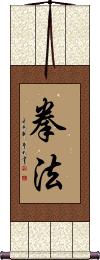
拳法 is a form of martial arts that can be translated in several ways.
Some will call it “fist principles,” “the way of the fist,” or even “law of the fist.” The first character literally means fist. The second can mean law, method, way, principle, or Buddhist teaching.
Kempo is really a potluck of martial arts. Often a combination of Chinese martial arts such as Shaolin Kung Fu with Japanese martial arts such as Karate, Jujutsu (Jujitsu), Aikido, and others. You may see the term “Kempo Karate,” which basically means Karate with other disciplines added. In this way, Kempo becomes an adjective rather than a title or school of martial arts.
These facts will long be argued by various masters and students of Kempo. Even the argument as to whether it should be spelled “kenpo” or “Kempo” ensues at dojos around the world (the correct Romaji should actually be “kenpou” if you precisely follow the rules).
The benefit of Kempo is that the techniques are easier to learn and master than pure Kung Fu (wu shu). Students are often taught basic Karate moves, kicks, and punches before augmenting the basic skills with complex Kung Fu techniques. This allows students of Kempo to achieve a level where they can defend themselves or fight in a relatively short amount of time (a few years rather than a decade or more).
Because the definition of this word is so fluid, I should make some notes here:
1. Purists in Okinawa will claim that “Okinawa Kenpo” or “Ryukyu Hon Kenpo” is the original and true version of this martial art from the old kingdom. It is actually little or no connection between Okinawa Kenpo and the way the word is used elsewhere.
2. In Chinese, where these characters are pronounced “quan fa” (sometimes Romanized as “chuan fa” because the Chinese-pinyin “q” actually sounds like an English “ch” sound), these characters do not hold the connotation of being a mixed martial art. It is simply defined as “the law of the fist.”
3. My Japanese dictionary oddly defines Kenpo as the “Chinese art of self-defense.” I personally don't feel this is the most common way that people perceive the word but just something you should know.
Science / Universal Law
The rules of life, the universe, and everything.
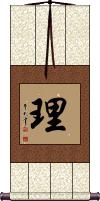
At its essence, 理 means science.
理 is a very ambiguous and open term; it speaks to the reason that all things exist, and how things work from the microscopic to the cosmic level.
In the Buddhist context, this character represents the “Universal Law.”
There are many translations for this word, including inner essence, intrinsic order, reason, logic, truth, natural science (esp. physics), principle, the underlying principles of the cosmos, the way of things, ruling principle, fundamental law, intrinsicality, universal basis, or essential element(s).
If you are a scientist, or just searching for “the answer to life, the universe, and everything,” this could be the character for you.
Kung Fu / Gong Fu
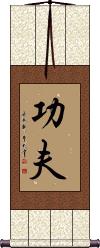
功夫 or Kung Fu is one of the most famous types of martial arts in the world - and not just because of Bruce Lee.
Some translate the meaning as “Accomplishment by Great Effort.” I think this is partially true, but directly translated, it literally means “Merit/Achievement/Accomplishment Man.” The word “fu” can sometimes mean “husband” or “porter,” but in this case, it can only mean “man.” However, few in China will think “man” when they hear the word “Gong Fu” spoken.
This term is also used for things other than martial arts. In fact, it's used to refer to a person with excellent skills in crafts that require a lot of effort to master, such as cooking, tea ceremonies, and calligraphy.
What a lot of people don't know is that the spelling of “Kung Fu” was actually taken from the old Wade Giles form of Romanization. Using this method, the sounds of the English “G” and “K” were both written as “K” and an apostrophe after the “K” told you it was supposed to sound like a “G.” Nobody in the west knew this rule, so most people pronounce it with a “K-sound.” And so, Gong Fu will always be Kung Fu for most westerners.
Also, just to educate you a little more, the “O” in “Gong” has a sound like the English word “oh.”
The popular Chinese dish “Kung Pao Chicken” suffers from the same problem. It should actually be “Gong Bao Chicken.”
Historical note: Many will claim that Kung Fu was invented by the monks of the Shaolin monastery. This fact is argued in both directions by scholars of Chinese history. Perhaps it is more accurate to say that the Shaolin Monks brought the original fame to Kung Fu many generations ago.
Japanese note: While most Japanese martial artists will recognize these characters, Katakana is more often used to approximate the pronunciation of "Kung Fu" with "カンフー." Some will argue as to whether this should be considered a Japanese word at all.
See Also: Bruce Lee
Xuan Wu / Genbu / Black Tortoise God
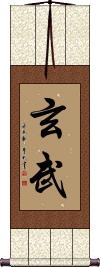
玄武 can refer to the Black Tortoise (an ancient Chinese constellation of stars- part of the seven mansions of the north sky).
In Daoism, this is the God of the North sky.
This also refers to a Black Tortoise god, said to rule over the northern heavens in Japanese. Can also be pronounced/romanized as genmu or when used as a personal name, Hirotake in Japanese.
Rule

魯爾 is the name Rule in Chinese (Mandarin).
Golden Rule
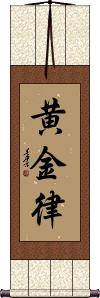
黄金律 is “The Golden Rule” in Japanese.
It's understood to mean “do unto others as you would have them do unto you.”
Way of Life / Art of Life
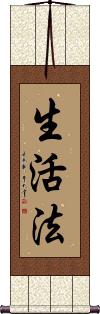
生活法 is a Japanese and Chinese title meaning “art of living” or “way of life.”
This can also be translated in a few other ways, such as “rule of life” and “the act of living.”
The “art” title kind of comes from the fact that the last character is the same as the book, “The Art of War.” So when you write your book, this is the title for “The Art of Life,” in Chinese and Japanese.
Rule

ルール is the name Rule in Japanese Katakana.
Note: Because this title is entirely Japanese Katakana, it should be written by a Japanese calligrapher.
Unbridled Creativity
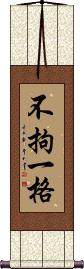
不拘一格 is a Chinese proverb that speaks of exploring different styles and not being stuck in conventional thinking.
It can also be translated as “not sticking to one pattern” or “not limited to one type (or style).” The most simple translation is “being creative” or “unbridled creativity.” Some may also say this means “not being stuck in a rut,” in the context of a designer or artist.
If you translate this, the first two characters mean “not stick to” or “not confine oneself to.”
The second two characters mean “one mode,” “one pattern,” “one form,” “one style,” or “one rule.”
Indomitable / Unyielding
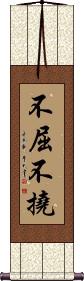
不屈不撓 means “Indomitable” or “Unyielding.”
不屈不撓 is a long word by Chinese standards. At least, it is often translated as a single word into English. It's actually a proverb in Chinese.
If you want to break it down, you can see that the first and third characters are the same. Both mean “not” (they work as a suffix to make a negative or opposite meaning to whatever character follows).
The second character means “bendable.”
The last means “scratched” or “bothered.”
So this really means “Won't be bent, can't be bothered.” I have also seen it written as “Will not crouch, will not submit.” This comes from the fact that the second character can mean “to crouch” and the last can mean “to submit” (as in “to give in” such as “submitting to the rule of someone else”). This may explain better why these four characters mean “indomitable.”
Notes:
Some will translate this as “indomitable spirit”; however, technically, there is no character to suggest the idea of “spirit” in this word.
Other translations include indefatigability, indomitableness, or unremitting tenacity.
The first two characters can be stand-alone words in Chinese.
In Japanese, this is considered two words (with very similar meanings). It's more common to see the word order flipped to 不撓不屈 in Japanese.
The same characters are used in old Korean Hanja. Just like in Japanese, the words are swapped to 不撓不屈 creating a word pronounced “불요불굴” in Korean.
See 不撓不屈
Mixed Martial Arts
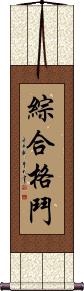
綜合格鬥 is a common Chinese title for “Mixed Martial Arts” or “MMA.”
The characters or words in this title break down this way:
綜合 zōng hé = composite, synthesized, to sum up, to integrate, and/or to synthesize.
格 gé = style, frame, or rule.
斗 dòu = fight, to battle, or to struggle.
Code Of Silence

沉默法則 means “The Code Of Silence” or "The Rule of Silence” in Chinese.
The Five Tenets of Confucius
The Five Cardinal Rules / Virtues of Confucius
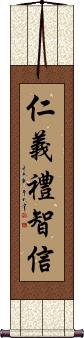
仁義禮智信 are the core of Confucius's philosophy.
Simply stated:
仁 = Benevolence / Charity
義 = Justice / Rectitude
禮 = Courtesy / Politeness / Tact
智 = Wisdom / Knowledge
信 = Fidelity / Trust / Sincerity
Many of these concepts can be found in various religious teachings. It should be clearly understood that Confucianism is not a religion but should instead be considered a moral code for a proper and civilized society.
This title is also labeled “5 Confucian virtues.”
 If you order this from the Japanese calligrapher, expect the middle Kanji to be written in a more simple form (as seen to the right). This can also be romanized as "jin gi rei satoshi shin" in Japanese. Not all Japanese will recognize this as Confucian tenets but they will know all the meanings of the characters.
See Also: Confucius Teachings | Ethics
Confucius: Golden Rule / Ethic of Reciprocity
Do not do to others what you do not want done to yourself
Some may think of this as a “Christian trait,” but actually, it transcends many religions.
This Chinese teaching dates back to about 2,500 years ago in China. Confucius had always taught the belief in being benevolent (ren), but this idea was hard to grasp for some of his students, as benevolence could be kind-heartedness or an essence of humanity itself.
When answering Zhong Gong's question as to what "ren" actually meant, Confucius said:
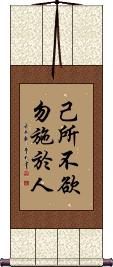
己所不欲勿施于人 or "When you go out, you should behave as if you were in the presence of a distinguished guest; when people do favors for you, act as if a great sacrifice was made for you. Whatever you wouldn't like done to you, do not do that thing to others. Don't complain at work or home.”
Hearing this, Zhong Gong said humbly, “Although I am not clever, I will do what you say.”
From this encounter, the Chinese version of the “Golden Rule” or “Ethic of Reciprocity” came to be.
The characters you see above express, “Do not do to others whatever you do not want to be done to yourself.”
See Also: Confucius Teachings | Benevolence
Listen to Both Sides and be Enlightened, Listen to One Side and be in the Dark
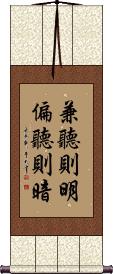
兼聽則明偏聽則暗 is an ancient Chinese proverb about getting all the information from all sides so that you truly understand a situation.
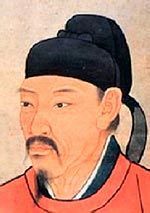
Wei Zheng
A man named Wei Zheng lived between 580-643 AD. He was a noble and wise historian and minister in the court of the early Tang Dynasty. The emperor once asked him, “What should an emperor do to understand the real-world situation, and what makes an emperor out-of-touch with reality?”
Wei Zheng replied, “Listen to both sides and you will be enlightened; listen to only one side and you will be left in the dark.”
Then Wei Zheng went on to cite examples of leaders in history that were victorious after heeding both sides of the story, and other leaders that met their doom because they believed one-sided stories which often came from flattering lips.
Please note that there is an unwritten rule when the same character appears twice in the same phrase, the calligrapher will alter the appearance so that no two characters are exactly alike in the same piece. This calligraphy has two repeating characters that will be written differently than they appear here.
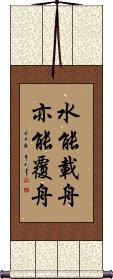
Not Only Can Water Float A Boat, It Can Sink It Also
Many things have opposite properties. The water you drink can also drown you. Pork may nourish you and keep you alive but under-cook it and it could kill you. Potassium nitrate is often used as a fertilizer to grow the food that sustains us but it's also been used as an explosive to topple buildings and destroy us.
This concept is easily associated with “yin yang” where an element has two opposite properties that are as different as night and day.
This proverb's meaning can be summed up this way: “Anything that can lead you to success may also contain great risks.”
This phrase is known in literary circles by Korean people (scholars or literature). It is therefore also a valid proverb in Korean Hanja, though most Koreans would not be able to make sense of it.
Please note that there is an unwritten rule when the same character appears twice in the same phrase, the calligrapher will alter the appearance so that no two characters are exactly alike in the same piece. This calligraphy has two repeating characters that will be written differently than they appear here.
The following table may be helpful for those studying Chinese or Japanese...
| Title | Characters | Romaji (Romanized Japanese) | Various forms of Romanized Chinese | |
| Seven Rules of Happiness | 幸福の七カ條 幸福の七カ条 | kou fuku no nana ka jou koufukunonanakajou ko fuku no nana ka jo | ||
| My Life, My Rules | 我的生活我做主 | wǒ de shēng huó wǒ zuò zhǔ wo3 de sheng1 huo2 wo3 zuo4 zhu3 wo de sheng huo wo zuo zhu wodeshenghuowozuozhu | wo te sheng huo wo tso chu woteshenghuowotsochu |
|
| Ten perfect Mahayana rules | 十法 | jippou / jipo | shí fǎ / shi2 fa3 / shi fa / shifa | shih fa / shihfa |
| Dojo Kun | 道場訓 道場训 | dou jou kun doujoukun do jo kun | ||
| Ritsu | 律 | ritsu | lǜ / lu:4 / lu: | lü |
| Suzaku | 朱雀 | suzaku | zhū què / zhu1 que4 / zhu que / zhuque | chu ch`üeh / chuchüeh / chu chüeh |
| Principles of Life | 生活信條 生活信条 | shēng huó xìn tiáo sheng1 huo2 xin4 tiao2 sheng huo xin tiao shenghuoxintiao | sheng huo hsin t`iao shenghuohsintiao sheng huo hsin tiao |
|
| Discipline | 規律 规律 | kiritsu | guī / gui1 lu:4 / gui lu: / guilu: | kuei lü / kueilü |
| State of Anarchy | 無警察 无警察 | mukeisatsu | wú jíng chá wu2 jing2 cha2 wu jing cha wujingcha | wu ching ch`a wuchingcha wu ching cha |
| Duty to Defend and Protect Country | 守土有責 守土有责 | shǒu tǔ yǒu zé shou3 tu3 you3 ze2 shou tu you ze shoutuyouze | shou t`u yu tse shoutuyutse shou tu yu tse |
|
| American Football | 美式橄欖球 美式橄榄球 | měi shì gǎn lǎn qiú mei3 shi4 gan3 lan3 qiu2 mei shi gan lan qiu meishiganlanqiu | mei shih kan lan ch`iu meishihkanlanchiu mei shih kan lan chiu |
|
| Dignity Honor Sanctity Integrity | 尊嚴 尊严 / 尊厳 | son gen / songen | zūn yán / zun1 yan2 / zun yan / zunyan | tsun yen / tsunyen |
| White Tiger | 白虎 | byakko / hakko byako / hako | bái hǔ / bai2 hu3 / bai hu / baihu | pai hu / paihu |
| Cooperation Collaboration | 協作 协作 | kyou saku / kyousaku / kyo saku | xié zuò / xie2 zuo4 / xie zuo / xiezuo | hsieh tso / hsiehtso |
| Respect | 禮 礼 | rei | lǐ / li3 / li | |
| Kenjutsu Kenjitsu | 剣術 剑术 | kenjutsu | jiàn shù / jian4 shu4 / jian shu / jianshu | chien shu / chienshu |
| Daodejing Tao Te Ching - Chapter 27 | 善行無轍跡善言無瑕謫善數不用籌策善閉無關鍵而不可開善結無繩約而不可解是以聖人常善救人故無棄人常善救物故無棄物是謂襲明故善人者不善人之師不善人者善人之資不貴其師不愛其資雖智大迷是謂要妙 善行无辙迹善言无瑕谪善数不用筹策善闭无关键而不可开善结无绳约而不可解是以圣人常善救人故无弃人常善救物故无弃物是谓袭明故善人者不善人之师不善人者善人之资不贵其师不爱其资虽智大迷是谓要妙 | shàn xíng wú zhé jì shàn yán wú xiá zhé shàn shù bù yòng chóu cè shàn bì wú guān jiàn ér bù kě kāi shàn jié wú shéng yuē ér bù kě jiě shì yǐ shèng rén cháng shàn jiù rén gù wú qì rén cháng shàn jiù wù gù wú qì wù shì wèi xí míng gù shàn rén zhě bù shàn rén zhī shī bù shàn rén zhě shàn rén zhī zī bù guì qí shī bù ài qí zī suī zhì dà mí shì wèi yào miào shan4 xing2 wu2 zhe2 ji4 shan4 yan2 wu2 xia2 zhe2 shan4 shu4 bu4 yong4 chou2 ce4 shan4 bi4 wu2 guan1 jian4 er2 bu4 ke3 kai1 shan4 jie2 wu2 sheng2 yue1 er2 bu4 ke3 jie3 shi4 yi3 sheng4 ren2 chang2 shan4 jiu4 ren2 gu4 wu2 qi4 ren2 chang2 shan4 jiu4 wu4 gu4 wu2 qi4 wu4 shi4 wei4 xi2 ming2 gu4 shan4 ren2 zhe3 bu4 shan4 ren2 zhi1 shi1 bu4 shan4 ren2 zhe3 shan4 ren2 zhi1 zi1 bu4 gui4 qi2 shi1 bu4 ai4 qi2 zi1 sui1 zhi4 da4 mi2 shi4 wei4 yao4 miao4 shan xing wu zhe ji shan yan wu xia zhe shan shu bu yong chou ce shan bi wu guan jian er bu ke kai shan jie wu sheng yue er bu ke jie shi yi sheng ren chang shan jiu ren gu wu qi ren chang shan jiu wu gu wu qi wu shi wei xi ming gu shan ren zhe bu shan ren zhi shi bu shan ren zhe shan ren zhi zi bu gui qi shi bu ai qi zi sui zhi da mi shi wei yao miao | shan hsing wu che chi shan yen wu hsia che shan shu pu yung ch`ou ts`e shan pi wu kuan chien erh pu k`o k`ai shan chieh wu sheng yüeh erh pu k`o chieh shih i sheng jen ch`ang shan chiu jen ku wu ch`i jen ch`ang shan chiu wu ku wu ch`i wu shih wei hsi ming ku shan jen che pu shan jen chih shih pu shan jen che shan jen chih tzu pu kuei ch`i shih pu ai ch`i tzu sui chih ta mi shih wei yao miao shan hsing wu che chi shan yen wu hsia che shan shu pu yung chou tse shan pi wu kuan chien erh pu ko kai shan chieh wu sheng yüeh erh pu ko chieh shih i sheng jen chang shan chiu jen ku wu chi jen chang shan chiu wu ku wu chi wu shih wei hsi ming ku shan jen che pu shan jen chih shih pu shan jen che shan jen chih tzu pu kuei chi shih pu ai chi tzu sui chih ta mi shih wei yao miao |
|
| Qi Gong Chi Kung | 氣功 气功 | ki kou / kikou / ki ko | qì gōng / qi4 gong1 / qi gong / qigong | ch`i kung / chikung / chi kung |
| Art of War: 5 Points of Analysis | 道天地將法 道天地将法 | dou ten chi shou hou doutenchishouhou do ten chi sho ho | dào tiān dì jiàng fǎ dao4 tian1 di4 jiang4 fa3 dao tian di jiang fa daotiandijiangfa | tao t`ien ti chiang fa taotientichiangfa tao tien ti chiang fa |
| Kenpo Kempo Quan Fa Chuan Fa | 拳法 | kenpou / kenpo | quán fǎ / quan2 fa3 / quan fa / quanfa | ch`üan fa / chüanfa / chüan fa |
| Science Universal Law | 理 | kotowari | lǐ / li3 / li | |
| Kung Fu Gong Fu | 功夫 | kan fu / ku fu kanfu / kufu | gōng fu / gong1 fu / gong fu / gongfu | kung fu / kungfu |
| Xuan Wu Genbu Black Tortoise God | 玄武 | genbu | xuán wǔ / xuan2 wu3 / xuan wu / xuanwu | hsüan wu / hsüanwu |
| Rule | 魯爾 鲁尔 | lǔ ěr / lu3 er3 / lu er / luer | lu erh / luerh | |
| Golden Rule | 黄金律 | ougonritsu / ogonritsu | ||
| Way of Life Art of Life | 生活法 | seikatsuhou seikatsuho | shēng huó fǎ sheng1 huo2 fa3 sheng huo fa shenghuofa | |
| Rule | ルール | ruuru / ruru | ||
| Unbridled Creativity | 不拘一格 | bù jū yī gé bu4 ju1 yi1 ge2 bu ju yi ge bujuyige | pu chü i ko puchüiko |
|
| Indomitable Unyielding | 不屈不撓 不屈不挠 | fu kutsu fu tou fukutsufutou fu kutsu fu to | bù qū bù náo bu4 qu1 bu4 nao2 bu qu bu nao buqubunao | pu ch`ü pu nao puchüpunao pu chü pu nao |
| Mixed Martial Arts | 綜合格鬥 综合格斗 | zōng hé gé dòu zong1 he2 ge2 dou4 zong he ge dou zonghegedou | tsung ho ko tou tsunghokotou |
|
| Code Of Silence | 沉默法則 沉默法则 | chén mò fǎ zé chen2 mo4 fa3 ze2 chen mo fa ze chenmofaze | ch`en mo fa tse chenmofatse chen mo fa tse |
|
| The Five Tenets of Confucius | 仁義禮智信 仁义礼智信 | jin gi rei tomo nobu jingireitomonobu | rén yì lǐ zhì xìn ren2 yi4 li3 zhi4 xin4 ren yi li zhi xin renyilizhixin | jen i li chih hsin jenilichihhsin |
| Confucius: Golden Rule Ethic of Reciprocity | 己所不欲勿施於人 己所不欲勿施于人 | jǐ suǒ bú yù wù shī yú rén ji3 suo3 bu2 yu4, wu4 shi1 yu2 ren2 ji suo bu yu, wu shi yu ren jisuobuyu,wushiyuren | chi so pu yü, wu shih yü jen chisopuyü,wushihyüjen |
|
| Listen to Both Sides and be Enlightened, Listen to One Side and be in the Dark | 兼聽則明偏聽則暗 兼听则明偏听则暗 | jiān tīng zé míng, piān tīng zé àn jian1 ting1 ze2 ming2, pian1 ting1 ze2 an4 jian ting ze ming, pian ting ze an | chien t`ing tse ming, p`ien t`ing tse an chien ting tse ming, pien ting tse an |
|
| Not Only Can Water Float A Boat, It Can Sink It Also | 水能載舟亦能覆舟 水能载舟亦能覆舟 | shuǐ néng zài zhōu yì néng fù zhōu shui3 neng2 zai4 zhou1 yi4 neng2 fu4 zhou1 shui neng zai zhou yi neng fu zhou | shui neng tsai chou i neng fu chou | |
| In some entries above you will see that characters have different versions above and below a line. In these cases, the characters above the line are Traditional Chinese, while the ones below are Simplified Chinese. | ||||

Successful Chinese Character and Japanese Kanji calligraphy searches within the last few hours...



