Many custom options...


And formats...



Room in Chinese / Japanese...
Buy a Room calligraphy wall scroll here!
Personalize your custom “Room” project by clicking the button next to your favorite “Room” title below...
1. The Whole Room Rocks With Laughter
2. Roar of Laughter / Big Laughs
3. Inner Peace / Silence / Serenity
5. Jikata
6. Peacefulness / Tranquility / Perfectly Quiet
8. Kobukan
10. Baby
11. Purity
12. Dojo / Martial Arts Studio
14. Reach Peace and Calm Through Meditation
16. Wellness
17. Radiance
18. Chess
19. Daodejing / Tao Te Ching - Chapter 9
20. Student
21. Bruce Lee
The Whole Room Rocks With Laughter
The perfect scroll if you love humor or as a gift for the comedian in your life
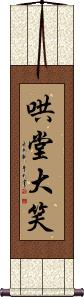
In China, 哄堂大笑 is a proverb that is used in response to a good joke or witty comment.
The story goes that Mr. Feng and Mr. He were both senior officials in the Song Dynasty (about a thousand years ago). One day, Mr. Feng walked into their shared office wearing a new pair of boots. The boots caught the eye of Mr. He who said, “New boots! - how much were they?.” Mr. Feng lifted one of the boots off the ground as if to show it off and responded, “900 coins.”
Astonished, Mr. Feng explained, “900? How can that be? - I paid 1800 coins for my boots!.” Mr. Feng then lifted his other foot off the ground and said, “This boot was also 900 coins.”
It is said that the whole room was shaking from the laughter of all that heard Mr. Feng's joke on Mr. He.
Roar of Laughter / Big Laughs
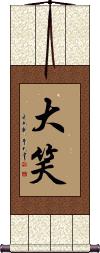
大笑 can be translated as “roar of laughter,” “loud laughter,” “hearty laugh,” or “cachinnation.”
The first character means big or great, and the second means to laugh or smile.
If you like humor, this is a great wall scroll to hang in your home.
See Also: The Whole Room Rocks With Laughter
Inner Peace / Silence / Serenity
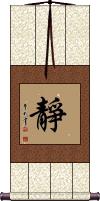
靜 is the simplest way to convey the meaning of inner peace and serenity.
靜 is often translated as “serenity.” It can also be used to express the ideas of still, calm, serene, quiet, silent, stillness, not moving, or tranquility.
In the old days, Chinese, Japanese, or Korean people might hang a wall scroll with this character in their reading room to bring about a sense of peace in the room.
 While they once used the same character form in Japan, they now use a slightly-simplified version in modern Japan (after WWII). This version is shown to the right, and can be selected for your wall scroll by clicking on that Kanji instead of the button above.
See Also: Peace
Sit Quietly in Meditation
A state of mind
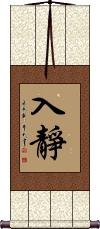
入靜 is used in Taoism and Qi Gong to describe the state you can reach while sitting quietly in meditation. It contains the idea of achieving a highly-tranquil and peaceful state. Some may describe this state as “sleeping while still awake.”
If you have a relaxation or meditation room, this is the calming wall scroll that you would want hanging in that room.
Jikata

This word has a few possible meanings.
It can refer to a room, hall, or place (a dojo or small theater). The dictionary suggests that in some context, this can refer to a special geisha who is talented in certain musical arts.
Peacefulness / Tranquility / Perfectly Quiet
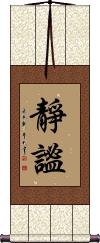
Gojukan / Goju-Kan
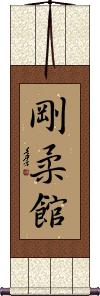
剛柔館 is the martial arts style Gojukan or Goju-Kan.
The meaning is “hardness [and] softness hall.”
剛 = Hard, firm, or strong.
柔 = Soft, softness, flexible, supple, yielding, gentleness, or pliant.
館 = Hall, building, school room, or an alternate word for a dojo.
Kobukan
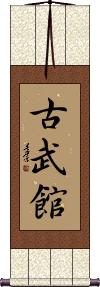
古武館 is the martial arts style Kobukan or Kobu-Kan.
The meaning is “ancient warrior hall.”
古 = Old, ancient, antique, or paleo-
武 = Martial, warrior, or military.
館 = Hall, building, school room, or an alternate word for a dojo.
Okinawan Goju-Kan
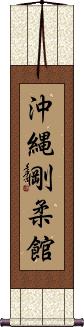
沖縄剛柔館 is the martial arts style Okinawan Gojukan or Okinawan Goju-Kan.
The meaning is “Okinawa hardness [and] softness hall.”
沖縄 = Okinawa.
剛 = Hard, firm, or strong.
柔 = Soft, softness, flexible, supple, yielding, gentleness, or pliant.
館 = Hall, building, school room, or an alternate word for a dojo.
Baby
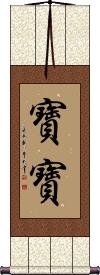
寶寶 is how Chinese people express “baby.”
The word is composed of the same character twice, and therefore literally means “double precious” or “double treasure.”
This would be a nice wall scroll to put either inside or by the door of your baby's room (not on the door, as wall scrolls swing around wildly when hung on doors that open and close a lot).
Purity
Clean and Pure
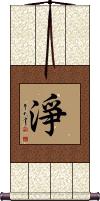
淨 is the most simple way to express purity or cleanliness in Chinese, Japanese Kanji, and old Korean Hanja.
As a single character, the concept is broad: This can be a verb (the act of cleaning, purifying, or cleansing) but it can also be the state of being clean, pure, and chaste. In some contexts, it can be a place to clean (like a bathing room for the soul in a Buddhist context). In Japanese, this can be a female given name “Jou” or “jō” (the Japanese equivalent of the English girl's name “Chastity”).
Dojo / Martial Arts Studio
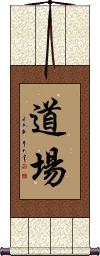
道場 is the Japanese term for a room or hall in which martial arts are taught.
道場 is often spelled “dojo” which has become a word in the English lexicon. However, the true Romaji is doujou or dōjō.
Please note: The Chinese definition of these characters is quite different. In Chinese, this is a place where Buddhist or Taoist mass is held. It could also be a place where spiritual or psychic events are performed.
God Is With You Always
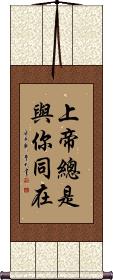
I was going to write this phrase as “God is with me always” but as a wall scroll, hanging in your room, it is talking to you (you're not talking), so it works better with you.
上帝總是與你同在 is a nice phrase that any Chinese Christian would enjoy on his/her wall.
If I annotate this, it sounds a little strange in English but it's perfectly natural in Chinese:
上帝 God | 总是 always | 与 and | 你 you | 同 together | 在 existing
Reach Peace and Calm Through Meditation
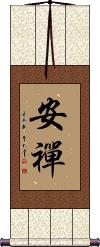
安禪 creates a title that means to reach peace and calm through meditation.
安禪 is an excellent wall scroll for your relaxation or meditation room.
This is also a Buddhist-related term that encompasses the idea of entering into dhyana meditation.
This is also used in Japanese, but in modern times, the second character has changed, so it's 安禅 now. If you want the modern Japanese version, just choose a Japanese calligrapher, and let me know when you place your order.
Wing Chun Fist Maxims (Part 1)
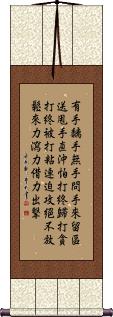
A customer asked me to split these Wing Chun maxims into two parts, so he could order a couplet. I thought this was a good idea, so it's been added here.
1 有手黐手,無手問手
2 來留區送, 甩手直沖
3 怕打終歸打, 貪打終被打
4 粘連迫攻, 絕不放鬆
5 來力瀉力, 借力出擊
A couplet is a set of two wall scrolls that start and finish one phrase or idea. Often, couplets are hung with the first wall scroll on the right side, and the second on the left side of a doorway or entrance. The order in Chinese is right-to-left, so that's why the first wall scroll goes on the right as you face the door.
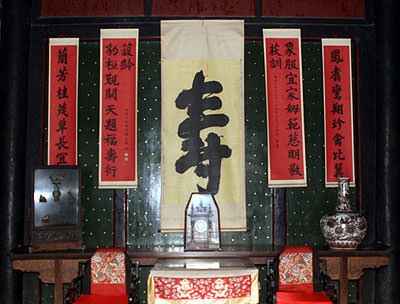
Of course, couplets can also be hung together on a wall. Often they can be hung to flank an altar, or table with incense, or even flanking a larger central wall scroll. See an example here from the home of Confucius
Be sure to order both parts 1 and 2 together. One without the other is like Eve without Adam.
Wellness
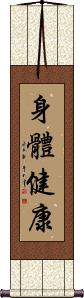
身體健康 is how to express “wellness” in Chinese. The meaning is not much different than the idea of “good health.” The first two characters alone are often translated as “health.” Some will also translate this title as “physical health.”
If you want to fill your room with a feeling of wellness, this is the wall scroll for you.
This is also the ancient way to express wellness in Japanese Kanji and old Korean Hanja. The modern Japanese form is 身体健康 (the only difference is the second Kanji). Let me know if you need your calligraphy written in modern Japanese.
Radiance
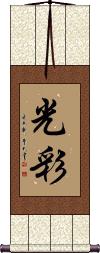
光彩 is the Chinese, Japanese Kanji, and old Korean Hanja for radiance.
Other meanings include luster, splendor/splendour, and brilliance.
光彩 is the radiance you see when a person's arrival brings happiness and joy to the room. Or the radiance on the face of a new bride etc.
If you delve into the dictionary, other forms of radiance will refer to isotopes emitting radiation. 光彩 is not related to radiation and is not the kind that causes cancer.
In Japanese, this can be several female given names such as Misa, Hikari, Hiiro, Teresa, or Arisa. And a more unisex given name of Kousai or Kosai.
Chess
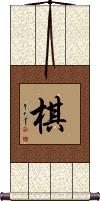
棋 is the most simple or generic way to write “chess” in Asia.
棋 is part of other more specific words for board games of strategy such as the western version of chess, Chinese chess, Weiqi, or Go.
In Japanese, this single character is pronounced “Go” and often refers to the game known in the west as “Go” (not just the 5-in-a-row version but also the complicated encirclement game of strategy known in China as Weiqi).
In Chinese, this can be more ambiguous as to which game of chess you speak.
If you like any version of chess, or games of intense strategy, this can be the character to hang on the wall in your game room.
Daodejing / Tao Te Ching - Chapter 9
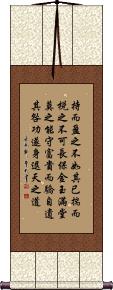
This text is the ninth chapter of the Daodejing / Tao Te Ching.
To hold until full is not as good as stopping.
An oversharpened sword cannot last long.
A room filled with gold and jewels cannot be protected.
Boasting of wealth and virtue brings your demise.
After finishing the work, withdraw.
持而盈之不如其已揣而梲之不可長保金玉滿堂莫之能守富貴而驕自遺其咎功遂身退天之道 is the Way of Heaven.
Dr. Muller's translation of all 81 Daodejing chapters
The text reads:
持而盈之、不如其已。揣而梲之、不可長保。 金玉滿堂、莫之能守。 富貴而驕、自遺其咎。 功遂身退、天之道。
This classical Chinese passage comes from the Mawangdui (馬王堆帛書) text.
Student
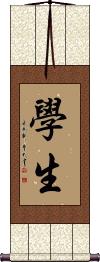
學生 is how to write “student” in Chinese, pre-WWII Japanese Kanji, and old Korean Hanja.
If you are a “student of life,” this might be an interesting wall scroll to hang in your reading room.
The first character means “study” or “learning.”
The second character means “life” or “birth.” Don't read too much into that second character unless you decide that this means “the birth of studies” or “the life of learning.” Everyone in China, Japan (and those who can read Hanja in Korea) will just read this word with the meaning of “student.”
If you put the character for “little” in front of this word, it becomes “elementary school student.” Prefixed with “middle,” it becomes “middle school student.” Prefixed with “big,” it becomes “university student” (though when these two characters for student are seen alone, it often suggests “university student”). The term “high school student” is written differently.
 There is a very common simplified version of the first character for this word. You will see this form in modern Japan and mainland China, Singapore, and other places. If you want this simplified version, please click on the character shown to the right instead of the "select and customize" button above.
Bruce Lee
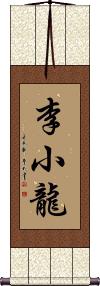
李小龍 is the real full name of Bruce Lee.
 Many people have no idea that Bruce Lee had a “real” Chinese name. In Mandarin and Cantonese, he is known as “Lǐ XiǎoLóng” and “Léi SíuLùng” respectively.
He kept his family name pronunciation (Li = Lee). 李 is a common family name that also means “plum.”
His given name 小龍 (Xiao-Long), literally means “little dragon.” 李小龍 is why you often see the character for dragon associated with Bruce Lee on various posters etc.
For a pronunciation lesson, the “X” in Romanized Mandarin is pronounced like a “sh” sound but with your tongue at the bottom of your mouth. The vowel sound in “Long” is like the English “oh,” not like the “ah” sound in the English word “long.”
If you are a big Bruce Lee fan, you should know this information, and you should have this wall scroll hanging in your room or martial arts studio.
Note: Japanese use these same Chinese characters / Kanji to write Bruce Lee's real name (with different pronunciation - which is a bit like how the name “Bruce Lee” sounds in English).
See Also: Kung Fu | Martial Arts
This in-stock artwork might be what you are looking for, and ships right away...

Gallery Price: $300.00
Your Price: $138.88

Gallery Price: $108.00
Your Price: $59.88
Gallery Price: $300.00
Your Price: $138.88
Gallery Price: $286.00
Your Price: $158.88
Gallery Price: $130.00
Your Price: $84.88
Gallery Price: $144.00
Your Price: $79.88
These search terms might be related to Room:
Crisis Equals Danger Plus Opportunity?
Fate / Opportunity / Chance
Opportunity
Opportunity / Good Luck
Opportunity Knocks Only Once
Sky / Air / Ether / Space
Universe / Space
The following table may be helpful for those studying Chinese or Japanese...
| Title | Characters | Romaji (Romanized Japanese) | Various forms of Romanized Chinese | |
| The Whole Room Rocks With Laughter | 哄堂大笑 | hōng tāng dà xiào hong1 tang1 da4 xiao4 hong tang da xiao hongtangdaxiao | hung t`ang ta hsiao hungtangtahsiao hung tang ta hsiao |
|
| Roar of Laughter Big Laughs | 大笑 | taishou / taisho | dà xiào / da4 xiao4 / da xiao / daxiao | ta hsiao / tahsiao |
| Inner Peace Silence Serenity | 靜 静 | shizu / sei | jìng / jing4 / jing | ching |
| Sit Quietly in Meditation | 入靜 入静 | rù jìng / ru4 jing4 / ru jing / rujing | ju ching / juching | |
| Jikata | 地方 | jikata | dì fāng / di4 fang1 / di fang / difang | ti fang / tifang |
| Peacefulness Tranquility Perfectly Quiet | 靜謐 静谧 | seihitsu | jìng mì / jing4 mi4 / jing mi / jingmi | ching mi / chingmi |
| Gojukan Goju-Kan | 剛柔館 刚柔馆 | gou juu kan goujuukan go ju kan | ||
| Kobukan | 古武館 古武馆 | ko bu kan / kobukan | ||
| Okinawan Goju-Kan | 沖縄剛柔館 沖縄刚柔馆 | okinawa gou juu kan okinawagoujuukan okinawa go ju kan | ||
| Baby | 寶寶 宝宝 | bǎo bao / bao3 bao / bao bao / baobao | pao pao / paopao | |
| Purity | 淨 | jou / jo | jìng / jing4 / jing | ching |
| Dojo Martial Arts Studio | 道場 道场 | dou jou / doujou / do jo | dào cháng dao4 chang2 dao chang daochang | tao ch`ang taochang tao chang |
| God Is With You Always | 上帝總是與你同在 上帝总是与你同在 | shàn dì zǒng shì yǔ nǐ tóng zài shan4 di4 zong3 shi4 yu3 ni3 tong2 zai4 shan di zong shi yu ni tong zai shandizongshiyunitongzai | shan ti tsung shih yü ni t`ung tsai shan ti tsung shih yü ni tung tsai |
|
| Reach Peace and Calm Through Meditation | 安禪 安禅 | an zen / anzen | ān chán / an1 chan2 / an chan / anchan | an ch`an / anchan / an chan |
| Wing Chun Fist Maxims (Part 1) | 有手黐手無手問手來留區送甩手直沖怕打終歸打貪打終被打粘連迫攻絕不放鬆來力瀉力借力出擊 有手黐手无手问手来留区送甩手直冲怕打终归打贪打终被打粘连迫攻绝不放松来力泻力借力出击 | |||
| Wellness | 身體健康 身体健康 | shin tai ken kou shintaikenkou shin tai ken ko | shēn tǐ jiàn kāng shen1 ti3 jian4 kang1 shen ti jian kang shentijiankang | shen t`i chien k`ang shentichienkang shen ti chien kang |
| Radiance | 光彩 | kousai / kosai | guāng cǎi guang1 cai3 guang cai guangcai | kuang ts`ai kuangtsai kuang tsai |
| Chess | 棋 | go | qí / qi2 / qi | ch`i / chi |
| Daodejing Tao Te Ching - Chapter 9 | 持而盈之不如其已揣而梲之不可長保金玉滿堂莫之能守富貴而驕自遺其咎功遂身退天之道 持而盈之不如其已揣而梲之不可长保金玉满堂莫之能守富贵而骄自遗其咎功遂身退天之道 | chí ér yíng zhī bù rú qí yǐ chuǎi ér zhī bù kě cháng bǎo jīn yù mǎn táng mò zhī néng shǒu fù guì ér jiāo zì yí qí jiù gōng suì shēn tuì tiān zhī dào chi2 er2 ying2 zhi1 bu4 ru2 qi2 yi3 chuai3 er2 棁 zhi1 bu4 ke3 chang2 bao3 jin1 yu4 man3 tang2 mo4 zhi1 neng2 shou3 fu4 gui4 er2 jiao1 zi4 yi2 qi2 jiu4 gong1 sui4 shen1 tui4 tian1 zhi1 dao4 chi er ying zhi bu ru qi yi chuai er 棁 zhi bu ke chang bao jin yu man tang mo zhi neng shou fu gui er jiao zi yi qi jiu gong sui shen tui tian zhi dao | ch`ih erh ying chih pu ju ch`i i ch`uai erh chih pu k`o ch`ang pao chin yü man t`ang mo chih neng shou fu kuei erh chiao tzu i ch`i chiu kung sui shen t`ui t`ien chih tao chih erh ying chih pu ju chi i chuai erh chih pu ko chang pao chin yü man tang mo chih neng shou fu kuei erh chiao tzu i chi chiu kung sui shen tui tien chih tao |
|
| Student | 學生 学生 | gakusei | xué shēng xue2 sheng1 xue sheng xuesheng | hsüeh sheng hsüehsheng |
| Bruce Lee | 李小龍 李小龙 | bu ruu su ri buruusuri bu ru su ri | lǐ xiǎo lóng li3 xiao3 long2 li xiao long lixiaolong | li hsiao lung lihsiaolung |
| In some entries above you will see that characters have different versions above and below a line. In these cases, the characters above the line are Traditional Chinese, while the ones below are Simplified Chinese. | ||||

Successful Chinese Character and Japanese Kanji calligraphy searches within the last few hours...