Many custom options...


And formats...



Retreats in Chinese / Japanese...
Buy a Retreats calligraphy wall scroll here!
The one who retreats 50 paces mocks the one to retreats 100
The pot calls the kettle black
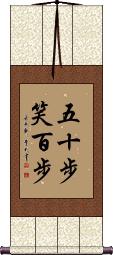
五十步笑百步 is a Chinese proverb that means the one who retreats 50 paces mocks the one who retreats 100 paces.
During the Warring States Period of what is now China (475 - 221 B.C.), the King of Wei was in love with war. He often fought with other kingdoms just for spite or fun.
One day, the King of Wei asked the philosopher Mencius, “I love my people, and all say I do the best for them. I move the people from famine-stricken areas to places of plenty and transport grains from rich areas to the poor. Nobody goes hungry in my kingdom, and I treat my people far better than other kings. But why does the population of my kingdom not increase, and why does the population of other kingdoms not decrease?”
Mencius answered, “Since you love war, I will make this example: When going to war, and the drums beat to start the attack, some soldiers flee for their lives in fear. Some run 100 paces in retreat, and others run 50 steps. Then the ones who retreated 50 paces laugh and taunt those who retreated 100 paces, calling them cowards mortally afraid of death. Do you think this is reasonable?
The King of Wei answered, “Of course not! Those who run 50 paces are just as timid as those who run 100 paces.”
Mencius then said, “You are a king who treats his subjects better than other kings treat their people, but you are so fond of war that your people suffer from great losses in battle. Therefore, your population does not grow. While other kings allow their people to starve to death, you send your people to die in war. Is there any difference?”
This famous conversation led to the six-character proverb shown here. It serves as a warning to avoid hypocrisy. It goes hand-in-hand with the western phrase, “The pot calls the kettle black,” or the Biblical phrase, “Before trying to remove a splinter from your neighbor's eye, first remove the plank from your own eye.”
Not the results for Retreats that you were looking for?
Below are some entries from our dictionary that may match your Retreats search...
| Characters If shown, 2nd row is Simp. Chinese |
Pronunciation Romanization |
Simple Dictionary Definition |
解間 解间 see styles |
jiě jiān jie3 jian1 chieh chien geai |
between retreats |
夏安居 see styles |
xià ān jū xia4 an1 ju1 hsia an chü geango げあんご |
{Buddh} summer retreat where monks stay in the same place to study summer retreats during the rainy season |
十六字訣 十六字诀 see styles |
shí liù zì jué shi2 liu4 zi4 jue2 shih liu tzu chüeh |
16-character formula, esp. Mao Zedong's mantra on guerrilla warfare: 敵進我退,敵駐我擾,敵疲我打,敵退我追|敌进我退,敌驻我扰,敌疲我打,敌退我追[di2 jin4 wo3 tui4 , di2 zhu4 wo3 rao3 , di2 pi2 wo3 da3 , di2 tui4 wo3 zhui1] when the enemy advances we retreat; when the enemy makes camp we harass; when the enemy is exhausted we fight; and when the enemy retreats we pursue |
結夏安居 结夏安居 see styles |
jié xià ān jū jie2 xia4 an1 ju1 chieh hsia an chü ketsuge ango |
summer retreats during the rainy season |
The following table may be helpful for those studying Chinese or Japanese...
| Title | Characters | Romaji (Romanized Japanese) | Various forms of Romanized Chinese | |
| The one who retreats 50 paces mocks the one to retreats 100 | 五十步笑百步 | wù shí bù xiào bǎi bù wu4 shi2 bu4 xiao4 bai3 bu4 wu shi bu xiao bai bu wushibuxiaobaibu | wu shih pu hsiao pai pu wushihpuhsiaopaipu |
|

Successful Chinese Character and Japanese Kanji calligraphy searches within the last few hours...



