Many custom options...


And formats...



Retreat in Chinese / Japanese...
Buy a Retreat calligraphy wall scroll here!
Personalize your custom “Retreat” project by clicking the button next to your favorite “Retreat” title below...
Mountain Villa
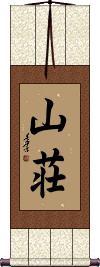
山荘 is a Japanese word that means mountain villa, mountain retreat, or mountain cottage.
This can also be a Japanese surname that romanizes as Yamajou, Yamajo, Sansou, or Sanso.
Five Codes of Tang Soo Do
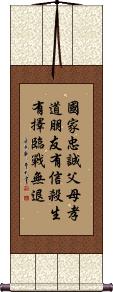
国家忠诚父母孝道朋友有信杀生有择临战无退 are the five codes of Tang Soo Do.
I suggest you have this arranged in five columns when you get to the options page for your custom calligraphy wall scroll.
Here are my translations of each of the five codes:
國家忠誠 Be loyal to your country.
父母孝道 In regards to parents, behave in a filial way.
朋友有信 Be faithful in friendship.
殺生有擇 When fighting for life and death, make noble choices.
臨戰無退 No retreat in battle.
Note: “Tang Soo Do” is a romanization of 唐手道. It's 당수도 in Korean Hangul. It can also be romanized as “Tangsudo” or “Dangsudo.”
The one who retreats 50 paces mocks the one to retreats 100
The pot calls the kettle black
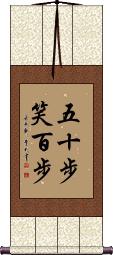
五十步笑百步 is a Chinese proverb that means the one who retreats 50 paces mocks the one who retreats 100 paces.
During the Warring States Period of what is now China (475 - 221 B.C.), the King of Wei was in love with war. He often fought with other kingdoms just for spite or fun.
One day, the King of Wei asked the philosopher Mencius, “I love my people, and all say I do the best for them. I move the people from famine-stricken areas to places of plenty and transport grains from rich areas to the poor. Nobody goes hungry in my kingdom, and I treat my people far better than other kings. But why does the population of my kingdom not increase, and why does the population of other kingdoms not decrease?”
Mencius answered, “Since you love war, I will make this example: When going to war, and the drums beat to start the attack, some soldiers flee for their lives in fear. Some run 100 paces in retreat, and others run 50 steps. Then the ones who retreated 50 paces laugh and taunt those who retreated 100 paces, calling them cowards mortally afraid of death. Do you think this is reasonable?
The King of Wei answered, “Of course not! Those who run 50 paces are just as timid as those who run 100 paces.”
Mencius then said, “You are a king who treats his subjects better than other kings treat their people, but you are so fond of war that your people suffer from great losses in battle. Therefore, your population does not grow. While other kings allow their people to starve to death, you send your people to die in war. Is there any difference?”
This famous conversation led to the six-character proverb shown here. It serves as a warning to avoid hypocrisy. It goes hand-in-hand with the western phrase, “The pot calls the kettle black,” or the Biblical phrase, “Before trying to remove a splinter from your neighbor's eye, first remove the plank from your own eye.”
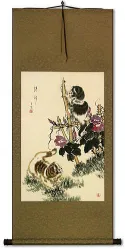
This in-stock artwork might be what you are looking for, and ships right away...


Gallery Price: $60.00
Your Price: $36.88
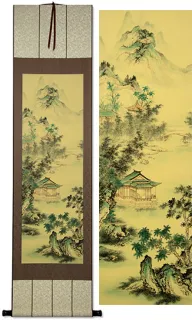
Gallery Price: $83.00
Your Price: $45.88
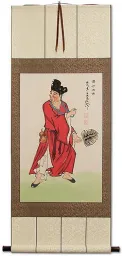
Gallery Price: $63.00
Your Price: $35.00
These search terms might be related to Retreat:
Flying / Flight
Flying / Flight / Rising Upward
Take Refuge in the Three Treasures
Not the results for Retreat that you were looking for?
Below are some entries from our dictionary that may match your Retreat search...
| Characters If shown, 2nd row is Simp. Chinese |
Pronunciation Romanization |
Simple Dictionary Definition |
山荘 see styles |
yamajou / yamajo やまじょう |
More info & calligraphy: Mountain Villa |
卻 却 see styles |
què que4 ch`üeh chüeh |
but; yet; however; while; to go back; to decline; to retreat; nevertheless; even though See: 却 |
庵 see styles |
ān an1 an ihori いほり |
hut; small temple; nunnery (n,n-suf) hermitage; retreat; (surname) Ihori A thatched hut, shelter, place of retirement from the world; a small temple; especially a nunnery, hence庵室; 庵寺 generally applies to such, and庵主 is the abbess. |
臈 腊 see styles |
là la4 la rou / ro ろう |
old variant of 臘|腊[la4] (1) {Buddh} year in the Buddhist order (after the completion of the first meditation retreat); (2) becoming more experienced with age; social status based on this experience The end of a Buddhist year; a Buddhist year; v. 臘. |
臘 腊 see styles |
là la4 la rou / ro ろう |
ancient practice of offering sacrifices to the gods in the 12th lunar month; the 12th lunar month; (bound form) (of meat, fish etc) cured in winter, esp. in the 12th lunar month (1) {Buddh} offering ceremony held on the third day of the dog after the winter solstice; (2) twelfth month of the lunisolar calendar; (3) (See 臈) year in the Buddhist order (after the completion of the first meditation retreat) Dried flesh; to sacrifice to the gods three days after the winter solstice; the end of the year; a year; a monastic year, i.e. the end of the annual summer retreat, also called 戒臘; 夏臘; 法臘. |
菴 庵 see styles |
ān an1 an iori いおり |
variant of 庵[an1] (n,n-suf) hermitage; retreat; (surname) Iori Hut, thatched cottage, small temple, nunnery; translit. aṃ, āṃ. |
退 see styles |
tuì tui4 t`ui tui tai |
to retreat; to withdraw; to reject; to return (something); to decline Retire, withdraw, backslide, recede, yield. |
一夏 see styles |
yī xià yi1 xia4 i hsia hitoka ひとか |
{Buddh} (See 安居・あんご) one summer (during which a monk attends a summer retreat); (female given name) Hitoka The summer retreat in India of, 90 days, from the 16th of the 4th moon to the 15th of the 7th; v. 雨. |
一臈 see styles |
yī là yi1 la4 i la ichirō |
一臘 The end of the monastic year at the summer retreat; a monastic year; also called 法臈? or 法歲, the religious year; cf. 一夏. |
上臈 see styles |
shàng là shang4 la4 shang la jourou / joro じょうろう |
court lady; noblewoman The "la" is the end of a summer's retreat, which ends the monastic year, hence 上臈 are senior, 下臈 junior monks. |
五德 see styles |
wǔ dé wu3 de2 wu te gotoku |
The five virtues, of which there are various definitions. The five virtues required in a confessor at the annual confessional ending the rainy retreat are: freedom from predilections, from anger, from fear, not easily deceived, discernment of shirkers of confession. Another group is the five virtues for a nurse of the sick, and there are others. |
別墅 别墅 see styles |
bié shù bie2 shu4 pieh shu bessho べっしょ |
villa; CL:幢[zhuang4],座[zuo4] (archaism) holiday home; country retreat |
制中 see styles |
zhì zhōng zhi4 zhong1 chih chung seichū |
period of retreat |
取歳 see styles |
qǔ suì qu3 sui4 ch`ü sui chü sui |
To receive, or add, a year to his monastic age, on the conclusion of the summer's retreat. |
回歸 回归 see styles |
huí guī hui2 gui1 hui kuei |
to return to; to retreat; regression (statistics) |
坐夏 see styles |
zuò xià zuo4 xia4 tso hsia zage |
坐臘 varṣā; the retreat or rest during the summer rains. |
坐臘 坐腊 see styles |
zuò là zuo4 la4 tso la zarō |
meditation retreat |
夏坐 see styles |
xià zuò xia4 zuo4 hsia tso geza |
坐夏; 夏安居 The period of the summer retreat for meditation, known as varṣās, the rains. |
夏末 see styles |
xià mò xia4 mo4 hsia mo gematsu |
夏滿; 夏竟; 夏解 The end of the summer (retreat), the 15th of the 7th month. |
夏滿 夏满 see styles |
xià mǎn xia4 man3 hsia man geman |
end of the summer meditation retreat |
夏竟 see styles |
xià jìng xia4 jing4 hsia ching ge kyō |
end of the summer meditation retreat |
夏衆 夏众 see styles |
xià zhòng xia4 zhong4 hsia chung geshu |
The assembly of monks at the summer retreat. |
夏解 see styles |
xià jiě xia4 jie3 hsia chieh ge aki |
end of the summer meditation retreat |
夏首 see styles |
xià shǒu xia4 shou3 hsia shou geshu |
The first day, or beginning, of the retreat. |
奔る see styles |
hashiru はしる |
(v5r,vi) (1) to run; (2) to travel (movement of vehicles); to drive; (3) to hurry to; (4) to retreat (from battle); to take flight; (5) to run away from home; (6) to elope; (7) to tend heavily toward; (8) to flash; to streak; to shoot through (e.g. pain) |
安居 see styles |
ān jū an1 ju1 an chü yasuoki やすおき |
to settle down; to live peacefully (n,vs,vi) {Buddh} varsika (meditation retreat; usu. for 90 days starting on the 15th day of the 4th month of the lunisolar calendar); (given name) Yasuoki Tranquil dwelling. varṣā, varṣās, or varṣāvasāna. A retreat during the three months of the Indian rainy season, and also, say some, in the depth of winter. During the rains it was 'difficult to move without injuring insect life'. But the object was for study and meditation. In Tokhara the retreat is said to have been in winter, from the middle of the 12th to the middle of the 3rd moon; in India from the middle of the 5th to the 8th, or the 6th to the 9th moons; usually from Śrāvaṇa, Chinese 5th moon, to Aśvayuja, Chinese 8th moon; but the 16th of the 4th to the 15th of the 7th moon has been the common period in China and Japan. The two annual periods are sometimes called 坐 夏 and 坐 臘 sitting or resting for the summer and for the end of the year. The period is divided into three sections, former, middle, and latter, each of a month. |
山家 see styles |
shān jiā shan1 jia1 shan chia yanbe やんべ |
mountain villa; chalet; mountain cottage; mountain retreat; house in the mountains; (surname) Yanbe The 'mountain school', the ' profounder ' interpretation of Tiantai doctrines developed by 四明 Ssu-ming; v. last entry. |
布薩 布萨 see styles |
bù sà bu4 sa4 pu sa fusatsu |
poṣadha, upavasatha, upoṣana; 布沙他 (or 布灑他); 褒沙陀 Pali: uposatha; fasting, a fast, the nurturing or renewal of vows, intp. by 淨住 or 善宿 or 長養, meaning abiding in retreat for spiritual refreshment. There are other similar terms, e. g. 布薩陀婆; 優補陀婆; also 布薩犍度 which the Vinaya uses for the meeting place; 鉢囉帝提舍耶寐 pratideśanīya, is self-examination and public confession during the fast. It is also an old Indian fast. Buddha's monks should meet at the new and fall moons and read the Prātimokṣa sutra for their moral edification, also disciples at home should observe the six fast days and the eight commands. The 布薩日 fast days are the 15th and 29th or 30th of the moon. |
幽居 see styles |
yuukyo / yukyo ゆうきょ |
(noun/participle) hermitage; retreat; retirement; seclusion |
座臘 座腊 see styles |
zuò là zuo4 la4 tso la zarō |
The end of the summer retreat; the monastic end of the year. |
Click here for more Retreat results from our dictionary
The following table may be helpful for those studying Chinese or Japanese...
| Title | Characters | Romaji (Romanized Japanese) | Various forms of Romanized Chinese | |
| Mountain Villa | 山荘 | yamajou / sansou yamajo / sanso | ||
| Five Codes of Tang Soo Do | 國家忠誠父母孝道朋友有信殺生有擇臨戰無退 国家忠诚父母孝道朋友有信杀生有择临战无退 | guó jiā zhōng chéng fù mǔ xiào dào péng yǒu yǒu xìn shā shēng yǒu zé lín zhàn wú tuì guo2 jia1 zhong1 cheng2 fu4 mu3 xiao4 dao4 peng2 you3 you3 xin4 sha1 sheng1 you3 ze2 lin2 zhan4 wu2 tui4 guo jia zhong cheng fu mu xiao dao peng you you xin sha sheng you ze lin zhan wu tui | kuo chia chung ch`eng fu mu hsiao tao p`eng yu yu hsin sha sheng yu tse lin chan wu t`ui kuo chia chung cheng fu mu hsiao tao peng yu yu hsin sha sheng yu tse lin chan wu tui |
|
| The one who retreats 50 paces mocks the one to retreats 100 | 五十步笑百步 | wù shí bù xiào bǎi bù wu4 shi2 bu4 xiao4 bai3 bu4 wu shi bu xiao bai bu wushibuxiaobaibu | wu shih pu hsiao pai pu wushihpuhsiaopaipu |
|
| In some entries above you will see that characters have different versions above and below a line. In these cases, the characters above the line are Traditional Chinese, while the ones below are Simplified Chinese. | ||||

Successful Chinese Character and Japanese Kanji calligraphy searches within the last few hours...



