Many custom options...


And formats...



Ren in Chinese / Japanese...
Buy a Ren calligraphy wall scroll here!
Personalize your custom “Ren” project by clicking the button next to your favorite “Ren” title below...
Benevolence
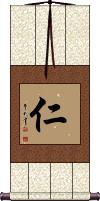
Beyond benevolence, 仁 can also be defined as “charity” or “mercy” depending on context.
The deeper meaning suggests that one should pay alms to the poor, care for those in trouble, and take care of his fellow man (or woman).
仁 is one of the five tenets of Confucius. In fact, it is a subject that Confucius spent a great deal of time explaining to his disciples.
I have also seen this benevolent-related word translated as perfect virtue, selflessness, love for humanity, humaneness, goodness, goodwill, or simply “love” in the non-romantic form.
This is also a virtue of the Samurai Warrior
See our page with just Code of the Samurai / Bushido here
Ninja
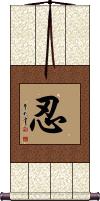
忍 is just the first character of “Ninja.”
It means to beat, to endure, or to tolerate.
Some use this as the short form of “Ninja” but it would be more correct to use the two-character version in most cases (and for clarity). Other definitions of this Kanji include: to bear, put up with, conceal, spy, or sneak. It is also a character in Korean Hanja and Chinese but not well-known with this meaning but rather a definition like “patience.” Note that when writing this as Kanji, Japanese will tend to write it in the form shown to the right. If you select our Japanese master calligrapher, please expect this Kanji form (yes, it's just one stroke that is slightly different in location, crossing another stroke in the Japanese Kanji form).
Patience / Perseverance
忍 contains the ideas of patience, equanimity, perseverance, forbearance, and endurance. Alone, this single character can be a bit ambiguous or flexible. It can also mean to endure, to bear, to put up with, or to conceal. If you want to simply decide what this character means to you within the general meaning but keep it a mystery to others, this is a good choice.
If you want to be more direct, you may want to choose one of our other selections that mean perseverance or patience (you will see this character within those larger words/phrases).
There is a secondary meaning in Japanese since this is the first character of the word ninja.Note that when writing this as Kanji, Japanese will tend to write it in the form shown to the right. If you select our Japanese master calligrapher, please expect this Kanji form (yes, it's just one stroke that is slightly different in location, crossing another stroke in the Japanese Kanji form).
See Also: Perseverance | Patience | Tenacious
Practice / Train / Drill
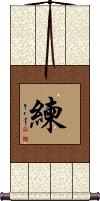
練 is a Chinese, Japanese, and Korean word that is the simplest way to say practice, train, drill, exercise, or to describe the effort taken to perfect one's skill.
Perseverance / Fortitude
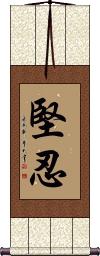
堅忍 means persistent, steadfast, fortitude, and/or perseverance.
The first character means strong, solid, firm, unyielding, or resolute.
The second character means to beat, endure, or tolerate.
Together they speak of the strength from within yourself. Some may also translate this as long-suffering in a more Biblical sense.
堅忍 is a common term in Chinese and Korean Hanja but a little less commonly used in modern Japanese Kanji. For that reason, this selection is best if your audience is Chinese or Korean.
 Note that when writing this as Kanji, Japanese will tend to write the second Kanji a little differently. If you select our Japanese master calligrapher, please expect the form where the little horizontal stroke crosses the vertical stroke. See differences in the images to the right. Technically, they are both the same character, and will be read the same in either language.
Integrity / Honesty
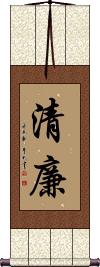
清廉 means honest, uncorrupted, honesty, integrity, purity, and unselfishness.
In Japanese, this can also be the given name Kiyoyuki.

レン is the name Len in Japanese Katakana.
Note: Because this title is entirely Japanese Katakana, it should be written by a Japanese calligrapher.
Renn
レン is the name Renn in Japanese Katakana.
Note: Because this title is entirely Japanese Katakana, it should be written by a Japanese calligrapher.
Wrenn
レン is the name Wrenn in Japanese Katakana.
Note: Because this title is entirely Japanese Katakana, it should be written by a Japanese calligrapher.
Strong Woman
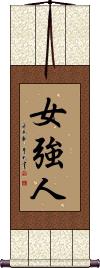
女強人 is the best way to say “strong woman” or “strong and independent woman” in Chinese.
Grammar in China is a bit different, so these three characters literally read as “female strength person” or “woman strong person.” This might sound funny in English, but this is a natural-sounding title in Chinese.
Hyakuren-Jitoku
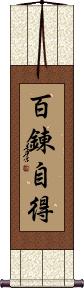
百錬自得 is a Japanese proverb that means only if you practice something 100 times will it become a part of yourself.
Some translate it in a short form like “Well train, self-gain.”
The first two characters are a word that means “100 forges” (or to forge 100 times). It translates more naturally as well-tempered, well-drilled, or well-trained.
The last two characters mean “self-benefit” or “self-gain.” It can also be translated into English as contented, self-satisfaction, realizing (through one's ability), or being paid back for one's deeds.
Perseverance / Indomitable / Invincible Fortitude

堅忍不抜 means determined, steadfast, unswerving, or unshakable in Japanese.
This is the Japanese version of an old Chinese 4-character perseverance proverb.
This would be understood in Chinese, but it's not commonly written this way in Chinese.
Note that when writing this as Kanji, Japanese calligraphers sometimes write the second Kanji in the form shown to the right. Yes,
it’s
just one stroke that is slightly different in location, crossing another stroke in this alternate Japanese Kanji form. If you have a preference, let us know when you order.
Due to some odd computer coding conventions, these two character forms were combined/merged into the same code point - thus, you will not see Kanji images of more Japanese form as you select options for your scroll.
Not the results for Ren that you were looking for?
Below are some entries from our dictionary that may match your Ren search...
| Characters If shown, 2nd row is Simp. Chinese |
Pronunciation Romanization |
Simple Dictionary Definition |
仁 see styles |
rén ren2 jen yasushi やすし |
More info & calligraphy: Benevolence(1) (じん only) benevolence (esp. as a virtue of Confucianism); consideration; compassion; humanity; charity; (2) (じん only) human; (3) kernel; (4) (じん only) {biol} (See 核小体) nucleolus; (given name) Yasushi Kindness, benevolence, virtue. |
任 see styles |
rèn ren4 jen makoto まこと |
to assign; to appoint; to take up a post; office; responsibility; to let; to allow; to give free rein to; no matter (how, what etc); classifier for terms served in office, or for spouses, girlfriends etc (as in 前任男友) obligation; duty; charge; responsibility; (given name) Makoto Bear, endure, let; office; it is used to connote laisser-faire; one of the 四病, as 任運 implies laisser-aller; it is intp. by let things follow their own course, or by 自然 naturally, without intervention. |
忍 see styles |
rěn ren3 jen nin にん |
More info & calligraphy: Patience / Perseverance(archaism) endurance; forbearance; patience; self-restraint; (given name) Nin kṣānti, 羼提 (or 羼底); patience, endurance, (a) in adverse circumstances, (b) in the religious state. There are groups of two, three, four, five, six, ten, and fourteen, indicating various forms of patience, equanimity, repression, forbearance, endurance, constancy, or "perseverance of the saints," both in mundane and spiritual things. |
人性 see styles |
rén xìng ren2 xing4 jen hsing jinsei / jinse じんせい |
More info & calligraphy: Human Naturehuman nature; instinct; humanity; humanism |
人情 see styles |
rén qíng ren2 qing2 jen ch`ing jen ching ninjou / ninjo にんじょう |
More info & calligraphy: Empathy / Humanity(1) humanity; empathy; kindness; sympathy; (2) human nature; common sense; customs and manners human emotions |
人道 see styles |
rén dào ren2 dao4 jen tao jindou(p); nindou / jindo(p); nindo じんどう(P); にんどう |
More info & calligraphy: The Tao or Dao of Being Human / Humanity(1) humanity; (2) sidewalk; footpath; (3) (にんどう only) {Buddh} (See 六道) human realm rebirth as a human being |
人類 人类 see styles |
rén lèi ren2 lei4 jen lei jinrui じんるい |
More info & calligraphy: Human Race / Humanity / Mankindmankind; humanity human beings |
人魚 人鱼 see styles |
rén yú ren2 yu2 jen yü hitona ひとな |
More info & calligraphy: Mermaid / Mermanmermaid; merman; (female given name) Hitona |
仁弟 see styles |
rén dì ren2 di4 jen ti |
More info & calligraphy: Rendi |
仁德 see styles |
rén dé ren2 de2 jen te |
More info & calligraphy: Kindheartedness / Benevolence / Humanity |
仁愛 仁爱 see styles |
rén ài ren2 ai4 jen ai megumi めぐみ |
More info & calligraphy: Benevolent Lovebenevolence; charity; love; (female given name) Megumi |
仁慈 see styles |
rén cí ren2 ci2 jen tz`u jen tzu hitoji ひとじ |
More info & calligraphy: Kindness / Benevolencekind-hearted; benevolence; (given name) Hitoji benevolence |
仙人 see styles |
xiān rén xian1 ren2 hsien jen sennin せんにん |
More info & calligraphy: Sennin(1) immortal mountain wizard (in Taoism); mountain man (esp. a hermit); (2) one not bound by earthly desires or the thoughts of normal men; (surname, given name) Sennin seer |
信任 see styles |
xìn rèn xin4 ren4 hsin jen shinnin しんにん |
More info & calligraphy: Belief / Trust(noun, transitive verb) trust; confidence; credence |
友人 see styles |
yǒu rén you3 ren2 yu jen yuuto / yuto ゆうと |
More info & calligraphy: Yujin(more formal than 友達) (See 友達) friend; (personal name) Yūto |
可人 see styles |
kě rén ke3 ren2 k`o jen ko jen yoshihito よしひと |
More info & calligraphy: Keren(given name) Yoshihito |
堅忍 坚忍 see styles |
jiān rěn jian1 ren3 chien jen kennin けんにん |
More info & calligraphy: Perseverance / Fortitude(n,vs,vt,vi) perseverance |
堅韌 坚韧 see styles |
jiān rèn jian1 ren4 chien jen |
More info & calligraphy: Perseverance / Fortitude |
夫人 see styles |
fū ren fu1 ren5 fu jen fujin(p); bunin(sk) ふじん(P); ぶにん(sk) |
More info & calligraphy: Fujin(n,n-suf) (1) (honorific or respectful language) wife; Mrs; Madam; (2) (archaism) wife of a nobleman; (3) (archaism) (also read ぶにん) consort (of the emperor) of the third rank (ritsuryō system) A wife; the wife of a king, i. e. a queen, devi. |
巨人 see styles |
jù rén ju4 ren2 chü jen mito みと |
More info & calligraphy: Giant(1) giant; great man; (2) (abbreviation) Tokyo Giants (baseball team); (female given name) Mito |
強韌 强韧 see styles |
qiáng rèn qiang2 ren4 ch`iang jen chiang jen |
More info & calligraphy: Resiliency |
忍法 see styles |
rěn fǎ ren3 fa3 jen fa ninpou / ninpo にんぽう |
More info & calligraphy: Ninpo(忍法位) The method or stage of patience, the sixth of the seven stages of the Hīnayāna in the attainment of arhatship, or sainthood: also the third of the four roots of goodness. |
忍者 see styles |
rěn zhě ren3 zhe3 jen che ninja にんじゃ |
More info & calligraphy: Ninja(hist) (See 忍術) ninja; person trained in ninjutsu and employed for covert purposes in feudal Japan |
忍耐 see styles |
rěn nài ren3 nai4 jen nai nintai にんたい |
More info & calligraphy: Patience / Perseverance / To Endure / Tolerant(noun, transitive verb) endurance; perseverance; patience forbearance |
情人 see styles |
qíng rén qing2 ren2 ch`ing jen ching jen joujin; jounin / jojin; jonin じょうじん; じょうにん |
More info & calligraphy: Lover / Sweetheartlover; sweetheart; mistress |
愛人 爱人 see styles |
ài ren ai4 ren5 ai jen yoshito よしと |
More info & calligraphy: Lover / Spouse / Sweetheartlover; mistress; (personal name) Yoshito |
戀人 恋人 see styles |
liàn rén lian4 ren2 lien jen |
More info & calligraphy: Lover / BelovedSee: 恋人 |
旅人 see styles |
lǚ rén lu:3 ren2 lü jen ryojin りょじん |
More info & calligraphy: Traveleritinerant (esp. itinerant gambler); drifter; nomad; rover; (personal name) Ryojin |
浪人 see styles |
làng rén lang4 ren2 lang jen rounin / ronin ろうにん |
More info & calligraphy: Ronin / Masterless Samurai(n,vs,adj-no) (1) ronin; wandering samurai without a master to serve; (2) out of work; (3) waiting for another chance to enter a university; (given name) Rounin |
狼人 see styles |
láng rén lang2 ren2 lang jen |
More info & calligraphy: Werewolf |
Click here for more Ren results from our dictionary
The following table may be helpful for those studying Chinese or Japanese...
| Title | Characters | Romaji (Romanized Japanese) | Various forms of Romanized Chinese | |
| Benevolence | 仁 | jin | rén / ren2 / ren | jen |
| Ninja | 忍 | nin | rěn / ren3 / ren | jen |
| Patience Perseverance | 忍 | nin | rěn / ren3 / ren | jen |
| Practice Train Drill | 練 练 | ren | liàn / lian4 / lian | lien |
| Perseverance Fortitude | 堅忍 坚忍 | ken nin / kennin | jiǎn rěn / jian3 ren3 / jian ren / jianren | chien jen / chienjen |
| Integrity Honesty | 清廉 | sei ren / seiren | qīng lián qing1 lian2 qing lian qinglian | ch`ing lien chinglien ching lien |
| Len | レン | ren | ||
| Renn | レン | ren | ||
| Wrenn | レン | ren | ||
| Strong Woman | 女強人 女强人 | nǚ qiáng rén nv3 qiang2 ren2 nv qiang ren nvqiangren | nü ch`iang jen nüchiangjen nü chiang jen |
|
| Hyakuren-Jitoku | 百錬自得 | hyaku ren ji toku hyakurenjitoku | ||
| Perseverance Indomitable Invincible Fortitude | 堅忍不抜 / 堅忍不拔 坚忍不拔 | kenninfubatsu | jiān rěn bù bá jian1 ren3 bu4 ba2 jian ren bu ba jianrenbuba | chien jen pu pa chienjenpupa |
| In some entries above you will see that characters have different versions above and below a line. In these cases, the characters above the line are Traditional Chinese, while the ones below are Simplified Chinese. | ||||

Successful Chinese Character and Japanese Kanji calligraphy searches within the last few hours...



