Many custom options...


And formats...



Religion in Chinese / Japanese...
Buy a Religion calligraphy wall scroll here!
Personalize your custom “Religion” project by clicking the button next to your favorite “Religion” title below...
True Religion / Buddha Truth
The way of the truth
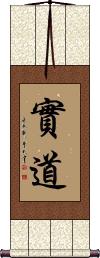
實道 is a Buddhist title that means “The true way,” “The true religion,” “The way of the truth,” or “The absolute Buddha-truth.”
Islam
The religion of the Hui People
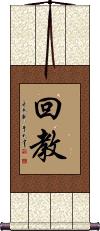
回教 means “Hui Religion” in Chinese.
It refers specifically to the Hui people (Huizu), who have typical Oriental looks but are Muslim (practice the religion of Islam). Hui people can be found throughout China, often establishing Muslim neighborhoods in many cities.
My Japanese dictionary lists this as the all-Kanji way to write Islam as well.
In Korean, the first character is used as a short name to say Muslim.
Religious Devotion / Faith in God / Religious Faith
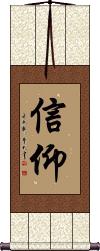
信仰 means firm belief, faith, persuasion, conviction, and sometimes religion or creed in Chinese, Japanese Kanji, and old Korean Hanja.
This clearly fits the religious connotation of the English word “devotion.”
This is often used to refer to a person of faith or a religious person.
This can be directly translated as “firm belief,” “creed,” “conviction,” or simply as “religious,” depending on context.
Some will also use this to mean “trust in God” in Japanese (though the term for God is not actually in this title).
It should be noted that this word is a little strange alone on a wall scroll.
While this can be pronounced in Japanese, it’s not a great selection for a wall scroll if your audience is Japanese.
See Also: Faith | Trust | Devotion | Trust | Trust in God
These search terms might be related to Religion:
Belief / Trust
Believe / Faith / Trust
Faith
Faith / Trusting in the Unseen
Faith Dojo
Faith Hope Love
Faith is the Bird That Feels the Light When the Dawn is Still Dark
Faith Love Peace
Firm Belief / Strong Faith
Good Intentions / Good Will / Good Faith
Love Faith Strength
Religious Devotion / Faith in God / Religious Faith
Trust / to Have Faith
Trust in God / Belief in God
Trust in God / Faith in God
Not the results for Religion that you were looking for?
Below are some entries from our dictionary that may match your Religion search...
| Characters If shown, 2nd row is Simp. Chinese |
Pronunciation Romanization |
Simple Dictionary Definition |
信 see styles |
xìn xin4 hsin yuki ゆき |
More info & calligraphy: Honesty / Fidelity(1) honesty; sincerity; fidelity; (2) trust; reliance; confidence; (3) (religious) faith; devotion; (counter) (4) counter for received messages; (female given name) Yuki śraddhā. Faith; to believe; belief; faith regarded as the faculty of the mind which sees, appropriates, and trusts the things of religion; it joyfully trusts in the Buddha, in the pure virtue of the triratna and earthly and transcendental goodness; it is the cause of the pure life, and the solvent of doubt. Two forms are mentioned: (1) adhimukti, intuition, tr. by self-assured enlightenment. (2) śraddhā, faith through hearing or being taught. For the Awakening of Faith, Śraddhotpāda, v. 起信論. |
法 see styles |
fǎ fa3 fa minori みのり |
More info & calligraphy: Dharma / The Law(n,n-suf) (1) law; act; principle; (n,n-suf) (2) method; (n,n-suf) (3) {gramm} mood; (n,n-suf) (4) {Buddh} dharma; law; (female given name) Minori Dharma, 達磨; 曇無 (or 曇摩); 達摩 (or 達謨) Law, truth, religion, thing, anything Buddhist. Dharma is 'that which is held fast or kept, ordinance, statute, law, usage, practice, custom'; 'duty'; 'right'; 'proper'; 'morality'; 'character'. M. W. It is used in the sense of 一切 all things, or anything small or great, visible or invisible, real or unreal, affairs, truth, principle, method, concrete things, abstract ideas, etc. Dharma is described as that which has entity and bears its own attributes. It connotes Buddhism as the perfect religion; it also has the second place in the triratna 佛法僧, and in the sense of 法身 dharmakāya it approaches the Western idea of 'spiritual'. It is also one of the six media of sensation, i. e. the thing or object in relation to mind, v. 六塵. |
上帝 see styles |
shàng dì shang4 di4 shang ti joutei; shoutei / jote; shote じょうてい; しょうてい |
More info & calligraphy: God of Zion / God of Abraham(1) Shangdi (creator deity in Chinese folk religion); (2) {Christn} God |
信仰 see styles |
xìn yǎng xin4 yang3 hsin yang shinkou / shinko しんこう |
More info & calligraphy: Religious Devotion / Faith in God / Religious Faith(noun, transitive verb) (religious) faith; belief; creed; (given name) Shinkou To believe in and look up to. |
十戒 see styles |
shí jiè shi2 jie4 shih chieh jukkai じゅっかい |
More info & calligraphy: Ten Commandments(1) (Buddhist term) the 10 precepts; (2) Ten Commandments; Decalogue; Decalog; (surname) Jukkai Śikṣāpada. The ten prohibitions (in Pāli form) consist of five commandments for the layman: (1) not to destroy life 不殺生 pāṇātipātāveramaṇi; (2) not to steal 不倫盜 adinnādānāver; (3) not to commit adultery 不婬慾 abrahmacaryaver.; (4) not to lie 不妄語musāvādāver.; (5) not to take intoxicating liquor 不飮酒 suramereyya-majjapamādaṭṭhānāver. Eight special commandments for laymen consist of the preceding five plus: (6) not to eat food out of regulated hours 不非時食 vikāla-bhojanāver.; (7) not to use garlands or perfumes 不著華鬘好香塗身 mālā- gandha-vilepana-dhāraṇa-maṇḍana-vibhūṣanaṭṭhānā; (8) not to sleep on high or broad beds (chastity) 不坐高廣大牀 uccāsayanā-mahāsayanā. The ten commandments for the monk are the preceding eight plus: (9) not to take part in singing, dancing, musical or theatrical performances, not to see or listen to such 不歌舞倡伎不往觀聽 nacca-gīta-vādita-visūkadassanāver.; (10) to refrain from acquiring uncoined or coined gold, or silver, or jewels 不得捉錢金銀寶物 jātarūpa-rajata-paṭīggahaṇāver. Under the Māhayāna these ten commands for the monk were changed, to accord with the new environment of the monk, to the following: not to kill, not to steal, to avoid all unchastity, not to lie, not to slander, not to insult, not to chatter, not to covet, not to give way to anger, to harbour no scepticism. |
四田 see styles |
sì tián si4 tian2 ssu t`ien ssu tien yotsuda よつだ |
More info & calligraphy: Yotsuda / ShidaThe four fields for cultivating happiness — animals; the poor; parents, etc.; the religion. |
實道 实道 see styles |
shí dào shi2 dao4 shih tao jitsudō |
More info & calligraphy: True Religion / Buddha Truth |
師公 师公 see styles |
shī gōng shi1 gong1 shih kung shikō |
More info & calligraphy: Si Gungthaumaturge |
復活 复活 see styles |
fù huó fu4 huo2 fu huo fukkatsu(p); fukkaatsu(sk) / fukkatsu(p); fukkatsu(sk) ふっかつ(P); ふっかーつ(sk) |
More info & calligraphy: Resurrection / Re-Birth(n,vs,vt,vi) (1) revival (of an old system, custom, fashion, etc.); restoration; return; comeback; (n,vs,vi) (2) resurrection; rebirth To live again, return to life. |
神道 see styles |
shén dào shen2 dao4 shen tao jindou / jindo じんどう |
More info & calligraphy: ShintoShinto; Shintoism; (surname) Jindō The spirit world of devas, asuras, and pretas. Psychology, or the doctrines concerning the soul. The teaching of Buddha. Shinto, the Way of the Gods, a Japanese national religion. |
聖人 圣人 see styles |
shèng rén sheng4 ren2 sheng jen masato まさと |
More info & calligraphy: Holy Man / Saint(1) {Christn} saint; (2) (orig. meaning) wise and virtuous person (esp. in Confucianism); great religious teacher; sage; (3) (See 清酒) refined sake; (male given name) Masato is the opposite of the 凡人 common, or unenlightened man. |
聖地 圣地 see styles |
shèng dì sheng4 di4 sheng ti seichi / sechi せいち |
More info & calligraphy: Holy Land(1) sacred place; holy ground; the Holy Land; (2) (slang) real-life location used as a setting in a novel, film, anime, etc.; (place-name) Seichi stage of enlightenment |
道場 道场 see styles |
dào chǎng dao4 chang3 tao ch`ang tao chang michiba みちば |
More info & calligraphy: Dojo / Martial Arts Studio(1) dojo; hall used for martial arts training; (2) (abbreviation) {Buddh} (See 菩提道場) manda (place of Buddhist practice or meditation, esp. the place under the bodhi tree where Buddha attained enlightenment); (surname) Michiba Truth-plot. bodhimaṇḍala, circle, or place of enlightenment. The place where Buddha attained enlightenment. A place, or method, for attaining to Buddha-truth. An object of or place for religious offerings. A place for teaching, learning, or practising religion. |
達磨 达磨 see styles |
dá mó da2 mo2 ta mo daruma だるま |
More info & calligraphy: Daruma / Damodharma; also 達摩; 達麼; 達而麻耶; 曇摩; 馱摩 tr. by 法. dharma is from dhara, holding, bearing, possessing, etc.; and means 'that which is to be held fast or kept, ordinance, statute, law, usage, practice'; 'anything right.' M.W. It may be variously intp. as (1) characteristic, attribute, predicate; (2) the bearer, the transcendent substratum of single elements of conscious life; (3) element, i.e. a part of conscious life; (4) nirvāṇa, i.e. the Dharma par excellence, the object of Buddhist teaching; (5) the absolute, the real; (6) the teaching or religion of Buddha; (7) thing, object, appearance. Also, Damo, or Bodhidharma, the twenty-eighth Indian and first Chinese patriarch, who arrived in China A.D. 520, the reputed founder of the Chan or Intuitional School in China. He is described as son of a king in southern India; originally called Bodhitara. He arrived at Guangdong, bringing it is said the sacred begging-bowl, and settled in Luoyang, where he engaged in silent meditation for nine years, whence he received the title of wall-gazing Brahman 壁觀婆羅門, though he was a kṣatriya. His doctrine and practice were those of the 'inner light', independent of the written word, but to 慧可 Huike, his successor, he commended the Laṅkāvatāra-sūtra as nearest to his views. There are many names with Dharma as initial: Dharmapāla, Dharmagupta, Dharmayaśas, Dharmaruci, Dharmarakṣa, Dharmatrāta, Dharmavardhana, etc. |
奉 see styles |
fèng feng4 feng matsuri まつり |
to offer (tribute); to present respectfully (to superior, ancestor, deity etc); to esteem; to revere; to believe in (a religion); to wait upon; to accept orders (from superior) (female given name) Matsuri To receive respectfully; honoured by, have the honour to, be favoured by, serve, offer. |
教 see styles |
jiào jiao4 chiao yuki ゆき |
(bound form) to teach; to instruct; a religion; to cause (sb to do something); to tell (sb to do something) (suffix) -ism (religion); (female given name) Yuki pravacana, to teach, instruct, inculcate; śāśana, teaching, precept, doctrine; āgama, sect, school, church. |
貧 贫 see styles |
pín pin2 p`in pin hanawa はなわ |
poor; inadequate; deficient; garrulous (1) poverty; penury; want; need; (2) (archaism) insufficiency; shortage; deficiency; (personal name) Hanawa Poor, in poverty.; The two kinds of poverty: of goods, and of the religion. |
齋 斋 see styles |
zhāi zhai1 chai hitoshi ひとし |
to fast or abstain from meat, wine etc; vegetarian diet; study room; building; to give alms (to a monk) (surname) Hitoshi To reverence: abstinence; to purify as by fasting, or abstaining, e.g. from flesh food; religious or abstinential duties, or times; upavasatha (uposatha), a fast; the ritual period for food, i.e. before noon; a room for meditation, a study, a building, etc., devoted to abstinence, chastity, or the Buddhist religion; mourning (for parents). |
二根 see styles |
èr gēn er4 gen1 erh ken nikon |
The two "roots" or natural powers. (1) (a) 利根 keen, able (in the religion); (b) 鈍根 dull. (2) (a) 正根; 勝義根The power or ability which uses the sense organs to discern the truth; (b) 扶根; 扶 (or浮) 塵根the sense organs 五根 as aids. (3) The male and female sexual organs. |
修道 see styles |
xiū dào xiu1 dao4 hsiu tao nagamichi ながみち |
to practice Daoism (n,vs,vi) learning; studying the fine arts; (given name) Nagamichi To cultivate the way of religion; be religious; the way of self-cultivation. In the Hīnayāna the stage from anāgāmin to arhat; in Mahāyāna one of the bodhisattva stages. |
像化 see styles |
xiàng huà xiang4 hua4 hsiang hua zō ke |
The religion of the image or symbol Buddhism. Also the second or formal period of the teaching of Buddhism by symbol, v. 像法. |
先知 see styles |
xiān zhī xian1 zhi1 hsien chih senchi せんち |
a person of foresight; (religion) a prophet (noun/participle) foresight; speedy comprehension to first know |
入信 see styles |
rù xìn ru4 xin4 ju hsin nyuushin / nyushin にゅうしん |
(n,vs,vi) entering a faith; joining a religion To believe, or enter into belief. |
入教 see styles |
rù jiào ru4 jiao4 ju chiao |
to join a religion |
八慢 see styles |
bā màn ba1 man4 pa man hachiman |
The eight kinds of pride, māna, arrogance, or self-conceit, 如慢 though inferior, to think oneself equal to others (in religion); 慢慢 to think oneself superior among manifest superiors; 不如慢 to think oneself not so much inferior among manifest superiors; 增上慢 to think one has attained more than is the fact, or when it is not the fact; 我慢 self-superiority, or self-sufficiency; 邪慢 pride in false views, or doings; 憍慢 arrogance; 大慢 extreme arrogance. |
同行 see styles |
tóng xíng tong2 xing2 t`ung hsing tung hsing doukou / doko どうこう |
to journey together (n,vs,vi) (1) accompanying (someone); going with; travelling together; (2) the same bank; the said bank Those who are practising religion together. |
因地 see styles |
yīn dì yin1 di4 yin ti inchi |
The causal ground, fundamental cause; the state of practising the Buddha-religion which leads to the 果地 or resulting Buddhahood. |
国教 see styles |
kokkyou / kokkyo こっきょう |
state religion; official religion; established religion |
國教 国教 see styles |
guó jiào guo2 jiao4 kuo chiao koku kyō |
state religion |
在教 see styles |
zài jiào zai4 jiao4 tsai chiao |
to be a believer (in a religion, esp. Islam) |
Click here for more Religion results from our dictionary
The following table may be helpful for those studying Chinese or Japanese...
| Title | Characters | Romaji (Romanized Japanese) | Various forms of Romanized Chinese | |
| True Religion Buddha Truth | 實道 实道 | jitsu dou / jitsudou / jitsu do | shí dào / shi2 dao4 / shi dao / shidao | shih tao / shihtao |
| Islam | 回教 | kai kyou / kaikyou / kai kyo | huí jiào / hui2 jiao4 / hui jiao / huijiao | hui chiao / huichiao |
| Religious Devotion Faith in God Religious Faith | 信仰 | shin kou / shinkou / shin ko | xìn yǎng / xin4 yang3 / xin yang / xinyang | hsin yang / hsinyang |
| In some entries above you will see that characters have different versions above and below a line. In these cases, the characters above the line are Traditional Chinese, while the ones below are Simplified Chinese. | ||||

Successful Chinese Character and Japanese Kanji calligraphy searches within the last few hours...



