Many custom options...


And formats...



Relations in Chinese / Japanese...
Buy a Relations calligraphy wall scroll here!
Personalize your custom “Relations” project by clicking the button next to your favorite “Relations” title below...
Relationship
Most common Japanese version
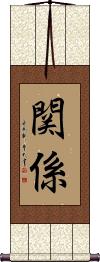
The dictionary definition is:
relation, relationship, connection, participation, involvement, concern, influence, effect, related to, connected to, or as a suffix to sexual it can mean sexual relations or relationship.
But there's more to it...
In Japan, the relationship that you have with certain people can open doors for you. Having this relationship with someone also means they would never rip you off but instead are honor-bound to treat you fairly.
See our Chinese Guanxi entry for more information. This term is used in very similar ways in China, Japan, and Korea.
See Also: Guanxi
Beautiful Life / Life in Perfect Harmony
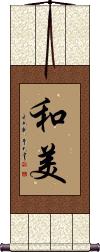
和美 is a word that means “harmonious” or, “in perfect harmony.”
The deeper meaning or more natural translation would be something like, “beautiful life.”
The first character means peace and harmony.
The second character means beautiful. But in this case, when combined with the first character, beautiful refers to being satisfied with what you have in your life. This can be having good relations, good feelings, comfort, and having enough (with no feeling of wanting).
Note: In Japanese, this is often used as the name "Wami." This title is probably more appropriate if your audience is Chinese.
Flying Tigers AVG
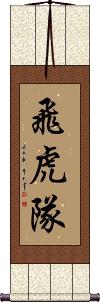
飛虎隊 is the full Chinese title of the “Flying Tigers Group.”
These were the American pilots that volunteered to go to China and fight the Japanese before the entry of the USA into World War Two. These fighter pilots were so esteemed in China that fallen American pilots could always find refuge in villages and safe passage and escape to areas of China that were not occupied by Japan at that time. Chinese villagers helped such fallen pilots with full knowledge that when the Japanese occupation forces found out, all the men, women, and children in the village would be massacred by Japanese troops (there are more than a few known cases of such massacres).
The Flying Tigers successfully kept supply lines to the Chinese resistance open and divided Japanese forces at a crucial time while America prepared to join WWII officially.
A wall scroll like this honors the men who risked or gave their lives as noble volunteers and is a reminder of the best moment in the history of Sino-American relations.
These three characters literally mean “flying tiger(s) group/team/squad.”
Note: Hanging these characters on your wall will not make you any friends with Japanese people who are aware or this history (most Japanese have no idea, as Japan’s involvement in WWII has all but been erased from school textbooks in Japan).
Guanxi
The Chinese Concept of Relationship and Exchange of Favors
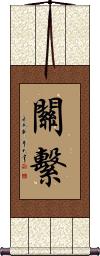
The dictionary definition is:
Relations/relationship, to concern, to affect, to have to do with, or connection.
But there's more to it...
In China, the relationship that you have with certain people can open doors for you. Having guanxi with someone also means they would never defraud you but are honor-bound to treat you fairly (of course, this goes both ways). Sometimes it is suggested that guanxi is the exchange of favors. 關繫 / 関繫 / 關係 is more about having a relationship that allows you to ask for and expect favors without shame.
There is no concept in western culture that exactly matches guanxi, but perhaps having a social or professional network is similar.
Note that there are some variations common within Chinese, Japanese Kanji, and Korean Hanja for this word... Japanese tend to use a Chinese alternate form as shown to the right for
the first character.
 There's also another alternate form of that first character (currently used as the official Simplified form in mainland China) which looks like the character shown to the right. It's basically the central radical of the alternate version shown above but without the “door radical” around it. In more free-flowing calligraphy styles, this version would be the likely choice for a calligrapher.
 In Modern Japanese, they use the character shown to the right.
They also tend to use this same form in Korean Hanja (I've only checked this word in my Korean dictionary, but it has not been confirmed by a translator's review).
 If that was not confusing enough, there is another alternate form of that second character. See right.
An Asian calligrapher of any nationality may use these forms at their discretion. However, They would tend to stick to the most common form used in their respective languages.
If you have any preference on any of these issues, please give us a special note with your order, and we'll make sure it's done the way you want.
Not the results for Relations that you were looking for?
Below are some entries from our dictionary that may match your Relations search...
| Characters If shown, 2nd row is Simp. Chinese |
Pronunciation Romanization |
Simple Dictionary Definition |
友誼 友谊 see styles |
yǒu yì you3 yi4 yu i tomoyoshi ともよし |
More info & calligraphy: Friendshipfriendship; friendly relations; fellowship; (personal name) Tomoyoshi |
関係 see styles |
riezon りえぞん |
More info & calligraphy: Relationship |
亂 乱 see styles |
luàn luan4 luan ran |
in confusion or disorder; in a confused state of mind; disorder; upheaval; riot; illicit sexual relations; to throw into disorder; to mix up; indiscriminate; random; arbitrary Disturb, perturb, confusion, disorder, rebellion. |
粋 see styles |
cuì cui4 ts`ui tsui sui すい |
Japanese variant of 粹 (1) essence; the best; cream; (noun or adjectival noun) (2) (See 粋・いき・1) chic; smart; stylish; tasteful; refined; sophisticated; (noun or adjectival noun) (3) considerate; understanding; thoughtful; tactful; (noun or adjectival noun) (4) familiar with worldly pleasures (esp. sexual relations, geisha districts and red-light districts); (female given name) Sui |
誼 谊 see styles |
yì yi4 i yoshimi よしみ |
friendship; also pr. [yi2] (kana only) friendship; friendly relations; connection; relation; intimacy; (female given name) Yoshimi right |
通 see styles |
tòng tong4 t`ung tung michiaki みちあき |
classifier for an activity, taken in its entirety (tirade of abuse, stint of music playing, bout of drinking etc) (n,n-suf,adj-na) (1) authority; expert; connoisseur; well-informed person; (counter) (2) counter for messages, letters, notes, documents, etc.; (noun or adjectival noun) (3) understanding (esp. of male-female relations); tact; insight; (4) supernatural powers; magical powers; (given name) Michiaki Permeate, pass through, pervade; perceive, know thoroughly; communicate; current; free, without hindrance, unimpeded universal; e.g. 神通 supernatural, ubiquitous powers. There are categories of 五通, 六通, and 十通, all referring to supernatural powers; the five are (1) knowledge of the supernatural world; (2) deva vision; (3) deva hearing; (4) knowledge of the minds of all others; (5) knowledge of all the transmigrations of self and all others. The six are the above together with perfect wisdom for ending moral hindrance and delusion. The ten are knowing all previous transmigrations, having deva hearing, knowing the minds of others, having deva vision, showing deva powers, manifesting many bodies or forms, being anywhere instantly, power of bringing glory to one's domain, manifesting a body of transformation, and power to end evil and transmigration. |
IR see styles |
ai aaru; aiaaru(sk) / ai aru; aiaru(sk) アイ・アール; アイアール(sk) |
(1) (See 情報検索) information retrieval; IR; (2) investor relations; (3) (See 統合型リゾート) integrated resort; (4) (See 赤外線) infrared radiation; infrared; (5) (See イソプレンゴム) isoprene rubber |
PR see styles |
pii aaru; piiaaru(sk) / pi aru; piaru(sk) ピー・アール; ピーアール(sk) |
(See パブリックリレーションズ) PR; public relations |
七情 see styles |
qī qíng qi1 qing2 ch`i ch`ing chi ching shichijou / shichijo しちじょう |
seven emotional states; seven affects of traditional Chinese medical theory and therapy, namely: joy 喜[xi3], anger 怒[nu4], anxiety 憂|忧[you1], thought 思[si1], grief 悲[bei1], fear 恐[kong3], fright 驚|惊[jing1]; seven relations (1) seven emotions (in The Book of Rites: joy, anger, sorrow, fear, love, hate, desire); seven emotions (in Buddhism: joy, anger, sorrow, pleasure, love, hate, desire); (2) seven effects (of a traditional Chinese medicine); (surname) Shichijō The seven emotions : pleasure, anger, sorrow, joy, love, hate, desire. |
中澳 see styles |
zhōng ào zhong1 ao4 chung ao |
China-Australia (relations) |
中非 see styles |
zhōng fēi zhong1 fei1 chung fei |
China-Africa (relations); Central Africa; Central African Republic |
乱婚 see styles |
rankon らんこん |
(See 雑婚・1) promiscuity; promiscuous sexual relations |
交情 see styles |
jiāo qing jiao1 qing5 chiao ch`ing chiao ching koujou / kojo こうじょう |
friendship; friendly relations intimacy; friendship |
交接 see styles |
jiāo jiē jiao1 jie1 chiao chieh kousetsu / kosetsu こうせつ |
(of two things) to come into contact; to meet; to hand over to; to take over from; to associate with; to have friendly relations with; to have sexual intercourse (n,vs,vi) (1) sexual intercourse; (n,vs,vi) (2) {zool} copulation; mating |
交歡 交欢 see styles |
jiāo huān jiao1 huan1 chiao huan |
to have cordial relations with each other; to have sexual intercourse |
交渉 see styles |
koushou / kosho こうしょう |
(n,vs,vt,vi) (1) negotiations; bargaining; discussions; talks; (2) connection; relationship; relations; dealings |
人事 see styles |
rén shì ren2 shi4 jen shih jinji じんじ |
personnel; human resources; human affairs; ways of the world; (euphemism) sexuality; the facts of life personnel affairs; human affairs; human resources; HR human relations |
人倫 人伦 see styles |
rén lún ren2 lun2 jen lun jinrin じんりん |
ethical norms governing human relationships human relations; humanity human relationship |
人緣 人缘 see styles |
rén yuán ren2 yuan2 jen yüan |
relations with other people |
修好 see styles |
xiū hǎo xiu1 hao3 hsiu hao nobuyoshi のぶよし |
to repair (something broken); to restore (something damaged); to establish friendly relations with; (literary) to do meritorious deeds (noun/participle) amity; friendship; (personal name) Nobuyoshi |
元因 see styles |
yuán yīn yuan2 yin1 yüan yin gan'in |
原因 The original or fundamental cause which produces phenomena, e. g. karma, reincarnation, etc.; every cause has its fruit or consequences. The idea of cause and effect is a necessary condition of antecedent and consequence; it includes such relations as interaction, correlation, interdependence, co-ordination based on an intrinsic necessity. |
公使 see styles |
gōng shǐ gong1 shi3 kung shih kuramu くらむ |
minister; diplomat performing ambassadorial role in Qing times, before regular diplomatic relations envoy; diplomat below the rank of ambassador (e.g. deputy chief of mission, charge d'affaires); minister (of legation); (surname) Kuramu |
公關 公关 see styles |
gōng guān gong1 guan1 kung kuan |
public relations |
六親 六亲 see styles |
liù qīn liu4 qin1 liu ch`in liu chin rokushin ろくしん |
six close relatives, namely: father 父[fu4], mother 母[mu3], older brothers 兄[xiong1], younger brothers 弟[di4], wife 妻[qi1], male children 子[zi3]; one's kin the six blood relations The six immediate relations— father and mother, wife and child, elder and younger brothers. |
冰釋 冰释 see styles |
bīng shì bing1 shi4 ping shih |
to dispel (enmity, misunderstandings etc); to vanish (of misgivings, differences of opinion); thaw (in relations) |
割席 see styles |
gē xí ge1 xi2 ko hsi |
(literary) to break off relations with a friend; to sever ties with sb |
労委 see styles |
roui / roi ろうい |
(abbreviation) (See 労働委員会) labor-relations board; labour-relations board |
友宜 see styles |
yuugi / yugi ゆうぎ |
friendship; friendly relations; fellowship |
和睦 see styles |
hé mù he2 mu4 ho mu waboku わぼく |
peaceful relations; harmonious (n,vs,vi) reconciliation; peace; rapprochement Concord, harmony. |
啖う see styles |
kuu / ku くう |
(out-dated kanji) (transitive verb) (1) (masculine speech) to eat; (2) to live; to make a living; to survive; (3) to bite; to sting (as insects do); (4) to tease; to torment; to taunt; to make light of; to make fun of; (5) to encroach on; to eat into; to consume; (6) to defeat a superior; to threaten a position; (7) to consume time and-or resources; (8) (colloquialism) to receive something (usu. an unfavourable event); (9) (masculine speech) (vulgar) to have sexual relations with a woman, esp. for the first time |
Click here for more Relations results from our dictionary
The following table may be helpful for those studying Chinese or Japanese...
| Title | Characters | Romaji (Romanized Japanese) | Various forms of Romanized Chinese | |
| Relationship | 關繫 / 関繫 / 關係 関係 | kan kei / kankei | guān xì / guan1 xi4 / guan xi / guanxi | kuan hsi / kuanhsi |
| Beautiful Life Life in Perfect Harmony | 和美 | wa mi / wami | hé měi / he2 mei3 / he mei / hemei | ho mei / homei |
| Flying Tigers AVG | 飛虎隊 飞虎队 | fēi hǔ duì fei1 hu3 dui4 fei hu dui feihudui | fei hu tui feihutui |
|
| Guanxi | 關繫 / 関繫 / 關係 关系 / 関係 | kankei | guān xì / guan1 xi4 / guan xi / guanxi | kuan hsi / kuanhsi |
| In some entries above you will see that characters have different versions above and below a line. In these cases, the characters above the line are Traditional Chinese, while the ones below are Simplified Chinese. | ||||

Successful Chinese Character and Japanese Kanji calligraphy searches within the last few hours...



