Many custom options...


And formats...



Protec in Chinese / Japanese...
Buy a Protec calligraphy wall scroll here!
Personalize your custom “Protec” project by clicking the button next to your favorite “Protec” title below...
Switched to secondary search mode due to lack of results using primary.
These secondary results may not be very accurate. Try a different but similar meaning word or phrase for better results. Or...
Look up Protec in my Japanese Kanji & Chinese Character Dictionary(My dictionary is a different system then the calligraphy search you just tried)
If you want a special phrase, word, title, name, or proverb, feel free to contact me, and I will translate your custom calligraphy idea for you.
3. Fierce and courageous training defeats the strong and protects the body.
4. God Bless You / May God Protect You
5. Protect Guard Treasure Cherish
6. Guan Shi Yin: Protector Of Life
8. Duty to Defend and Protect Country
10. Protection
11. Protector
Blessings and Protection
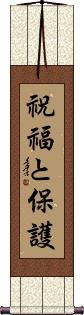
祝福と保護 means “blessings and protection,” in Japanese.
Divine Protection
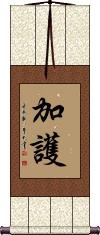
加護 is Japanese for “divine protection” or “the saving grace of God.”
Please consider this blessing to be Japanese only. This can have the same meaning in the context of Buddhism in Chinese, but it's also a nickname for “intensive care” at Chinese hospitals.
Note: My Japanese translator says this is not commonly used in Japanese. I added this because a customer asked for it. There is no better Japanese phrase to express this idea - so this is it if you want it.
Fierce and courageous training defeats the strong and protects the body.

This is a martial arts phrase that roughly translates as, “Fierce and courageous training defeats the strong and protects the body,” or “Brave and fierce training result in victory over the strong and defend the body.”
God Bless You / May God Protect You
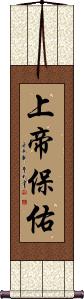
上帝保佑 is a blessing exchanged between Chinese Christians.
The first two characters mean God (The God of Zion). The second two characters express the idea of giving protection. Another way to translate this is “May God protect you.”
See Also: Guardian Angel
Protect Guard Treasure Cherish
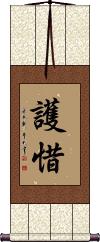
護惜 is a Zen Buddhist word that means to protect, guard, treasure, and/or cherish.
Guan Shi Yin: Protector Of Life
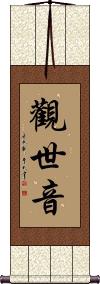
觀世音 is an alternate title for Guanyin, the Bodhisattva of Compassion or Goddess of Mercy.
觀世音 is the Buddhist bestower of children, the protector of life and all in distress (especially of those at sea).
Love and Protect
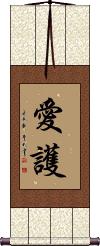
愛護 is the Chinese and Japanese Kanji for cherish, to treasure, to take care of, to love and protect, to provide loving protection, or tender care.
Duty to Defend and Protect Country
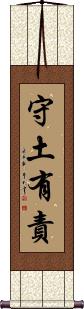
守土有責 is a Chinese proverb that expresses one's duty to defend the country.
守 means to guard, defend, keep watch, abide by the law, and/or observe (rules or ritual).
土 means land, earth, or soil.
有 is a possessive modifier in effect meaning “is a.”
責 means duty or responsibility.
So you get a literal translation of “Protecting [the] land is [a] duty/responsibility.”
Blessings and Protection
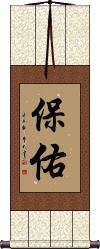
保佑 is the more religious and sometimes superstitious word for protection in Chinese. It's sort of a blessing of protection and is often translated as “bless and protect,” “blessing,” or “to bless.”
This would be used as the protection or blessing that a deity (such as God) would bestow upon you. It is not religion-specific in the same way a language cannot be specific to any religion.
 Note: Sometimes the second character is written in the form shown to the right. Let us know if you have a preference when you place your order.
See Also: Guardian Angel
Protection
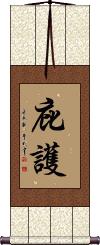
庇護 is not the most common word for a wall scroll, but this is the word for protection in Chinese, Japanese Kanji, and old Korean Hanja.
庇護 is the non-religious, non-superstitious form of protection.
庇護 can be translated as shelter, shield, defend, safeguard, take under one's wing, to put under protection. In a certain context, it means to grant asylum or give refuge and sanctuary.
See Also: Guardian Angel
Protector
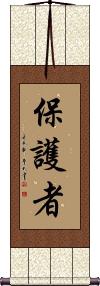
保護者 is the universal word for protector in Chinese, Japanese Kanji, and old Korean Hanja.
The first character means to defend, to protect, to insure or guarantee, to maintain, hold or keep, or to guard.
The second character means to protect.
Together the first and second characters create a word that means to defend, protect, or safeguard.
The last character means person.
Add all three characters together, and you have a word that means “protector,” one who will protect, guard, and keep you safe.
Some will also translate this word as guardian or patron.
Note: Not a common selection for a wall scroll in Asia.
See Also: Guardian Angel
Protector
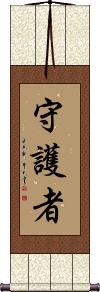
守護者 is a Chinese, Japanese Kanji, and old Korean Hanja title for a protector, watcher, or keeper.
The character breakdown:
守護 = to guard; to protect; protection; safeguard.
者 = person; someone of that nature; someone doing that work, the one [who, which].
From this breakdown, you can translate this as “The one who protects,” “Someone who safeguards,” or “guardian.”
Under the Protection of the Dragon Saint
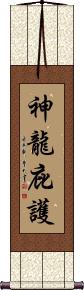
神龍庇護 is not the most common thing to say in Chinese, but it is grammatically correct and a cool title.
The first character means “supernatural or saintly.” The second is “dragon.” The last two mean protection. You could also translate this as something like “Protected by the Dragon God” or more closely “Holy Dragon.”
The following table may be helpful for those studying Chinese or Japanese...
| Title | Characters | Romaji (Romanized Japanese) | Various forms of Romanized Chinese | |
| Blessings and Protection | 祝福と保護 | shukufuku to hogo shukufukutohogo | ||
| Divine Protection | 加護 加护 | ka go / kago | jiā hù / jia1 hu4 / jia hu / jiahu | chia hu / chiahu |
| Fierce and courageous training defeats the strong and protects the body. | 剛勇之猛練勝強而保體 刚勇之猛练胜强而保体 | gāng yǒng zhī měng liàn shèng qiáng ér bǎo tǐ gang1 yong3 zhi1 meng3 lian4 sheng4 qiang2 er2 bao3 ti3 gang yong zhi meng lian sheng qiang er bao ti | kang yung chih meng lien sheng ch`iang erh pao t`i kang yung chih meng lien sheng chiang erh pao ti |
|
| God Bless You May God Protect You | 上帝保佑 | shàng dì bǎo yòu shang4 di4 bao3 you4 shang di bao you shangdibaoyou | shang ti pao yu shangtipaoyu |
|
| Protect Guard Treasure Cherish | 護惜 护惜 | goshaku | hù xí / hu4 xi2 / hu xi / huxi | hu hsi / huhsi |
| Guan Shi Yin: Protector Of Life | 觀世音 观世音 | kanzeon | guān shì yīn guan1 shi4 yin1 guan shi yin guanshiyin | kuan shih yin kuanshihyin |
| Love and Protect | 愛護 爱护 | ai go / aigo | ài hù / ai4 hu4 / ai hu / aihu | |
| Duty to Defend and Protect Country | 守土有責 守土有责 | shǒu tǔ yǒu zé shou3 tu3 you3 ze2 shou tu you ze shoutuyouze | shou t`u yu tse shoutuyutse shou tu yu tse |
|
| Blessings and Protection | 保佑 / 保祐 保佑 | bǎo yòu / bao3 you4 / bao you / baoyou | pao yu / paoyu | |
| Protection | 庇護 庇护 | hi go / higo | bì hù / bi4 hu4 / bi hu / bihu | pi hu / pihu |
| Protector | 保護者 保护者 | hogosha | bǎo hù zhě bao3 hu4 zhe3 bao hu zhe baohuzhe | pao hu che paohuche |
| Protector | 守護者 守护者 | shu go sha / shugosha | shǒu hù zhě shou3 hu4 zhe3 shou hu zhe shouhuzhe | shou hu che shouhuche |
| Under the Protection of the Dragon Saint | 神龍庇護 神龙庇护 | shén lóng bì hù shen2 long2 bi4 hu4 shen long bi hu shenlongbihu | shen lung pi hu shenlungpihu |
|
| In some entries above you will see that characters have different versions above and below a line. In these cases, the characters above the line are Traditional Chinese, while the ones below are Simplified Chinese. | ||||

Successful Chinese Character and Japanese Kanji calligraphy searches within the last few hours...



