Many custom options...


And formats...



Prin in Chinese / Japanese...
Buy a Prin calligraphy wall scroll here!
Personalize your custom “Prin” project by clicking the button next to your favorite “Prin” title below...
Switched to secondary search mode due to lack of results using primary.
These secondary results may not be very accurate. Try a different but similar meaning word or phrase for better results. Or...
Look up Prin in my Japanese Kanji & Chinese Character Dictionary(My dictionary is a different system then the calligraphy search you just tried)
If you want a special phrase, word, title, name, or proverb, feel free to contact me, and I will translate your custom calligraphy idea for you.
2. Beauty / Beautiful Princess
4. The Five Principles of Reiki
8. Prince
9. Princess
10. Better to sacrifice your life than your principles
12. Prine
13. Pringle
14. Prinsloo
15. Springer
16. Springs
17. Spring Season
18. Sprinkle
19. Fundamental Principles of Tai Chi Chuan
20. You must endure a harsh winter to appreciate the warmth of springtime
Beautiful Princess
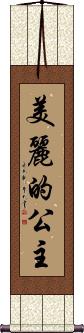
美麗的公主 is how to write beautiful princess in Chinese.
The first two characters mean feminine beauty or rather a way to say beautiful that only applies to women. The middle character is just a connecting character. The last two characters mean princess.
See Also: Queen
Beauty / Beautiful Princess
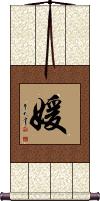
媛 means, a beauty; beautiful (woman); princess; a young lady of noble birth; girl; small & lovely.
媛 is used a bit more commonly in Chinese than in Japanese.
Note: This can be the female given name "Hime" in Japanese.
The Principles of Buddhism
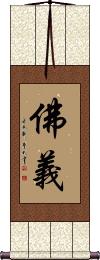
In short, 佛義 is the Principles of Buddhism, but there is more (especially for the second character):
佛 is the character for the Buddha and Buddhism.
義 has deeper meanings including justice, righteousness, morality, honour/honor, teachings, doctrine, right, proper, righteous, loyalty, purpose, or meaning. So the single word “principles” is often used to encompass all these ideas.
The Five Principles of Reiki
Reiki Gokai

These are the five principles of Reiki.
They translate into English as...
At least for today:
Do not be angry,
Do not worry,
Be grateful,
Work with diligence,
Be kind to people.
Note: Because this selection contains some special Japanese Hiragana characters, it should be written by a Japanese calligrapher.
Harusame / Spring Rain
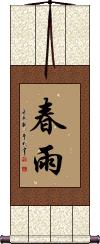
春雨 is a Japanese name that means gentle spring rain or gift from above.
It has the same meaning (and can be a given name) in Chinese.
Having High Principles
Do not bow down for the sake of five pecks of rice
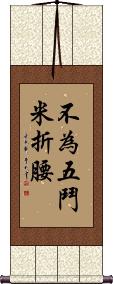
不为五斗米折腰 is a Chinese idiom/proverb that speaks of being above bribes and not losing face or honor for short-term gain.
Some may also translate the perceived meaning as “high-hearted” or “integrity beyond reproach.”
The more literal meaning is “Do not bow down for the sake of five pecks of rice.”
Moral Principles Of Life
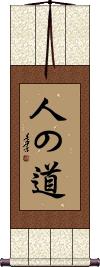
人の道 is the Japanese way to express the “moral way of life,” “correct path,” or “moral principles.”
Prince
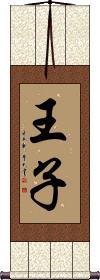
王子 is prince in Chinese characters and Japanese Kanji.
If you look at the meaning of each character, the first means king, and the second means son (or child). Thus, “King's Son,” “Son of the King,” or “King's Child” is the literal meaning of this title.
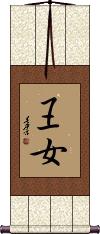
Princess
Better to sacrifice your life than your principles
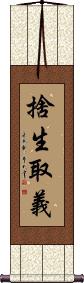
捨生取義 is a Chinese proverb that comes from the philosopher Mencius.
It can be translated in a few different ways:
To give up life for righteousness.
To choose honor over life
Better to sacrifice one's life than one's principles.
Principles of Life
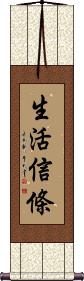
生活信條 is a Chinese proverb that means “principles of life” or “The personal obligations and rules that you live by.”
For instance, if you were a vegetarian, the act of not eating meat fits into this category.
This could also be translated as a “Way of living.”
Prine

普林 is the name Prine in Chinese (Mandarin).
Prine

プライン is the name Prine in Japanese Katakana.
Note: Because this title is entirely Japanese Katakana, it should be written by a Japanese calligrapher.
Pringle

普林格爾 is the name Pringle in Chinese (Mandarin).
Pringle

プリングル is the name Pringle in Japanese Katakana.
Note: Because this title is entirely Japanese Katakana, it should be written by a Japanese calligrapher.
Prinsloo

普林斯盧 is the name Prinsloo in Chinese (Mandarin).
Prinsloo

プリンスルー is the name Prinsloo in Japanese Katakana.
Note: Because this title is entirely Japanese Katakana, it should be written by a Japanese calligrapher.
Springer

斯普林格 is the name Springer in Chinese (Mandarin).
Springer

スプリンガー is the name Springer in Japanese Katakana.
Note: Because this title is entirely Japanese Katakana, it should be written by a Japanese calligrapher.
Springs

斯普林斯 is the name Springs in Chinese (Mandarin).
Springs

スプリングス is the name Springs in Japanese Katakana.
Note: Because this title is entirely Japanese Katakana, it should be written by a Japanese calligrapher.
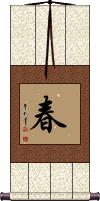
Spring Season
Sprinkle

斯普林克 is the name Sprinkle in Chinese (Mandarin).
Sprinkle

スプリンクル is the name Sprinkle in Japanese Katakana.
Note: Because this title is entirely Japanese Katakana, it should be written by a Japanese calligrapher.
Fundamental Principles of Tai Chi Chuan
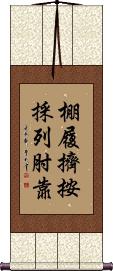
Peng, Lu, Ji, An, Cai, Lie, Zhou, and Kao are the eight fundamentals or forces of Tai Chi Chuan or Taiqiquan.
棚 (Peng) refers to the outward (or upward) expansion of energy.
履 (Lu) is often referred to as “rollback.” Lu is the ability to absorb, yield/deflect incoming force.
擠 (Ji) is often thought of as a “forward press.” However, it is also best described as a “squeezing out of space.”
按 (An) is a downward movement of energy, best translated as “(relaxed) sinking.”
採 (Cai or Tsai) translated as “downward pluck.” Cai is a combination of Lu and An.
列 (Lie or Lieh) is “Split” and is a combination of Peng and Ji.
肘 (Zhou) Elbowing.
靠 (Kao) Shouldering (for when the arms are bound/distance is too close to punch).
Source: https://combativecorner.wordpress.com/2015/12/03/the-8-energies-and-5-movements-of-taijiquan/
You must endure a harsh winter to appreciate the warmth of springtime
You must know hardship to appreciate happiness
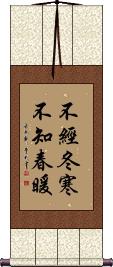
This literally translates as: Without having experienced the cold of winter, one cannot appreciate the warmth of spring.
Figuratively, this means: One cannot truly appreciate happiness without having gone through hardship.
There are many contrasts in life. One simply cannot fully know what joy is without having experienced misery, difficulty, and pain. How could you explain “light” if you did not have “darkness” to compare it to?
Embrace hardship, as it makes the good times seem even better.
The following table may be helpful for those studying Chinese or Japanese...
| Title | Characters | Romaji (Romanized Japanese) | Various forms of Romanized Chinese | |
| Beautiful Princess | 美麗的公主 美丽的公主 | měi lì de gōng zhǔ mei3 li4 de gong1 zhu3 mei li de gong zhu meilidegongzhu | mei li te kung chu meilitekungchu |
|
| Beauty Beautiful Princess | 媛 | hime / haru | yuàn / yuan4 / yuan | yüan |
| The Principles of Buddhism | 佛義 佛义 | butsu gi / butsugi | fó yì / fo2 yi4 / fo yi / foyi | fo i / foi |
| The Five Principles of Reiki | 今日丈けは怒るな心配すな感謝して業をはけめ人に親切に | kyou da ke wa oko ru na shin pai su na kan sha shi te gyou wo ha ke me hito ni shin setsu ni kyo da ke wa oko ru na shin pai su na kan sha shi te gyo wo ha ke me hito ni shin setsu ni | ||
| Harusame Spring Rain | 春雨 | harusame | chūn yǔ / chun1 yu3 / chun yu / chunyu | ch`un yü / chunyü / chun yü |
| Having High Principles | 不為五斗米折腰 不为五斗米折腰 | bù wèi wǔ dǒu mǐ zhé yāo bu4 wei4 wu3 dou3 mi3 zhe2 yao1 bu wei wu dou mi zhe yao buweiwudoumizheyao | pu wei wu tou mi che yao puweiwutoumicheyao |
|
| Moral Principles Of Life | 人の道 | hitonomichi | ||
| Prince | 王子 | ou ji / ouji / o ji | wáng zǐ / wang2 zi3 / wang zi / wangzi | wang tzu / wangtzu |
| Princess | 王女 | oujo / ojo | ||
| Better to sacrifice your life than your principles | 捨生取義 舍生取义 | shě shēng qǔ yì she3 sheng1 qu3 yi4 she sheng qu yi sheshengquyi | she sheng ch`ü i sheshengchüi she sheng chü i |
|
| Principles of Life | 生活信條 生活信条 | shēng huó xìn tiáo sheng1 huo2 xin4 tiao2 sheng huo xin tiao shenghuoxintiao | sheng huo hsin t`iao shenghuohsintiao sheng huo hsin tiao |
|
| Prine | 普林 | pǔ lín / pu3 lin2 / pu lin / pulin | p`u lin / pulin / pu lin | |
| Prine | プライン | purain | ||
| Pringle | 普林格爾 普林格尔 | pǔ lín gé ěr pu3 lin2 ge2 er3 pu lin ge er pulingeer | p`u lin ko erh pulinkoerh pu lin ko erh |
|
| Pringle | プリングル | puringuru | ||
| Prinsloo | 普林斯盧 普林斯卢 | pǔ lín sī lú pu3 lin2 si1 lu2 pu lin si lu pulinsilu | p`u lin ssu lu pulinssulu pu lin ssu lu |
|
| Prinsloo | プリンスルー | purinsuruu / purinsuru | ||
| Springer | 斯普林格 | sī pǔ lín gé si1 pu3 lin2 ge2 si pu lin ge sipulinge | ssu p`u lin ko ssupulinko ssu pu lin ko |
|
| Springer | スプリンガー | supuringaa / supuringa | ||
| Springs | 斯普林斯 | sī pǔ lín sī si1 pu3 lin2 si1 si pu lin si sipulinsi | ssu p`u lin ssu ssupulinssu ssu pu lin ssu |
|
| Springs | スプリングス | supuringusu | ||
| Spring Season | 春 | haru | chūn / chun1 / chun | ch`un / chun |
| Sprinkle | 斯普林克 | sī pǔ lín kè si1 pu3 lin2 ke4 si pu lin ke sipulinke | ssu p`u lin k`o ssupulinko ssu pu lin ko |
|
| Sprinkle | スプリンクル | supurinkuru | ||
| Fundamental Principles of Tai Chi Chuan | 棚履擠按採列肘靠 棚履挤按采列肘靠 | péng lǚ jǐ àn cǎi liè zhǒu kào peng2 lv3 ji3 an4 cai3 lie4 zhou3 kao4 peng lv ji an cai lie zhou kao penglvjiancailiezhoukao | p`eng lü chi an ts`ai lieh chou k`ao peng lü chi an tsai lieh chou kao |
|
| You must endure a harsh winter to appreciate the warmth of springtime | 不經冬寒不知春暖 不经冬寒不知春暖 | bù jīng dōng hán bù zhī chūn nuǎn bu4 jing1 dong1 han2 bu4 zhi1 chun1 nuan3 bu jing dong han bu zhi chun nuan | pu ching tung han pu chih ch`un nuan pu ching tung han pu chih chun nuan |
|
| In some entries above you will see that characters have different versions above and below a line. In these cases, the characters above the line are Traditional Chinese, while the ones below are Simplified Chinese. | ||||

Successful Chinese Character and Japanese Kanji calligraphy searches within the last few hours...



