Many custom options...


And formats...



Pond in Chinese / Japanese...
Buy a Pond calligraphy wall scroll here!
Personalize your custom “Pond” project by clicking the button next to your favorite “Pond” title below...
Drain the pond to get all the fish
Kill the goose that lays the golden eggs
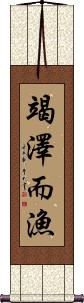
In 632 BC, Duke Wen of the Kingdom of Jin was about to lead an army against the forces of the Kingdom of Chu.
The Duke asked one of his advisers, Jiu Fan, how they could win the impending battle, as they were drastically outnumbered.
Jiu Fan said, “All is fair in war,” and suggested a plan of dishonorable tactics (cheating).
The Duke was unsure of this advice, so he asked another adviser, Yong Ji, who replied, “If you catch fish by draining the pond, you can certainly get all the fish. But there will be no fish the following year. You can cheat this one time in battle, but such tactics can only be used once, as the enemy will be wise in future encounters.”
The Duke heard the words of his wiser adviser but cheated to gain victory in the battle. However, he rewarded Yong Ji more than Jiu Fan at the victory celebration, stating that while Jiu Fan's advice gained one victory, the wise words of Yong Ji would last forever.
This Chinese idiom/proverb is still used, over 2600 years later to remind people not to burn bridges, cheat, or dishonor themselves in exchange for a short-term gain while sacrificing the future.
竭澤而漁 is very similar to the meaning of the English phrase, “Kill the goose that lays the golden eggs.”
Mind Like Water
Mizu No Kokoro
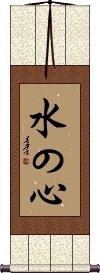
水の心 is the Japanese Buddhist and martial arts phrase, “Mizu no Kokoro,” which means “mind like water” or “heart of water.”
The phrase is a metaphor describing the pond that clearly reflects its surroundings when calm but whose images are obscured once a pebble is dropped into its waters.
No Mind / Mushin
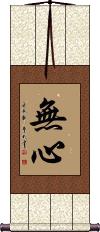
In Japanese, 無心 means innocent or without knowledge of good and evil. It literally means “without mind.”
無心 is one of the five spirits of the warrior (budo) and is often used as a Japanese martial arts tenet. Under that context, places such as the Budo Dojo define it this way: “No mind, a mind without ego. A mind like a mirror which reflects and dos not judge.” The original term was “mushin no shin,” meaning “mind of no mind.” It is a state of mind without fear, anger, or anxiety. Mushin is often described by the phrase “Mizu no Kokoro,” which means “mind like water.” The phrase is a metaphor describing the pond that clearly reflects its surroundings when calm but whose images are obscured once a pebble is dropped into its waters.
This has a good meaning in conjunction with Chan / Zen Buddhism in Japan. However, out of that context, it means mindlessness or absent-mindedness. To non-Buddhists in China, this is associated with doing something without thinking.
In Korean, this usually means indifference.
Use caution and know your audience before ordering this selection.
More info: Wikipedia: Mushin
Push or Knock
To weigh one's words
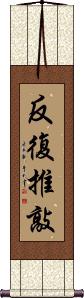
During the Tang Dynasty, a man named Jia Dao (born in the year 779), a well-studied scholar and poet, went to the capital to take the imperial examination.
One day as he rides a donkey through the city streets, a poem begins to form in his mind. A portion of the poem comes into his head like this:
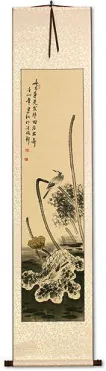
“The bird sits on the tree branch near a pond,
A monk approaches and knocks at the gate...”
At the same time, he wondered if the word “push” would be better than “knock” in his poem.
As he rides down the street, he imagines the monk pushing or knocking. Soon he finds himself making motions of pushing and shaking a fist in a knocking motion as he debates which word to use. He is quite a sight as he makes his way down the street on his donkey with hands and fists flying about as the internal debate continues.
As he amuses people along the street, he becomes completely lost in his thoughts and does not see the mayor's procession coming in the opposite direction. Jia Bao is blocking the way for the procession to continue down the road, and the mayor's guards immediately decide to remove Jia Bao by force. Jia Bao, not realizing that he was in the way, apologizes, explains his poetic dilemma and awaits his punishment for blocking the mayor's way.
The mayor, Han Yu, a scholar and author of prose himself, finds himself intrigued by Jia Dao's poem and problem. Han Yu gets off his horse and addresses Jia Bao, stating, “I think knock is better.” The relieved Jia Bao raises his head and is invited by the mayor to join the procession, and are seen riding off together down the street, exchanging their ideas and love of poetry.
In modern Chinese, this 反復推敲 idiom is used when someone is trying to decide which word to use in their writing or when struggling to decide between two things when neither seems to have a downside.
This in-stock artwork might be what you are looking for, and ships right away...

Gallery Price: $60.00
Your Price: $36.88

Gallery Price: $60.00
Your Price: $36.88

Gallery Price: $340.00
Your Price: $188.88
Gallery Price: $340.00
Your Price: $188.88
Gallery Price: $304.00
Your Price: $168.88

Gallery Price: $60.00
Your Price: $36.88
Gallery Price: $340.00
Your Price: $188.88

Gallery Price: $65.00
Your Price: $35.88

Gallery Price: $65.00
Your Price: $35.88

Gallery Price: $60.00
Your Price: $39.88
Gallery Price: $126.00
Your Price: $69.88
These search terms might be related to Pond:
Not the results for Pond that you were looking for?
Below are some entries from our dictionary that may match your Pond search...
| Characters If shown, 2nd row is Simp. Chinese |
Pronunciation Romanization |
Simple Dictionary Definition |
澤 泽 see styles |
zé ze2 tse yanazawa やなざわ |
More info & calligraphy: Zee(surname) Yanazawa |
竭澤而漁 竭泽而渔 see styles |
jié zé ér yú jie2 ze2 er2 yu2 chieh tse erh yü |
More info & calligraphy: Drain the pond to get all the fish |
埧 see styles |
jù ju4 chü |
diked pond |
塘 see styles |
táng tang2 t`ang tang tomo とも |
dyke; embankment; pool or pond; hot-water bathing pool (surname, given name) Tomo |
池 see styles |
chí chi2 ch`ih chih tsuruike つるいけ |
pond; reservoir; moat pond; (surname) Tsuruike pond |
沼 see styles |
zhǎo zhao3 chao masanori まさのり |
pond; pool (1) marsh; swamp; wetland; bog; pond; (n,n-suf) (2) (slang) obsession; addiction; being hooked on; getting sucked into; (3) (net-sl) ugly man; (4) (net-sl) (derogatory term) (See 池沼・2) retard; mentally disabled person; (personal name) Masanori |
洿 see styles |
wū wu1 wu |
dig (a pond); stagnant water |
溏 see styles |
táng tang2 t`ang tang |
half congealed; pond |
滊 see styles |
xiē xie1 hsieh |
saline pond |
潢 see styles |
huáng huang2 huang |
dye paper; lake; pond; mount scroll |
潭 see styles |
tán tan2 t`an tan tan たん |
deep pool; pond; pit (dialect); depression (1) deep pool; deep water; abyss; (2) depths (e.g. of despair, etc.); grip (e.g. of death); (given name) Tan A deep, a pool. |
瀦 潴 see styles |
zhū zhu1 chu |
pool; pond See: 潴 |
畔 see styles |
pàn pan4 p`an pan kuroyanagi くろやなぎ |
(bound form) side; edge; boundary (1) (kana only) on the bank of; by the side of (e.g. a river, pond); (2) (in the) neighbourhood; neighborhood; vicinity; nearby; (1) (kana only) ridge of earth between rice fields; (2) (kana only) ridge between grooves in threshold or lintel; (3) (abbreviation) footpath between rice fields; causeway; (surname) Kuroyanagi A path between fields, or boundary; to trespass; translit. ban, van, par, pra. v. 般, 班, etc. |
蕩 荡 see styles |
dàng dang4 tang tō |
to wash; to squander; to sweep away; to move; to shake; dissolute; pond to cleanse |
螺 see styles |
luó luo2 lo horagai ほらがい |
spiral shell; snail; conch (kana only) small spiral-shelled snail; (1) (kana only) whelk (esp. Neptunea and Buccinum spp.); (2) small spiral-shelled snail (esp. a pond snail); (out-dated or obsolete kana usage) small spiral-shelled snail (esp. a pond snail); (surname) Horagai A conch, snail, spiral, screw. |
ツブ see styles |
tsubu ツブ |
(1) (kana only) whelk (esp. Neptunea and Buccinum spp.); (2) small spiral-shelled snail (esp. a pond snail) |
中島 中岛 see styles |
zhōng dǎo zhong1 dao3 chung tao nagajima ながじま |
Nakajima or Nakashima (Japanese surname and place name) island in a pond or river; (place-name) Nagajima |
中門 see styles |
nakakado なかかど |
(1) (See 寝殿造り,対の屋,釣り殿) gate in the middle of the corridor connecting an annex to a pond-side building (in traditional palatial-style architecture); (2) central gate (between the main gate and main hall of a temple); (3) central gate (separating the inner and outer gardens of a teahouse); (surname) Nakakado |
偃塞 see styles |
ensoku えんそく |
damming (e.g. a pond) |
公魚 see styles |
wakasagi わかさぎ |
(kana only) Japanese pond smelt (Hypomesus nipponensis); (female given name) Wakasagi |
内池 see styles |
naichi ないち |
garden pond; (surname) Naichi |
前水 see styles |
sensui せんすい |
(1) garden pond; miniature lake; (2) fountain |
古池 see styles |
furuchi ふるち |
old pool; old pond; (surname) Furuchi |
園池 see styles |
sonoike そのいけ |
garden with a pond; (surname) Sonoike |
堰塞 see styles |
ensoku えんそく |
damming (e.g. a pond) |
塗潭 涂潭 see styles |
tú tán tu2 tan2 t`u t`an tu tan |
muddy water in a pool or pond |
塘堰 see styles |
táng yàn tang2 yan4 t`ang yen tang yen |
irrigation pond or dam |
山水 see styles |
shān shuǐ shan1 shui3 shan shui yamamizu やまみず |
water from a mountain; mountains and rivers; scenery; landscape (1) mountain and water; landscape (containing hills and rivers); (2) (さんすい only) (abbreviation) (See 山水画) landscape picture; (3) mountain stream; water that flows down from a mountain; (4) (さんすい only) (See 築山) garden which contains an artificial hill and a pond; (surname) Yamamizu mountains and rivers |
放流 see styles |
houryuu / horyu ほうりゅう |
(noun, transitive verb) (1) discharge (e.g. of water from a dam); (noun, transitive verb) (2) {fish} release of fish (into a river, pond, etc.); stocking with fish (a river, etc.); (noun, transitive verb) (3) (archaism) banishment; exile |
文池 see styles |
wén chí wen2 chi2 wen ch`ih wen chih Monchi |
The dragon pool by the side of the throne of Vajrapāṇi, called 目眞鄰陀 Mucilinda q. v. |
Click here for more Pond results from our dictionary
The following table may be helpful for those studying Chinese or Japanese...
| Title | Characters | Romaji (Romanized Japanese) | Various forms of Romanized Chinese | |
| Drain the pond to get all the fish | 竭澤而漁 竭泽而渔 | jié zé ér yú jie2 ze2 er2 yu2 jie ze er yu jiezeeryu | chieh tse erh yü chiehtseerhyü |
|
| Mind Like Water | 水の心 | mizu no kokoro mizunokokoro | ||
| No Mind Mushin | 無心 无心 | mu shin / mushin | wú xīn / wu2 xin1 / wu xin / wuxin | wu hsin / wuhsin |
| Push or Knock | 反復推敲 反复推敲 | fǎn fù tuī qiāo fan3 fu4 tui1 qiao1 fan fu tui qiao fanfutuiqiao | fan fu t`ui ch`iao fanfutuichiao fan fu tui chiao |
|
| In some entries above you will see that characters have different versions above and below a line. In these cases, the characters above the line are Traditional Chinese, while the ones below are Simplified Chinese. | ||||

Successful Chinese Character and Japanese Kanji calligraphy searches within the last few hours...



