Many custom options...


And formats...



Not what you want?
Try other similar-meaning words, fewer words, or just one word.
Pleasure 1 in Chinese / Japanese...
Buy a Pleasure 1 calligraphy wall scroll here!
Personalize your custom “Pleasure 1” project by clicking the button next to your favorite “Pleasure 1” title below...
1. Pleasure
2. There is no pleasure without pain
7. Happy
9. Enjoy Life
11. Fast
12. 8. Right Concentration / Perfect Concentration
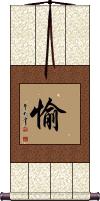
Pleasure
There is no pleasure without pain
No pain, no gain
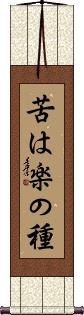
苦は楽の種 is a Japanese proverb that means “One cannot have pleasure without pain.”
It's one of a few Japanese ways to say, “No pain, no gain.”
Note: Because this selection contains some special Japanese Hiragana characters, it should be written by a Japanese calligrapher.
Happiness / Contentment
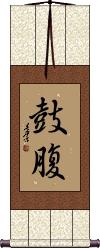
鼓腹 means happiness and contentment in Japanese Kanji.
The first Kanji represents your internal beat or drum.
The second Kanji represents your mind and body.
Together, it suggests that your internal rhythm or beat is regular, soothing, and at the proper tempo.
See Also: Satisfaction | Pleasure | Well-Being
Happiness / Contentment
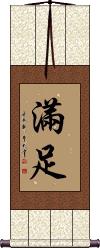
滿足 is the kind of happiness that involves being satisfied and content.
This can also suggest the actions of “to satisfy,” and “to meet the needs of.”
Other single-word definitions include satisfaction, contentment, sufficient, enough, adequate, full, or complete.
 In Japanese, the Kanji for this word is an alternate Chinese form. You can see and select this version at the right (recommended only if your audience is specifically Japanese).
See Also: Satisfaction | Contentment | Pleasure | Well-Being
Kama - Desire Wish Longing
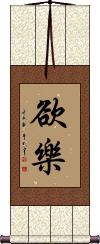
欲樂 is the Chinese and Japanese title representing the Buddhist and Jainist joys of the five desires.
Kama comes from the Pali/Sanskrit काम. The meaning is “desire, wish, longing.”
In Jainism, it can include sensual pleasure, sexual desire, and longing.
However, the Buddhist context refers more to any desire, wish, passion, longing, the pleasure of the senses, desire for, longing to and after, the aesthetic enjoyment of life, affection, or love, enjoyment of love is particularly with or without the enjoyment of sexual, sensual and erotic desire, and is often used without sexual connotations.
Pleasant Feeling
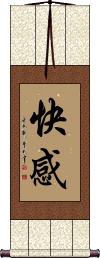
快感 is a Chinese, Japanese, and old Korean word meaning pleasure, thrill, delight, joy, pleasurable sensation, or pleasant feeling.
Eat Drink and Be Merry
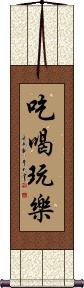
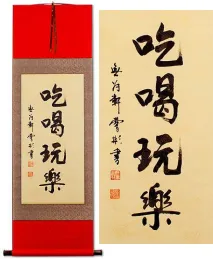
吃喝玩樂 is the short version of, “Eat, drink, and be merry.”
This is a Chinese proverb that suggests abandoning oneself to a life of pleasure.
Happy
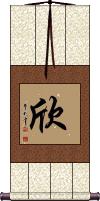
欣 is the type of happiness that you feel on the inside. It is the feeling of being released and delighted as well as being in a state of contentment. 欣 is more the internal happiness that perhaps only shows by the smile on your face. It can also be translated as “to take pleasure in” or “to rejoice.”
Note: 欣 is often used in compound words - especially in Korean Hanja.
As Japanese Kanji, this is so rare, that most Japanese people are not aware of its existence.
See Also: Happiness
Happiness / Joyful / Joy
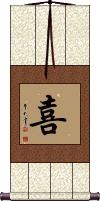
喜 is the Chinese, Japanese Kanji, and Korean Hanja for the kind of happiness known in the west as “joy.”
喜 can also be translated as rejoice, enjoyment, delighted, pleased, or “take pleasure in.” Sometimes it can mean “to be fond of” (in a certain context).
If you write two of these happiness/joy characters side by side, you create another character known in English as “double happiness,” which is a symbol associated with weddings and happy marriages.
There is another version of this character that you will find on our website with an additional radical on the left side (exactly same meaning, just an alternate form). The version of happiness shown here is the commonly written form in China, Japan and South Korea (banned in North Korea).
See Also: Contentment | Happiness | Joy
Enjoy Life
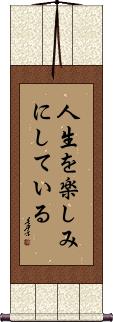
人生を楽しみにしている is one way to write “enjoy life” in Japanese.
The character breakdown:
人生 (jinsei) life (i.e. conception to death) human lifetime, living.
を (o) connecting particle.
楽しみ (tanoshimi) enjoyment; pleasure; anticipation; looking forward to.
に (ni) connecting particle.
し (shi) to do; to cause; to become; to make (into).
て (te) connecting particle.
いる (iru) indicates continuing action or resulting state.
Note: Because this selection contains some special Japanese Hiragana characters, it should be written by a Japanese calligrapher.
Joyfulness / Happiness
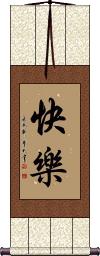
快樂 or joyfulness is an inner sense of peace and happiness.
You appreciate the gifts each day brings. Without joyfulness, when the fun stops, our happiness stops. Joy can carry us through hard times even when we are feeling very sad.
快樂 can also mean pleasure, enjoyment, delight, cheerfulness, or merry. In some ways, this is the essence that makes someone perceived as a charming person.
See Also: Happiness
Fast
Fast, as in a race car
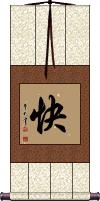
快 is the single character for “fast” in Chinese.
This applies to race cars, airplanes, rockets, etc.
This can also mean rapid, quick, speed, rate, soon, to make haste, clever, or sharp (of knives or wits). In some context it can mean cheerful or happy.
This is not a common choice for a wall scroll but if you're a speed freak, this may work for you.
Note: In Japanese, this usually has a meaning of pleasure, cheerful, delight, enjoyment, or the female given name Yoshi.
8. Right Concentration / Perfect Concentration
Samyak Samadhi / Samma Samadhi
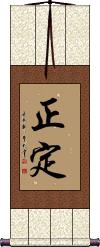
正定 is one of the Noble Eightfold Paths of Buddhism. Right Concentration, along with Right Effort and Right Mindfulness, constitute the path to Concentration or Perfect Thought.
Right Concentration has to do with leaving behind sensuality, unwholesome states, as well as pleasure and pain. 正定 is a complex idea, but once you have achieved the shedding of worldly sensation, you can truly concentrate and find a higher level of awareness.
Another definition: Concentration of mind that finds its high point in the four absorptions.
This term is exclusively used by devout Buddhists. It is not a common term, and is remains an unknown concept to most Japanese and Chinese people.
See Also: Buddhism | Enlightenment | Noble Eightfold Path
Ten perfect Mahayana rules
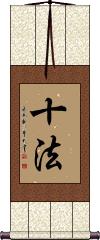
十法 is the title of the ten perfect or perfecting Mahāyāna rules.
The order of rules is as follows:
1. right belief.
2. right conduct.
3. right spirit.
4. the joy of the bodhi mind.
5. joy in the dharma.
6. joy in meditation.
7. pursuing the correct dharma.
8. obedience to, or accordance with dharma.
9. departing from pride, desire, etc.
10. comprehending the inner teaching of Buddha and taking no pleasure in attaining such knowledge or noting the ignorance of others.
This title is only used in the context of Buddhism. Japanese and Chinese people who are not familiar with Buddhism will not recognize this title.
Unmoved by the Eight Winds

八風吹不動 is an ancient Buddhist phrase from about 1000 years ago.
Literal meaning: “The Eight Winds cannot move [me].”
The original famous anecdote is from Song Dynasty China, involving the poet-official 蘇東坡 (Su Dongpo / Su Shi, 1037–1101) and Zen master 佛印 (Foyin).
Su Dongpo wrote 八風吹不動,一屁打過江
“The Eight Winds cannot move me; Yet one fart blows me across the river.”
Foyin’s irreverent reply exposed Su Dongpo’s ego, which is kind of a classic Zen/Chan teaching story.
利 gain
衰 loss
毀 disgrace
譽 praise
稱 honor
譏 ridicule
苦 suffering
樂 pleasure
“The Eight Winds cannot move [him / the mind].”
“Unmoved by the Eight Winds.”
“The Eight Winds do not move me.”
“Not moved by the Eight Winds.”
“Unshaken by the Eight Winds.”
“Unaffected by the Eight Winds.”
“Unmoved by worldly forces.”
“Steadfast against the Eight Winds.”
“Remaining unmoved amid the Eight Winds.”
There is a shorter Japanese Zen version, 八風不動, which drops the middle character. Often romanized as happū fudō. The romanization of 八風吹不動 is arguably happū fukedomo ugokazu or happū sui fudō.
This in-stock artwork might be what you are looking for, and ships right away...
Gallery Price: $176.00
Your Price: $97.77
The following table may be helpful for those studying Chinese or Japanese...
| Title | Characters | Romaji (Romanized Japanese) | Various forms of Romanized Chinese | |
| Pleasure | 愉 | yu | yú / yu2 / yu | yü |
| There is no pleasure without pain | 苦は楽の種 | ku wa raku no tane kuwarakunotane | ||
| Happiness Contentment | 鼓腹 | ko fuku / kofuku | ||
| Happiness Contentment | 滿足 / 満足 满足 | man zoku / manzoku | mǎn zú / man3 zu2 / man zu / manzu | man tsu / mantsu |
| Kama - Desire Wish Longing | 欲樂 欲乐 | yokuraku | yù lè / yu4 le4 / yu le / yule | yü le / yüle |
| Pleasant Feeling | 快感 | kaikan | kuài gǎn / kuai4 gan3 / kuai gan / kuaigan | k`uai kan / kuaikan / kuai kan |
| Eat Drink and Be Merry | 吃喝玩樂 吃喝玩乐 | chī hē wán lè chi1 he1 wan2 le4 chi he wan le chihewanle | ch`ih ho wan le chihhowanle chih ho wan le |
|
| Happy | 欣 | kin | xīn / xin1 / xin | hsin |
| Happiness Joyful Joy | 喜 | ki / yorokobi | xǐ / xi3 / xi | hsi |
| Enjoy Life | 人生を楽しみにしている | jin sei o tano shi mi ni shi te i ru | ||
| Joyfulness Happiness | 快樂 快乐 | kai raku / kairaku | kuài lè / kuai4 le4 / kuai le / kuaile | k`uai le / kuaile / kuai le |
| Fast | 快 | yoshi | kuài / kuai4 / kuai | k`uai / kuai |
| 8. Right Concentration Perfect Concentration | 正定 | sei jou / seijou / sei jo | zhèng dìng zheng4 ding4 zheng ding zhengding | cheng ting chengting |
| Ten perfect Mahayana rules | 十法 | jippou / jipo | shí fǎ / shi2 fa3 / shi fa / shifa | shih fa / shihfa |
| Unmoved by the Eight Winds | 八風吹不動 八风吹不动 | happuu sui fudou happuusuifudou hapu sui fudo | bā fēng chuī bù dòng ba1 feng1 chui1 bu4 dong4 ba feng chui bu dong bafengchuibudong | pa feng ch`ui pu tung pafengchuiputung pa feng chui pu tung |
| In some entries above you will see that characters have different versions above and below a line. In these cases, the characters above the line are Traditional Chinese, while the ones below are Simplified Chinese. | ||||

Successful Chinese Character and Japanese Kanji calligraphy searches within the last few hours...



