Many custom options...


And formats...



Piece in Chinese / Japanese...
Buy a Piece calligraphy wall scroll here!
Personalize your custom “Piece” project by clicking the button next to your favorite “Piece” title below...
2. Time is more valuable than Jade
3. Tea Fate
6. One Love
8. Secret
9. Kill / Massacre / Mass Killing
10. Bamboo Moon
11. Kill / Slaughter / Murder / Butcher
12. Warrior
13. Beauty Shop / Beauty Salon
14. King
16. Sensei / Master / Teacher / Mister
17. Not Only Can Water Float A Boat, It Can Sink It Also
18. Choose Life
19. Kansei Engineering / Sense Engineering
20. Listen to Both Sides and be Enlightened, Listen to One Side and be in the Dark
Death Before Dishonor
Better to be broken jade than unbroken pottery
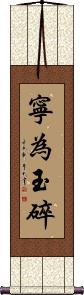
寧為玉碎 is the short version of a longer Chinese proverb which means “rather be shattered piece of jade than an unbroken piece of pottery.”
寧為玉碎 says the “rather be a broken piece of jade” part (the second half is implied - everyone in China knows this idiom).
A little more explanation:
Death is implied with the “broken” meaning. Jade is one of the most precious materials in Chinese history, and in this case, is compared with one's honor and self-worth. Pottery is just something you eat off of; it has no deep value, just as a person who has lost their honor or had none to begin with.
Thus, this means “better to die with honor than to live in shame” or words to that effect.
This is often translated in English as “Death Before Dishonor,” the famous military slogan.
I would also compare this to the English proverb, “Better to die on your feet than to live on your knees.”
Death Before Dishonor
Better to be broken jade than unbroken pottery
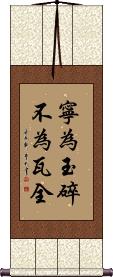
寧為玉碎不為瓦全 is the long version of a Chinese proverb that means “rather be shattered piece of jade than an unbroken piece of pottery.”
A little more explanation:
Death is implied with the “broken” meaning. Jade is one of the most precious materials in Chinese history, and in this case, is compared with one's honor and self-worth. Pottery is just something you eat off of, it has no deep value, just as a person who has lost their honor, or had none to begin with.
Thus, this means “better to die with honor than to live in shame” or words to that effect.
寧為玉碎不為瓦全 is often translated in English as “Death Before Dishonor,” the famous military slogan.
I would also compare this to the English proverb, “Better to die on your feet than to live on your knees.”
This is an idiom. It therefore doesn’t directly say exactly what it means. If you think about the English idiom, "The grass is always greener," it does not directly say "jealousy" or "envy" but everyone knows that it is implied.
Time is more valuable than Jade
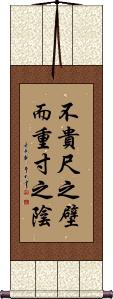
不贵尺之壁而重寸之阴 literally translates as: Treasure not a foot long [piece of] jade, [rather] treasure an inch of time.
Figuratively, this suggests that time is the most important/valuable thing in life.
Tea Fate
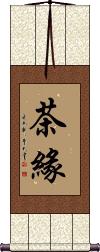
茶緣 is a special title for the tea lover. This kind of means “tea fate,” but it's more spiritual and hard to define. Perhaps the tea brought you in to drink it. Perhaps the tea will bring you and another tea-lover together. Perhaps you were already there, and the tea came to you. Perhaps it's the ah-ha moment you will have when drinking the tea.
I've been told not to explain this further, as it will either dilute or confuse the purposefully-ambiguous idea embedded in this enigma.
I happen to be the owner of a piece of calligraphy written by either the son or nephew of the last emperor of China, which is the title he wrote. It was given to me at a Beijing tea house in 2001. 茶緣 is where I learned to love tea after literally spending weeks tasting and studying everything I could about Chinese tea. I did not understand the significance of the authorship or the meaning of the title at all. Some 10 years later, I realized the gift was so profound and had such providence. Only now do I realize the value of a gift that it is too late to give proper thanks for. It was also years later that I ended up in this business and could have the artwork properly mounted as a wall scroll. It has been borrowed for many exhibitions and shows and always amazes native Chinese and Taiwanese who read the signature. This piece of calligraphy I once thought was just a bit of ink on a thin and wrinkled piece of paper, is now one of my most valued possessions. And fate has taught me to be more thankful for seemingly simple gifts.
Grandmaster / Grand Master
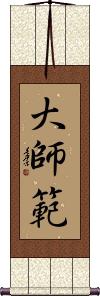
大師範 is a Japanese title for the master, grandmaster, or senior instructor.
This is a bit of an odd selection for a piece of calligraphy artwork, so proceed with caution. Better to find an appropriate phrase or title (such as the name of the martial art) and then add something like “Grandmaster Smith” as a smaller inscription down the side.
Celestial Dragon
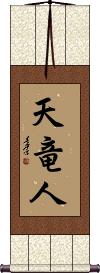
天竜人 is Celestial Dragon or Tenryūbito in Japanese.
This title is associated with the One Piece Manga/Anime series. This title is also translated in this context as “World Nobles” with the literal meaning “Heavenly Dragon Folk” or “Heaven Dragon Person/People.”
Can also be romanized as Tenryūbito, Tenryūhito, or Tenryūjin.
One Love
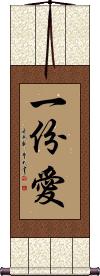
一份愛 means “one love.”
一份愛 is not referring to a person but the emotion of love.
It's like saying, “A piece of love” or “One unit of love.” There's not a perfect way to express a singular love, which is probably what you were searching for.
Pledge of Lifelong Love
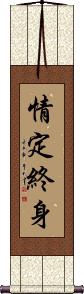
情定終身 is a pledge of eternal love in Chinese.
This can also be a colloquial way to refer to the act of exchanging marriage vows.
If you and your mate want to express how committed you are to your life-long love, this will be a great piece of calligraphy for your wall. Also, a nice phrase to celebrate an anniversary.
Secret
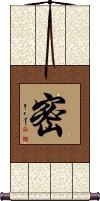
密 can mean secret, secrecy, confidential, quiet, still, and/or esoteric.
As a piece of calligraphy artwork, it will be read with this secret or secrecy meaning.
When used in the context between people, this can mean: close; close together; intimate; closed in.
When referring to materials or objects, it can refer to thickness, density, thick, dense, fine, and/or small.
Notes:
In Chinese, this can be the surname Mi.
In Japanese, this can be the name Mitsu.
Kill / Massacre / Mass Killing
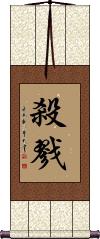
殺戮 is how to write “kill” or “massacre.”
殺戮 is an absolutely shocking word to have on a wall scroll. It will bewilder, scare, and perhaps offend any Chinese, Korean or Japanese person who sees it. I do not in any way recommend this for a piece of calligraphy artwork. This entry is only here because our calligraphy search engine received many requests for “kill” and “massacre.”
You are all a bunch of sick puppies!
Bamboo Moon
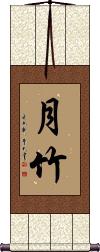
月竹 is the title, “Bamboo Moon” - Technically, it's in the order of “moon bamboo,” but that's the most natural order in Chinese and Japanese.
With a little research, I found this title has been used as the name of a linen company, a band, a song title, an actual person's name, the title for a piece of artwork featuring bamboo with a moon in the background, and a few other things. I added it here because many people searched for “bamboo moon” on my website, so here it is for you.
The typical Japanese pronunciation would probably be "tsu-ki ta-ke." However, this would not be the only possible pronunciation in Japanese (especially if used as a given name).
Kill / Slaughter / Murder / Butcher
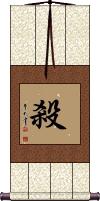
殺 is how to write “to kill” or “killing.”
殺 is an absolutely shocking word to have on a wall scroll. It will bewilder, scare, and perhaps offend any Chinese, Korean, or Japanese person who sees it. I do not in any way recommend this for a piece of calligraphy artwork. This entry is only here because our calligraphy search engine received so many requests for “kill.”
Note: In Korean Hanja, this character is not often used alone - see the other two-character entry for “kill.”
Warrior
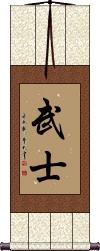
The first character, 武, is the spirit or essence of a warrior. The second character, 士, means soldier, officer, or official. 武士 is also used appropriately enough to describe a piece of a chess game. 武士 can also be translated as a soldier, cavalier, palace guard, or samurai, and sometimes as a knight. I've occasionally seen this translated as strong man or tough man (gender not necessarily implied).
By far, 武士 is the most common way to write warrior in Chinese characters, Japanese Kanji, and old Korean Hanja.
Note: In Japanese, this is Bushi, as in Bushido.
Beauty Shop / Beauty Salon
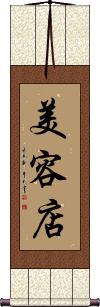
美容店 is how to write “Beauty Shop” or “Beauty Salon.”
If you own such a business, this will make a nice wall scroll to hang up - and many of your Asian customers will be able to read and appreciate it.
When traveling in China, you will see signs like this in the window of any place that offers full services of hair styling, manicures, pedicures, and often shampoo with head and back massage.
However, as a handmade wall scroll, this becomes a very fancy piece of artwork that shows the high class of your business (a great sign for your window if you don't get direct sunlight).
King
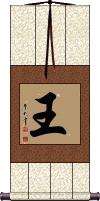
王 is wang which means king. It is not pronounced the way you think in Chinese. It is more like English speakers would want to pronounce wong. It has roughly the same vowel sound as tong, song, or long in English.
Note that this means king only, not the emperor. An emperor is higher than a king, and theoretically is chosen by God, according to ancient Chinese culture. However, the definition is often blurred at various points in Asian history.
王 can also be defined as ruler, sovereign, monarch, or magnate. It is also can refer to a game piece in the chess-like Japanese strategic game of shoji.
Note: This can also be a family name in Chinese, Korean and Vietnamese (in Vietnamese it's Vương).
See Also: Queen
Profound / Powerful Words
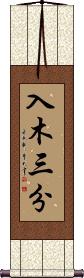
入木三分 is a four-character Chinese proverb that translates in English to a strong form of “profound” or “written with a forceful hand.”
But there is much more to the story...
The deep meaning behind this proverb comes from a man named Wan Xizhi, who lived in the third century.
He was a great writer and calligrapher whose writing style influenced generations of other writers and calligraphers.
He once wrote words on a piece of wood to be taken to an engraver.
When the engraver began to carve the characters into the wood, he found that Wang Xizhi's writing had penetrated the wood about 3/8 of an inch.
Thus people believed that his words were so powerful and profound that they caused the ink from his brush to penetrate the wood deeply.
The proverb literally means “penetrated wood three fen” (A fen is an ancient Chinese measurement of a little over 1/8 of an inch or almost 4mm).
Sensei / Master / Teacher / Mister
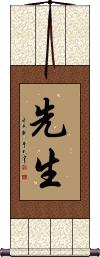
先生 is sensei, which is associated in the west with a master or instructor of karate, aikido, judo, and other Japanese martial arts.
In reality, this is a term of respect for almost any professional or skilled person (doctor, lawyer, teacher, etc.). Sometimes, it is used for musicians and artists who have achieved a certain level of fame, skill, or accomplishment.
It should be noted that this is also a courtesy title in Chinese but more like calling someone “mister” or “gentleman.” It doesn't have the “master” or “teacher” meaning in Chinese - see our Chinese “Master / Sifu / Shi Fu” entry if your audience is Chinese.
In Korean Hanja, this means teacher, instructor, schoolmaster, or schoolmistress.
This entry is for educational purposes. 先生 is kind of a strange thing to put on a wall scroll. It's a title that is used more orally to show respect rather than something written in calligraphy. If you feel it is appropriate in your circumstances, we will create a piece of sensei Japanese calligraphy artwork for you.
Not Only Can Water Float A Boat, It Can Sink It Also
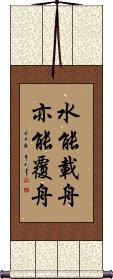
Many things have opposite properties. The water you drink can also drown you. Pork may nourish you and keep you alive but under-cook it and it could kill you. Potassium nitrate is often used as a fertilizer to grow the food that sustains us but it's also been used as an explosive to topple buildings and destroy us.
This concept is easily associated with “yin yang” where an element has two opposite properties that are as different as night and day.
This proverb's meaning can be summed up this way: “Anything that can lead you to success may also contain great risks.”
This phrase is known in literary circles by Korean people (scholars or literature). It is therefore also a valid proverb in Korean Hanja, though most Koreans would not be able to make sense of it.
Please note that there is an unwritten rule when the same character appears twice in the same phrase, the calligrapher will alter the appearance so that no two characters are exactly alike in the same piece. This calligraphy has two repeating characters that will be written differently than they appear here.
Choose Life
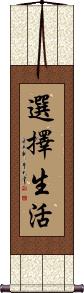
選擇生活 can mean to choose life instead of death (or suicide) or to choose to live life to the fullest.
I think of it as the key phrase used by Renton (Ewan McGregor) in the movie Trainspotting. While Chinese people will not think of Trainspotting when they see this phrase, for me, it will always be what comes near the end of this colorful rant:
Choose life. Choose a job. Choose a career. Choose a family. Choose a fucking big television. Choose washing machines, cars, compact disc players, and electrical tin can openers. Choose good health, low cholesterol, and dental insurance. Choose fixed-interest mortgage repayments. Choose a starter home. Choose your friends. Choose leisure wear and matching luggage. Choose a three-piece suite on-hire purchase in a range of fucking fabrics. Choose DIY and wondering who the fuck you are on a Sunday morning. Choose sitting on that couch watching mind-numbing, spirit-crushing game shows, stuffing fucking junk food into your mouth. Choose rotting away at the end of it all, pissing your last in a miserable home, nothing more than an embarrassment to the selfish, fucked-up brats you have spawned to replace yourself. Choose your future. Choose life.
Kansei Engineering / Sense Engineering
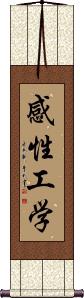
In short, 感性工學 or Kansei engineering involves collecting data on human experiences with a product and then designing or engineering improvements based on those experiences or “senses.”
Some may define Kansei as “engineering around the human experience.”
There is a lot more to know about Kansei, but if you are looking for this word, you probably already know the big picture.
Note: This term is very new in China and is only used by businesses, factories, and engineers that are implementing TQM principles. While the characters have the same base meaning in both languages, this is a Japanese title that flows back into the Chinese language (in history, most things flowed from China to Japan). To a Chinese person unfamiliar with this concept, they may interpret this as “sense vocational studies,” which doesn't make much sense. You may have to explain the intended meaning to some Chinese viewers. But that can make it a great conversation piece.
Kansei is also a newer term in Korean and is only used in certain parts of the industry, with the definition of “Sensory Engineering.” Not yet in widespread use in Korea.
Above is the modern Japanese version of this title. The last character has a Traditional Chinese version, making this 感性工學 instead of 感性工学. If you want the Traditional Chinese version, please include special instructions or email me so that I make sure the calligrapher writes the version you want.
See Also: Kaizen
Listen to Both Sides and be Enlightened, Listen to One Side and be in the Dark
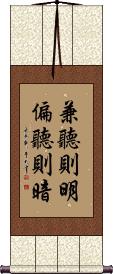
兼聽則明偏聽則暗 is an ancient Chinese proverb about getting all the information from all sides so that you truly understand a situation.
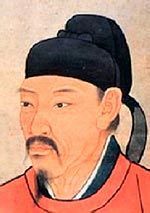
Wei Zheng
A man named Wei Zheng lived between 580-643 AD. He was a noble and wise historian and minister in the court of the early Tang Dynasty. The emperor once asked him, “What should an emperor do to understand the real-world situation, and what makes an emperor out-of-touch with reality?”
Wei Zheng replied, “Listen to both sides and you will be enlightened; listen to only one side and you will be left in the dark.”
Then Wei Zheng went on to cite examples of leaders in history that were victorious after heeding both sides of the story, and other leaders that met their doom because they believed one-sided stories which often came from flattering lips.
Please note that there is an unwritten rule when the same character appears twice in the same phrase, the calligrapher will alter the appearance so that no two characters are exactly alike in the same piece. This calligraphy has two repeating characters that will be written differently than they appear here.
This in-stock artwork might be what you are looking for, and ships right away...
Gallery Price: $353.00
Your Price: $195.88

Gallery Price: $450.00
Your Price: $248.88
Gallery Price: $520.00
Your Price: $288.88
Gallery Price: $520.00
Your Price: $288.88
Gallery Price: $108.00
Your Price: $59.88

Gallery Price: $72.00
Your Price: $39.88
These search terms might be related to Piece:
Case
Example is Better Than Precept
Sample
To Cut and Polish Each Other
Warriors: Quality Over Quantity
Wing Chun Fist Maxims (Part 1)
Wing Chun Fist Maxims (Part 2)
The following table may be helpful for those studying Chinese or Japanese...
| Title | Characters | Romaji (Romanized Japanese) | Various forms of Romanized Chinese | |
| Death Before Dishonor | 寧為玉碎 宁为玉碎 | níng wéi yù suì ning2 wei2 yu4 sui4 ning wei yu sui ningweiyusui | ning wei yü sui ningweiyüsui |
|
| Death Before Dishonor | 寧為玉碎不為瓦全 宁为玉碎不为瓦全 | níng wéi yù suì bù wéi wǎ quán ning2 wei2 yu4 sui4 bu4 wei2 wa3 quan2 ning wei yu sui bu wei wa quan ningweiyusuibuweiwaquan | ning wei yü sui pu wei wa ch`üan ning wei yü sui pu wei wa chüan |
|
| Time is more valuable than Jade | 不貴尺之壁而重寸之陰 不贵尺之壁而重寸之阴 | bù guì chǐ zhī bì ér zhòng cùn zhī yīn bu4 gui4 chi3 zhi1 bi4 er2 zhong4 cun4 zhi1 yin1 bu gui chi zhi bi er zhong cun zhi yin | pu kuei ch`ih chih pi erh chung ts`un chih yin pu kuei chih chih pi erh chung tsun chih yin |
|
| Tea Fate | 茶緣 茶缘 | chá yuán / cha2 yuan2 / cha yuan / chayuan | ch`a yüan / chayüan / cha yüan | |
| Grandmaster Grand Master | 大師範 | daishihan | ||
| Celestial Dragon | 天竜人 | ten ryuu bito tenryuubito ten ryu bito | ||
| One Love | 一份愛 一份爱 | yí fèn ài yi2 fen4 ai4 yi fen ai yifenai | i fen ai ifenai |
|
| Pledge of Lifelong Love | 情定終身 情定终身 | qíng dìng zhōng shēn qing2 ding4 zhong1 shen1 qing ding zhong shen qingdingzhongshen | ch`ing ting chung shen chingtingchungshen ching ting chung shen |
|
| Secret | 密 | mitsu | mì / mi4 / mi | |
| Kill Massacre Mass Killing | 殺戮 杀戮 | satsuriku | shā lù / sha1 lu4 / sha lu / shalu | |
| Bamboo Moon | 月竹 | tsuki take / tsukitake | yuè zhú / yue4 zhu2 / yue zhu / yuezhu | yüeh chu / yüehchu |
| Kill Slaughter Murder Butcher | 殺 杀 | satsu | shā / sha1 / sha | |
| Warrior | 武士 | bu shi / bushi | wǔ shì / wu3 shi4 / wu shi / wushi | wu shih / wushih |
| Beauty Shop Beauty Salon | 美容店 | měi róng diàn mei3 rong2 dian4 mei rong dian meirongdian | mei jung tien meijungtien |
|
| King | 王 | ou / o | wáng / wang2 / wang | |
| Profound Powerful Words | 入木三分 | rù mù sān fēn ru4 mu4 san1 fen1 ru mu san fen rumusanfen | ju mu san fen jumusanfen |
|
| Sensei Master Teacher Mister | 先生 | sen sei / sensei | xiān shēng xian1 sheng1 xian sheng xiansheng | hsien sheng hsiensheng |
| Not Only Can Water Float A Boat, It Can Sink It Also | 水能載舟亦能覆舟 水能载舟亦能覆舟 | shuǐ néng zài zhōu yì néng fù zhōu shui3 neng2 zai4 zhou1 yi4 neng2 fu4 zhou1 shui neng zai zhou yi neng fu zhou | shui neng tsai chou i neng fu chou | |
| Choose Life | 選擇生活 选择生活 | xuǎn zé shēng huó xuan3 ze2 sheng1 huo2 xuan ze sheng huo xuanzeshenghuo | hsüan tse sheng huo hsüantseshenghuo |
|
| Kansei Engineering Sense Engineering | 感性工學 感性工学 | kansei kougaku kanseikougaku kansei kogaku | gǎn xìng gōng xué gan3 xing4 gong1 xue2 gan xing gong xue ganxinggongxue | kan hsing kung hsüeh kanhsingkunghsüeh |
| Listen to Both Sides and be Enlightened, Listen to One Side and be in the Dark | 兼聽則明偏聽則暗 兼听则明偏听则暗 | jiān tīng zé míng, piān tīng zé àn jian1 ting1 ze2 ming2, pian1 ting1 ze2 an4 jian ting ze ming, pian ting ze an | chien t`ing tse ming, p`ien t`ing tse an chien ting tse ming, pien ting tse an |
|
| In some entries above you will see that characters have different versions above and below a line. In these cases, the characters above the line are Traditional Chinese, while the ones below are Simplified Chinese. | ||||

Successful Chinese Character and Japanese Kanji calligraphy searches within the last few hours...



