Many custom options...


And formats...



Passions in Chinese / Japanese...
Buy a Passions calligraphy wall scroll here!
Personalize your custom “Passions” project by clicking the button next to your favorite “Passions” title below...
Passions / Feelings / Emotions
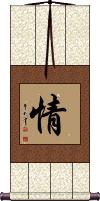
情 means feelings, emotions, passions, and sometimes refers to the situation you are in (with your emotions).
At least, this is the definition in Chinese and Japanese. This word is a bit stronger in Korean Hanja, where it means affection, love, compassion, sympathy, tender feelings, and emotions. Just as in Chinese and Japanese, this can also refer to your circumstances or your facts of life in Korean.
情 is also the original Korean Hanja for the surname Jeong (정).
In Japanese, this can be the surname Sei.
Lust / Desire / Passion
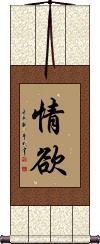
情欲 can be defined as lust, sexual desire, sensual desire, carnal desire, carnal passions, sexual desire, and passion.
The first character means feeling, emotions, passionate, sympathy, affection, love, compassion, tender feelings, and sometimes circumstances or facts.
The second character means desire, longing, appetite, wish, covetousness, greed, passion, desire, and craving.
This word is universal in Chinese, Japanese Kanji, and Korean Hanja.
Not the results for Passions that you were looking for?
Below are some entries from our dictionary that may match your Passions search...
| Characters If shown, 2nd row is Simp. Chinese |
Pronunciation Romanization |
Simple Dictionary Definition |
情 see styles |
qíng qing2 ch`ing ching makoto まこと |
More info & calligraphy: Passions / Feelings / Emotions(1) feelings; emotion; sentiment; (2) compassion; sympathy; (3) passion; affection; love; (4) the way things really are; the actual situation; (personal name) Makoto The feelings, passions, desires, affections, sensations; sentient; affinities; affairs, facts. Particular affections, duties, or affairs. |
蓋 盖 see styles |
gài gai4 kai kinugasa きぬがさ |
More info & calligraphy: Guycover; lid; cap; (surname) Kinugasa A cover, anything that screens, hides, or hinders; to build; then, for. The passions which delude the real mind so that it does not develop. A hat, or umbrella, or any cover. The canopy over a Buddha. |
三昧 see styles |
sān mèi san1 mei4 san mei sanmai さんまい |
More info & calligraphy: Samadhi(1) (さんまい only) {Buddh} samadhi (state of intense concentration achieved through meditation) (san:); (suffix noun) (2) (usu. ざんまい) being immersed in; being absorbed in; indulging in; doing to one's heart's content; (suffix noun) (3) (usu. ざんまい) prone to; apt to; (given name) Sanmai (三昧地) Samādhi, "putting together, composing the mind, intent contemplation, perfect absorption, union of the meditator with the object of meditation." (M. W.) Also 三摩地 (三摩提, 三摩帝, 三摩底). Interpreted by 定 or 正定, the mind fixed and undisturbed; by 正受 correct sensation of the object contemplated; by 調直定 ordering and fixing the mind; by 正心行處 the condition when the motions of the mind are steadied and harmonized with the object; by 息慮凝心 the cessation of distraction and the fixation of the mind; by 等持 the mind held in equilibrium; by 奢摩他, i.e. 止息 to stay the breathing. It is described as concentration of the mind (upon an object). The aim is 解脫, mukti, deliverance from all the trammels of life, the bondage of the passions and reincarnations. It may pass from abstraction to ecstasy, or rapture, or trance. Dhyāna 定 represents a simpler form of contemplation; samāpatti 三摩鉢底 a stage further advanced; and samādhi the highest stage of the Buddhist equivalent for Yoga, though Yoga is considered by some as a Buddhist development differing from samādhi. The 翻譯名義 says: 思專 when the mind has been concentrated, then 志一不分 the will is undivided; when 想寂 active thought has been put to rest, then 氣虛神朗 the material becomes etherealized and the spirit liberated, on which 智 knowledge, or the power to know, has free course, and there is no mystery into which it cannot probe. Cf. 智度論 5, 20, 23, 28; 止觀 2; 大乘義章 2, 9, 1 3, 20, etc. There are numerous kinds and degrees of samādhi. |
伊蘭 伊兰 see styles |
yī lán yi1 lan2 i lan iran いらん |
More info & calligraphy: Ilhanairāvaṇa, erāvaṇa, 伊羅 and other forms, v. supra; name of a tree with beautiful flowers of nauseous scent which spreads its odour for 40 li; typifying 煩惱 the passions and delusions. |
四諦 四谛 see styles |
sì dì si4 di4 ssu ti shitai したい |
More info & calligraphy: Four Noble Truths (Buddhism){Buddh} (See 苦集滅道) The Four Noble Truths catvāri-ārya-satyāni; 四聖諦; 四眞諦. The four dogmas, or noble truths, the primary and fundamental doctrines of Śākyamuni, said to approximate to the form of medical diagnosis. They are pain or 'suffering, its cause, its ending, the way thereto; that existence is suffering, that human passion (taṇhā, 欲 desire) is the cause of continued suffering, that by the destruction of human passion existence may be brought to an end; that by a life of holiness the destruction of human passion may be attained'. Childers. The four are 苦, 聚 (or 集), 滅, and 道諦, i. e. duḥkha 豆佉, samudaya 三牟提耶, nirodha 尼棲陀, and mārga 末加. Eitel interprets them (1) 'that 'misery' is a necessary attribute of sentient existence'; (2) that 'the 'accumulation' of misery is caused by the passions'; (3) that 'the 'extinction' of passion is possible; (4) mārga is 'the doctrine of the 'path' that leads to the extinction of passion'. (1) 苦 suffering is the lot of the 六趣 six states of existence; (2) 集 is the aggregation (or exacerbation) of suffering by reason of the passions; (3) 滅 is nirvana, the extinction of desire and its consequences, and the leaving of the sufferings of mortality as void and extinct; (4) 道 is the way of such extinction, i. e. the 八正道 eightfold correct way. The first two are considered to be related to this life, the last two to 出世間 a life outside or apart from the world. The four are described as the fundamental doctrines first preached to his five former ascetic companions. Those who accepted these truths were in the stage of śrāvaka. There is much dispute as to the meaning of 滅 'extinction' as to whether it means extinction of suffering, of passion, or of existence. The Nirvana Sutra 18 says that whoever accepts the four dogmas will put an end to births and deaths 若能見四諦則得斷生死 which does not of necessity mean the termination of existence but that of continued transmigration. v. 滅. |
情欲 see styles |
qíng yù qing2 yu4 ch`ing yü ching yü jōyoku じょうよく |
More info & calligraphy: Lust / Desire / PassionThe passions, desires. |
集諦 集谛 see styles |
jí dì ji2 di4 chi ti jittai じったい |
More info & calligraphy: Four Noble Truths: Desire and Attachmentsamudaya, the second of the four dogmas, that the cause of suffering lies in the passions and their resultant karma. The Chinese 集 'accumulation' does not correctly translate samudaya, which means 'origination'. |
卽 see styles |
jí ji2 chi zoku |
variant of 即[ji2]; promptly To draw up to, or near; approach; forthwith; to be; i.e. alias; if, even if; 就是. It is intp. as 和融 united together; 不二not two, i.e. identical; 不離 not separate, inseparable. It resembles implication, e.g. the afflictions or passions imply, or are, bodhi; births-and-deaths imply, or are, nirvana; the indication being that the one is contained in or leads to the other. Tiantai has three definitions: (1) The union, or unity, of two things, e.g. 煩惱 and 菩提, i.e. the passions and enlightenment, the former being taken as the 相 form, the latter 性 spirit, which two are inseparable; in other words, apart from the subjugation of the passions there is no enlightenment. (2) Back and front are inseparables; also (3) substance and quality, e.g. water and wave. |
取 see styles |
qǔ qu3 ch`ü chü takadori たかどり |
to take; to get; to choose; to fetch {Buddh} (See 十二因縁) appropriation; obtaining; (surname) Takadori upādāna. To grasp, hold on to, held by, be attached to, love; used as indicating both 愛 love or desire and 煩惱 the vexing passions and illusions. It is one of the twelve nidānas 十二因緣 or 十二支 the grasping at or holding on to self-existence and things. |
滅 灭 see styles |
miè mie4 mieh metsu |
to extinguish or put out; to go out (of a fire etc); to exterminate or wipe out; to drown Extinguish, exterminate, destroy; a tr. of nirodha, suppression, annihilation; of nirvāṇa, blown out, extinguished, dead, perfect rest, highest felicity, etc.; and of nivṛtti, cessation, disappearance. nirodha is the third of the four axioms: 苦, 集, 滅, 道 pain, its focussing, its cessation (or cure), the way of such cure. Various ideas are expressed as to the meaning of 滅, i.e. annihilation or extinction of existence; or of rebirth and mortal existence; or of the passions as the cause of pain; and it is the two latter views which generally prevail; cf. M017574 10 strokes. |
漏 see styles |
lòu lou4 lou ro |
to leak; to divulge; to leave out by mistake; waterclock or hourglass (old) āsrava, 'flowing, running, discharge; distress, pain, affliction.' M.W. It is defined as another term for 煩惱 q.v.; also as the discharge, or outflow, from the organs of sense, wherever those exist, hence it is applied to the passions and their filth; impure efflux from the mind, v. 欲有; also to the leakage or loss thereby of the 正道 truth; also to the stream of transmigration. |
痴 see styles |
chī chi1 ch`ih chih chi ち oko おこ |
imbecile; sentimental; stupid; foolish; silly (1) foolishness; fool; (2) (Buddhist term) moha (ignorance, folly); (noun or adjectival noun) foolish thing; stupid thing; absurdity moha, 'unconsciousness,' 'delusion,' 'perplexity,' 'ignorance, folly,' 'infatuation,' etc. M.W. Also, mūḍha. In Chinese it is silly, foolish, daft, stupid. It is intp. by 無明 unenlightened, i.e. misled by appearances, taking the seeming for real; from this unenlightened condition arises every kind of kleśa, i.e. affliction or defilement by the passions, etc. It is one of the three poisons, desire, dislike, delusion. |
結 结 see styles |
jié jie2 chieh ribon りぼん |
knot; sturdy; bond; to tie; to bind; to check out (of a hotel) (female given name) Ribon Knot, tie, bond; bound; settle, wind up; to form. The bond of transmigration. There are categories of three, five, and nine bonds; e.g. false views, the passions, etc. |
縛 缚 see styles |
fù fu4 fu baku ばく |
to bind; to tie; Taiwan pr. [fu2] (See 縛につく) tying up; restraint; restriction; arrest bandha. Tie, attachment, bind, bond, another name for kleśa-afflictions, the passions, etc., which bind men; the 'three bonds' are 貪瞋痴 desire, resentment, stupidity; translit. pa, ba, va; cf. 跋, 婆, 飯. |
纏 缠 see styles |
chán chan2 ch`an chan matome まとめ |
to wind around; to wrap round; to coil; tangle; to involve; to bother; to annoy (given name) Matome To bind with cords; bonds; another name for 煩惱 the passions and delusions, etc. |
血 see styles |
xuè xue4 hsüeh chi ち |
blood; colloquial pr. [xie3]; CL:滴[di1],片[pian4] (1) blood; (2) blood; ancestry; lineage; stock; (3) (the) blood; feelings; passions Blood. 以血洗血 To wash out blood with blood, from one sin to fall into another. |
障 see styles |
zhàng zhang4 chang shō |
to block; to hinder; to obstruct varaṇa; āvaraṇa; a screen, barricade, partition, a term for the passions or any delusion which hinders enlightenment. |
三明 see styles |
sān míng san1 ming2 san ming mitsuaki みつあき |
see 三明市[San1 ming2 Shi4] {Buddh} (See 宿命通,天眼通,漏尽通) three kinds of awareness; (surname, given name) Mitsuaki The three insights; also 三達. Applied to Buddhas they are called 三達, to arhats 三明. (a) 宿命明 Insight into the mortal conditions of self and others in previous lives; (b) 天眼明 supernatural insight into future mortal conditions; (c) 漏盡明 nirvāṇa insight, i.e. into present mortal sufferings so as to overcome aIl passions or temptations. In the 倶舍論 27 the three are termed 住智識證明; 死生識證明 and 漏盡識證明. For 三明經 v. 長阿含16. |
三毒 see styles |
sān dú san1 du2 san tu sandoku さんどく |
{Buddh} (See 煩悩・2) the three kleshas that poison the heart of man (desire, ill will and ignorance) The three poisons, also styled 三根; 三株; they are 貪 concupiscence, or wrong desire, 瞋 anger, hate, or resentment, and 痴 stupidity, ignorance, unintelligence, or unwillingness to accept Buddha-truth; these three are the source of all the passions and delusions. They represent in part the ideas of love, hate, and moral inertia. v. 智度論 19, 31. |
三障 see styles |
sān zhàng san1 zhang4 san chang sanshō |
The three vighna, i.e. hinderers or barriers, of which three groups are given: (1) (a) 煩惱障 the passions, i.e. 三毒 desire, hate, stupidity; (b) 業障 the deeds done; (c) 報障 the retributions. (2) (a) 皮煩惱障 ; (b) 肉煩惱障 ; (c) 心煩惱障 skin, flesh, and heart (or mind) troublers, i.e. delusions from external objects: internal views, and mental ignorance. (3) 三重障 the three weighty obstructions: (a) self-importance, 我慢; (b) envy, 嫉妬; (c) desire, 貧欲. |
九界 see styles |
jiǔ jiè jiu3 jie4 chiu chieh kukai |
(九界情執) The nine realms of error, or subjection to the passions, i.e. all the realms of the living except the tenth and highest, the Buddha-realm. |
二漏 see styles |
èr lòu er4 lou4 erh lou niro |
The two conditions relating to the passions and delusions: 有漏 the condition in which they can prevail; 無漏 that in which they cannot prevail. |
二障 see styles |
èr zhàng er4 zhang4 erh chang nishō |
The two hindrances:(1) (a) 煩惱障 The passions and delusion which aid rebirth and hinder entrance into nirvana; (b) 智障 or所知障, worldly wisdom e.g. accounting the seeming as real, a hindrance to true wisdom. (2) (a) 煩惱障 as above; (b) 解脱障 hindrances to deliverance. (3) (a)理障 hindrances to truth; (b) 事障 hindrances of the passions, etc. |
五情 see styles |
wǔ qíng wu3 qing2 wu ch`ing wu ching gojou / gojo ごじょう |
the five passions (anger, joy, hatred, desire and grief) The feelings, or passions, which are stirred by the 五根 five senses. |
五濁 五浊 see styles |
wǔ zhuó wu3 zhuo2 wu cho gotaku |
the five impurities (Buddhism) 五滓; 五渾 The five kaṣāya periods of turbidity, impurity, or chaos, i. e. of decay; they are accredited to the 住 kalpa, see 四劫, and commence when human life begins to decrease below 20,000 years. (1) 劫濁 the kalpa in decay, when it suffers deterioration and gives rise to the ensuing form; (2) 見濁 deterioration of view, egoism, etc., arising; (3) 煩惱濁 the passions and delusions of desire, anger, stupidity, pride, and doubt prevail; (4) 衆生濁 in consequence human miseries increase and happiness decreases; (5) 命濁 human life time gradually diminishes to ten years. The second and third are described as the 濁 itself and the fourth and fifth its results. |
人欲 see styles |
jinyoku じんよく |
human desires; human passions |
人空 see styles |
rén kōng ren2 kong1 jen k`ung jen kung ningū |
Man is only a temporary combination formed by the five skandhas and the twelve nidānas, being the product of previous causes, and without a real self or permanent soul. Hīnayāna is said to end these causes and consequent reincarnation by discipline in subjection of the passions and entry into nirvana by the emptying of the self. Mahāyāna fills the "void" with the Absolute, declaring that when man has emptied himself of the ego he realizes his nature to be that of the absolute, bhūtatathatā; v. 二空. |
八風 八风 see styles |
bā fēng ba1 feng1 pa feng happuu / happu はっぷう |
see 八風穴|八风穴[ba1 feng1 xue2] (1) {Buddh} eight winds; eight things that hinder enlightenment; prosperity, decline, disgrace, honor, praise, censure, suffering, and pleasure; (2) eight winds (e.g. in eight directions); (given name) Happuu The eight winds, or influences which fan the passions, i.e. gain, loss; defamation, eulogy; praise, ridicule; sorrow, joy. Also 八法. |
八魔 see styles |
bā mó ba1 mo2 pa mo hachima |
The eight Māras, or destroyers: 煩惱魔 the māras of the passions; 陰魔 the skandha-māras, v. 五陰; 死魔 death-māra ; 他化自在天魔 the māra-king. The above four are ordinarily termed the four māras: the other four are the four Hīnayāna delusions of śrāvakas and pratyekabuddhas, i.e. 無常 impermanence; 無樂 joylessness; 無我 impersonality; 無淨 impurity; cf. 八顚倒. |
凡情 see styles |
fán qíng fan2 qing2 fan ch`ing fan ching bonjō |
Desires or passions of the unconverted. |
Click here for more Passions results from our dictionary
The following table may be helpful for those studying Chinese or Japanese...
| Title | Characters | Romaji (Romanized Japanese) | Various forms of Romanized Chinese | |
| Passions Feelings Emotions | 情 | jou / nasake jo / nasake | qíng / qing2 / qing | ch`ing / ching |
| Lust Desire Passion | 情欲 | jouyoku / joyoku | qíng yù / qing2 yu4 / qing yu / qingyu | ch`ing yü / chingyü / ching yü |

Successful Chinese Character and Japanese Kanji calligraphy searches within the last few hours...



