Many custom options...


And formats...



Para in Chinese / Japanese...
Buy a Para calligraphy wall scroll here!
Personalize your custom “Para” project by clicking the button next to your favorite “Para” title below...
Switched to secondary search mode due to lack of results using primary.
These secondary results may not be very accurate. Try a different but similar meaning word or phrase for better results. Or...
Look up Para in my Japanese Kanji & Chinese Character Dictionary(My dictionary is a different system then the calligraphy search you just tried)
If you want a special phrase, word, title, name, or proverb, feel free to contact me, and I will translate your custom calligraphy idea for you.
1. Boparai
2. The Pain of Separation from Your Loves
3. Paracelsus
4. Parada
5. Paradero
6. Paradis
8. Paraguay
9. Paramartha
10. Paramo
Boparai

博帕萊 is the name Boparai in Chinese (Mandarin).
Boparai

ボパライ is the name Boparai in Japanese Katakana.
Note: Because this title is entirely Japanese Katakana, it should be written by a Japanese calligrapher.
The Pain of Separation from Your Loves
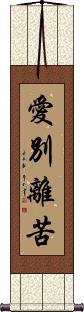
愛別離苦 is a Buddhist term that refers to “the pain of separation from loved ones,” or “the suffering of being separated from those whom one loves.”
If you translate each character separately, you get, “love(s) separated [and] departed [yields] pain.”
The pain character can also be defined as anguish; suffering; distress; anxiety; worry; trouble; difficulty; hardship; bitterness; to suffer; anguish; distress; anxiety; worry; trouble; difficulty; bitterness; unhappiness; or misery.
Paracelsus
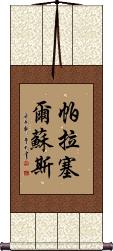
帕拉塞爾蘇斯 is the name Paracelsus in Chinese (Mandarin).
Paracelsus
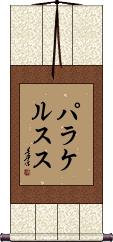
パラケルスス is the name Paracelsus in Japanese (Katakana).
Note: Because this title is entirely Japanese Katakana, it should be written by a Japanese calligrapher.
Parada

帕拉達 is the name Parada in Chinese (Mandarin).
Parada

パラダ is the name Parada in Japanese Katakana.
Note: Because this title is entirely Japanese Katakana, it should be written by a Japanese calligrapher.
Paradero
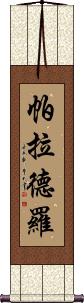
帕拉德羅 is the name Paradero in Chinese (Mandarin).
Paradero
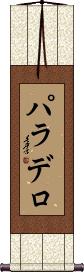
パラデロ is the name Paradero in Japanese Katakana.
Note: Because this title is entirely Japanese Katakana, it should be written by a Japanese calligrapher.
Paradis

帕拉迪斯 is the name Paradis in Chinese (Mandarin).
Paradis

パラディス is the name Paradis in Japanese Katakana.
Note: Because this title is entirely Japanese Katakana, it should be written by a Japanese calligrapher.
Paradise / Wonderland
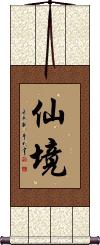
仙境 means fairyland, wonderland, paradise, or enchanted land.
Same meaning in both Chinese and Japanese Kanji.
Paraguay
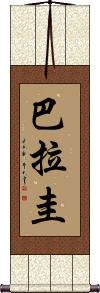
Paraguay
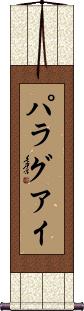
This is Paraguay in Japanese Katakana.
Note: Because this title is entirely Japanese Katakana, it should be written by a Japanese calligrapher.
Paramartha
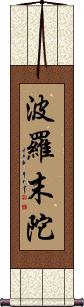
波羅末陀 is the Chinese and Japanese way to write the ancient Sanskrit word Paramārtha or परमार्थ which now means the highest truth, ultimate truth, ultimate reality, or fundamental meaning.
Paramārtha is the name of a famous Buddhist monk born in 499 CE. Paramārtha traveled the world (including Cambodia and territories that are now part of China) to spread the teachings of Buddhism by translating scriptures into the local languages so the truth could be understood by the masses.
So, we should all want to be a Paramārtha who brings the ultimate truth, knowledge, and enlightenment to others.
Paramo

帕拉莫 is the name Paramo in Chinese (Mandarin).
Paramo

パラモ is the name Paramo in Japanese Katakana.
Note: Because this title is entirely Japanese Katakana, it should be written by a Japanese calligrapher.
Patience and Preparation

忍耐準備 can be translated as “Perseverance/Endurance and Readiness,” or “Patience and Preparation.”
Preparation Yields No Fear or Worries
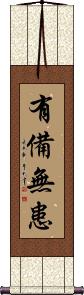
有備無患 means “When you are well-prepared, you have nothing to fear.”
Noting that the third character means “no” or “without” and modifies the last... The last character can mean misfortune, troubles, worries, or fears. It could even be stretched to mean sickness. Therefore you can translate this proverb in a few ways. I've also seen it translated as “Preparedness forestalls calamities.”
有備無患 is comparable to the English idiom, “Better safe than sorry,” but does not directly/literally mean this.
Preparation Yields No Regrets
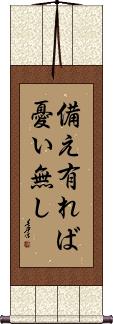
備え有れば憂い無し is as proverb that means “When you are well-prepared, you have nothing to regret” in Japanese.
Note: Because this selection contains some special Japanese Hiragana characters, it should be written by a Japanese calligrapher.
The following table may be helpful for those studying Chinese or Japanese...
| Title | Characters | Romaji (Romanized Japanese) | Various forms of Romanized Chinese | |
| Boparai | 博帕萊 博帕莱 | bó pà lái bo2 pa4 lai2 bo pa lai bopalai | po p`a lai popalai po pa lai |
|
| Boparai | ボパライ | boparai | ||
| The Pain of Separation from Your Loves | 愛別離苦 爱别离苦 | ai betsu ri ku aibetsuriku | ài bié lí kǔ ai4 bie2 li2 ku3 ai bie li ku aibieliku | ai pieh li k`u aipiehliku ai pieh li ku |
| Paracelsus | 帕拉塞爾蘇斯 帕拉塞尔苏斯 | pà lā sāi ěr sū sī pa4 la1 sai4 er3 su1 si1 pa la sai er su si palasaiersusi | p`a la sai erh su ssu palasaierhsussu pa la sai erh su ssu |
|
| Paracelsus | パラケルスス | parakerususu | ||
| Parada | 帕拉達 帕拉达 | pà lā dá pa4 la1 da2 pa la da palada | p`a la ta palata pa la ta |
|
| Parada | パラダ | parada | ||
| Paradero | 帕拉德羅 帕拉德罗 | pà lā dé luó pa4 la1 de2 luo2 pa la de luo paladeluo | p`a la te lo palatelo pa la te lo |
|
| Paradero | パラデロ | paradero | ||
| Paradis | 帕拉迪斯 | pà lā dí sī pa4 la1 di2 si1 pa la di si paladisi | p`a la ti ssu palatissu pa la ti ssu |
|
| Paradis | パラディス | paradisu | ||
| Paradise Wonderland | 仙境 | sen kyou / senkyou / sen kyo | xiān jìng xian1 jing4 xian jing xianjing | hsien ching hsienching |
| Paraguay | 巴拉圭 | bā lā guī ba1 la1 gui1 ba la gui balagui | pa la kuei palakuei |
|
| Paraguay | パラグアイ | pa ra gu a i paraguai | ||
| Paramartha | 波羅末陀 波罗末陀 | ha ra ma da haramada | bō luó mò tuó bo1 luo2 mo4 tuo2 bo luo mo tuo boluomotuo | po lo mo t`o polomoto po lo mo to |
| Paramo | 帕拉莫 | pà lā mò pa4 la1 mo4 pa la mo palamo | p`a la mo palamo pa la mo |
|
| Paramo | パラモ | paramo | ||
| Patience and Preparation | 忍耐準備 | nin tai jun bi nintaijunbi | rěn nài zhǔn bèi ren3 nai4 zhun3 bei4 ren nai zhun bei rennaizhunbei | jen nai chun pei jennaichunpei |
| Preparation Yields No Fear or Worries | 有備無患 有备无患 | yǒu bèi wú huàn you3 bei4 wu2 huan4 you bei wu huan youbeiwuhuan | yu pei wu huan yupeiwuhuan |
|
| Preparation Yields No Regrets | 備え有れば憂い無し | sona e a re ba ure i na shi sonaearebaureinashi | ||
| In some entries above you will see that characters have different versions above and below a line. In these cases, the characters above the line are Traditional Chinese, while the ones below are Simplified Chinese. | ||||

Successful Chinese Character and Japanese Kanji calligraphy searches within the last few hours...



