Many custom options...


And formats...



Not what you want?
Try other similar-meaning words, fewer words, or just one word.
Number Three in Chinese / Japanese...
Buy a Number Three calligraphy wall scroll here!
Personalize your custom “Number Three” project by clicking the button next to your favorite “Number Three” title below...
Three
The number three
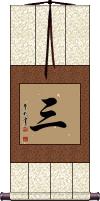
三 is the number three in Chinese, Japanese Kanji, and old Korean Hanja.
This is a strange selection for a wall scroll, so it's here mostly for reference. I guess it's OK if the number three is important to you.

 Because this character is rather simple (just three lines), there is an anti-fraud way to write three on bank documents. These variants are shown to the right.
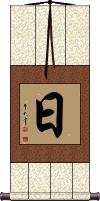
This is how to write “day” in Chinese, Japanese, and Korean Hanja.
This can also mean “Sun,” the star in the middle of the Solar system in which we live. In Japanese, it can also mean “sunshine” or even “Sunday.”
When writing the date in modern Chinese and Japanese, putting a number in front of this character indicates the day of the month. Of course, you need to indicate the month too... The month is expressed with a number followed by the character for the moon. So “three moons ten suns” would be “March 10th” or “3/10.”
Note: This is also the first character for the proper name of Japan. Remember that Japan is “The land of the rising sun”? Well, the first character for Japan means “sun” and the second means “origin” so you get the real meaning now. Sometimes, in China, this sun character can be a short name for Japan or a suffix for something of or from Japan.
Daodejing / Tao Te Ching - Excerpt
Excerpt from Chapter 67
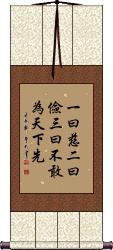
一曰慈二曰儉三曰不敢為天下先 is an excerpt from the 67th Chapter of Lao Tzu's (Lao Zi's) Te-Tao Ching (Dao De Jing).
This is the part where the three treasures are discussed. In English, we'd say these three treasures are compassion, frugality, and humility. Some may translate these as love, moderation, and lack of arrogance. I have also seen them translated as benevolence, modesty, and “Not presuming to be at the forefront in the world.” You can mix them up the way you want, as translation is not really a science but rather an art.
I should also explain that the first two treasures are single-character ideas, yet the third treasure was written out in six characters (there are also some auxiliary characters to number the treasures).
If Lao Tzu's words are important to you, then a wall scroll with this passage might make a great addition to your home.
One
The number one
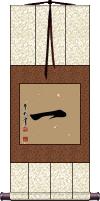
一 is “one” or “1” in Chinese, Japanese Kanji, and old Korean Hanja.
People keep searching for “one” but I'm not sure what you want. This would be a strange selection for a wall scroll, so please don't order it. Post a request on our forum if you want a phrase with “one” in it that you can't find on our site.
The “one” character is really simple, it's just one stroke. Two is two strokes and three is three strokes, from four and above, the characters get more complicated.
In some ways, the “one” character is too simple, it could be a stray mark, or added to a banking document. Therefore, the following banking anti-fraud character for “one” has developed over the last 1500 years in China and Japan:


Life Energy / Spiritual Energy
Chi Energy: Essence of Life / Energy Flow
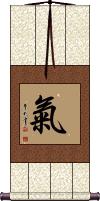
This 氣 energy flow is a fundamental concept of traditional Asian culture.
氣 is romanized as “Qi” or “Chi” in Chinese, “Gi” in Korean, and “Ki” in Japanese.
Chi is believed to be part of everything that exists, as in “life force” or “spiritual energy.” It is most often translated as “energy flow” or literally as “air” or “breath.” Some people will simply translate this as “spirit,” but you must consider the kind of spirit we're talking about. I think this is weighted more toward energy than spirit.
The character itself is a representation of steam (or breath) rising from rice. To clarify, the character for rice looks like this: 
Steam was apparently seen as visual evidence of the release of “life energy” when this concept was first developed. The Qi / Chi / Ki character is still used in compound words to mean steam or vapor.
The etymology of this character is a bit complicated. It's suggested that the first form of this character from bronze script (about 2500 years ago) looked like these samples: 

However, it was easy to confuse this with the character for the number three. So the rice radical was added by 221 B.C. (the exact time of this change is debated). This first version with the rice radical looks like this: 
The idea of Qi / Chi / Ki is really a philosophical concept. It's often used to refer to the “flow” of metaphysical energy that sustains living beings. Yet there is much debate that has continued for thousands of years as to whether Qi / Chi / Ki is pure energy or consists partially or fully of matter.
You can also see the character for Qi / Chi / Ki in common compound words such as Tai Chi / Tai Qi, Aikido, Reiki, and Qi Gong / Chi Kung.
In the modern Japanese Kanji, the rice radical has been changed into two strokes that form an X.
 The original and traditional Chinese form is still understood in Japanese, but we can also offer that modern Kanji form in our custom calligraphy. If you want this Japanese Kanji, please click on the character to the right instead of the “Select and Customize” button above.
More language notes: This is pronounced like “chee” in Mandarin Chinese, and like “key” in Japanese.
This is also the same way to write this in Korean Hanja where it is Romanized as “gi” and pronounced like “gee” but with a real G-sound, not a J-sound.
Though Vietnamese no longer use Chinese characters in their daily language, this character is still widely known in Vietnam.
See Also: Energy | Life Force | Vitality | Life | Birth | Soul
This in-stock artwork might be what you are looking for, and ships right away...

Gallery Price: $60.00
Your Price: $36.88
Gallery Price: $200.00
Your Price: $79.88
Gallery Price: $108.00
Your Price: $59.88

Gallery Price: $304.00
Your Price: $168.88

Gallery Price: $61.00
Your Price: $33.88

Gallery Price: $61.00
Your Price: $33.88

Gallery Price: $61.00
Your Price: $33.88

Gallery Price: $72.00
Your Price: $39.88

Gallery Price: $61.00
Your Price: $33.88

Gallery Price: $61.00
Your Price: $33.88
Gallery Price: $178.00
Your Price: $98.88
Gallery Price: $178.00
Your Price: $98.88
Not the results for Number Three that you were looking for?
Below are some entries from our dictionary that may match your Number Three search...
| Characters If shown, 2nd row is Simp. Chinese |
Pronunciation Romanization |
Simple Dictionary Definition |
佛 see styles |
fú fu2 fu hotoke ほとけ |
More info & calligraphy: Buddhism / Buddha(surname) Hotoke Buddha, from budh to "be aware of", "conceive", "observe", "wake"; also 佛陀; 浮圖; 浮陀; 浮頭; 浮塔; 勃陀; 勃馱; 沒馱; 母馱; 母陀; 部陀; 休屠. Buddha means "completely conscious, enlightened", and came to mean the enlightener. he Chinese translation is 覺 to perceive, aware, awake; and 智 gnosis, knowledge. There is an Eternal Buddha, see e.g. the Lotus Sutra, cap. 16, and multitudes of Buddhas, but the personality of a Supreme Buddha, an Ādi-Buddha, is not defined. Buddha is in and through all things, and some schools are definitely Pan-Buddhist in the pantheistic sense. In the triratna 三寳 commonly known as 三寳佛, while Śākyamuni Buddha is the first "person" of the Trinity, his Law the second, and the Order the third, all three by some are accounted as manifestations of the All-Buddha. As Śākyamuni, the title indicates him as the last of the line of Buddhas who have appeared in this world, Maitreya is to be the next. As such he is the one who has achieved enlightenment, having discovered the essential evil of existence (some say mundane existence, others all existence), and the way of deliverance from the constant round of reincarnations; this way is through the moral life into nirvana, by means of self-abnegation, the monastic life, and meditation. By this method a Buddha, or enlightened one, himself obtains Supreme Enlightenment, or Omniscience, and according to Māhāyanism leads all beings into the same enlightenment. He sees things not as they seem in their phenomenal but in their noumenal aspects, as they really are. The term is also applied to those who understand the chain of causality (twelve nidānas) and have attained enlightenment surpassing that of the arhat. Four types of the Buddha are referred to: (1) 三藏佛the Buddha of the Tripiṭaka who attained enlightenment on the bare ground under the bodhi-tree; (2) 通佛the Buddha on the deva robe under the bodhi-tree of the seven precious things; (3) 別佛the Buddha on the great precious Lotus throne under the Lotus realm bodhi-tree; and (4) 圓佛the Buddha on the throne of Space in the realm of eternal rest and glory where he is Vairocana. The Hīnayāna only admits the existence of one Buddha at a time; Mahāyāna claims the existence of many Buddhas at one and the same time, as many Buddhas as there are Buddha-universes, which are infinite in number. |
地獄 地狱 see styles |
dì yù di4 yu4 ti yü jigoku じごく |
More info & calligraphy: Hell(1) {Buddh} hell realm; Naraka; (2) {Christn} Hell; (3) hell; misery; nightmare; inferno; (4) place where a volcano or hot springs constantly spew smoke or steam; (place-name) Jigoku naraka, 捺落迦 (or 那落迦) ; niraya 泥犂; explained by 不樂 joyless; 可厭 disgusting, hateful; 苦具, 苦器 means of suffering; if 地獄 earth-prison; 冥府 the shades, or departments of darkness. Earth-prison is generally intp. as hell or the hells; it may also be termed purgatory; one of the six gati or ways of transmigration. The hells are divided into three classes: I. Central, or radical, 根本地獄 consisting of (1) The eight hot hells. These were the original hells of primitive Buddhism, and are supposed to be located umder the southern continent Jambudvīpa 瞻部州, 500 yojanas below the surface. (a) 等活 or 更活 Saṃjīva, rebirth, where after many kinds of suffering a cold wind blows over the soul and returns it to this life as it was before, hence the name 等活. (b) 黑繩 Kaslasūtra, where the sufferer is bound with black chains and chopped or sawn asunder. (c) 線合; 衆合; 堆壓 Saṃghāta, where are multitudes of implements of torture, or the falling of mountains upon the sufferer. (d) 號呌; 呼呼; 叫喚 Raurava, hell of wailing. (e) 大呌; 大號呌; 大呼 Mahāraurava, hell of great wailing. (f) 炎熱; 燒炙 Tapana, hell of fames and burning. (g) 大熱; 大燒炙; 大炎熱 Pratāpana, hell of molten lead. (h) 無間; 河鼻旨; 阿惟越致; 阿毗至; 阿鼻; 阿毗 Avīci, unintermitted suffering, where sinners die and are reborn to suffer without interval. (2) The eight cold hells 八寒地獄. (a) 頞浮陀地獄 Arbuda, where the cold causes blisters. (b) 尼刺部陀 Nirarbuda, colder still causing the blisters to burst. (c) 頞哳吒; 阿吒吒 Atata, where this is the only possible sound from frozen lips. (d) 臛臛婆; 阿波波 Hahava or Apapa, where it is so cold that only this sound can be uttered. (e) 虎虎婆 Hāhādhara or Huhuva, where only this sound can be uttered. (f) 嗢鉢羅; 鬱鉢羅 (or 優鉢羅) Utpala, or 尼羅鳥 (or 漚) 鉢羅 Nīlotpala, where the skin is frozen like blue lotus buds. (g) 鉢特摩 Padma, where the skin is frozen and bursts open like red lotus buds. (h) 摩訶鉢特摩 Mahāpadma, ditto like great red lotus buds. Somewhat different names are also given. Cf. 倶舍論 8; 智度論 16; 涅槃經 11. II. The secondary hells are called 近邊地獄 adjacent hells or 十六遊增 each of its four sides, opening from each such door are four adjacent hells, in all sixteen; thus with the original eight there are 136. A list of eighteen hells is given in the 十八泥梨經. III. A third class is called the 孤地獄 (獨地獄) Lokāntarika, or isolated hells in mountains, deserts, below the earth and above it. Eitel says in regard to the eight hot hells that they range 'one beneath the other in tiers which begin at a depth of 11,900 yojanas and reach to a depth of 40,000 yojanas'. The cold hells are under 'the two Tchahavālas and range shaft-like one below the other, but so that this shaft is gradually widening to the fourth hell and then narrowing itself again so that the first and last hell have the shortest, those in the centre the longest diameter'. 'Every universe has the same number of hells, ' but 'the northern continent has no hell whatever, the two continents east and west of Meru have only small Lokāntarika hells... whilst all the other hells are required for the inhabitants of the southern continent '. It may be noted that the purpose of these hells is definitely punitive, as well as purgatorial. Yama is the judge and ruler, assisted by eighteen officers and a host of demons, who order or administer the various degrees of torture. 'His sister performs the same duties with regard to female criminals, ' and it may be mentioned that the Chinese have added the 血盆池 Lake of the bloody bath, or 'placenta tank' for women who die in childbirth. Release from the hells is in the power of the monks by tantric means. |
三八 see styles |
sān bā san1 ba1 san pa miya みや |
International Women's Day 婦女節|妇女节[Fu4 nu:3 jie2], 8th March; foolish; stupid (1) three and eight; (2) (abbreviation) (See 三八式歩兵銃) Arisaka Type 38 rifle; (personal name) Miya (days ending with the number) 3 and 8 |
三桁 see styles |
sanketa; miketa さんけた; みけた |
three-digit number; hundreds column |
十二 see styles |
shí èr shi2 er4 shih erh tooji とおじ |
twelve; 12 12; twelve; (given name) Tooji dvātriṃśa. Thirty-two. 三十二應 (or 三十二身) The thirty-two forms of Guanyin, and of Puxian, ranging from that of a Buddha to that of a man, a maid, a rakṣas; similar to the thirty-three forms named in the Lotus Sūtra. 三十二相三十二大人相 dvātriṃśadvaralakṣaṇa. The thirty-two lakṣaṇas, or physical marks of a cakravartī, or 'wheel-king', especially of the Buddha, i. e. level feet, thousand-spoke wheel-sign on feet, long slender fingers, pliant hands and feet, toes and fingers finely webbed, full-sized heels, arched insteps, thighs like a royal stag, hands reaching below the knees well-retracted male organ, height and stretch of arms equal, every hair-root dark coloured, body hair graceful and curly, golden-hued body, a 10 ft. halo around him, soft smooth skin, the 七處, i. e. two soles, two palms, two shoulders, and crown well rounded, below the armpits well-filled, lion-shaped body, erect, full shoulders, forty teeth, teeth white even and close, the four canine teeth pure white, lion-jawed, saliva improving the taste of all food, tongue long and broad, voice deep and resonant, eyes deep blue, eyelashes like a royal bull, a white ūrnā or curl between the eyebrows emitting light, an uṣṇīṣa or fleshy protuberance on the crown. These are from the 三藏法數 48, with which the 智度論 4, 涅盤經 28, 中阿含經, 三十ニ相經 generally agree. The 無量義經 has a different list. 三十二相經 The eleventh chapter of the 阿含經. 三十二相經願 The twenty-first of Amitābha's vows, v. 無量壽經. 三十三 trayastriṃśat. Thirty-three. 三十三天忉利天; 憺梨天, 多羅夜登陵舍; 憺利夜登陵奢; 憺利耶憺利奢 Trayastriṃśas. The Indra heaven, the second of the six heavens of form. Its capital is situated on the summit of Mt. Sumeru, where Indra rules over his thirty-two devas, who reside on thirty-two peaks of Sumeru, eight in each of the four directons. Indra's capital is called 殊勝 Sudarśana, 喜見城 Joy-view city. Its people are a yojana in height, each one's clothing weighs 六鐵 (1; 4 oz. ), and they live 1, 000 years, a day and night being equal to 100 earthly years. Eitel says Indra's heaven 'tallies in all its details with the Svarga of Brahminic mythology' and suggests that 'the whole myth may have an astronomical meaning', or be connected, with 'the atmosphere with its phenomena, which strengthens Koeppen's hypothesis explaining the number thirty-three as referring to the eight Vasus, eleven Rudras, twelve Ādityas, and two Aśvins of Vedic mythology'. In his palace called Vaijayanta 'Indra is enthroned with 1, 000 eyes with four arms grasping the vajra. There he revels in numberless sensual pleasures together with his wife Śacī... and with 119, 000 concubines with whom he associates by means of transformation'.; dvādaśa, twelve. |
四禪 四禅 see styles |
sì chán si4 chan2 ssu ch`an ssu chan shizen |
(四禪天) The four dhyāna heavens, 四靜慮 (四靜慮天), i. e. the division of the eighteen brahmalokas into four dhyānas: the disciple attains to one of these heavens according to the dhyāna he observes: (1) 初禪天 The first region, 'as large as one whole universe' comprises the three heavens, Brahma-pāriṣadya, Brahma-purohita, and Mahābrahma, 梵輔, 梵衆, and 大梵天; the inhabitants are without gustatory or olfactory organs, not needing food, but possess the other four of the six organs. (2) 二禪天 The second region, equal to 'a small chiliocosmos' 小千界, comprises the three heavens, according to Eitel, 'Parīttābha, Apramāṇābha, and Ābhāsvara, ' i. e. 少光 minor light, 無量光 infinite light, and 極光淨 utmost light purity; the inhabitants have ceased to require the five physical organs, possessing only the organ of mind. (3) 三禪天 The third region, equal to 'a middling chiliocosmos '中千界, comprises three heavens; Eitel gives them as Parīttaśubha, Apramāṇaśubha, and Śubhakṛtsna, i. e. 少淨 minor purity, 無量淨 infinite purity, and 徧淨 universal purity; the inhabitants still have the organ of mind and are receptive of great joy. (4) 四禪天 The fourth region, equal to a great chiliocosmos, 大千界, comprises the remaining nine brahmalokas, namely, Puṇyaprasava, Anabhraka, Bṛhatphala, Asañjñisattva, Avṛha, Atapa, Sudṛśa, Sudarśana, and Akaniṣṭha (Eitel). The Chinese titles are 福生 felicitous birth, 無雲 cloudless, 廣果 large fruitage, 無煩 no vexations, atapa is 無熱 no heat, sudṛśa is 善見 beautiful to see, sudarśana is 善現 beautiful appearing, two others are 色究竟 the end of form, and 無想天 the heaven above thought, but it is difficult to trace avṛha and akaniṣṭha; the inhabitants of this fourth region still have mind. The number of the dhyāna heavens differs; the Sarvāstivādins say 16, the 經 or Sutra school 17, and the Sthavirāḥ school 18. Eitel points out that the first dhyāna has one world with one moon, one mem, four continents, and six devalokas; the second dhyāna has 1, 000 times the worlds of the first; the third has 1, 000 times the worlds of the second; the fourth dhyāna has 1, 000 times those of the third. Within a kalpa of destruction 壞劫 the first is destroyed fifty-six times by fire, the second seven by water, the third once by wind, the fourth 'corresponding to a state of absolute indifference' remains 'untouched' by all the other evolutions; when 'fate (天命) comes to an end then the fourth dhyāna may come to an end too, but not sooner'. |
結界 结界 see styles |
jié jiè jie2 jie4 chieh chieh kekkai けっかい |
(Buddhism) to designate the boundaries of a sacred place within which monks are to be trained; a place so designated; (fantasy fiction) force field; invisible barrier (orthographic borrowing from Japanese 結界 "kekkai") (1) {Buddh} (fixing) boundaries for religious practices; (2) {Buddh} prohibition (of items, people, spirits, etc. that would hinder Buddhist practice); (3) {Buddh} fence between inner and outer sanctums in a temple; (4) (archaism) (See 帳場格子) short two or three-fold lattice around the front desk of a store; (5) (colloquialism) (esp. in games, manga, etc.) barrier; dimensional barrier; containment zone; containment barrier; mystical barrier A fixed place, or territory; a definite area; to fix a place for a monastery, or an altar; a determined number, e.g. for an assembly of monks; a limit. It is a term specially used by the esoteric sects for an altar and its area, altars being of five different shapes. |
帶分數 带分数 see styles |
dài fēn shù dai4 fen1 shu4 tai fen shu |
mixed fraction; mixed number (i.e. with an integer part and a fraction part, e.g. four and three quarters); see also: improper fraction 假分數|假分数[jia3 fen1 shu4] and proper fraction 真分數|真分数[zhen1 fen1 shu4] |
忉利天 see styles |
dāo lì tiān dao1 li4 tian1 tao li t`ien tao li tien Tōri Ten |
trāyastriṃśas, 怛唎耶怛唎奢; 多羅夜登陵舍; the heavens of the thirty-three devas, 三十三天, the second of the desire-heavens, the heaven of Indra; it is the Svarga of Hindu mythology, situated on Meru with thirty-two deva-cities, eight on each side; a central city is 善見城 Sudarśana, or Amarāvatī, where Indra, with 1, 000 heads and eyes and four arms, lives in his palace called 禪延; 毘闍延 (or 毘禪延) ? Vaijayanta, and 'revels in numberless sensual pleasures together with his wife' Śacī and with 119, 000 concubines. 'There he receives the monthly reports of the' four Mahārājas as to the good and evil in the world. 'The whole myth may have an astronomical' or meteorological background, e. g. the number thirty-three indicating the 'eight Vasus, eleven Rudras, twelve Ādityas, and two Aśvins of Vedic mythology. ' Eitel. Cf. 因陀羅. |
獨龍江 独龙江 see styles |
dú lóng jiāng du2 long2 jiang1 tu lung chiang |
Dulong river in northwest Yunnan on border with Myanmar, tributary of Salween or Nujiang 怒江, sometimes referred to as number four of Three parallel rivers 三江並流|三江并流, wildlife protection unit |
第三者 see styles |
dì sān zhě di4 san1 zhe3 ti san che daisansha だいさんしゃ |
sb who is romantically involved with sb already in a committed relationship; the other woman; the other man; third person; third party (in dispute); disinterested party; number three in a list third party; third person; outsider; disinterested person |
五十二位 see styles |
wǔ shí èr wèi wu3 shi2 er4 wei4 wu shih erh wei gojūni i |
The fifty-two stages in the process of becoming a Buddha; of these fifty-one are to bodhisattvahood, the fifty-second to Buddhahood. They are: Ten 十信 or stages of faith; thirty of the 三賢 or three grades of virtue i. e. ten 十住, ten 十行, and ten 十廻向; and twelve of the three grades of 聖 holiness, or sainthood, i. e. ten 地, plus 等覺 and 妙覺. These are the Tiantai stages; there are others, and the number and character of the stages vary in different schools. |
第二第三 see styles |
dì èr dì sān di4 er4 di4 san1 ti erh ti san daini daisan |
number two and number three |
三千塵點劫 三千尘点劫 see styles |
sān qiān chén diǎn jié san1 qian1 chen2 dian3 jie2 san ch`ien ch`en tien chieh san chien chen tien chieh sanzen jinten gō |
The kalpa of the ancient Buddha Mahābhijñābhibhū (大通智; 勝佛), mentioned in the Lotus Sūtra, i. e. a kalpa of incalculable antiquity, e. g. surpassing the number of the particles of a chiliocosm which has been ground to powder, turned into ink, and dropped, drop by drop, at vast distances throughout boundless space. |
三阿僧祇劫 see styles |
sān ā sēng qí jié san1 a1 seng1 qi2 jie2 san a seng ch`i chieh san a seng chi chieh san asōgikō |
The three great asaṃkhyeya (i.e. beyond number) kalpas— the three timeless periods of a bodhisattva's progress to Buddhahood. |
一大三千世界 see styles |
yī dà sān qiān shì jiè yi1 da4 san1 qian1 shi4 jie4 i ta san ch`ien shih chieh i ta san chien shih chieh ichi dai sanzen sekai |
A great chiliocosmos or universe of the three kinds of thousands of worlds. The three 千 are termed 一千; 中千; 大千. A great chiliocosmos is also termed 三千大千世界 q.v. Each world consists of its central mountain Sumeru, surrounded by four continents, its seas being surrounded by a girdle or wall of iron; 1,000 such worlds make a small chiliocosmos; 1,000 of these make a medium chiliocosmos; 1,000 of these make a great chiliocosmos, or 1,000,000,000 worlds. Later Buddhists increased this number to a figure with 4,456,489 digits. It is a Buddha-universe. |
Variations: |
ori おり |
(n,adv) (1) (esp. 折) opportunity; chance; occasion; time; (2) (esp. 折り) folding; fold; pleat; crease; (3) (esp. 折り) small food box (wooden or cardboard); (suffix noun) (4) (as 二つ折り, 三つ折り, etc.; number indicates the number of layers after folding) folding in ... (two, three, etc.); (counter) (5) counter for folded items; (counter) (6) (See 折り箱) counter for items (esp. food) packed in an oribako |
三大紀律八項注意 三大纪律八项注意 see styles |
sān dà jì lǜ bā xiàng zhù yì san1 da4 ji4 lu:4 ba1 xiang4 zhu4 yi4 san ta chi lü pa hsiang chu i |
the Three Rules of Discipline and Eight Points for Attention, a military doctrine issued in 1928 by Mao Zedong for the Red Army, which included a number of injunctions demanding high standards of behavior and respect for civilians during wartime |
The following table may be helpful for those studying Chinese or Japanese...
| Title | Characters | Romaji (Romanized Japanese) | Various forms of Romanized Chinese | |
| Three | 三 / 參 三 / 参 | san | sān / san1 / san | |
| Day | 日 | hi / nichi | rì / ri4 / ri | jih |
| Daodejing Tao Te Ching - Excerpt | 一曰慈二曰儉三曰不敢為天下先 一曰慈二曰俭三曰不敢为天下先 | yī yuē cí èr yuē jiǎn sān yuē bù gǎn wéi tiān xià xiān yi1 yue1 ci2 er4 yue1 jian3 san1 yue1 bu4 gan3 wei2 tian1 xia4 xian1 yi yue ci er yue jian san yue bu gan wei tian xia xian | i yüeh tz`u erh yüeh chien san yüeh pu kan wei t`ien hsia hsien i yüeh tzu erh yüeh chien san yüeh pu kan wei tien hsia hsien |
|
| One | 一 | ichi | yī / yi1 / yi | i |
| Life Energy Spiritual Energy | 氣 气 / 気 | ki | qì / qi4 / qi | ch`i / chi |
| In some entries above you will see that characters have different versions above and below a line. In these cases, the characters above the line are Traditional Chinese, while the ones below are Simplified Chinese. | ||||

Successful Chinese Character and Japanese Kanji calligraphy searches within the last few hours...



