Many custom options...


And formats...



Not what you want?
Try other similar-meaning words, fewer words, or just one word.
Feel free to email me with your request. If it's easy, I'll translate it for free and add it to this database of calligraphy for you.
Number Five in Chinese / Japanese...
Buy a Number Five calligraphy wall scroll here!
Personalize your custom “Number Five” project by clicking the button next to your favorite “Number Five” title below...
Five
The number five
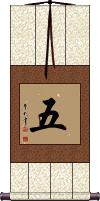
五 is the number five in Chinese, Japanese Kanji, and old Korean Hanja.
This is a strange selection for a wall scroll, so it's here mostly for reference. I guess it's OK if the number five is important to you.
 Because this character is rather simple (just four strokes), there is an anti-fraud way to write three on bank documents. These variants are shown to the right. This version can also refer to a squad of five soldiers, or in Korean, refer to rank.
Sky / Ether / Void / Emptiness / Unreality
(Used in Japanese version of five elements)
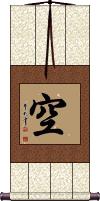
空 is a single character that means empty, void, hollow, vacant, vacuum, blank, nonexistent, vacuity, voidness, emptiness, non-existence, immateriality, unreality, the false or illusory nature of all existence, and being unreal.
In the Buddhist context, this relates to the doctrine that all phenomena and the ego have no reality but are composed of a certain number of skandhas or elements, which disintegrate. The void, the sky, space. The universal, the absolute, complete abstraction without relativity. The doctrine further explains that all things are compounds, or unstable organisms, possessing no self-essence, i.e. are dependent, or caused, come into existence only to perish. The underlying reality, the principle of eternal relativity, or non-infinity, i.e. śūnya, permeates all phenomena making possible their evolution.
From Sanskrit and/or Pali, this is the translation to Chinese and Japanese of the title śūnya or śūnyatā.
In Japanese, when pronounced as “ron” (sounds like “roan”) this can be a given name. It should be noted that this Kanji has about 5 different possible pronunciations in Japanese: kuu, kara, sora, ron, and uro. 空 is also an element in the Japanese version of the five elements.
Not the results for Number Five that you were looking for?
Below are some entries from our dictionary that may match your Number Five search...
| Characters If shown, 2nd row is Simp. Chinese |
Pronunciation Romanization |
Simple Dictionary Definition |
空 see styles |
kòng kong4 k`ung kung ron ろん |
More info & calligraphy: Sky / Ether / Void / Emptiness / Unreality(1) empty air; sky; (2) {Buddh} shunyata (the lack of an immutable intrinsic nature within any phenomenon); emptiness; (3) (abbreviation) (See 空軍) air force; (noun or adjectival noun) (4) fruitlessness; meaninglessness; (noun or adjectival noun) (5) (See 五大・1) void (one of the five elements); (can be adjective with の) (6) {math} empty (e.g. set); (female given name) Ron śūnya, empty, void, hollow, vacant, nonexistent. śūnyatā, 舜若多, vacuity, voidness, emptiness, non-existence, immateriality, perhaps spirituality, unreality, the false or illusory nature of all existence, the seeming 假 being unreal. The doctrine that all phenomena and the ego have no reality, but are composed of a certain number of skandhas or elements, which disintegrate. The void, the sky, space. The universal, the absolute, complete abstraction without relativity. There are classifications into 2, 3, 4, 6, 7, 11, 13, 16, and 18 categories. The doctrine is that all things are compounds, or unstable organisms, possessing no self-essence, i.e. are dependent, or caused, come into existence only to perish. The underlying reality, the principle of eternal relativity, or non-infinity, i.e. śūnya, permeates all phenomena making possible their evolution. From this doctrine the Yogācārya school developed the idea of the permanent reality, which is Essence of Mind, the unknowable noumenon behind all phenomena, the entity void of ideas and phenomena, neither matter nor mind, but the root of both. |
戒 see styles |
jiè jie4 chieh kai; ingoto(ok) かい; いんごと(ok) |
to guard against; to exhort; to admonish or warn; to give up or stop doing something; Buddhist monastic discipline; ring (for a finger) (1) (かい only) {Buddh} admonition; commandment; (2) sila (precept) śīla, 尸羅. Precept, command, prohibition, discipline, rule; morality. It is applied to the five, eight, ten, 250, and other commandments. The five are: (1) not to kill; (2 ) not to steal; (3) not to commit adultery; (4) not to speak falsely; (5) not to drink wine. These are the commands for lay disciples; those who observe them will be reborn in the human realm. The Sarvāstivādins did not sanction the observance of a limited selection from them as did the 成實宗 Satyasiddhi school. Each of the five precepts has five guardian spirits, in all twenty-five, 五戒二十五神. The eight for lay disciples are the above five together with Nos. 7, 8, and 9 of the following; the ten commands for the ordained, monks and nuns, are the above five with the following: (6) not to use adornments of flowers, nor perfumes; (7) not to perform as an actor, juggler, acrobat, or go to watch and hear them; (8) not to sit on elevated, broad, and large divans (or beds); (9) not to eat except in regulation hours; (10) not to possess money, gold or silver, or precious things. The 具足戒full commands for a monk number 250, those for a nun are 348, commonly called 500. Śīla is also the first of the 五分法身, i.e. a condition above all moral error. The Sutra of Brahma's Net has the following after the first five: (6) not to speak of the sins of those in orders; (7) not to vaunt self and depreciate others; (8) not to be avaricious; (9) not to be angry; (10) not to slander the triratna. |
五旬 see styles |
wǔ xún wu3 xun2 wu hsün gojun |
pañca-bhijñā. The five supernatural or magical powers; six is the more common number in Chinese texts, five is the number in Ceylon; v. 五神通. |
五桁 see styles |
goketa ごけた |
five-digit number; "ten thousands" column |
僧佉 see styles |
sēng qiā seng1 qia1 seng ch`ia seng chia sōkya |
saṅkhyā, 僧企耶; intp. 數 number, reckon, calculate; Saṅkhyā, 'one of the great divisions of Hindu philosophy ascribed to the sage Kapila, and so called as 'reckoning up' or 'enumerating' twenty-five Tattvas or true principles, its object being to effect the final liberation of the twenty-fifth (Purusha, the Soul) from the fetters of the phenomenal creation by conveying the correct knowledge of the twenty-four other Tattvas, and rightly discriminating the soul from them.' M.W. Cf. 迦 and 數. |
四禪 四禅 see styles |
sì chán si4 chan2 ssu ch`an ssu chan shizen |
(四禪天) The four dhyāna heavens, 四靜慮 (四靜慮天), i. e. the division of the eighteen brahmalokas into four dhyānas: the disciple attains to one of these heavens according to the dhyāna he observes: (1) 初禪天 The first region, 'as large as one whole universe' comprises the three heavens, Brahma-pāriṣadya, Brahma-purohita, and Mahābrahma, 梵輔, 梵衆, and 大梵天; the inhabitants are without gustatory or olfactory organs, not needing food, but possess the other four of the six organs. (2) 二禪天 The second region, equal to 'a small chiliocosmos' 小千界, comprises the three heavens, according to Eitel, 'Parīttābha, Apramāṇābha, and Ābhāsvara, ' i. e. 少光 minor light, 無量光 infinite light, and 極光淨 utmost light purity; the inhabitants have ceased to require the five physical organs, possessing only the organ of mind. (3) 三禪天 The third region, equal to 'a middling chiliocosmos '中千界, comprises three heavens; Eitel gives them as Parīttaśubha, Apramāṇaśubha, and Śubhakṛtsna, i. e. 少淨 minor purity, 無量淨 infinite purity, and 徧淨 universal purity; the inhabitants still have the organ of mind and are receptive of great joy. (4) 四禪天 The fourth region, equal to a great chiliocosmos, 大千界, comprises the remaining nine brahmalokas, namely, Puṇyaprasava, Anabhraka, Bṛhatphala, Asañjñisattva, Avṛha, Atapa, Sudṛśa, Sudarśana, and Akaniṣṭha (Eitel). The Chinese titles are 福生 felicitous birth, 無雲 cloudless, 廣果 large fruitage, 無煩 no vexations, atapa is 無熱 no heat, sudṛśa is 善見 beautiful to see, sudarśana is 善現 beautiful appearing, two others are 色究竟 the end of form, and 無想天 the heaven above thought, but it is difficult to trace avṛha and akaniṣṭha; the inhabitants of this fourth region still have mind. The number of the dhyāna heavens differs; the Sarvāstivādins say 16, the 經 or Sutra school 17, and the Sthavirāḥ school 18. Eitel points out that the first dhyāna has one world with one moon, one mem, four continents, and six devalokas; the second dhyāna has 1, 000 times the worlds of the first; the third has 1, 000 times the worlds of the second; the fourth dhyāna has 1, 000 times those of the third. Within a kalpa of destruction 壞劫 the first is destroyed fifty-six times by fire, the second seven by water, the third once by wind, the fourth 'corresponding to a state of absolute indifference' remains 'untouched' by all the other evolutions; when 'fate (天命) comes to an end then the fourth dhyāna may come to an end too, but not sooner'. |
數論 数论 see styles |
shù lùn shu4 lun4 shu lun Suron |
number theory (math.) The śāstras of the Sarvāstivādins; also Kaplila, called數論外道; 數論師 founder of the Sāṅkhyā philosophy; v. 僧伽, 劫, and 迦. It is an attempt to place all concepts in twenty-five categories, with puruṣa at the head and the others in ordered progress. Inter alia it also teaches 'the eternity and multiplicity of souls' (Eitel). Vasubandhu wrote in criticism of the system. |
明處 明处 see styles |
míng chù ming2 chu4 ming ch`u ming chu myōsho |
clear place; out in the open The regions or realms of study which produce wisdom, five in number, v. 五明 (五明處). |
結界 结界 see styles |
jié jiè jie2 jie4 chieh chieh kekkai けっかい |
(Buddhism) to designate the boundaries of a sacred place within which monks are to be trained; a place so designated; (fantasy fiction) force field; invisible barrier (orthographic borrowing from Japanese 結界 "kekkai") (1) {Buddh} (fixing) boundaries for religious practices; (2) {Buddh} prohibition (of items, people, spirits, etc. that would hinder Buddhist practice); (3) {Buddh} fence between inner and outer sanctums in a temple; (4) (archaism) (See 帳場格子) short two or three-fold lattice around the front desk of a store; (5) (colloquialism) (esp. in games, manga, etc.) barrier; dimensional barrier; containment zone; containment barrier; mystical barrier A fixed place, or territory; a definite area; to fix a place for a monastery, or an altar; a determined number, e.g. for an assembly of monks; a limit. It is a term specially used by the esoteric sects for an altar and its area, altars being of five different shapes. |
真分數 真分数 see styles |
zhēn fēn shù zhen1 fen1 shu4 chen fen shu |
proper fraction (with numerator < denominator, e.g. five sevenths); see also: improper fraction 假分數|假分数[jia3 fen1 shu4] and mixed number 帶分數|带分数[dai4 fen1 shu4] See: 真分数 |
衞世師 衞世师 see styles |
wèi shì shī wei4 shi4 shi1 wei shih shih Eiseishi |
Vaiśeṣika; derived from viśeṣa, characteristic, individuality, particularity or individual essence. M.W. Also 鞞世師 (or 鞞思迦); 吠世史迦; 勝論宗 An atomistic school founded by Kaṇāda. Like the Saṅkhya philosophy it taught a dualism and an endless number of souls, also by its doctrine of particularity or individual essence maintained 'the eternally distinct or sui generis nature of the nine substances' (see below), 'of which the first five including mind are held to be atomic.' M.W. The interaction of these with the six mentioned below produces cosmic evolution. It chiefly occupied itself, like the orthodox Nyāya philosophy, with the theory of knowledge, but it differed by distinguishing only six categories of cognition 六諦, viz. substance, quality, activity, species, distinction, and correlation, also a seventh of non-existence, and nine substances possessed of qualities, these 九陰 being: the five elements, air, fire, water, earth, ether, together with time, space, spirit (manas), and soul (ātman). Cf. Keith, Indian Logic and Atomism, and Dasgupta, History of Indian Philosophy. |
五不可思議 五不可思议 see styles |
wǔ bù kě sī yì wu3 bu4 ke3 si1 yi4 wu pu k`o ssu i wu pu ko ssu i go fukashigi |
The five inconceivable, or thought-surpassing things. v. 不可思議.; The five indescribables, of the 智度論 30, are: The number of living beings; all the consequences of karma; the powers of a state of dhyāna; the powers of nagas; the powers of the Buddhas. |
千眼千臂觀世音 千眼千臂观世音 see styles |
qiān yǎn qiān bì guān shì yīn qian1 yan3 qian1 bi4 guan1 shi4 yin1 ch`ien yen ch`ien pi kuan shih yin chien yen chien pi kuan shih yin Sengensenhi Kanseon |
Sahasrabhuja-sahasranetra. One of the six forms of Kuanyin with a thousand arms and a thousand eyes. The image usually has forty arms, one eye in each hand; and forty multiplied by twenty-five is the number of regions in this universe. For the 二十八部 or retinue, the maṇḍala and signs v. 千手經. |
The following table may be helpful for those studying Chinese or Japanese...
| Title | Characters | Romaji (Romanized Japanese) | Various forms of Romanized Chinese | |
| Five | 五 / 伍 五 | go | wǔ / wu3 / wu | |
| Sky Ether Void Emptiness Unreality | 空 | kuu / kara / sora / ron ku / kara / sora / ron | kōng / kong1 / kong | k`ung / kung |
| In some entries above you will see that characters have different versions above and below a line. In these cases, the characters above the line are Traditional Chinese, while the ones below are Simplified Chinese. | ||||

Successful Chinese Character and Japanese Kanji calligraphy searches within the last few hours...



