Many custom options...


And formats...



Not what you want?
Try other similar-meaning words, fewer words, or just one word.
No Gain in Chinese / Japanese...
Buy a No Gain calligraphy wall scroll here!
Personalize your custom “No Gain” project by clicking the button next to your favorite “No Gain” title below...
Without a big net, how can you catch fish?
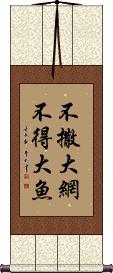
不撒大網不得大魚 is a Chinese proverb that literally translates as: [if one does] not cast a big net, [one can] not get big fish.
Figuratively, this means: One cannot make great accomplishments without making great efforts or taking great pains.
This is sort of the fishing version of, “No pain, no gain.”
No Pain No Gain
Literally: No Pain, No Strength
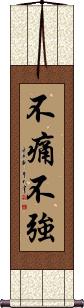
不痛不強 is a proverb that is close to our idea of “no pain, no gain” in English. It holds this meaning in the context of working out at the gym etc.
不痛不強 means “no pain, no strength,” meaning that if you don't experience a little pain, you will not gain any strength.
No Pain No Gain
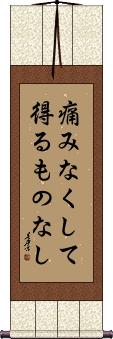
痛みなくして得るものなし is a Japanese phrase that means “no pain, no gain.”
This suggests that with pain, a gain must follow.
The pain Kanji here can also be translated as sorrow or suffering. The gain can also mean profit, advantage, or benefit. In the Japanese Buddhist context, that gain Kanji can mean rebirth in paradise, entering nirvana.
The character breakdown:
痛みなく (itami naku) pain; ache; sore; grief; distress. The naku part adds the meaning of “a lot of” or “extended”
して (shite) and then. (indicates a causative expression; acts as a connective particle)
得る (eru) to get; to acquire; to obtain; to procure; to earn; to win; to gain; to secure; to attain.
もの (mono) conjunctive particle indicating a cause or reason.
なし (nashi) none of; -less; without; no.
Note: Because this selection contains some special Japanese Hiragana characters, it should be written by a Japanese calligrapher.
There is no pleasure without pain
No pain, no gain
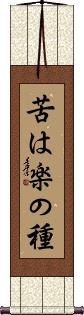
苦は楽の種 is a Japanese proverb that means “One cannot have pleasure without pain.”
It's one of a few Japanese ways to say, “No pain, no gain.”
Note: Because this selection contains some special Japanese Hiragana characters, it should be written by a Japanese calligrapher.
The Confident Helmsman Inspires Confidence in the Passengers
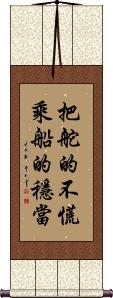
把舵的不慌乘船的稳当 is a Chinese proverb that literally translates as: [If the] helmsman is not nervous, the passengers [will feel] secure.
Figuratively, this means: If the leader appears confident, his/her followers will gain confidence also.
This is a great suggestion that a confident leader inspires confidence in his/her troops or followers. Of course, a nervous leader will create fear in troops or followers.
Drain the pond to get all the fish
Kill the goose that lays the golden eggs
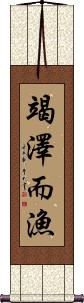
In 632 BC, Duke Wen of the Kingdom of Jin was about to lead an army against the forces of the Kingdom of Chu.
The Duke asked one of his advisers, Jiu Fan, how they could win the impending battle, as they were drastically outnumbered.
Jiu Fan said, “All is fair in war,” and suggested a plan of dishonorable tactics (cheating).
The Duke was unsure of this advice, so he asked another adviser, Yong Ji, who replied, “If you catch fish by draining the pond, you can certainly get all the fish. But there will be no fish the following year. You can cheat this one time in battle, but such tactics can only be used once, as the enemy will be wise in future encounters.”
The Duke heard the words of his wiser adviser but cheated to gain victory in the battle. However, he rewarded Yong Ji more than Jiu Fan at the victory celebration, stating that while Jiu Fan's advice gained one victory, the wise words of Yong Ji would last forever.
This Chinese idiom/proverb is still used, over 2600 years later to remind people not to burn bridges, cheat, or dishonor themselves in exchange for a short-term gain while sacrificing the future.
竭澤而漁 is very similar to the meaning of the English phrase, “Kill the goose that lays the golden eggs.”
This in-stock artwork might be what you are looking for, and ships right away...
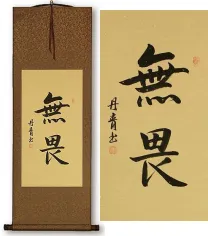
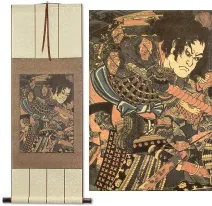
Gallery Price: $108.00
Your Price: $59.88
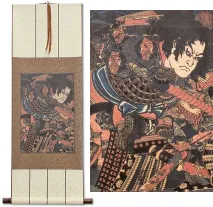
Gallery Price: $108.00
Your Price: $59.88
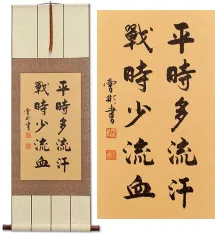
Gallery Price: $220.00
Your Price: $112.88

Gallery Price: $61.00
Your Price: $33.88
Not the results for No Gain that you were looking for?
Below are some entries from our dictionary that may match your No Gain search...
| Characters If shown, 2nd row is Simp. Chinese |
Pronunciation Romanization |
Simple Dictionary Definition |
ブラス see styles |
purasu プラス |
More info & calligraphy: Bras |
苦は楽の種 see styles |
kuharakunotane くはらくのたね |
More info & calligraphy: There is no pleasure without pain |
不勞無獲 不劳无获 see styles |
bù láo wú huò bu4 lao2 wu2 huo4 pu lao wu huo |
no pain, no gain (idiom) |
無欲恬淡 see styles |
muyokutentan むよくてんたん |
(adj-na,adj-no,adj-t,adv-to,n) (yoji) indifferent to worldly gain |
ハイゲイン see styles |
haigein / haigen ハイゲイン |
(adj-no,n) {electr} high-gain (sound, antenna, etc.) |
プラマイ0 see styles |
puramaizero プラマイゼロ |
(abbreviation) (kana only) (See プラスマイナスゼロ) no loss or gain; coming out even |
プラマイゼロ see styles |
puramaizero プラマイゼロ |
(abbreviation) (See プラスマイナスゼロ) no loss or gain; coming out even |
有所得必有所失 see styles |
yǒu suǒ dé bì yǒu suǒ shī you3 suo3 de2 bi4 you3 suo3 shi1 yu so te pi yu so shih |
there is no gain without a loss (idiom); there is no such thing as a free meal |
プラスマイナス0 see styles |
purasumainasuzero; purasu mainasu zero プラスマイナスゼロ; プラス・マイナス・ゼロ |
(kana only) no loss or gain (wasei: plus minus zero); coming out even |
何の得にもならない see styles |
nannotokunimonaranai なんのとくにもならない |
(exp,adj-i) to gain nothing; to be of no benefit; to be no use; to be unprofitable |
労多くして功少なし see styles |
rouookushitekousukunashi / roookushitekosukunashi ろうおおくしてこうすくなし |
(expression) (idiom) all pain and no gain; lots of pain and not much gain |
百害あって一利なし see styles |
hyakugaiatteichirinashi / hyakugaiattechirinashi ひゃくがいあっていちりなし |
(expression) all pain, no gain; doing no good and a lot of harm; having no redeeming features; being a complete disadvantage; a hundred harms and not a single gain |
百害あって一利無し see styles |
hyakugaiatteichirinashi / hyakugaiattechirinashi ひゃくがいあっていちりなし |
(expression) all pain, no gain; doing no good and a lot of harm; having no redeeming features; being a complete disadvantage; a hundred harms and not a single gain |
吃得苦中苦,方為人上人 吃得苦中苦,方为人上人 |
chī dé kǔ zhōng kǔ , fāng wéi rén shàng rén chi1 de2 ku3 zhong1 ku3 , fang1 wei2 ren2 shang4 ren2 ch`ih te k`u chung k`u , fang wei jen shang jen chih te ku chung ku , fang wei jen shang jen |
one cannot achieve glory and wealth without having been through trials and tribulations (proverb); no pain, no gain |
Variations: |
kuarebarakuari くあればらくあり |
(expression) (proverb) no pain, no gain; no cross, no crown |
Variations: |
hyakugaiatteichirinashi / hyakugaiattechirinashi ひゃくがいあっていちりなし |
(expression) (idiom) all pain, no gain; doing no good and a lot of harm; having no redeeming features; being a complete disadvantage; a hundred harms and not a single gain |
Variations: |
purasumainasuzero; purasu mainasu zero プラスマイナスゼロ; プラス・マイナス・ゼロ |
no loss or gain (wasei: plus minus zero); coming out even |
Variations: |
atozuke あとづけ |
(1) appendix; postscript; back matter; (noun, transitive verb) (2) retrofit; post-installation; custom installation; (noun, transitive verb) (3) giving a reason afterwards; making an excuse after the event; (4) {mahj} atozuke; tenpai hand with no guaranteed yaku, but can gain yaku upon obtaining a specific winning tile |
The following table may be helpful for those studying Chinese or Japanese...
| Title | Characters | Romaji (Romanized Japanese) | Various forms of Romanized Chinese | |
| Without a big net, how can you catch fish? | 不撒大網不得大魚 不撒大网不得大鱼 | bù sā dà wǎng bù dé dà yú bu4 sa1 da4 wang3 bu4 de2 da4 yu2 bu sa da wang bu de da yu busadawangbudedayu | pu sa ta wang pu te ta yü pusatawangputetayü |
|
| No Pain No Gain | 不痛不強 不痛不强 | bú tòng bù qiáng bu2 tong4 bu4 qiang2 bu tong bu qiang butongbuqiang | pu t`ung pu ch`iang putungpuchiang pu tung pu chiang |
|
| No Pain No Gain | 痛みなくして得るものなし | itami naku shite erumono wa nashi | ||
| There is no pleasure without pain | 苦は楽の種 | ku wa raku no tane kuwarakunotane | ||
| The Confident Helmsman Inspires Confidence in the Passengers | 把舵的不慌乘船的穩當 把舵的不慌乘船的稳当 | bǎ tuò de bù huāng chéng chuán de wěn dang ba3 tuo4 de bu4 huang1 cheng2 chuan2 de wen3 dang ba tuo de bu huang cheng chuan de wen dang | pa t`o te pu huang ch`eng ch`uan te wen tang pa to te pu huang cheng chuan te wen tang |
|
| Drain the pond to get all the fish | 竭澤而漁 竭泽而渔 | jié zé ér yú jie2 ze2 er2 yu2 jie ze er yu jiezeeryu | chieh tse erh yü chiehtseerhyü |
|
| In some entries above you will see that characters have different versions above and below a line. In these cases, the characters above the line are Traditional Chinese, while the ones below are Simplified Chinese. | ||||

Successful Chinese Character and Japanese Kanji calligraphy searches within the last few hours...



