Many custom options...


And formats...



Not what you want?
Try other similar-meaning words, fewer words, or just one word.
Ni Hen Ke Ai in Chinese / Japanese...
Buy a Ni Hen Ke Ai calligraphy wall scroll here!
Personalize your custom “Ni Hen Ke Ai” project by clicking the button next to your favorite “Ni Hen Ke Ai” title below...
Switched to secondary search mode due to lack of results using primary.
These secondary results may not be very accurate. Try a different but similar meaning word or phrase for better results. Or...
Look up Ni Hen Ke Ai in my Japanese Kanji & Chinese Character Dictionary(My dictionary is a different system then the calligraphy search you just tried)
If you want a special phrase, word, title, name, or proverb, feel free to contact me, and I will translate your custom calligraphy idea for you.
1. The Buddha is in Each Sentient Being
2. Enjoy Life
5. Gee
8. Love
9. Luo
10. Mencius
12. Ni
13. Ni-Dan
15. Two
The Buddha is in Each Sentient Being
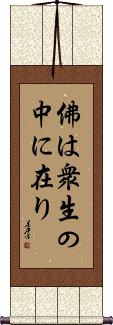
佛は衆生の中に在り is “Butsu wa shujo no naka ni ari” and means that the Buddha (potential for Buddhahood) exists in all beings in the universe.
So yes, your dog has the potential to be a Buddha (but only in a future reincarnation as a human). But all things, from the tiny cricket to the humpback whale have Buddha nature within them. If one takes the time to look and contemplate, one will see the Buddha in all things.
In Japan, sometimes the Buddha character is written 仏 instead of 佛, so you might see the whole phrase written as 仏は衆生の中に在り.
Note: Because this selection contains some special Japanese Hiragana characters, it should be written by a Japanese calligrapher.
Enjoy Life
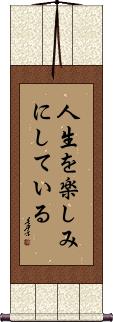
人生を楽しみにしている is one way to write “enjoy life” in Japanese.
The character breakdown:
人生 (jinsei) life (i.e. conception to death) human lifetime, living.
を (o) connecting particle.
楽しみ (tanoshimi) enjoyment; pleasure; anticipation; looking forward to.
に (ni) connecting particle.
し (shi) to do; to cause; to become; to make (into).
て (te) connecting particle.
いる (iru) indicates continuing action or resulting state.
Note: Because this selection contains some special Japanese Hiragana characters, it should be written by a Japanese calligrapher.
Family / Home
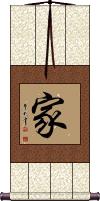
家 is the single character that means family in Chinese and Japanese.
It can also mean home or household depending on context.
Hanging this on your wall suggests that you put “family first.”
Pronunciation varies in Japanese depending on context. When pronounced “uchi” in Japanese, it means home, but when pronounced “ke,” it means family.
 Note that there is an alternate form of this character. It has an additional radical on the left side but no difference in meaning or pronunciation. The version shown above is the most universal, and is also ancient/traditional. The image shown to the right is only for reference.
Forever In My Heart
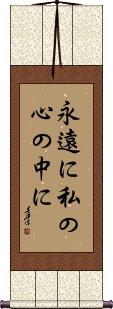
永遠に私の心の中に means “forever in my heart” or “always in my heart” in Japanese.
The character breakdown:
永遠 (eien) eternity; perpetuity; immortality; permanence.
に (ni) indicates the location of a person or thing.
私の (watashi no) my; mine.
心の中 (kokoro no naka) the middle of one's mind; the midst of one's heart.
に (ni) indicates the location of a person or thing (makes this “in” the middle of one's heart).
Note: There’s more than one way to say "Forever in My Heart" in Japanese, so you’ll find another version in our database. This is the very verbose version.
Note: Because this selection contains some special Japanese Hiragana characters, it should be written by a Japanese calligrapher.
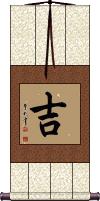
吉 is a surname sometimes romanized as Gee from Chinese.
There are several characters that can also be romanizations or transliterations of Gee, including 紀 (Ji), 季 (Ji), 葛 (Ge), 朱 (Zhu - meaning vermilion/cinnabar), 余 (Yu), 俞 (Yu), and 倪 (Ni).
Hello / Ni Hao
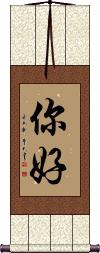
你好 is the day-to-day way to say hello in Chinese.
The characters literally mean, “You good?” It's the equivalent of “What's up?” in English, where nobody expects an actual answer.
This explanation is here for educational purposes only. 你好 is an oral word that is not appropriate for a scroll (not a bad meaning, just very odd for a wall scroll).
Karate Ni Sente Nashi
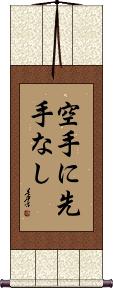
空手に先手なし means there is no first attack in Karate, or there is no first strike in Karate.
Note: Because this selection contains some special Japanese Hiragana characters, it should be written by a Japanese calligrapher.
Love
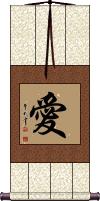
愛 universally means love in Chinese, Japanese Kanji, old Korean Hanja, and old Vietnamese.
愛 is one of the most recognized Asian symbols in the West and is often seen on tee shirts, coffee mugs, tattoos, and more.
愛 can also be defined as affection, to be fond of, to like, or to be keen on. It often refers to romantic love, and is found in phrases like, “I love you.” But in Chinese, one can say, “I love that movie” using this character as well.
This can also be a pet name or part of a pet name in the way we say “dear” or “honey” in English.
This can be a girl’s name “Ai” in both Chinese and Japanese.
More about this character:
This may be hard to imagine as a westerner but the strokes at the top of this love character symbolize family & marriage.
 The symbol in the middle is a little easier to identify. It is the character for "heart" (it can also mean "mind" or "soul"). I guess you can say that no matter if you are from the East or the West, you must put your heart into your love.
 The strokes at the bottom create a modified character that means "friend" or "friendship."
I suppose you could say that the full meaning of this love character is to love your family, spouse, and friends with all of your heart, since all three elements exist in this character.
See Also: I Love You | Caring | Benevolence | Friendliness | Double Happiness Happy Marriage Wall Scroll
Luo
Surname
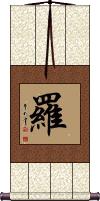
羅 is a character that can be the Chinese surname Luo.
This can also be the Japanese surname Ra, Ami, Ai, Rou, or Ro (and a few others).
The meaning is to collect, gather, catch, or sift. It may also refer to gauze, a lightweight fabric, or thin silk.
Mencius
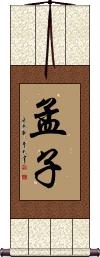
孟子 is the name Mencius in Chinese.
Mencius had the name “Mèng Kē” (孟軻) at birth. This later changed to Mèng Zǐ (孟子). He lived between 372 and 289 BCE.
Mencius was a Chinese Confucian philosopher who has often been referred to as the “Second Sage” following Confucius himself.
For disambiguation, one of the classic books of Confucianism is also titled 孟子.
Romanization of Mencius from Chinese includes Meng Tsu, Mengzi, and his original name Mengke or Meng Ko. In Japanese, he is Mōshi or Moushi.
Misty / Cloudy Sky
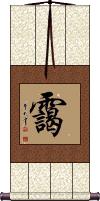
靄 is the Chinese, Japanese Kanji, and old Korean Hanja for misty mist; haze; cloudy sky.
When pronounced “Ai” in Japanese, it can be a female given name.
靄 is probably a good character to represent “Misty” if that is your name.

倪 is the name Ni in Chinese (Mandarin).

ニ is the name Ni in Japanese Katakana.
Note: Because this title is entirely Japanese Katakana, it should be written by a Japanese calligrapher.
Ni-Dan
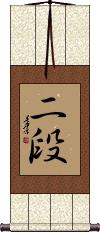
二段 is a Japanese Kanji word that literally means “second degree.”
二段 is the second black belt rank in Japanese martial arts.
The first Kanji means two or second in Japanese.
The second Kanji means step, grade, rank, or level.
二段 can also be written as 弐段. This version just uses a more complicated Kanji for the number two.
The Roar of the Lioness
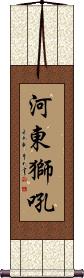
河東獅吼 is actually a proverb and joke about the plight and fear of a hen-pecked husband.
In ancient times, it was used to describe a wife who would berate her husband or go into jealous rages. However, this phrase currently brings about ideas of a husband that cowers in fear and cringes when his wife screams (or roars) at him.
Please only purchase this as a good-natured joke. If your wife or husband does not have a good sense of humor, it's probably not a good idea to hang this on your wall to irritate your mate.
Two
The number two
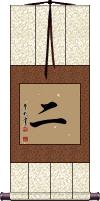
二 is the number 2 in Chinese, Korean Hanja, and Japanese Kanji. I have no idea why you would want this as a calligraphy wall scroll but hundreds of visitors search for this number.
In Japanese, this character can be pronounced several different ways depending on context. It can be ni, aru-, futa-, and a few others when combined with other characters.
There's just one way to pronounce this in Chinese. Korean also has just one pronunciation.
Work Unselfishly for the Common Good
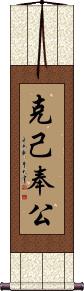
克己奉公 is a Chinese proverb that is often used to express how one should act as a government official. Most of us wish our public officials would hold themselves to higher standards. I wish I could send this scroll, along with the meaning to every member of Congress, and the President (or if I was from the UK, all the members of Parliament, and the PM)
This can also mean: “Place Strict Standards on Oneself in Public Service.”
The story behind this ancient Chinese idiom:
Cai Zun was born in China a little over 2000 years ago. In 24 AD, he joined an uprising led by Liu Xiu, who later became the emperor of the Eastern Han Dynasty.
Later, the new emperor put Cai Zun in charge of the military court. Cai Zun exercised his power in strict accordance with military law, regardless of the offender's rank or background. He even ordered the execution of one of the emperor's close servants after the servant committed a serious crime.
Cai Zun led a simple life but put great demands on himself to do all things honorably. The emperor rewarded him for his honest character and honorable nature by promoting him to the rank of General and granting him the title of Marquis.
Whenever Cai Zun would receive an award, he would give credit to his men and share the reward with them.
Cai Zun was always praised by historians who found many examples of his selfless acts that served the public interest.
Sometime long ago in history, people began to refer to Cai Zun as “ke ji feng gong.”
See Also: Unselfish | Selflessness | Altruism
Rooster / Chicken
Year of the Rooster / Zodiac Sign
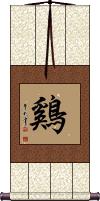
鷄 or 雞 is the character for rooster or chicken in Chinese, old Korean, and Japanese.
If you were born in the year of the rooster (chicken), you . . .
Have a unique sense of color.
Are highly principled and responsible.
Have persuasive power.
Are honest.
Have a great ability to communicate.


Please note: There are a few different ways to write rooster/chicken, as shown to the right. If you are particular about the form, please let us know when you place your order.
See also our Chinese Zodiac page.
This in-stock artwork might be what you are looking for, and ships right away...

The following table may be helpful for those studying Chinese or Japanese...
| Title | Characters | Romaji (Romanized Japanese) | Various forms of Romanized Chinese | |
| The Buddha is in Each Sentient Being | 佛は衆生の中に在り | butsu wa shujou no naka ni ari butsuwashujounonakaniari butsu wa shujo no naka ni ari | ||
| Enjoy Life | 人生を楽しみにしている | jin sei o tano shi mi ni shi te i ru | ||
| Family Home | 家 / 傢 家 | ei / uchi / ke | jiā / jia1 / jia | chia |
| Forever In My Heart | 永遠に私の心の中に | ei en ni watashi no kokoro no naka ni | ||
| Gee | 吉 | jí / ji2 / ji | chi | |
| Hello Ni Hao | 你好 | nǐ hǎo / ni3 hao3 / ni hao / nihao | ||
| Karate Ni Sente Nashi | 空手に先手なし | karate ni sente nashi karatenisentenashi | ||
| Love | 愛 爱 | ai | ài / ai4 / ai | |
| Luo | 羅 罗 | ra | luō / luo1 / luo | lo |
| Mencius | 孟子 | mou shi / moushi / mo shi | mèng zi / meng4 zi5 / meng zi / mengzi | meng tzu / mengtzu |
| Misty Cloudy Sky | 靄 霭 | moya | ǎi / ai3 / ai | |
| Ni | 倪 | ní / ni2 / ni | ||
| Ni | ニ | ni | ||
| Ni-Dan | 二段 | ni dan / nidan | ||
| The Roar of the Lioness | 河東獅吼 河东狮吼 | hé dōng shī hǒu he2 dong1 shi1 hou3 he dong shi hou hedongshihou | ho tung shih hou hotungshihhou |
|
| Two | 二 | ni / aru- / futa- | èr / er4 / er / er | erh |
| Work Unselfishly for the Common Good | 克己奉公 | kè jǐ fèng gōng ke4 ji3 feng4 gong1 ke ji feng gong kejifenggong | k`o chi feng kung kochifengkung ko chi feng kung |
|
| Rooster Chicken | 鷄 or 雞 鸡 or 鶏 | niwatori | jī / ji1 / ji | chi |
| In some entries above you will see that characters have different versions above and below a line. In these cases, the characters above the line are Traditional Chinese, while the ones below are Simplified Chinese. | ||||

Successful Chinese Character and Japanese Kanji calligraphy searches within the last few hours...



