Many custom options...


And formats...



Not what you want?
Try other similar-meaning words, fewer words, or just one word.
Ni Hao Ma in Chinese / Japanese...
Buy a Ni Hao Ma calligraphy wall scroll here!
Personalize your custom “Ni Hao Ma” project by clicking the button next to your favorite “Ni Hao Ma” title below...
Switched to secondary search mode due to lack of results using primary.
These secondary results may not be very accurate. Try a different but similar meaning word or phrase for better results. Or...
Look up Ni Hao Ma in my Japanese Kanji & Chinese Character Dictionary(My dictionary is a different system then the calligraphy search you just tried)
If you want a special phrase, word, title, name, or proverb, feel free to contact me, and I will translate your custom calligraphy idea for you.
1. The Buddha is in Each Sentient Being
2. Enjoy Life
4. Gee
5. Hao
7. Hao
8. Joshua 1:9
11. Ma
13. Ni
14. Ni-Dan
15. Old, But More Vigorous in Spirit
16. Two
The Buddha is in Each Sentient Being
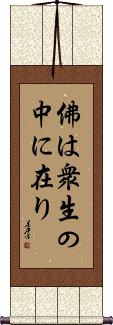
佛は衆生の中に在り is “Butsu wa shujo no naka ni ari” and means that the Buddha (potential for Buddhahood) exists in all beings in the universe.
So yes, your dog has the potential to be a Buddha (but only in a future reincarnation as a human). But all things, from the tiny cricket to the humpback whale have Buddha nature within them. If one takes the time to look and contemplate, one will see the Buddha in all things.
In Japan, sometimes the Buddha character is written 仏 instead of 佛, so you might see the whole phrase written as 仏は衆生の中に在り.
Note: Because this selection contains some special Japanese Hiragana characters, it should be written by a Japanese calligrapher.
Enjoy Life
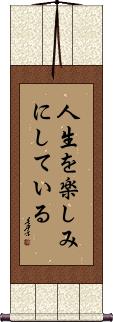
人生を楽しみにしている is one way to write “enjoy life” in Japanese.
The character breakdown:
人生 (jinsei) life (i.e. conception to death) human lifetime, living.
を (o) connecting particle.
楽しみ (tanoshimi) enjoyment; pleasure; anticipation; looking forward to.
に (ni) connecting particle.
し (shi) to do; to cause; to become; to make (into).
て (te) connecting particle.
いる (iru) indicates continuing action or resulting state.
Note: Because this selection contains some special Japanese Hiragana characters, it should be written by a Japanese calligrapher.
Forever In My Heart
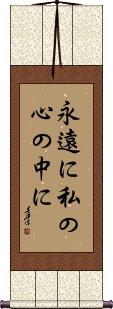
永遠に私の心の中に means “forever in my heart” or “always in my heart” in Japanese.
The character breakdown:
永遠 (eien) eternity; perpetuity; immortality; permanence.
に (ni) indicates the location of a person or thing.
私の (watashi no) my; mine.
心の中 (kokoro no naka) the middle of one's mind; the midst of one's heart.
に (ni) indicates the location of a person or thing (makes this “in” the middle of one's heart).
Note: There’s more than one way to say "Forever in My Heart" in Japanese, so you’ll find another version in our database. This is the very verbose version.
Note: Because this selection contains some special Japanese Hiragana characters, it should be written by a Japanese calligrapher.
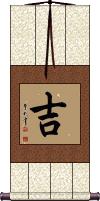
吉 is a surname sometimes romanized as Gee from Chinese.
There are several characters that can also be romanizations or transliterations of Gee, including 紀 (Ji), 季 (Ji), 葛 (Ge), 朱 (Zhu - meaning vermilion/cinnabar), 余 (Yu), 俞 (Yu), and 倪 (Ni).
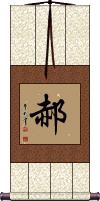
Hello / Ni Hao
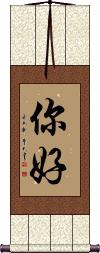
你好 is the day-to-day way to say hello in Chinese.
The characters literally mean, “You good?” It's the equivalent of “What's up?” in English, where nobody expects an actual answer.
This explanation is here for educational purposes only. 你好 is an oral word that is not appropriate for a scroll (not a bad meaning, just very odd for a wall scroll).
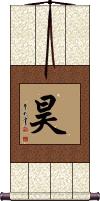
This means vast and limitless or the vast sky.
昊 is also a Chinese surname that romanizes as Hao.
In Japanese, this can be the given names Hiroshi, Takashi, Sora, or Atsushi.
Joshua 1:9
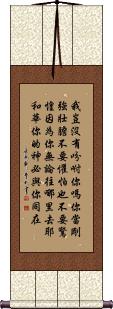
Here is the full translation of Joshua 1:9 into Chinese.
The text with punctuation:
我岂没有吩咐你吗?你当刚强壮胆。不要惧怕,也不要惊惶。因为你无论往哪里去,耶和华你的神必与你同在。
Hand-painted calligraphy does not retain punctuation.
This translation comes from the 1919 Chinese Union Bible.
For reference, from the KJV, this reads, “Have not I commanded thee? Be strong and of a good courage; be not afraid, neither be thou dismayed: for the LORD thy God is with thee whithersoever thou goest.”
Karate Ni Sente Nashi
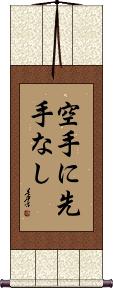
空手に先手なし means there is no first attack in Karate, or there is no first strike in Karate.
Note: Because this selection contains some special Japanese Hiragana characters, it should be written by a Japanese calligrapher.
Kobayashi / Shobayashi
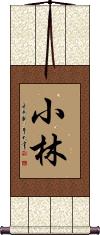
小林 means little forest in Japanese and Chinese.
This can also be the Japanese surname or martial arts style called Kobayashi or Shōbayashi.
In Japanese martial arts, this can also be pronounced as Shorin and is included as such in some MA school names.
Ma
Surname
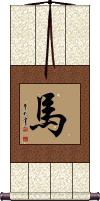
馬 is the surname Ma in Chinese (Mandarin).
The meaning of 馬 is horse. There is a less-common Chinese surname, 麻, meaing hemp.

マ is the name Ma in Japanese Katakana.
Note: Because this title is entirely Japanese Katakana, it should be written by a Japanese calligrapher.
Mama / Mother / Mommy
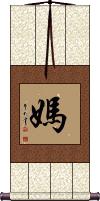
媽 is the oral way that most Chinese people refer to their mothers. Often, they will put this together twice (two of the same character in a row) to create a word that sounds like “Mama.” That's absolutely what little kids call their mothers in China. This Chinese “Mama” is the rough equivalent of “Mommy” in English. Beyond a certain age, Chinese will start to just say “Ma,” which is like saying “Mom.”
This entry is just here for a language lesson. This would make a strange wall scroll by Chinese standards. In Chinese, there are sometimes oral words that don't seem appropriate when written in calligraphy, and this is one of them. See our entry for “Loving Mother” for a better selection.
See Also: Loving Mother | Family

倪 is the name Ni in Chinese (Mandarin).

ニ is the name Ni in Japanese Katakana.
Note: Because this title is entirely Japanese Katakana, it should be written by a Japanese calligrapher.
Ni-Dan
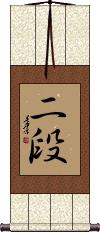
二段 is a Japanese Kanji word that literally means “second degree.”
二段 is the second black belt rank in Japanese martial arts.
The first Kanji means two or second in Japanese.
The second Kanji means step, grade, rank, or level.
二段 can also be written as 弐段. This version just uses a more complicated Kanji for the number two.
Old, But More Vigorous in Spirit
Age is just a number
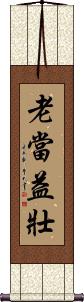
老當益壯 is a Chinese proverb that means “old but vigorous” or “hale and hearty despite the years.”
Said of someone who is more spirited when he/she grows older.
The story behind this Chinese proverb:
In the Eastern Han Dynasty, there was a man named Ma Yuan. He had been planning to herd animals on the frontier since he was young. When he grew up, Ma became a minor official of a county.
Once, he was sending some prisoners to another location. He felt pity for them, so he set them free, and then he fled to another county in the north. He herded animals there, and thus his dream came true. He always said: “If you want to be a great man, the poorer you are, the firmer in spirit you have to be; the older you are, the more spirited you should be.”
Later, when he was even older, Ma Yuan became a famous general of the Eastern Han Dynasty and contributed to many battles.
Two
The number two
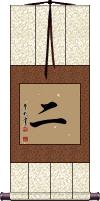
二 is the number 2 in Chinese, Korean Hanja, and Japanese Kanji. I have no idea why you would want this as a calligraphy wall scroll but hundreds of visitors search for this number.
In Japanese, this character can be pronounced several different ways depending on context. It can be ni, aru-, futa-, and a few others when combined with other characters.
There's just one way to pronounce this in Chinese. Korean also has just one pronunciation.
The following table may be helpful for those studying Chinese or Japanese...
| Title | Characters | Romaji (Romanized Japanese) | Various forms of Romanized Chinese | |
| The Buddha is in Each Sentient Being | 佛は衆生の中に在り | butsu wa shujou no naka ni ari butsuwashujounonakaniari butsu wa shujo no naka ni ari | ||
| Enjoy Life | 人生を楽しみにしている | jin sei o tano shi mi ni shi te i ru | ||
| Forever In My Heart | 永遠に私の心の中に | ei en ni watashi no kokoro no naka ni | ||
| Gee | 吉 | jí / ji2 / ji | chi | |
| Hao | 郝 | hǎo / hao3 / hao | ||
| Hello Ni Hao | 你好 | nǐ hǎo / ni3 hao3 / ni hao / nihao | ||
| Hao | 昊 | hiroshi | hào / hao4 / hao | |
| Joshua 1:9 | 我豈沒有吩咐你嗎你當剛強壯膽不要懼怕也不要驚惶因為你無論往哪里去耶和華你的神必與你同在 我岂没有吩咐你吗你当刚强壮胆不要惧怕也不要惊惶因为你无论往哪里去耶和华你的神必与你同在 | wǒ qǐ méi yǒu fēn fù nǐ ma nǐ dāng gāng qiáng zhuàng dǎn bù yào jù pà yě bù yào jīng huáng yīn wèi nǐ wú lùn wǎng nǎ lǐ qù yē hé huá nǐ de shén bì yǔ nǐ tóng zài wo3 qi3 mei2 you3 fen1 fu4 ni3 ma ni3 dang1 gang1 qiang2 zhuang4 dan3 bu4 yao4 ju4 pa4 ye3 bu4 yao4 jing1 huang2 yin1 wei4 ni3 wu2 lun4 wang3 na3 li3 qu4 ye1 he2 hua2 ni3 de shen2 bi4 yu3 ni3 tong2 zai4 wo qi mei you fen fu ni ma ni dang gang qiang zhuang dan bu yao ju pa ye bu yao jing huang yin wei ni wu lun wang na li qu ye he hua ni de shen bi yu ni tong zai | wo ch`i mei yu fen fu ni ma ni tang kang ch`iang chuang tan pu yao chü p`a yeh pu yao ching huang yin wei ni wu lun wang na li ch`ü yeh ho hua ni te shen pi yü ni t`ung tsai wo chi mei yu fen fu ni ma ni tang kang chiang chuang tan pu yao chü pa yeh pu yao ching huang yin wei ni wu lun wang na li chü yeh ho hua ni te shen pi yü ni tung tsai |
|
| Karate Ni Sente Nashi | 空手に先手なし | karate ni sente nashi karatenisentenashi | ||
| Kobayashi Shobayashi | 小林 | shou bayashi / ko bayashi shoubayashi / kobayashi sho bayashi / ko bayashi | xiǎo lín / xiao3 lin2 / xiao lin / xiaolin | hsiao lin / hsiaolin |
| Ma | 馬 马 | mǎ / ma3 / ma | ||
| Ma | マ | ma | ||
| Mama Mother Mommy | 媽 妈 | mā / ma1 / ma | ||
| Ni | 倪 | ní / ni2 / ni | ||
| Ni | ニ | ni | ||
| Ni-Dan | 二段 | ni dan / nidan | ||
| Old, But More Vigorous in Spirit | 老當益壯 老当益壮 | lǎo dāng yì zhuàng lao3 dang1 yi4 zhuang4 lao dang yi zhuang laodangyizhuang | lao tang i chuang laotangichuang |
|
| Two | 二 | ni / aru- / futa- | èr / er4 / er / er | erh |
| In some entries above you will see that characters have different versions above and below a line. In these cases, the characters above the line are Traditional Chinese, while the ones below are Simplified Chinese. | ||||

Successful Chinese Character and Japanese Kanji calligraphy searches within the last few hours...



