Many custom options...


And formats...



Myth in Chinese / Japanese...
Buy a Myth calligraphy wall scroll here!
Personalize your custom “Myth” project by clicking the button next to your favorite “Myth” title below...
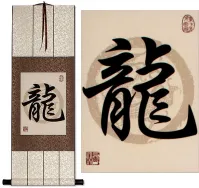
Dragon
Year of the Dragon / Zodiac Sign
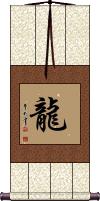
龍 is the character for dragon in Chinese, old Korean Hanja, and Japanese Kanji.
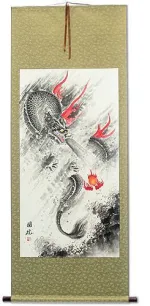
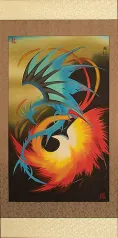
The dragon is a creature of myth and legend that dominates Chinese, Japanese, and even European folklore. In China, the dragon is the symbol of the Emperor, strength, and power, and the Chinese dragon is known as the god of water.
From the Chinese Zodiac, if you were born in the year of the Dragon, you . . .
Have a strong body and spirit.
Are full of energy.
Have vast goals.
Have a deep level of self-awareness.
Will do whatever you can to “save face.”
See also our Chinese Zodiac or Dragon Calligraphy pages.
Crisis equals Danger plus Opportunity?
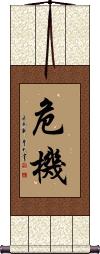
危機 means crisis in Chinese and Japanese.
Separately, the first character here does mean “danger” or “to endanger,” and the second character can mean “opportunity.”
However, I want to debunk a myth that was propagated by some westerners who did not have a clear understanding of Asian languages...
While often, Chinese/Japanese/Korean compound words (words of two or more characters) are the sum of their parts, this is not always the case. The compound is often understood with a completely different meaning than the two characters individually.
Many have said that the Chinese/Japanese/Korean word for Crisis is made up of the characters for “danger” and “opportunity.” 危機 is true when phrased this way.
However, it's not absolutely correct to say that “danger + opportunity = crisis” in Asian cultures.
English example:
If I tell you that...
Bovine creature + Guy behind the plate in baseball = Locomotive train protection

...you would think I was mad. But consider that “cow + catcher = cowcatcher,” which is the device that used to be found on steam engines to protect them if they hit an animal on the tracks. When we hear the word “cowcatcher,” we don't separate the words into their individual meanings (necessarily).
The same is true with the word for crisis in Chinese/Japanese/Korean. While you can separate the characters, few Asian people would automatically do so in their minds.
The final answer:
It is a half-truth to say, “danger plus opportunity equals crisis” in Chinese/Japanese/Korean. Use this statement and concept with caution.
Also, the second character can mean “secret” or “machine,” depending on context so I guess you have to say “a dangerous machine = crisis” or “danger + a secret = crisis.” Both of these are only slightly more ridiculous than the first premise.
PS: 危機 is probably not a great word for a scroll unless you have a special use for it.
This in-stock artwork might be what you are looking for, and ships right away...
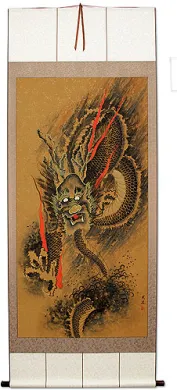
Gallery Price: $240.00
Your Price: $148.88
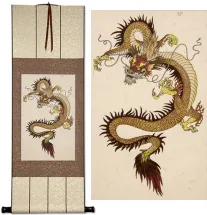
Gallery Price: $300.00
Your Price: $138.88
Gallery Price: $168.00
Your Price: $92.88
Not the results for Myth that you were looking for?
Below are some entries from our dictionary that may match your Myth search...
| Characters If shown, 2nd row is Simp. Chinese |
Pronunciation Romanization |
Simple Dictionary Definition |
神龍 see styles |
shenron シェンロン |
More info & calligraphy: Shen Long |
クロノス see styles |
kuronosu クロノス |
More info & calligraphy: Chronus |
螭 see styles |
chī chi1 ch`ih chih |
dragon with horns not yet grown (in myth or heraldry); variant of 魑[chi1] |
鰐 鳄 see styles |
è e4 o wani わに |
variant of 鱷|鳄[e4] (1) (kana only) crocodile; alligator; (2) (archaism) shark; (place-name) Wani; (myth) wani (mythological sea monster) A crocodile. |
九曜 see styles |
jiǔ yào jiu3 yao4 chiu yao kuyou / kuyo くよう |
(1) (myth) Navagraha (divine personifications of the nine celestial bodies in Hindu mythology); nine luminaries; (2) (abbreviation) (See 九曜星,陰陽道) (in Onmyōdō) divination of a person's fate based on the nine celestial bodies's positions at birth; (surname) Kuyou 九執 q.v. Navagraha. The nine luminaries: 日 Āditya, the sun; 月 Sōma, the moon; the five planets, i.e. 火星 Aṅgāraka, Mars; 水 Budha, Mercury; 木 Bṛhaspati, Jupiter; 金 Sukra, Venus; and 土 Śanaiścara, Saturn; also 羅睺 Rāhu, the spirit that causes eclipses; and 計都 Ketu, a comet. Each is associated with a region of the sky and also with a bodhisattva, etc., e.g. the sun with Guanyin, Venus with Amitābha, etc. |
伏羲 see styles |
fú xī fu2 xi1 fu hsi fukugi ふくぎ |
Fuxi, legendary Chinese emperor, trad. 2852–2738 BC, mythical creator of fishing, trapping and writing (myth) Fuxi (first mythical emperor of China); Fu Hsi |
十二 see styles |
shí èr shi2 er4 shih erh tooji とおじ |
twelve; 12 12; twelve; (given name) Tooji dvātriṃśa. Thirty-two. 三十二應 (or 三十二身) The thirty-two forms of Guanyin, and of Puxian, ranging from that of a Buddha to that of a man, a maid, a rakṣas; similar to the thirty-three forms named in the Lotus Sūtra. 三十二相三十二大人相 dvātriṃśadvaralakṣaṇa. The thirty-two lakṣaṇas, or physical marks of a cakravartī, or 'wheel-king', especially of the Buddha, i. e. level feet, thousand-spoke wheel-sign on feet, long slender fingers, pliant hands and feet, toes and fingers finely webbed, full-sized heels, arched insteps, thighs like a royal stag, hands reaching below the knees well-retracted male organ, height and stretch of arms equal, every hair-root dark coloured, body hair graceful and curly, golden-hued body, a 10 ft. halo around him, soft smooth skin, the 七處, i. e. two soles, two palms, two shoulders, and crown well rounded, below the armpits well-filled, lion-shaped body, erect, full shoulders, forty teeth, teeth white even and close, the four canine teeth pure white, lion-jawed, saliva improving the taste of all food, tongue long and broad, voice deep and resonant, eyes deep blue, eyelashes like a royal bull, a white ūrnā or curl between the eyebrows emitting light, an uṣṇīṣa or fleshy protuberance on the crown. These are from the 三藏法數 48, with which the 智度論 4, 涅盤經 28, 中阿含經, 三十ニ相經 generally agree. The 無量義經 has a different list. 三十二相經 The eleventh chapter of the 阿含經. 三十二相經願 The twenty-first of Amitābha's vows, v. 無量壽經. 三十三 trayastriṃśat. Thirty-three. 三十三天忉利天; 憺梨天, 多羅夜登陵舍; 憺利夜登陵奢; 憺利耶憺利奢 Trayastriṃśas. The Indra heaven, the second of the six heavens of form. Its capital is situated on the summit of Mt. Sumeru, where Indra rules over his thirty-two devas, who reside on thirty-two peaks of Sumeru, eight in each of the four directons. Indra's capital is called 殊勝 Sudarśana, 喜見城 Joy-view city. Its people are a yojana in height, each one's clothing weighs 六鐵 (1; 4 oz. ), and they live 1, 000 years, a day and night being equal to 100 earthly years. Eitel says Indra's heaven 'tallies in all its details with the Svarga of Brahminic mythology' and suggests that 'the whole myth may have an astronomical meaning', or be connected, with 'the atmosphere with its phenomena, which strengthens Koeppen's hypothesis explaining the number thirty-three as referring to the eight Vasus, eleven Rudras, twelve Ādityas, and two Aśvins of Vedic mythology'. In his palace called Vaijayanta 'Indra is enthroned with 1, 000 eyes with four arms grasping the vajra. There he revels in numberless sensual pleasures together with his wife Śacī... and with 119, 000 concubines with whom he associates by means of transformation'.; dvādaśa, twelve. |
和邇 see styles |
wani わに |
(place-name) Wani; (myth) wani (mythological sea monster) |
壽桃 寿桃 see styles |
shòu táo shou4 tao2 shou t`ao shou tao |
(myth.) peaches of immortality, kept by Xi Wangmu; fresh or confectionery peaches offered as a birthday gift |
女媧 女娲 see styles |
nǚ wā nu:3 wa1 nü wa joka じょか |
Nüwa (creator of humans in Chinese mythology) (myth) Nüwa (mother goddess of Chinese mythology); Nügua |
燭陰 see styles |
shokuin しょくいん |
(myth) Zhulong (dragon-god in Chinese mythology); Zhuyin; Torch Dragon |
神竜 see styles |
shenron シェンロン |
(myth) Shen Long (spiritual dragon in Chinese mythology); Shen-lung |
神話 神话 see styles |
shén huà shen2 hua4 shen hua kamiwa かみわ |
legend; fairy tale; myth; mythology myth; mythology; (female given name) Kamiwa |
窮奇 see styles |
kyuuki / kyuki きゅうき |
(myth) Qiongqi (beast in Chinese mythology; one of the Four Perils) |
迷思 see styles |
mí sī mi2 si1 mi ssu |
(loanword) myth |
インプ see styles |
inpu インプ |
(myth) (creat) imp (creature in European folklore); (myth,cr) imp (creature in European folklore) |
伊弉冉 see styles |
izanami; izanami いざなみ; イザナミ |
(kana only) {Shinto} (See 伊弉冉尊) Izanami (deity); (dei,myth) Izanami (Shinto goddess) |
伊弉弥 see styles |
izanami いざなみ |
(dei,myth) Izanami (Shinto goddess) |
作り話 see styles |
tsukuribanashi つくりばなし |
fiction; made-up story; fable; fabrication; myth |
創世紀 创世纪 see styles |
chuàng shì jì chuang4 shi4 ji4 ch`uang shih chi chuang shih chi |
creation myth |
大洪水 see styles |
daikouzui / daikozui だいこうずい |
(1) heavy flooding; disastrous flood; deluge; (2) great flood (sent by a deity); flood myth |
忉利天 see styles |
dāo lì tiān dao1 li4 tian1 tao li t`ien tao li tien Tōri Ten |
trāyastriṃśas, 怛唎耶怛唎奢; 多羅夜登陵舍; the heavens of the thirty-three devas, 三十三天, the second of the desire-heavens, the heaven of Indra; it is the Svarga of Hindu mythology, situated on Meru with thirty-two deva-cities, eight on each side; a central city is 善見城 Sudarśana, or Amarāvatī, where Indra, with 1, 000 heads and eyes and four arms, lives in his palace called 禪延; 毘闍延 (or 毘禪延) ? Vaijayanta, and 'revels in numberless sensual pleasures together with his wife' Śacī and with 119, 000 concubines. 'There he receives the monthly reports of the' four Mahārājas as to the good and evil in the world. 'The whole myth may have an astronomical' or meteorological background, e. g. the number thirty-three indicating the 'eight Vasus, eleven Rudras, twelve Ādityas, and two Aśvins of Vedic mythology. ' Eitel. Cf. 因陀羅. |
迦楼羅 see styles |
karura かるら |
Garuda (man-bird deity and 'vahana' of Hindu-Buddhist myth); Garua; (personal name) Karura |
ウラノス see styles |
uranosu ウラノス |
Uranus; (myth) Uranus (Greek god) |
げじべえ see styles |
gejibee げじべえ |
(myth) Yakushima forest yōkai which haunts loggers; (myth) Yakushima forest yōkai which haunts loggers |
ダフニス see styles |
dafunisu ダフニス |
Daphnis (in Greek mythology); (myth) Daphnis (in Greek mythology) |
テュケー see styles |
teukee テュケー |
(myth) Tyche (Greek goddess) |
ニドヘグ see styles |
nidohegu ニドヘグ |
(myth) Nidhogg |
ルサルカ see styles |
rusaruka ルサルカ |
(wk) Rusalka (opera by Dvořák); (myth) rusalka (female spirit in Slavic folklore) |
三皇五帝 see styles |
sān huáng wǔ dì san1 huang2 wu3 di4 san huang wu ti sankougotei / sankogote さんこうごてい |
three sovereigns 三皇[san1 huang2] and five emperors 五帝[wu3 di4] of myth and legend; the earliest system of Chinese historiography {chmyth} Three Sovereigns and Five Emperors (mythological rulers of ancient China) |
Click here for more Myth results from our dictionary
The following table may be helpful for those studying Chinese or Japanese...
| Title | Characters | Romaji (Romanized Japanese) | Various forms of Romanized Chinese | |
| Dragon | 龍 龙 | ryuu / tatsu ryu / tatsu | lóng / long2 / long | lung |
| Crisis equals Danger plus Opportunity? | 危機 危机 | kiki | wēi jī / wei1 ji1 / wei ji / weiji | wei chi / weichi |
| In some entries above you will see that characters have different versions above and below a line. In these cases, the characters above the line are Traditional Chinese, while the ones below are Simplified Chinese. | ||||

Successful Chinese Character and Japanese Kanji calligraphy searches within the last few hours...



