Many custom options...


And formats...



Not what you want?
Try other similar-meaning words, fewer words, or just one word.
My Lover in Chinese / Japanese...
Buy a My Lover calligraphy wall scroll here!
Personalize your custom “My Lover” project by clicking the button next to your favorite “My Lover” title below...
2. Brought Together from 1000 Miles Away by Fate
4. Lover / Spouse / Sweetheart
7. You are always a beauty in your lover’s eyes
9. Non-Violence
10. Tea Fate
11. Love and Honor
13. The Red String
Longing for Lover
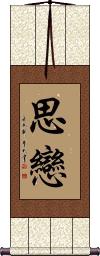
思戀 is a term used for when you miss a lover.
It suggests that you are separated (not by choice) and have longed for each other. It's a strong feeling of missing your lover.
Brought Together from 1000 Miles Away by Fate
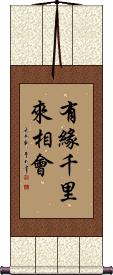
有緣千里來相會 means that fate or destiny has caused us to meet from a thousand miles away.
The 有緣 part suggests something that is connected as if by a thread due to fate, destiny, or karma.
This romantic phrase is seen in Chinese greeting cards. It relays the idea that your love was meant to be and that you were destined to meet (regardless of what distance or obstacles might have made such a meeting unlikely).
See Also: Red Thread
Lover / Sweetheart
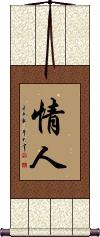
情人 means lover, sweetheart, or beloved in Chinese and Japanese Kanji.
This term is gender-neutral so anyone can use it.
Please note that this term can easily be read or used to mean “mistress” or the kind of lover you have an affair with (especially in Japanese). The context in which this word is used affects the actual meaning. Husbands and wives or boyfriends and girlfriends can also use this term for each other with no ill meaning.
Lover / Spouse / Sweetheart
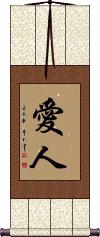
愛人 means lover, sweetheart, spouse, husband, wife, or beloved in Chinese, Japanese Kanji, and old Korean Hanja.
The first character means “love,” and the second means “person.”
This title can be used in many different ways, depending on the context. Husbands and wives may use this term for each other. But, if you change the context, this title could be used to mean “mistress.” It's pretty similar to the way we can use “lover” in many different ways in English.
In modern Japan, this lover title has slipped into the definition of mistress and is not good for a wall scroll.
Lover / Beloved
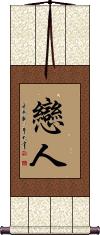
戀人 means lover, sweetheart, or beloved in Chinese, Japanese Kanji, and old Korean Hanja.
This term is gender-neutral, so that anyone can use it.
 In modern Japan and China, the first character has been simplified. We suggest the traditional version, as shown above if your audience is Chinese or Korean. However, this generation of Japanese are more likely to recognize the simplified version. If you want this simple (modern Japanese) version, please click on the image shown to the right, instead of the button above.
Adventure Lover
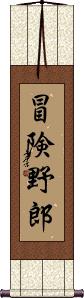
冒険野郎 is a Japanese title that means “adventure lover.”
This literally means something like “adventure wild man.”
This is a funny choice for a wall scroll, but it's a legitimate word in Japanese.
You are always a beauty in your lover’s eyes
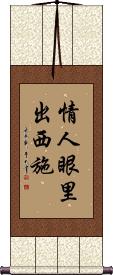
Any woman with affection for Asian art will love a gift of this Chinese proverb calligraphy on a wall scroll.
She will melt in your arms as you tell her the meaning of these characters.
Contained in this phrase is a reference to the most beautiful woman in Chinese history. Her name was Xi Shi, and she was known to have good looks that need not have fine robes or makeup. Her charms were so powerful that she brought down an entire kingdom (in a successful effort to bring honor and pride back to her people).
情人眼里出西施 is a great way to express that the woman in your life is your one love.
Wealth / Riches / Fortune
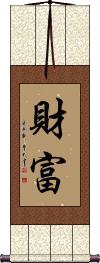
財富 means wealth or riches in Chinese.
Hanging this on your wall will label you as a “lover of money” or a “greedy person.” Order this only if you don't mind being seen in this light.
Non-Violence
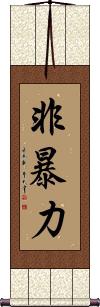
非暴力 is fairly self-explanatory.
The first character means “not,” “non-,” or “un-”
The middle and last character together mean “violence,” “use of force,” or simply “violent.”
Together, these three characters would normally be translated as “nonviolence.” A great gift for your favorite peace-lover.
See Also: Peace
Tea Fate
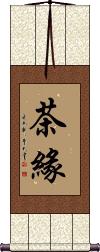
茶緣 is a special title for the tea lover. This kind of means “tea fate,” but it's more spiritual and hard to define. Perhaps the tea brought you in to drink it. Perhaps the tea will bring you and another tea-lover together. Perhaps you were already there, and the tea came to you. Perhaps it's the ah-ha moment you will have when drinking the tea.
I've been told not to explain this further, as it will either dilute or confuse the purposefully-ambiguous idea embedded in this enigma.
I happen to be the owner of a piece of calligraphy written by either the son or nephew of the last emperor of China, which is the title he wrote. It was given to me at a Beijing tea house in 2001. 茶緣 is where I learned to love tea after literally spending weeks tasting and studying everything I could about Chinese tea. I did not understand the significance of the authorship or the meaning of the title at all. Some 10 years later, I realized the gift was so profound and had such providence. Only now do I realize the value of a gift that it is too late to give proper thanks for. It was also years later that I ended up in this business and could have the artwork properly mounted as a wall scroll. It has been borrowed for many exhibitions and shows and always amazes native Chinese and Taiwanese who read the signature. This piece of calligraphy I once thought was just a bit of ink on a thin and wrinkled piece of paper, is now one of my most valued possessions. And fate has taught me to be more thankful for seemingly simple gifts.
Love and Honor
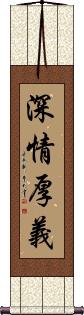
深情厚義 means to love and honor.
This is more or less the kind of thing you'd find in marriage vows.
The first two characters suggest deep love or deep emotions, passion, and feelings.
The last two characters mean generous justice or thick honor (the third character is an adjective that means generous or thick). It just means that you will honor your lover's wishes and treat them justly and righteously (fairly).
This is the longer four-character version, there is also a short and sweet two character version.
See Also: Love and Honor
Love and Honor
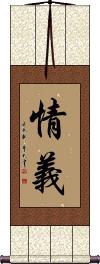
情義 means to love and honor in Chinese. 情義 is more or less the kind of thing you'd find in marriage vows.
The first character suggests emotions, passion, heart, humanity, sympathy, and feelings.
In this context, the second character means to honor your lover's wishes and treat them justly and righteously (fairly). That second character can also be translated as “obligation,” as in the obligation a husband and wife have to love each other even through difficult times.
In the context outside of a couple's relationship, this word can mean “comradeship.”
Japanese may see this more as “humanity and justice” than “love and honor.” It's probably best if your target is Chinese.
This is the short and sweet form, there is also a longer poetic form (you can find it here: Love and Honor if it’s not on the page you are currently viewing).
See Also: Love and Honor
In Wine there is Truth
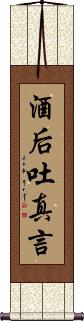
酒后吐真言 / 酒後吐真言 is a nice Asian proverb if you know a vintner or wine seller - or wine lover - although the actual meaning might not be exactly what you think or hope.
The literal meaning is that someone drinking wine is more likely to let the truth slip out. It can also be translated as “People speak their true feelings after drinking alcohol.”
It's long believed in many parts of Asia that one can not consciously hold up a facade of lies when getting drunk, and therefore the truth will come out with a few drinks.
I've had the experience where a Korean man would not trust me until I got drunk with him (I was trying to gain access to the black market in North Korea which is tough to do as an untrusted outsider) - so I think this idea is still well-practiced in many Asian countries.
 VS
VS 
Please note that there are two common ways to write the second character of this phrase. The way it's written will be left up to the mood of the calligrapher, unless you let us know that you have a certain preference.
The Red String
Thread of Lover's Destiny / Fate
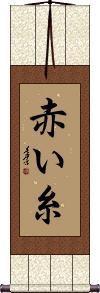
This literally translates as “the red string” or “the red thread” in Japanese, but the real meaning is much deeper...
In Japanese culture, it's believed that fate, destiny, or karma joins lovers by an unseen string, tied around one little finger of each. 赤い糸 is how soul mates find and are drawn to each other.
The Japanese concept of the red thread of fate, by most estimations, comes from Chinese folklore, where it's known as 姻緣紅線. The only difference is that in China, the celestial red thread is tied around the ankles of the lovers (versus what is usually represented as the pinky finger in Japan).
This in-stock artwork might be what you are looking for, and ships right away...
Gallery Price: $240.00
Your Price: $98.88

The following table may be helpful for those studying Chinese or Japanese...
| Title | Characters | Romaji (Romanized Japanese) | Various forms of Romanized Chinese | |
| Longing for Lover | 思戀 思恋 | sī liàn / si1 lian4 / si lian / silian | ssu lien / ssulien | |
| Brought Together from 1000 Miles Away by Fate | 有緣千里來相會 有缘千里来相会 | yǒu yuán qiān lǐ lái xiāng huì you3 yuan2 qian1 li3 lai2 xiang1 hui4 you yuan qian li lai xiang hui youyuanqianlilaixianghui | yu yüan ch`ien li lai hsiang hui yu yüan chien li lai hsiang hui |
|
| Lover Sweetheart | 情人 | jou nin / jou jin jounin / joujin jo nin / jo jin | qíng rén / qing2 ren2 / qing ren / qingren | ch`ing jen / chingjen / ching jen |
| Lover Spouse Sweetheart | 愛人 爱人 | ai jin / aijin | ài ren / ai4 ren / ai ren / airen | ai jen / aijen |
| Lover Beloved | 戀人 恋人 | koi bito / koibito | liàn rén / lian4 ren2 / lian ren / lianren | lien jen / lienjen |
| Adventure Lover | 冒険野郎 | bou ken ya rou boukenyarou bo ken ya ro | ||
| You are always a beauty in your lover’s eyes | 情人眼里出西施 | qíng rén yǎn lǐ chū xī shī qing2 ren2 yan3 li3 chu1 xi1 shi1 qing ren yan li chu xi shi qingrenyanlichuxishi | ch`ing jen yen li ch`u hsi shih chingjenyenlichuhsishih ching jen yen li chu hsi shih |
|
| Wealth Riches Fortune | 財富 财富 | cái fù / cai2 fu4 / cai fu / caifu | ts`ai fu / tsaifu / tsai fu | |
| Non-Violence | 非暴力 | hibouryoku / hiboryoku | fēi bào lì fei1 bao4 li4 fei bao li feibaoli | fei pao li feipaoli |
| Tea Fate | 茶緣 茶缘 | chá yuán / cha2 yuan2 / cha yuan / chayuan | ch`a yüan / chayüan / cha yüan | |
| Love and Honor | 深情厚義 深情厚义 | shēn qíng hòu yì shen1 qing2 hou4 yi4 shen qing hou yi shenqinghouyi | shen ch`ing hou i shenchinghoui shen ching hou i |
|
| Love and Honor | 情義 情义 | qíng yì / qing2 yi4 / qing yi / qingyi | ch`ing i / chingi / ching i | |
| In Wine there is Truth | 酒后吐真言 / 酒後吐真言 酒后吐真言 | jiǔ hòu tǔ zhēn yán jiu3 hou4 tu3 zhen1 yan2 jiu hou tu zhen yan jiuhoutuzhenyan | chiu hou t`u chen yen chiuhoutuchenyen chiu hou tu chen yen |
|
| The Red String | 赤い糸 | akai ito / akaiito | ||
| In some entries above you will see that characters have different versions above and below a line. In these cases, the characters above the line are Traditional Chinese, while the ones below are Simplified Chinese. | ||||

Successful Chinese Character and Japanese Kanji calligraphy searches within the last few hours...



