Many custom options...


And formats...



Muni in Chinese / Japanese...
Buy a Muni calligraphy wall scroll here!
Personalize your custom “Muni” project by clicking the button next to your favorite “Muni” title below...
Switched to secondary search mode due to lack of results using primary.
These secondary results may not be very accurate. Try a different but similar meaning word or phrase for better results. Or...
Look up Muni in my Japanese Kanji & Chinese Character Dictionary(My dictionary is a different system then the calligraphy search you just tried)
If you want a special phrase, word, title, name, or proverb, feel free to contact me, and I will translate your custom calligraphy idea for you.
Community
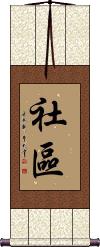
社區 is how to write community in Chinese.
社區 can mean the neighborhood you live in. It can also be used the same way we use the word community in English.
Examples: African-American community, Christian community, Asian community, etc.
If you need a special calligraphy wall scroll to describe your community, just contact me, and I’ll translate it and make it for you.
Muniz

穆尼茲 is the name Muniz in Chinese (Mandarin).
Muniz

ムニス is the name Muniz in Japanese Katakana.
Note: Because this title is entirely Japanese Katakana, it should be written by a Japanese calligrapher.
Namo Shakyamuni Buddha
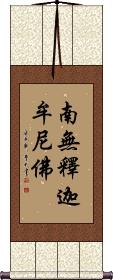
南無釋迦牟尼佛 is a Buddhist chant or prayer of respect to the Shakyamuni Buddha.
Some will translate this as the Buddhist vow.
The first two characters, 南無, are sometimes translated as “amen”; others will translate it as “belief in” or “homage to.”
To expand on this, 南無 can also mean “taking of refuge in” while representing devotion or conviction. 南無 as with most religious concepts or words, different people or denominations will have varying definitions.
Shakyamuni / The Buddha
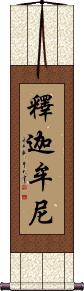
釋迦牟尼 is a transliteration of “Shakyamuni” or “Sakyamuni” in Chinese, Japanese, and old Korean.
The perceived meaning of the name is roughly translated as “Sage of the Sakyas.”
This same Buddha is also known as “Siddhartha Gautama,” “Gotama Buddha,” “Tathagata,” or simply, “The Supreme Buddha.”
Shakyamuni is the legendary man and prince who eventually established the Buddhist religion.
Note: Occasionally Romanized as “Siddhattha Gotama.”
This combination of characters is sometimes seen and used in South Korea and Japan as well (with the same meaning).
Note: 釋迦牟尼 came from the Sanskrit शाक्यमुनि and can also be romanized with diuretics as Śākyamuni.
Shakyamuni / The Buddha
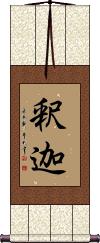
釈迦 is the way to write Shakyamuni in Japanese.
It's just two Kanji, the first is a simplified version of the one used in Chinese for Shakyamuni, and the second one is identical to the Chinese.
This refers to the Buddha (Siddhartha Gautama, 563 BCE-483 BCE) also known as Sakyamuni and Gautama Buddha.
This has a very good meaning in Japanese but is an odd selection for a wall scroll. It appears here more for reference.
Not the results for Muni that you were looking for?
Below are some entries from our dictionary that may match your Muni search...
| Characters If shown, 2nd row is Simp. Chinese |
Pronunciation Romanization |
Simple Dictionary Definition |
文尼 see styles |
wén ní wen2 ni2 wen ni monni むに |
More info & calligraphy: Vinnymuni, idem 牟尼 and 茂尼, e. g. Śākyamuni. |
ムーニー see styles |
muunii / muni ムーニー |
More info & calligraphy: Mooney |
釋迦牟尼 释迦牟尼 see styles |
shì jiā móu ní shi4 jia1 mou2 ni2 shih chia mou ni Shakamuni |
More info & calligraphy: Shakyamuni / The Buddha釋迦文 (釋迦文尼); 釋伽文 Śākyamuni, the saint of the Śākya tribe. muni is saint, holy man, sage, ascetic monk; it is: intp. as 仁 benevolent, charitable, kind, also as 寂默 one who dwells in seclusion. After '500 or 550' previous incarnations, Śākyamuni finally attained to the state of Bodhisattva, was born in the Tuṣita heaven, and descended as a white elephant, through her right side, into the womb of the immaculate Māyā, the purest woman on earth; this was on the 8th day of the 4th month; next year on the 8th day of the 2nd month he was born from her right side painlessly as she stood under a tree in the Lumbinī garden. For the subsequent miraculous events v. Eitel. also the 神通遊戲經 (Lalitavistara), the 釋迦如來成道記, etc. Simpler statements say that he was born the son of Śuddhodana, of the kṣatriya caste, ruler of Kapilavastu, and Māyā his wife; that Māyā died seven days later, leaving him to be brought up by her sister Prājapati; that in due course he was married to Yaśodharā who bore him a son, Rāhula; that in search of truth he left home, became an ascetic, severely disciplined himself, and finally at 35 years of age, under a tree, realized that the way of release from the chain of rebirth and death lay not in asceticism but in moral purity; this he explained first in his four dogmas, v. 四諦 and eightfold noble way 八正道, later amplified and developed in many sermons. He founded his community on the basis of poverty, chastity, and insight or meditation, ad it became known as Buddhism, as he became known as Buddha, the enlightened. His death was probably in or near 487 B.C., a few years before that of Confucius in 479. The sacerdotal name of his family is Gautama, said to be the original name of the whole clan, Śākya being that of his branch, v. 瞿, 喬.; his personal name was Siddhārtha, or Sarvārthasiddha, v. 悉. |
ムニ see styles |
muni ムニ |
(personal name) Muni |
無二 无二 see styles |
wú èr wu2 er4 wu erh muni むに |
(adj-no,n) peerless; matchless; unparalleled; unrivalled; unequalled; incomparable; second to none; (female given name) Muni non-duality |
牟尼 see styles |
móu ní mou2 ni2 mou ni muni むに |
(1) (honorific or respectful language) muni (Indian ascetic or sage); (2) Buddha (牟尼仙), 文尼; 茂泥; (馬曷摩尼) 摩尼 muni; mahāmuni; 月摩尼 vimuni. A sage, saint, ascetic, monk, especially Śākyamuni; interpreted as 寂 retired, secluded, silent, solitary, i. e. withdrawn from the world. See also 百八摩尼. |
茂泥 see styles |
mào ní mao4 ni2 mao ni moni |
文尼; 牟尼 muni, a solitary, a recluse, e. g. Śākyamuni, the recluse of the Śākya family; genī; intp. as one who seeks solitude, and one who is able to be kind. |
三妙行 see styles |
sān miào xíng san1 miao4 xing2 san miao hsing san myō gyō |
A muni, recluse, or monk, who controls his body, mouth, and mind 身, 口, 意. Also 三牟尼. |
牟尼王 see styles |
móu ní wáng mou2 ni2 wang2 mou ni wang muni ō |
The monk-king, a title of the Buddha. |
ムーニィ see styles |
muuni / muni ムーニィ |
(surname) Mooney |
寂滅無二 寂灭无二 see styles |
jí miè wú èr ji2 mie4 wu2 er4 chi mieh wu erh jakumetsu muni |
Nirvāṇa as absolute without disunity or phenomena. |
有無無二 有无无二 see styles |
yǒu wú wú èr you3 wu2 wu2 er4 yu wu wu erh umu muni |
nonduality of existence and non-existence |
無二無別 无二无别 see styles |
wú èr wú bié wu2 er4 wu2 bie2 wu erh wu pieh muni mubetsu |
without duality or distinction |
牟尼世尊 see styles |
móu ní shì zūn mou2 ni2 shi4 zun1 mou ni shih tsun Muni Seson |
World Honored Śākyamuni |
ポールムニ see styles |
poorumuni ポールムニ |
(person) Paul Muni |
Variations: |
muni むに |
(1) (honorific or respectful language) muni (Indian ascetic or sage); (2) Buddha |
生死涅槃無二無別 生死涅槃无二无别 see styles |
shēng sǐ niè pán wú èr wú bié sheng1 si3 nie4 pan2 wu2 er4 wu2 bie2 sheng ssu nieh p`an wu erh wu pieh sheng ssu nieh pan wu erh wu pieh shōji nehan muni mubetsu |
saṃsāra and nirvāṇa are not two — they lack distinction |
The following table may be helpful for those studying Chinese or Japanese...
| Title | Characters | Romaji (Romanized Japanese) | Various forms of Romanized Chinese | |
| Community | 社區 社区 | shè qū / she4 qu1 / she qu / shequ | she ch`ü / shechü / she chü | |
| Muniz | 穆尼茲 穆尼兹 | mù ní zī mu4 ni2 zi1 mu ni zi munizi | mu ni tzu munitzu |
|
| Muniz | ムニス | munisu | ||
| Namo Shakyamuni Buddha | 南無釋迦牟尼佛 南无释迦牟尼佛 | namu shakamuni butsu namushakamunibutsu | nán wú shì jiā móu ní fó nan2 wu2 shi4 jia1 mou2 ni2 fo2 nan wu shi jia mou ni fo nanwushijiamounifo | nan wu shih chia mou ni fo nanwushihchiamounifo |
| Shakyamuni The Buddha | 釋迦牟尼 释迦牟尼 | sha ka mu ni shakamuni | shì jiā móu ní shi4 jia1 mou2 ni2 shi jia mou ni shijiamouni | shih chia mou ni shihchiamouni |
| Shakyamuni The Buddha | 釈迦 | sha ka / shaka | shì jiā / shi4 jia1 / shi jia / shijia | shih chia / shihchia |
| In some entries above you will see that characters have different versions above and below a line. In these cases, the characters above the line are Traditional Chinese, while the ones below are Simplified Chinese. | ||||

Successful Chinese Character and Japanese Kanji calligraphy searches within the last few hours...



