Many custom options...


And formats...



Motion in Chinese / Japanese...
Buy a Motion calligraphy wall scroll here!
Personalize your custom “Motion” project by clicking the button next to your favorite “Motion” title below...
Dynamic
Moving / Motion / Ever-Changing
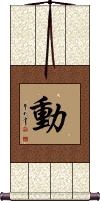
動 is the only Chinese/Japanese/Korean word that can encompass the idea of “dynamic” into one character.
動 can also mean:
to use; to act; to move; to change; motion; stir.
In the Buddhist context, it means: Movement arises from the nature of wind which is the cause of motion.
The key point of this word is that it represents motion or always moving. Some might say “lively” or certainly the opposite of something that is stagnant or dead.
Note: In Japanese, this can also be a female given name, Yurugi.
Therapeutic Massage
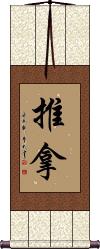
推拿 is “Tui Na,” a Chinese version of therapeutic massage.
The title suggests a pushing and pulling motion.
In reality, this is the most legitimate form of massage in China. Seeing this on a sign in front of a building tells you it's a place for health improvement via massage. No mistaking this for any illicit version of massage.
Dynamic
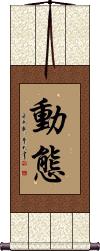
動態 is the Chinese, Japanese Kanji, and old Korean Hanja for a word that means “dynamic state.”
This word can also mean:
movement; motion; development; trend; dynamic (science); the state of being dynamic.
This word can be used to describe someone or an organization that keeps up with cutting-edge trends. Always flexible, always changing, always moving.
Motivation
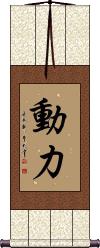
動力 can be used for motivation - it can also mean power/motion/propulsion/force. It can be anything internal or external that keeps you going.
動力 is the safest way to express motivation in Chinese. If your audience is Japanese, please see the other entry for motivation. 動力 is a word in Japanese and Korean, but it means “motive power” or “kinetic energy” (without the motivation meaning that you are probably looking for).
See Also: Enthusiasm | Passion
Shidai / Sida / Mahabhuta
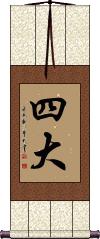
In Mahayana Buddhism, 四大 represents mahābhūta, the four elements of which all things are made: earth, water, fire, and wind.
This can also represent the four freedoms: speaking out freely, airing views fully, holding great debates, and writing big-character posters.
In some contexts, this can be a university or college offering four-year programs.
To others, this can represent the Tao, Heaven, Earth, and King.
Going back to the Buddhist context, these four elements “earth, water, fire, and wind,” represent 堅, 濕, 煖, 動, which are: solid, liquid, heat, and motion.
Tai Chi Chuan / Tai Ji Quan
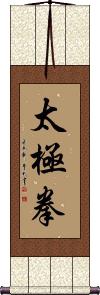
太極拳 is the famous Taoist meditation and martial art exercise. The direct translation of these characters would be something like “grand ultimate fist,” but that does not quite hit the mark for what this title really means.
An early-morning walk through any city in China near a park or an open area will yield a view of Chinese people practicing this ancient technique.
A typical scene is an old man of no less than 80 years on this earth, with a wispy white beard and perhaps a sword in one hand. He makes slow moves that are impossibly smooth. He is steady-footed and always in balance. For him, time is meaningless and proper form, and technique is far more important than speed.
For the younger generation, faster moves may look impressive and seem smooth to the casual observer. But more discipline and mental strength are needed to create perfectly smooth moves in virtual slow motion.
Note: There are two ways to Romanize these Chinese characters, as seen in the title above. The pronunciation and actual characters are the same in Chinese. If you really used English sounds/words to pronounce this, it would be something like “tie jee chew-on” (make the “chew-on” one flowing syllable).
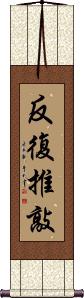
Push or Knock
To weigh one's words
During the Tang Dynasty, a man named Jia Dao (born in the year 779), a well-studied scholar and poet, went to the capital to take the imperial examination.
One day as he rides a donkey through the city streets, a poem begins to form in his mind. A portion of the poem comes into his head like this:
“The bird sits on the tree branch near a pond,
A monk approaches and knocks at the gate...”
At the same time, he wondered if the word “push” would be better than “knock” in his poem.
As he rides down the street, he imagines the monk pushing or knocking. Soon he finds himself making motions of pushing and shaking a fist in a knocking motion as he debates which word to use. He is quite a sight as he makes his way down the street on his donkey with hands and fists flying about as the internal debate continues.
As he amuses people along the street, he becomes completely lost in his thoughts and does not see the mayor's procession coming in the opposite direction. Jia Bao is blocking the way for the procession to continue down the road, and the mayor's guards immediately decide to remove Jia Bao by force. Jia Bao, not realizing that he was in the way, apologizes, explains his poetic dilemma and awaits his punishment for blocking the mayor's way.
The mayor, Han Yu, a scholar and author of prose himself, finds himself intrigued by Jia Dao's poem and problem. Han Yu gets off his horse and addresses Jia Bao, stating, “I think knock is better.” The relieved Jia Bao raises his head and is invited by the mayor to join the procession, and are seen riding off together down the street, exchanging their ideas and love of poetry.
In modern Chinese, this 反復推敲 idiom is used when someone is trying to decide which word to use in their writing or when struggling to decide between two things when neither seems to have a downside.
This in-stock artwork might be what you are looking for, and ships right away...
Gallery Price: $472.20
Your Price: $198.88
Gallery Price: $220.00
Your Price: $138.88
Gallery Price: $120.00
Your Price: $79.88


Gallery Price: $67.00
Your Price: $36.88
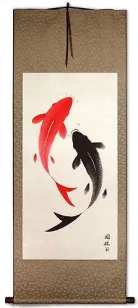
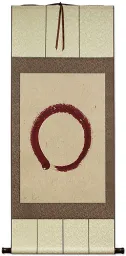
Gallery Price: $150.00
Your Price: $88.88
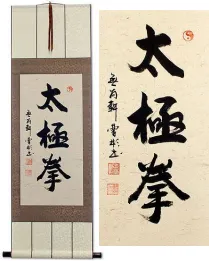
Gallery Price: $200.00
Your Price: $98.88
These search terms might be related to Motion:
4. Right Action / Perfect Conduct
A Deliberate Inaction is Better Than a Blind Action
Aquarius Zodiac Symbol / Sign
Aries Zodiac Symbol / Sign
Big Wave
Cancer Zodiac Symbol / Sign
Capricorn Zodiac Symbol / Sign
Conquering Yourself is a Sign of Strength
Do Not Take Action Until the Time is Right
Gemini Zodiac Symbol / Sign
Leo Zodiac Symbol / Sign
Libra Zodiac Symbol / Sign
Ophiuchus Zodiac Symbol / Sign
Pisces Zodiac Symbol / Sign
Sagittarius Zodiac Symbol / Sign
Scorpio Zodiac Symbol / Sign
Taurus Zodiac Symbol / Sign
The Way of the Wave
Tsunami / Tidal Wave
Virgo Zodiac Symbol / Sign
Wave
Wu Wei / Without Action
Not the results for Motion that you were looking for?
Below are some entries from our dictionary that may match your Motion search...
| Characters If shown, 2nd row is Simp. Chinese |
Pronunciation Romanization |
Simple Dictionary Definition |
來 来 see styles |
lái lai2 lai rai らい |
More info & calligraphy: To Come / To Arrive(female given name) Rai āgama; āgam-; āgata. Come, the coming, future. |
動 动 see styles |
dòng dong4 tung yurugi ゆるぎ |
More info & calligraphy: Dynamic(ant: 静・1) motion; (female given name) Yurugi Move, stir, motion, mutable; movement arises from the nature of wind which is the cause of motion. |
動態 动态 see styles |
dòng tài dong4 tai4 tung t`ai tung tai doutai / dotai どうたい |
More info & calligraphy: Dynamic(See 静態) movement; dynamic state |
四大 see styles |
sì dà si4 da4 ssu ta shidai しだい |
More info & calligraphy: Shidai / Sida / Mahabhuta(1) {Buddh} the four elements (earth, water, fire, wind); (2) the human body; (3) Tao, heaven, earth and king mahābhūta, 四界; 四大界. The four elements of which all things are made; or the four realms; i. e. earth, water, fire, and wind (or air); they represent 堅, 濕, 煖, and 動 solid, liquid, heat, and motion; motion produces and maintains life. As 實 active or formative forces they are styled 四界 (四大界) ; as 假 passive or material objects they are 四大; but the 成實論 Satyasiddhi śāstra disputes the 實 and recognizes only the 假. |
ラッシュ see styles |
rasshu ラッシュ |
More info & calligraphy: Lash |
去 see styles |
qù qu4 ch`ü chü kyo |
to go; to go to (a place); (of a time etc) last; just passed; to send; to remove; to get rid of; to reduce; to be apart from in space or time; to die (euphemism); to play (a part); (when used either before or after a verb) to go in order to do something; (after a verb of motion indicates movement away from the speaker); (used after certain verbs to indicate detachment or separation) Go, go away; gone, past; depart, leave; to remove, dismiss; the 去 tone. |
直 see styles |
zhí zhi2 chih masami まさみ |
straight; to straighten; fair and reasonable; frank; straightforward; (indicates continuing motion or action); vertical; vertical downward stroke in Chinese characters (prefix) (kana only) earnestly; immediately; exactly; (surname) Masami Straight, upright, direct; to arrange. |
三世 see styles |
sān shì san1 shi4 san shih miyo みよ |
the Third (of numbered kings) (1) {Buddh} three temporal states of existence; past, present and future; (2) (さんぜ only) three generations; (female given name) Miyo The three periods, 過去, 現在, 未來or 過, 現, 未, past, present, and future. The universe is described as eternally in motion, like flowing stream. Also 未生, 巳生,後滅, or 未, 現, 過 unborn, born, dead The 華嚴經 Hua-yen sūtra has a division of ten kinds of past, present, and future i.e. the past spoken of as past, present, and future, the present spoken of in like manner, the future also, with the addition of the present as the three periods in one instant. Also 三際. |
下來 下来 see styles |
xià lai xia4 lai5 hsia lai |
to come down; (completed action marker); (after verb of motion, indicates motion down and towards us, also fig.); (indicates continuation from the past towards us); to be harvested (of crops); to be over (of a period of time); to go among the masses (said of leaders) |
交變 交变 see styles |
jiāo biàn jiao1 bian4 chiao pien |
half-period of a wave motion; alternation |
体動 see styles |
taidou / taido たいどう |
body motion |
傾動 倾动 see styles |
qīng dòng qing1 dong4 ch`ing tung ching tung keidou / kedo けいどう |
to admire (noun/participle) tilting (of a geological block) motion |
働き see styles |
hataraki はたらき |
(1) work; labor; labour; (2) achievement; performance; ability; talent; (3) salary; income; earnings; (4) action; activity; workings; function; operation; movement; motion; (5) {ling} (also written as 活) conjugation; inflection |
六諦 六谛 see styles |
liù dì liu4 di4 liu ti rokutai |
The six logical categories of the Vaiśeṣika philosophy: dravya, substance; guṇa, quality; karman, motion or activity; sāmānya, generality; viśeṣa, particularity; samavāya, inherence: Keith, Logic, 179. Eitel has 'substance, quality, action, existence, the unum et diversum, and the aggregate'. |
円転 see styles |
enten えんてん |
(adj-t,adv-to) orotund; smooth circular motion; spherical; rolling smoothly; (with) smooth circular motion |
動き see styles |
ugoki うごき |
(1) movement; move; motion; (2) trend; development; change; fluctuation |
動作 动作 see styles |
dòng zuò dong4 zuo4 tung tso dousa / dosa どうさ |
movement; motion; action; to act; to move (1) movement (of the body); action; motion; gesture; (2) bearing; carriage; behaviour; behavior; demeanour; demeanor; (n,vs,vi) (3) operation (of a machine, software, etc.); running; working; functioning activity |
動寂 动寂 see styles |
dòng jí dong4 ji2 tung chi dōjaku |
motion and stillness |
動議 动议 see styles |
dòng yì dong4 yi4 tung i dougi / dogi どうぎ |
motion; proposal motion (i.e. proposal to a committee, etc.) |
原案 see styles |
genan げんあん |
original plan; original bill; original motion; draft |
可決 可决 see styles |
kě jué ke3 jue2 k`o chüeh ko chüeh kaketsu かけつ |
to adopt; to pass; to vote approval (of a law etc) (noun, transitive verb) approval; adoption (of a motion, bill, etc.); passage |
啟動 启动 see styles |
qǐ dòng qi3 dong4 ch`i tung chi tung |
to start (a machine); (fig.) to set in motion; to launch (an operation); to activate (a plan) |
地大 see styles |
dì dà di4 da4 ti ta chihiro ちひろ |
(personal name) Chihiro Earth as one of the 四大 four elements, 地 earth, 水大 water, 火大 fire, and 風大 air (i. e. air in motion, wind); to these 空大 space (Skt. ākāśa) is added to make the 五大 five elements; 識 vijñāna, perception to make the six elements; and 見 darśana, views, concepts, or reasonings to make the seven elements. The esoteric sect use the five fingers, beginning with the little finger, to symbolize the five elements. |
天道 see styles |
tiān dào tian1 dao4 t`ien tao tien tao tendou / tendo てんどう |
natural law; heavenly law; weather (dialect) (1) (てんとう only) the sun; (2) god of heaven and the earth; (3) laws governing the heavens; (4) {astron} celestial path; celestial motion; (5) {Buddh} (See 六道) deva realm (svarga); (surname, given name) Tendō deva-gati, or devasopāna, 天趣. (1) The highest of the six paths 六道, the realm of devas, i. e. the eighteen heavens of form and four of formlessness. A place of enjoyment, where the meritorious enjoy the fruits of good karma, but not a place of progress toward bodhisattva perfection. (2) The Dao of Heaven, natural law, cosmic energy; according to the Daoists, the origin and law of all things. |
妄動 妄动 see styles |
wàng dòng wang4 dong4 wang tung mōdō もうどう |
to rush indiscriminately into action (noun/participle) acting rashly; acting recklessly deluded motion |
定格 see styles |
dìng gé ding4 ge2 ting ko teikaku / tekaku ていかく |
to fix; to confine to; freeze frame; stop motion (filmmaking) {engr} rated value |
差動 see styles |
sadou / sado さどう |
(can act as adjective) differential (e.g. motion) |
建議 建议 see styles |
jiàn yì jian4 yi4 chien i kengi けんぎ |
to propose; to suggest; to recommend; proposal; suggestion; recommendation (CL:點|点[dian3]) (noun/participle) proposition; motion; proposal; suggestion |
影片 see styles |
yǐng piàn ying3 pian4 ying p`ien ying pien |
a copy of a film; film; motion picture; movie; (Tw) video; video clip; CL:部[bu4] |
従節 see styles |
juusetsu / jusetsu じゅうせつ |
(1) {gramm} subordinate clause; dependent clause; (2) follower (machine part receiving motion from another); (personal name) Juusetsu |
Click here for more Motion results from our dictionary
The following table may be helpful for those studying Chinese or Japanese...
| Title | Characters | Romaji (Romanized Japanese) | Various forms of Romanized Chinese | |
| Dynamic | 動 动 | dou / do | dòng / dong4 / dong | tung |
| Therapeutic Massage | 推拿 | tuī ná / tui1 na2 / tui na / tuina | t`ui na / tuina / tui na | |
| Dynamic | 動態 动态 | dou tai / doutai / do tai | dòng tài / dong4 tai4 / dong tai / dongtai | tung t`ai / tungtai / tung tai |
| Motivation | 動力 动力 | douryoku / doryoku | dòng lì / dong4 li4 / dong li / dongli | tung li / tungli |
| Shidai Sida Mahabhuta | 四大 | shi dai / shidai | sì dà / si4 da4 / si da / sida | ssu ta / ssuta |
| Tai Chi Chuan Tai Ji Quan | 太極拳 太极拳 | tai kyoku ken taikyokuken | tài jí quán tai4 ji2 quan2 tai ji quan taijiquan | t`ai chi ch`üan taichichüan tai chi chüan |
| Push or Knock | 反復推敲 反复推敲 | fǎn fù tuī qiāo fan3 fu4 tui1 qiao1 fan fu tui qiao fanfutuiqiao | fan fu t`ui ch`iao fanfutuichiao fan fu tui chiao |
|
| In some entries above you will see that characters have different versions above and below a line. In these cases, the characters above the line are Traditional Chinese, while the ones below are Simplified Chinese. | ||||

Successful Chinese Character and Japanese Kanji calligraphy searches within the last few hours...



