Many custom options...


And formats...



Modest in Chinese / Japanese...
Buy a Modest calligraphy wall scroll here!
Personalize your custom “Modest” project by clicking the button next to your favorite “Modest” title below...
Humble / Modest
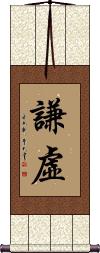
謙虛 can also be translated as humbleness or humility.
In Chinese and Korean, the first character means “modest.” The second means “empty.” Together these characters reinforce the ideas of modesty and being empty of ego.
 In Japan, they tend to use a slightly-simplified version of the second Kanji for this word. It also happens to be an alternate/simplified version used in China too. If you want to order the modern Japanese/simplified version, just click in the Kanji image shown to the right, instead of the button above.
See Also: Moderation
Humility / Being Humble
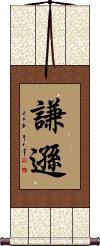
謙遜 can also be translated as being modest, humble, or unpretentious.
Being humble is considering others to be as important as yourself. You are thoughtful of their needs and willing to be of service. You don't expect others or yourself to be perfect. You learn from your mistakes. When you do great things, humility reminds you to be thankful instead of boastful.
This Humility title is also used as one of the 8 key concepts of Tang Soo Do. Often romanized as “Kyum Son.”
Also sometimes used in Japanese to express humility with an essence of modesty.
Humble
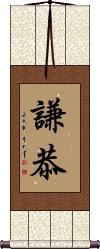
Humble / Modesty / Humility
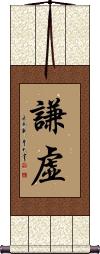
謙虚 is the most common way to say humble or modest in Japanese without a derogatory meaning (some other words suggest weakness, but this version holds a better humble meaning).
In Japanese, the first Kanji means self-effacing, humble oneself, and modesty. The second means void or emptiness.
See Also: Moderation
Kyojitsu: Falsehood and Truth
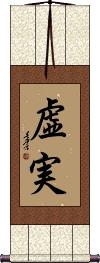
虚実 is a Japanese word that means “falsehood [and] truth” or “fiction [and] fact.”
This concept is used in warfare, gameplay, and martial arts strategies. 虚実 can be a strategy of real and/or deceptive moves. This gets to some Sun Tzu Art of War stuff where in warfare a strategic move is either a real and serious move or it is a deceptive blow.
Let's explore each character in more depth:
虚 was originally written 虛 (there is a very subtle difference in the strokes at the bottom of the character) and means unpreparedness, falsehood, emptiness, void, abstract theory, empty or unoccupied, diffident or timid, false, humble or modest, virtual, or in vain.
In the Buddhist context, 虛 represents the Pali/Sanskrit word “śūnya,” meaning empty, vacant, unreal, unsubstantial, untrue, space, humble, or in vain.
In ancient Eastern/Chinese astronomy, 虛 represents the “Emptiness” constellation (one of the 28 mansions in the sky).
実 was originally 實 in Chinese (they currently write it as 实 in Simplified Chinese) with the meaning, truth, reality, sincerity, honesty, fidelity, and substance.
The Buddhist context is similar, adding real, true, honest, really, solid, definitely, sincere, solid, fixed, full, to fill, fruit, kernel, verily, in fact, the supreme fact, or ultimate reality to the definition.
Not the results for Modest that you were looking for?
Below are some entries from our dictionary that may match your Modest search...
| Characters If shown, 2nd row is Simp. Chinese |
Pronunciation Romanization |
Simple Dictionary Definition |
謙恭 谦恭 see styles |
qiān gōng qian1 gong1 ch`ien kung chien kung |
More info & calligraphy: Humble |
謙虚 see styles |
kenkyo けんきょ |
More info & calligraphy: Humble / Modesty / Humility |
謙虛 谦虚 see styles |
qiān xū qian1 xu1 ch`ien hsü chien hsü |
More info & calligraphy: Humble / Modest |
謙遜 谦逊 see styles |
qiān xùn qian1 xun4 ch`ien hsün chien hsün kenson けんそん |
More info & calligraphy: Modesty(adj-na,n,adj-no,vs) humble; humility; modesty; being humble |
質素 质素 see styles |
zhì sù zhi4 su4 chih su shisso しっそ |
More info & calligraphy: Simplicity / Modesty(noun or adjectival noun) (1) simple; plain; (noun or adjectival noun) (2) modest; frugal; reserved |
愚 see styles |
yú yu2 yü gu ぐ |
to be stupid; to cheat or deceive; me or I (modest) (noun or adjectival noun) (1) foolishness; silliness; stupidity; folly; (pronoun) (2) (archaism) (humble language) I; me; (given name) Gu Monkey-witted, silly, stupid, ignorant. |
虛 虚 see styles |
xū xu1 hsü kyo |
emptiness; void; abstract theory or guiding principles; empty or unoccupied; diffident or timid; false; humble or modest; (of health) weak; virtual; in vain śūnya. Empty, vacant; unreal, unsubstantial, untrue; space; humble; in vain. |
謙 谦 see styles |
qiān qian1 ch`ien chien yuzuru ゆずる |
modest (given name) Yuzuru to yield |
遜 逊 see styles |
xùn xun4 hsün yuzuru ゆずる |
to abdicate; modest; yielding; unpretentious; inferior to; (slang) to suck (given name) Yuzuru To yield, accord; modest. |
中破 see styles |
chuuha / chuha ちゅうは |
(n,vs,vi) medium damage; modest damage; some damage |
嗜む see styles |
tashinamu; tashimu(ok) たしなむ; たしむ(ok) |
(transitive verb) (1) (kana only) to have a taste for; to be fond of; to enjoy (in moderation); to have an interest in (e.g. a hobby); (transitive verb) (2) (kana only) to be modest; to be prudent; to watch (e.g. one's behaviour) |
客氣 客气 see styles |
kè qi ke4 qi5 k`o ch`i ko chi |
polite; courteous; formal; modest |
小樓 小楼 see styles |
xiǎo lóu xiao3 lou2 hsiao lou |
small multi-story building; modest house with two or more floors |
幽婉 see styles |
yuuen / yuen ゆうえん |
(noun or adjectival noun) modest and beautiful; profound and elegant |
幽艶 see styles |
yuuen / yuen ゆうえん |
(noun or adjectival noun) modest and beautiful; profound and elegant |
從儉 从俭 see styles |
cóng jiǎn cong2 jian3 ts`ung chien tsung chien |
economical; modest |
微供 see styles |
wēi gōng wei1 gong1 wei kung bikū |
modest offerings |
微施 see styles |
wēi shī wei1 shi1 wei shih bise |
modest gift |
愚計 see styles |
gukei / guke ぐけい |
(1) foolish plan; (2) (humble language) (one's own) plan; one's modest proposal |
撝挹 㧑挹 see styles |
huī yì hui1 yi4 hui i |
to be extremely modest and polite |
敬虔 see styles |
jìng qián jing4 qian2 ching ch`ien ching chien keiken / keken けいけん |
devout (noun or adjectival noun) pious; devout; modest |
禮讓 礼让 see styles |
lǐ ràng li3 rang4 li jang raijō |
to show consideration for (others); to yield to (another vehicle etc); courtesy; comity courtesy and modest |
簡素 see styles |
kanso かんそ |
(noun or adjectival noun) simple; plain; modest |
自謙 自谦 see styles |
zì qiān zi4 qian1 tzu ch`ien tzu chien jiken じけん |
modest; self-deprecating (personal name) Jiken self-satisfaction |
謙和 谦和 see styles |
qiān hé qian1 he2 ch`ien ho chien ho yoshikazu よしかず |
meek; modest; amiable (personal name) Yoshikazu |
謙稱 谦称 see styles |
qiān chēng qian1 cheng1 ch`ien ch`eng chien cheng |
modest appellation |
謙詞 谦词 see styles |
qiān cí qian1 ci2 ch`ien tz`u chien tzu |
modest word (grammar) |
謙誠 谦诚 see styles |
qiān chéng qian1 cheng2 ch`ien ch`eng chien cheng kenjou / kenjo けんじょう |
modest and sincere; humble (given name) Kenjō |
謙辞 see styles |
kenji けんじ |
modest word; humble language |
謙順 谦顺 see styles |
qiān shùn qian1 shun4 ch`ien shun chien shun kenjun |
modest and deferential |
Click here for more Modest results from our dictionary
The following table may be helpful for those studying Chinese or Japanese...
| Title | Characters | Romaji (Romanized Japanese) | Various forms of Romanized Chinese | |
| Humble Modest | 謙虛 谦虚 | ken kyo / kenkyo | qiān xū / qian1 xu1 / qian xu / qianxu | ch`ien hsü / chienhsü / chien hsü |
| Humility Being Humble | 謙遜 谦逊 | ken son / kenson | qiān xùn / qian1 xun4 / qian xun / qianxun | ch`ien hsün / chienhsün / chien hsün |
| Humble | 謙恭 谦恭 | qiān gōng qian1 gong1 qian gong qiangong | ch`ien kung chienkung chien kung |
|
| Humble Modesty Humility | 謙虚 | ken kyo / kenkyo | qiān xū / qian1 xu1 / qian xu / qianxu | ch`ien hsü / chienhsü / chien hsü |
| Kyojitsu: Falsehood and Truth | 虚実 | kyo jitsu / kyojitsu | ||
| In some entries above you will see that characters have different versions above and below a line. In these cases, the characters above the line are Traditional Chinese, while the ones below are Simplified Chinese. | ||||

Successful Chinese Character and Japanese Kanji calligraphy searches within the last few hours...



