Many custom options...


And formats...



Mindful in Chinese / Japanese...
Buy a Mindful calligraphy wall scroll here!
Personalize your custom “Mindful” project by clicking the button next to your favorite “Mindful” title below...
1. 7. Right Mindfulness / Right Memory / Perfect Mindfulness
4. Mindfulness
5. Bodhi - Awakening Enlightenment
6. The True and Complete Enlightenment
8. The Nature of Enlightenment in One's Mind
10. Kensho - Initial Enlightenment
13. The Tree of Enlightenment / The Bodhi Tree
14. Enlightenment
15. Kensho Jobutsu - Enlightenment - Path to Buddha
16. Devotion / Dedication / Attentive / Focused
17. You are only as old as you feel
7. Right Mindfulness / Right Memory / Perfect Mindfulness
Samyak Smriti / Samyak Smrti / Samma Sati
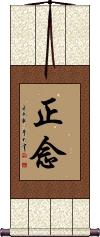
正念 is one of the Noble Eightfold Paths of Buddhism. Right Mindfulness, along with Right Effort and Right Concentration, constitute the path to Concentration or Perfect Thought.
Right Mindfulness is about remaining focused on one's body, feelings, mind, and mental qualities. It's also about being ardent, aware, and mindful, and supposes that you've already put aside worldly desire and aversion.
Monk Bhikkhu Bodhi described this as “The mind is deliberately kept at the level of bare attention, a detached observation of what is happening within us and around us in the present moment.” When practicing right mindfulness, the mind is trained to remain in the present, open, quiet, and alert, contemplating the present event.
Another definition: Ongoing mindfulness of body, feelings, thinking, and objects of thought.
This term is exclusively used by devout Buddhists. It is not a common term, and is remains an unknown concept to most Japanese and Chinese people.
See Also: Buddhism | Enlightenment | Noble Eightfold Path
Heart / Mind / Spirit
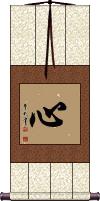
心 would often be translated as “heart.”
However, because it was believed in Chinese culture for thousands of years that your consciousness and thoughts came from the big red organ in the middle of your chest, it also means “mind” or “spirit” and sometimes even “soul.”
In Korean, beyond heart, mind, and spirit, this character can mean moral, nature, mind, affections, intentions, core, and center. In fact, it is used in Chinese to mean “center” as well but only with another character in front of it. For instance, “medical center” or even “shopping center.” Separately and alone, it will not be read with that “center” meaning unless thought of as “the center of your soul.”
Satori / Enlightenment
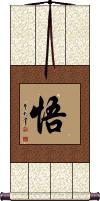
悟 means enlightenment but can also mean to perceive, discern, realize, understand or comprehend.
悟 has the same meaning in Chinese, Japanese and Korean, though used most often with deep significance in Japanese culture and language. 悟 is often seen in Japan along with a secondary Hiragana character. We also offer that option but this is the more universal single-character entry.
Mindfulness
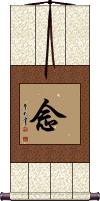
念 is the simplest way to write “mindfulness” in Chinese, Japanese Kanji, and old Korean Hanja.
念 can be defined these ways: To read; to study (a degree course); to read aloud; to miss somebody (keeping them in your mind); idea; remembrance; sense; thought; feeling; desire; concern; attention; recollection; memory; to think on/about; reflect; repeat, intone; a moment.
Obviously, the context in which the character is used determines which definition or meaning is perceived. As a single character, it's open and perhaps ambiguous. Thus, it can be read with any or all of these meanings.
念 is used in a Buddhist context (often written as 正念 or “right mindfulness”) with similar meanings of thought and contemplation.
In Japanese, this character is sometimes used as the name “Nen.”
See Also: Buddhism | Enlightenment
Bodhi - Awakening Enlightenment
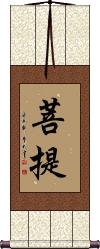
The Bodhi or 菩提 is the moment of completion in Buddhism.
It is when all things become known and you have completed your journey to enlightenment.
The reference is to the Bodhi tree where Siddhartha Gautama (the legendary man who established the Buddhist religion) achieved enlightenment. Sometimes this is referred to as “the tree of enlightenment,” but if you want the full version with the character for a tree at the end, please see the Bodhi Tree entry.
See Also: Buddhism | Buddha | Nirvana | Enlightenment
The True and Complete Enlightenment
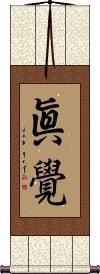
眞覺 means true and complete enlightenment.
This can refer to the perfect nirvana of the Buddha or the perception of ultimate truth or true awareness of all things (reality and unreality).
Determination
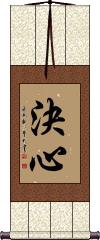
決心 is a Chinese, Japanese, and Korean word that holds the dictionary definition of determination but literally means determined heart.
The first character means to determine or determined.
The second character means heart, mind, or soul, so you can imagine that this form of determination partially means putting your heart into something. It can also be translated as resolve, resolution, or decision (as in a decision made and followed).
See Also: Devotion | Tenacious | Passion | Dedication | Will-Power
The Nature of Enlightenment in One's Mind
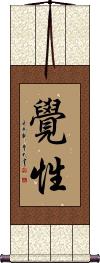
覺性 represents “The enlightened mind free from all illusion,” “The nature of enlightenment in one's mind,” or “The Buddha-nature.”
To reach this “enlightened nature,” one must form their mind into and utilize their mind as the agent of knowledge, or enlightenment.
Enlightenment
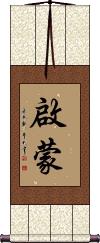
啟蒙 is the Chinese word for enlightenment.
The first character means to open, to start, to begin, to commence, or to explain. The second character means deception or ignorance. It suggests that enlightenment is the opening or cutting through what deceives you in the world or the ignorance of the world. This title can also mean to educate.
 The Japanese and Korean version of the first character of this title varies slightly from the Chinese. Please click on the Kanji to the right, instead of the button above, if you want the Japanese/Korean version.
Kensho - Initial Enlightenment
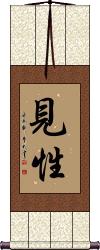
見性 has the same meaning as Satori but refers to the initial state or initial experience of enlightenment.
This can also mean “self-discovery,” “self-awareness,” or “consciousness of one's character.”
In a very religious context, this means to behold the Buddha nature within oneself.
This term is exclusively used by devout Buddhists. It is not a common term, and is remains an unknown concept to most Japanese and Chinese people. Some Japanese people will dispute whether this title is valid in the Japanese language. Only order this if you are sure this title is right for you.
See Also: Buddhism | Enlightenment
Longing for Lover
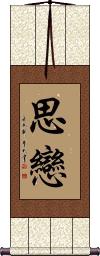
思戀 is a term used for when you miss a lover.
It suggests that you are separated (not by choice) and have longed for each other. It's a strong feeling of missing your lover.
Satori / Enlightenment
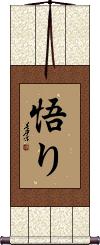
悟り is the Japanese term for enlightenment which can also mean to perceive, discern, realize, understand, or comprehend.
The first character has the same meaning in Chinese and Korean but has deeper significance in Japanese culture and language. This version of Satori incorporates the Japanese secondary character (Hiragana, not Kanji) that adds the “ri” to Satori. It's unnecessary to have the second character, as it does not add to the meaning as much as clarity for the context in which you are using this term.
The Tree of Enlightenment / The Bodhi Tree
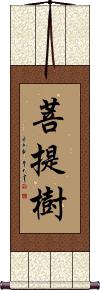
菩提樹 is the full title of the Bodhi tree (a fig tree) under which Siddhartha Gautama (the legendary man who established the Buddhist religion), achieved enlightenment.
Sometimes this is referred to as “the tree of enlightenment.” If you don't have a Bodhi tree to sit under, maybe you can achieve enlightenment under a wall scroll with this title.
Enlightenment
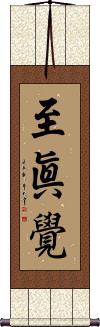
至眞覺 represents the enlightenment of one who has attained the ultimate truth.
This would be the state of an enlightened or liberated person in the context of Buddhism. A goal that all should want to attain and aspire for.
Kensho Jobutsu - Enlightenment - Path to Buddha
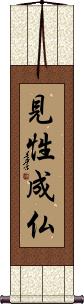
見性成仏 or Kenshō Jōbutsu is the initial enlightenment that leads to self-awareness, becoming Buddha, and the path to enter Nirvana.
Kenshō Jōbutsu is a complex concept in Japanese Buddhism. 見性成仏 is probably better translated as “Seeing one’s nature and becoming a Buddha.”
See Also: Buddhism | Enlightenment | Initial Enlightenment
Devotion / Dedication / Attentive / Focused
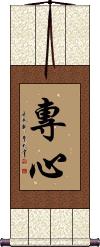
專心 makes a word that means “paying attention with your heart.”
It's often translated as “dedication,” as in “be absorbed in” or “concentrate one's efforts.” It's also used to mean “with the single mind,” “whole-heartedly,” “paying attention,” “undivided attention,” “concentration (-ed),” “engrossed,” “devotionally (listening/watching),” and/or “attentive.”
The first character means “for a particular person, occasion, or purpose,” “focused on one single thing,” “concentrated,” and sometimes, “special.”
The second character means “heart” or “mind” by itself.
My favorite translation, which comes from the Oxford Advanced Chinese/English Dictionary, is, “wholehearted devotion.”
If it seems like the meaning of this word is quite open, you are correct. The context in which the word is used matters a lot. It can mean different things depending on how you use it. This makes it kind of nice as you can decide what this means to you (within some limits). This is always positive in meaning, so even if a Chinese person reads it differently than you, it will still have a good meaning.
 In Japanese, they tend to use a variation of the second character which has one less stroke. If you want your calligraphy written this Japanese form, please click on the Kanji shown to the right instead of the button above. Note: Japanese and Chinese people will recognize either form.
You are only as old as you feel
You're only old if you think you're old
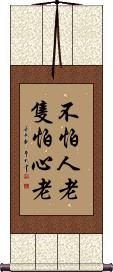
不怕人老只怕心老 literally translates as: Do not be concerned about being old; be concerned about a mind which is old.
Figuratively, this means: You are not as old as you look, you are only as old as you think you are.
Comparison Leads to Truth and Enlightenment
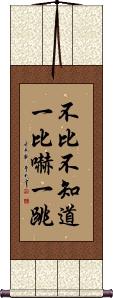
不比不知道一比吓一跳 is a Chinese proverb that literally means: [If one not does] not make comparisons, [one will] not know [the truth] when [one] compares, [one will be] greatly surprised.
This goes to the idea that if you do not know bad times, you cannot know what good times are.
...And...
You can not know light without experiencing darkness.
Another way to translate this would be: If you wish to be enlightened, you need to make comparisons and analyze every aspect (of a situation, issue, or problem).
Chop Wood, Carry Water
Before enlightenment or after, chores remain.
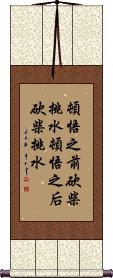
頓悟之前砍柴挑水; 頓悟之後砍柴挑水 means “Before enlightenment, chop wood, carry water; After enlightenment, chop wood, carry water.
This is a Chinese proverb that is attributed to 吴力 (Wú Lì) who lived between 1632 and 1718 - living part of his life as a devout Buddhist, and many years as a Catholic Jesuit Priest in China - what an interesting life!
This has been explained many times in many ways. I am a Buddhist, and here is my brief take on this proverb...
Before enlightenment, one may find daily chores mundane, tedious, and boring. However, upon reaching enlightenment one is not relieved of the details of daily life. An enlightened person will, however, see such chores as a joy, and do them mindfully.
There is another version floating around, which is 在你領悟之前砍柴、運水。在你領悟之後,砍柴、運水。
If you want this other version, just contact me. The meaning is the same, just different phrasing.
This in-stock artwork might be what you are looking for, and ships right away...


Gallery Price: $90.00
Your Price: $39.00


Gallery Price: $50.00
Your Price: $29.88
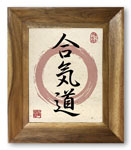

Gallery Price: $72.00
Your Price: $39.88

Gallery Price: $60.00
Your Price: $36.88

Gallery Price: $200.00
Your Price: $128.88

Gallery Price: $60.00
Your Price: $39.88

Gallery Price: $31.00
Your Price: $16.88

Gallery Price: $222.00
Your Price: $122.88

Gallery Price: $200.00
Your Price: $122.88

Gallery Price: $198.00
Your Price: $109.88
These search terms might be related to Mindful:
Alert / on Guard / Lingering Mind
Devotion / Dedication / Attentive / Focused
Mono No Aware
The following table may be helpful for those studying Chinese or Japanese...
| Title | Characters | Romaji (Romanized Japanese) | Various forms of Romanized Chinese | |
| 7. Right Mindfulness Right Memory Perfect Mindfulness | 正念 | sei nen / seinen | zhèng niàn zheng4 nian4 zheng nian zhengnian | cheng nien chengnien |
| Heart Mind Spirit | 心 | kokoro | xīn / xin1 / xin | hsin |
| Satori Enlightenment | 悟 | sato / go | wù / wu4 / wu | |
| Mindfulness | 念 | nen | niàn / nian4 / nian | nien |
| Bodhi - Awakening Enlightenment | 菩提 | bodai | pú tí / pu2 ti2 / pu ti / puti | p`u t`i / puti / pu ti |
| The True and Complete Enlightenment | 眞覺 眞觉 | shinkaku | zhēn jué / zhen1 jue2 / zhen jue / zhenjue | chen chüeh / chenchüeh |
| Determination | 決心 决心 | kesshin / keshin | jué xīn / jue2 xin1 / jue xin / juexin | chüeh hsin / chüehhsin |
| The Nature of Enlightenment in One's Mind | 覺性 觉性 | kakushou / kakusho | jué xìng / jue2 xing4 / jue xing / juexing | chüeh hsing / chüehhsing |
| Enlightenment | 啟蒙 启蒙 | keimou / keimo | qǐ méng / qi3 meng2 / qi meng / qimeng | ch`i meng / chimeng / chi meng |
| Kensho - Initial Enlightenment | 見性 见性 | ken shou / kenshou / ken sho | jiàn xìng jian4 xing4 jian xing jianxing | chien hsing chienhsing |
| Longing for Lover | 思戀 思恋 | sī liàn / si1 lian4 / si lian / silian | ssu lien / ssulien | |
| Satori Enlightenment | 悟り | satori | ||
| The Tree of Enlightenment The Bodhi Tree | 菩提樹 菩提树 | bodaiju | pú tí shù pu2 ti2 shu4 pu ti shu putishu | p`u t`i shu putishu pu ti shu |
| Enlightenment | 至眞覺 至眞觉 | shi shin kaku shishinkaku | zhì zhēn jué zhi4 zhen1 jue2 zhi zhen jue zhizhenjue | chih chen chüeh chihchenchüeh |
| Kensho Jobutsu - Enlightenment - Path to Buddha | 見性成佛 見性成仏 | ken shou jou butsu kenshoujoubutsu ken sho jo butsu | ||
| Devotion Dedication Attentive Focused | 專心 / 専心 / 耑心 专心 | sen shin / senshin | zhuān xīn zhuan1 xin1 zhuan xin zhuanxin | chuan hsin chuanhsin |
| You are only as old as you feel | 不怕人老隻怕心老 不怕人老只怕心老 | bú pà rén lǎo zhǐ pà xīn lǎo bu2 pa4 ren2 lao3 zhi3 pa4 xin1 lao3 bu pa ren lao zhi pa xin lao buparenlaozhipaxinlao | pu p`a jen lao chih p`a hsin lao pupajenlaochihpahsinlao pu pa jen lao chih pa hsin lao |
|
| Comparison Leads to Truth and Enlightenment | 不比不知道一比嚇一跳 不比不知道一比吓一跳 | bù bǐ bù zhī dào yī bǐ xià yì tiào bu4 bi3 bu4 zhi1 dao4 yi1 bi3 xia4 yi4 tiao4 bu bi bu zhi dao yi bi xia yi tiao | pu pi pu chih tao i pi hsia i t`iao pu pi pu chih tao i pi hsia i tiao |
|
| Chop Wood, Carry Water | 頓悟之前砍柴挑水頓悟之后砍柴挑水 顿悟之前砍柴挑水顿悟之后砍柴挑水 | dùn wù zhī qián kǎn chái tiāo shuǐ dùn wù zhī hòu kǎn chái tiāo shuǐ dun4 wu4 zhi1 qian2 kan3 chai2 tiao1 shui3 dun4 wu4 zhi1 hou4 kan3 chai2 tiao1 shui3 dun wu zhi qian kan chai tiao shui dun wu zhi hou kan chai tiao shui | tun wu chih ch`ien k`an ch`ai t`iao shui tun wu chih hou k`an ch`ai t`iao shui tun wu chih chien kan chai tiao shui tun wu chih hou kan chai tiao shui |
|
| In some entries above you will see that characters have different versions above and below a line. In these cases, the characters above the line are Traditional Chinese, while the ones below are Simplified Chinese. | ||||

Successful Chinese Character and Japanese Kanji calligraphy searches within the last few hours...



