Many custom options...


And formats...



Mantis in Chinese / Japanese...
Buy a Mantis calligraphy wall scroll here!
Personalize your custom “Mantis” project by clicking the button next to your favorite “Mantis” title below...
Mantis / Praying Mantis
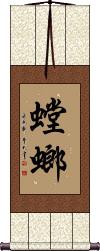
螳螂 is mantis or “praying mantis,” as it's often titled in English.
Technically speaking, this especially applies to the narrow-winged mantis (Tenodera angustipennis)
It is best to use this very common two-character Asian title for the mantis, as the second character alone can mean mantis or dragonfly (totally ambiguous).
This title is antiquated in Japanese, as they tend to write カマキリ (kama kiri) in Katakana to mean praying mantis.
 Note: There is an alternate form of this title which uses the character shown to the right instead of the first character shown above. This is uncommon in both Japan and China (if you really want it anyway, please let us know).
Praying Mantis
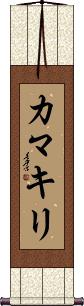
In Japan, they used to write praying mantis in Kanji, but this Katakana title has taken over as the most common version.
This refers to the narrow-winged mantis, Tenodera angustipennis if you are a biologist.
Note: Because this title is entirely Japanese Katakana, it should be written by a Japanese calligrapher.
Southern Praying Mantis
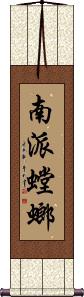
南派螳螂 can be translated literally as “Southern School Praying Mantis” or “Southern Style Praying Mantis.”
Despite its name, the Southern Praying Mantis style of Chinese martial arts is unrelated to the Northern Praying Mantis style. Southern Praying Mantis is instead related most closely to fellow Hakka styles such as Dragon and more distantly to the Fujian family of styles that includes Fujian White Crane, Five Ancestors, and Wing Chun.
This style of martial arts focuses more on fighting skills rather than aesthetics.
Of course, you already knew that if you were looking for this term.
Note: This title can be pronounced and does have meaning in Korean but only to Koreans familiar with Chinese martial arts.
Northern Praying Mantis
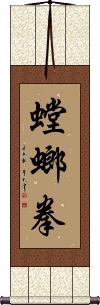
This can be translated literally as “Praying Mantis Fist.”
螳螂拳 is sometimes called Shandong Praying Mantis after its place of origin. It was created by Wang Lang and was named after the praying mantis, an insect, the aggressiveness of which inspired the style.
Shaolin records document that Wang Lang was one of the 18 masters gathered by the Shaolin Abbot Fu Ju, which dates him and Northern Praying Mantis style to the Song Dynasty (960-1279 A.D.).
The fact that the word “Northern” is used in the English title has more to do with where this style came from (Shandong is in northern China), but “north” is absent from this Chinese title.
Note: 螳螂拳 is also a title in Japanese - however, only a Japanese person who practices or is familiar with the “Praying Mantis Fist” style would recognize it.
Not the results for Mantis that you were looking for?
Below are some entries from our dictionary that may match your Mantis search...
| Characters If shown, 2nd row is Simp. Chinese |
Pronunciation Romanization |
Simple Dictionary Definition |
螳螂 see styles |
táng láng tang2 lang2 t`ang lang tang lang tourou / toro とうろう kamakiri かまきり |
More info & calligraphy: Mantis / Praying Mantis(kana only) praying mantis (esp. the narrow-winged mantis, Tenodera angustipennis) |
螳螂拳 see styles |
tourouken / toroken とうろうけん |
More info & calligraphy: Northern Praying Mantis |
カマキリ see styles |
kamakiri カマキリ |
More info & calligraphy: Praying Mantis |
南派螳螂 see styles |
nán pài táng láng nan2 pai4 tang2 lang2 nan p`ai t`ang lang nan pai tang lang |
More info & calligraphy: Southern Praying Mantis |
螳 see styles |
táng tang2 t`ang tang |
praying mantis |
蟭 see styles |
jiāo jiao1 chiao |
eggs of mantis |
蟷 see styles |
dāng dang1 tang |
mantis |
刀螂 see styles |
dāo lang dao1 lang5 tao lang |
(dialect) mantis |
爬蝦 爬虾 see styles |
pá xiā pa2 xia1 p`a hsia pa hsia |
mantis shrimp |
蝦蛄 虾蛄 see styles |
xiā gū xia1 gu1 hsia ku shako しゃこ |
mantis shrimp (kana only) mantis shrimp (any marine crustacean of order Stomatopoda, esp. the species Oratosquilla oratoria) |
螵蛸 see styles |
piāo xiāo piao1 xiao1 p`iao hsiao piao hsiao |
ootheca, i.e. eggs in their capsule, of a praying mantis (used in TCM); cuttlebone (abbr. for 海螵蛸[hai3 piao1 xiao1]) |
蟐螂 see styles |
kamakiri かまきり |
(kana only) praying mantis (esp. the narrow-winged mantis, Tenodera angustipennis) |
蟷螂 see styles |
tourou / toro とうろう |
(kana only) praying mantis (esp. the narrow-winged mantis, Tenodera angustipennis); (surname) Tourou |
鎌切 see styles |
kamakiri かまきり |
(kana only) praying mantis (esp. the narrow-winged mantis, Tenodera angustipennis) |
鎌首 see styles |
kamakubi かまくび |
sickle-shaped neck (e.g. snake, praying mantis); crooked neck; gooseneck |
口足目 see styles |
kǒu zú mù kou3 zu2 mu4 k`ou tsu mu kou tsu mu |
Stomatopoda, order of marine crustaceans (whose members are called mantis shrimps) |
皮皮蝦 皮皮虾 see styles |
pí pí xiā pi2 pi2 xia1 p`i p`i hsia pi pi hsia |
mantis shrimp |
蝦爬子 虾爬子 see styles |
xiā pá zi xia1 pa2 zi5 hsia p`a tzu hsia pa tzu |
mantis shrimp |
蟷螂拳 see styles |
tourouken / toroken とうろうけん |
(martial arts term) praying mantis style |
青竜蝦 see styles |
shako しゃこ |
(kana only) mantis shrimp (any marine crustacean of order Stomatopoda, esp. the species Oratosquilla oratoria) |
朝鮮蟷螂 see styles |
chousenkamakiri / chosenkamakiri ちょうせんかまきり |
narrow-winged mantis |
腹広蟷螂 see styles |
harabirokamakiri; harabirokamakiri はらびろかまきり; ハラビロカマキリ |
(kana only) Indo-Pacific mantis (Hierodula patellifera) |
螳臂當車 螳臂当车 see styles |
táng bì dāng chē tang2 bi4 dang1 che1 t`ang pi tang ch`e tang pi tang che |
lit. a mantis trying to stop a chariot (idiom); fig. to overrate oneself and attempt something impossible |
螳螂捕蟬 螳螂捕蝉 see styles |
táng láng bǔ chán tang2 lang2 bu3 chan2 t`ang lang pu ch`an tang lang pu chan |
the mantis stalks the cicada, unaware of the oriole behind (idiom, from Daoist classic Zhuangzi 莊子|庄子[Zhuang1 zi3]); to pursue a narrow gain while neglecting a greater danger |
マンティス see styles |
mantisu マンティス |
mantis |
北派螳螂拳 see styles |
běi pài táng láng quán bei3 pai4 tang2 lang2 quan2 pei p`ai t`ang lang ch`üan pei pai tang lang chüan |
Beipai Tanglang Quan - "Northern Praying Mantis" (Chinese Martial Art) |
Variations: |
shako; shako しゃこ; シャコ |
(kana only) mantis shrimp (any marine crustacean of order Stomatopoda, esp. the species Oratosquilla oratoria) |
Variations: |
tourouken / toroken とうろうけん |
{MA} praying mantis style |
ハラビロカマキリ see styles |
harabirokamakiri ハラビロカマキリ |
(kana only) Indo-Pacific mantis (Hierodula patellifera) |
ミステリーかまきり see styles |
misuteriikamakiri / misuterikamakiri ミステリーかまきり |
(work) Praying Mantis (film); (wk) Praying Mantis (film) |
Click here for more Mantis results from our dictionary
The following table may be helpful for those studying Chinese or Japanese...
| Title | Characters | Romaji (Romanized Japanese) | Various forms of Romanized Chinese | |
| Mantis Praying Mantis | 螳螂 / 蟷螂 螳螂 | tou rou / tourou / to ro | táng láng tang2 lang2 tang lang tanglang | t`ang lang tanglang tang lang |
| Praying Mantis | カマキリ | kamakiri | ||
| Southern Praying Mantis | 南派螳螂 | nán pài táng láng nan2 pai4 tang2 lang2 nan pai tang lang nanpaitanglang | nan p`ai t`ang lang nanpaitanglang nan pai tang lang |
|
| Northern Praying Mantis | 螳螂拳 | tou rou ken tourouken to ro ken | táng láng quán tang2 lang2 quan2 tang lang quan tanglangquan | t`ang lang ch`üan tanglangchüan tang lang chüan |
| In some entries above you will see that characters have different versions above and below a line. In these cases, the characters above the line are Traditional Chinese, while the ones below are Simplified Chinese. | ||||

Successful Chinese Character and Japanese Kanji calligraphy searches within the last few hours...



