Many custom options...


And formats...



Mant in Chinese / Japanese...
Buy a Mant calligraphy wall scroll here!
Personalize your custom “Mant” project by clicking the button next to your favorite “Mant” title below...
Switched to secondary search mode due to lack of results using primary.
These secondary results may not be very accurate. Try a different but similar meaning word or phrase for better results. Or...
Look up Mant in my Japanese Kanji & Chinese Character Dictionary(My dictionary is a different system then the calligraphy search you just tried)
If you want a special phrase, word, title, name, or proverb, feel free to contact me, and I will translate your custom calligraphy idea for you.
2. Amantha
3. Bustamante
4. Dhimant
5. Diamantina
7. Hemant
8. Manticore
9. Mantra to Buddha / Nembutsu
10. Nimantha
12. Romantic Passion
14. Praying Mantis
15. Samanta
16. Samantha
18. Talamantes
19. Zamantha
Adamantine / King Kong
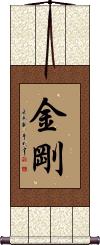
金剛 can translate as adamantine from Chinese, Japanese, and old Korean.
Other meanings and translations can include diamond, thunderbolt, Indra's indestructible weapon, a Buddhist symbol of the indestructible truth, Vajra (a mythical weapon), guardian deity, hardness, indestructibility, power, the least frangible of minerals.
The Chinese pronunciation of “Jīn Gāng” became the loanword used in English as “King Kong.” You can see King Kong as the indestructible ape guardian deity depending on how you read the story.
Amantha

阿曼莎 is the name Amantha in Chinese (Mandarin).
Amantha

アマンサ is the name Amantha in Japanese Katakana.
Note: Because this title is entirely Japanese Katakana, it should be written by a Japanese calligrapher.
Bustamante

布斯塔曼特 is the name Bustamante in Chinese (Mandarin).
Bustamante

ブスタマンテ is the name Bustamante in Japanese Katakana.
Note: Because this title is entirely Japanese Katakana, it should be written by a Japanese calligrapher.
Dhimant
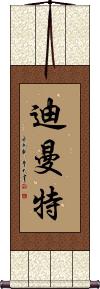
迪曼特 is the name Dhimant in Chinese (Mandarin).
Dhimant
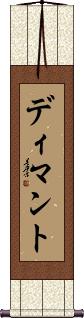
ディマント is the name Dhimant in Japanese Katakana.
Note: Because this title is entirely Japanese Katakana, it should be written by a Japanese calligrapher.
Diamantina
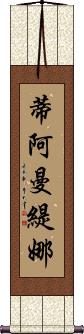
This is a common Mandarin Chinese transliteration for the female Portuguese/Latin name Diamantina.
Diamantina
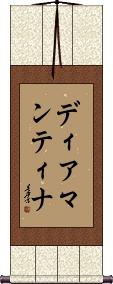
ディアマンティナ is the name Diamantina in Japanese (Katakana).
Note: Because this title is entirely Japanese Katakana, it should be written by a Japanese calligrapher.
Heart Sutra Mantra
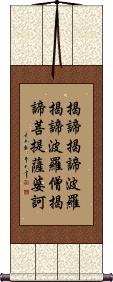
揭諦揭諦波羅揭諦波羅僧揭諦菩提薩婆訶 is the Mantra included within the Heart Sutra.
Hemant
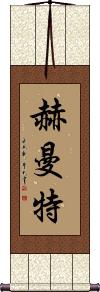
赫曼特 is the name Hemant in Chinese (Mandarin).
Hemant
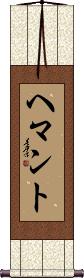
ヘマント is the name Hemant in Japanese (Katakana).
Note: Because this title is entirely Japanese Katakana, it should be written by a Japanese calligrapher.
Manticore

マンティコア is the name Manticore in Japanese Katakana.
Note: Because this title is entirely Japanese Katakana, it should be written by a Japanese calligrapher.
Mantra to Buddha / Nembutsu
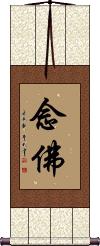
念佛 is used primarily in Japanese, where it is romanized as nenbutsu.
The meaning is to pray to Buddha, chant the name of Buddha, or repeat the name of Buddha. This can be an audible or inaudible chant.
Nimantha

尼曼塔 is the name Nimantha in Chinese (Mandarin).
Nimantha

ニマンサ is the name Nimantha in Japanese Katakana.
Note: Because this title is entirely Japanese Katakana, it should be written by a Japanese calligrapher.
Northern Praying Mantis
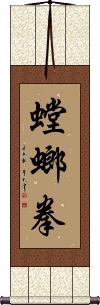
This can be translated literally as “Praying Mantis Fist.”
螳螂拳 is sometimes called Shandong Praying Mantis after its place of origin. It was created by Wang Lang and was named after the praying mantis, an insect, the aggressiveness of which inspired the style.
Shaolin records document that Wang Lang was one of the 18 masters gathered by the Shaolin Abbot Fu Ju, which dates him and Northern Praying Mantis style to the Song Dynasty (960-1279 A.D.).
The fact that the word “Northern” is used in the English title has more to do with where this style came from (Shandong is in northern China), but “north” is absent from this Chinese title.
Note: 螳螂拳 is also a title in Japanese - however, only a Japanese person who practices or is familiar with the “Praying Mantis Fist” style would recognize it.
Romantic Passion
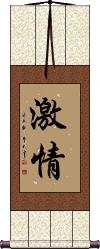
Beyond romantic passion, 激情 also means “strong emotion” or “fervor.”
The meaning in Japanese is a little more radical, as beyond "passion" it can be understood as "violent emotion" or "fury."
Mantis / Praying Mantis
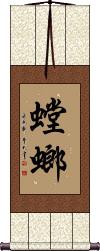
螳螂 is mantis or “praying mantis,” as it's often titled in English.
Technically speaking, this especially applies to the narrow-winged mantis (Tenodera angustipennis)
It is best to use this very common two-character Asian title for the mantis, as the second character alone can mean mantis or dragonfly (totally ambiguous).
This title is antiquated in Japanese, as they tend to write カマキリ (kama kiri) in Katakana to mean praying mantis.
 Note: There is an alternate form of this title which uses the character shown to the right instead of the first character shown above. This is uncommon in both Japan and China (if you really want it anyway, please let us know).
Praying Mantis
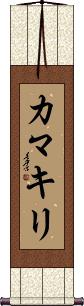
In Japan, they used to write praying mantis in Kanji, but this Katakana title has taken over as the most common version.
This refers to the narrow-winged mantis, Tenodera angustipennis if you are a biologist.
Note: Because this title is entirely Japanese Katakana, it should be written by a Japanese calligrapher.
Samanta
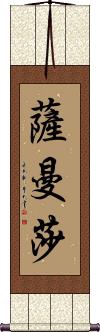
薩曼莎 is the name Samanta in Chinese (Mandarin).
Samanta
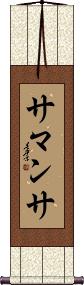
サマンサ is the name Samanta in Japanese Katakana.
Note: Because this title is entirely Japanese Katakana, it should be written by a Japanese calligrapher.
Samantha
薩曼莎 is the name Samantha in Chinese (Mandarin).
Samantha
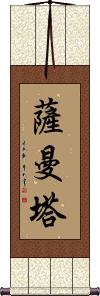
This is a Mandarin Chinese transliteration for the female French name Samantha.
Samantha
サマンサ is the name Samantha in Japanese.
Note: Because this title is entirely Japanese Katakana, it should be written by a Japanese calligrapher.
Southern Praying Mantis
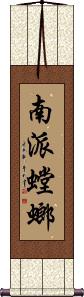
南派螳螂 can be translated literally as “Southern School Praying Mantis” or “Southern Style Praying Mantis.”
Despite its name, the Southern Praying Mantis style of Chinese martial arts is unrelated to the Northern Praying Mantis style. Southern Praying Mantis is instead related most closely to fellow Hakka styles such as Dragon and more distantly to the Fujian family of styles that includes Fujian White Crane, Five Ancestors, and Wing Chun.
This style of martial arts focuses more on fighting skills rather than aesthetics.
Of course, you already knew that if you were looking for this term.
Note: This title can be pronounced and does have meaning in Korean but only to Koreans familiar with Chinese martial arts.
Talamantes

塔拉曼特斯 is the name Talamantes in Chinese (Mandarin).
Talamantes

タラマンテス is the name Talamantes in Japanese Katakana.
Note: Because this title is entirely Japanese Katakana, it should be written by a Japanese calligrapher.
Zamantha
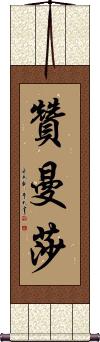
贊曼莎 is the name Zamantha in Chinese (Mandarin).
Zamantha
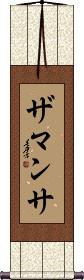
ザマンサ is the name Zamantha in Japanese (Katakana).
Note: Because this title is entirely Japanese Katakana, it should be written by a Japanese calligrapher.
The following table may be helpful for those studying Chinese or Japanese...
| Title | Characters | Romaji (Romanized Japanese) | Various forms of Romanized Chinese | |
| Adamantine King Kong | 金剛 金刚 | kongou / kongo | jīn gāng / jin1 gang1 / jin gang / jingang | chin kang / chinkang |
| Amantha | 阿曼莎 | ā màn shā a1 man4 sha1 a man sha amansha | ||
| Amantha | アマンサ | amansa | ||
| Bustamante | 布斯塔曼特 | bù sī tǎ màn tè bu4 si1 ta3 man4 te4 bu si ta man te busitamante | pu ssu t`a man t`e pussutamante pu ssu ta man te |
|
| Bustamante | ブスタマンテ | busutamante | ||
| Dhimant | 迪曼特 | dí màn tè di2 man4 te4 di man te dimante | ti man t`e timante ti man te |
|
| Dhimant | ディマント | dimanto | ||
| Diamantina | 蒂阿曼緹娜 蒂阿曼缇娜 | dì ā màn tí nà di4 a1 man4 ti2 na4 di a man ti na diamantina | ti a man t`i na tiamantina ti a man ti na |
|
| Diamantina | ディアマンティナ | diamantina | ||
| Heart Sutra Mantra | 揭諦揭諦波羅揭諦波羅僧揭諦菩提薩婆訶 揭谛揭谛波罗揭谛波罗僧揭谛菩提萨婆诃 | jiē dì jiē dì bō luō jiē dì bō luō sēng jiē dì pú tí sà pó hē jie1 di4 jie1 di4 bo1 luo1 jie1 di4 bo1 luo1 seng1 jie1 di4 pu2 ti2 sa4 po2 he1 jie di jie di bo luo jie di bo luo seng jie di pu ti sa po he | chieh ti chieh ti po lo chieh ti po lo seng chieh ti p`u t`i sa p`o ho chieh ti chieh ti po lo chieh ti po lo seng chieh ti pu ti sa po ho |
|
| Hemant | 赫曼特 | hè màn tè he4 man4 te4 he man te hemante | ho man t`e homante ho man te |
|
| Hemant | ヘマント | hemanto | ||
| Manticore | マンティコア | mantikoa | ||
| Mantra to Buddha Nembutsu | 念佛 | nenbutsu | niàn fó / nian4 fo2 / nian fo / nianfo | nien fo / nienfo |
| Nimantha | 尼曼塔 | ní màn tǎ ni2 man4 ta3 ni man ta nimanta | ni man t`a nimanta ni man ta |
|
| Nimantha | ニマンサ | nimansa | ||
| Northern Praying Mantis | 螳螂拳 | tou rou ken tourouken to ro ken | táng láng quán tang2 lang2 quan2 tang lang quan tanglangquan | t`ang lang ch`üan tanglangchüan tang lang chüan |
| Romantic Passion | 激情 | gekijou / gekijo | jī qíng / ji1 qing2 / ji qing / jiqing | chi ch`ing / chiching / chi ching |
| Mantis Praying Mantis | 螳螂 / 蟷螂 螳螂 | tou rou / tourou / to ro | táng láng tang2 lang2 tang lang tanglang | t`ang lang tanglang tang lang |
| Praying Mantis | カマキリ | kamakiri | ||
| Samanta | 薩曼莎 萨曼莎 | sà màn shā sa4 man4 sha1 sa man sha samansha | ||
| Samanta | サマンサ | samansa | ||
| Samantha | 薩曼莎 萨曼莎 | sà màn shā sa4 man4 sha1 sa man sha samansha | ||
| Samantha | 薩曼塔 萨曼塔 | sà màn tǎ sa4 man4 ta3 sa man ta samanta | sa man t`a samanta sa man ta |
|
| Samantha | サマンサ | samansa | ||
| Southern Praying Mantis | 南派螳螂 | nán pài táng láng nan2 pai4 tang2 lang2 nan pai tang lang nanpaitanglang | nan p`ai t`ang lang nanpaitanglang nan pai tang lang |
|
| Talamantes | 塔拉曼特斯 | tǎ lā màn tè sī ta3 la1 man4 te4 si1 ta la man te si talamantesi | t`a la man t`e ssu talamantessu ta la man te ssu |
|
| Talamantes | タラマンテス | taramantesu | ||
| Zamantha | 贊曼莎 赞曼莎 | zàn màn shā zan4 man4 sha1 zan man sha zanmansha | tsan man sha tsanmansha |
|
| Zamantha | ザマンサ | zamansa | ||
| In some entries above you will see that characters have different versions above and below a line. In these cases, the characters above the line are Traditional Chinese, while the ones below are Simplified Chinese. | ||||

Successful Chinese Character and Japanese Kanji calligraphy searches within the last few hours...



