Many custom options...


And formats...



Not what you want?
Try other similar-meaning words, fewer words, or just one word.
Man Woman in Chinese / Japanese...
Buy a Man Woman calligraphy wall scroll here!
Personalize your custom “Man Woman” project by clicking the button next to your favorite “Man Woman” title below...
Holy Man / Saint
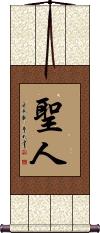
聖人 can mean saint, sage, or holy man.
Note: There is more than one way to express this idea. This one really matches “Holy man” because the second character means “human” or “person” (therefore, this could equally mean “Holy woman”).
Person of Character
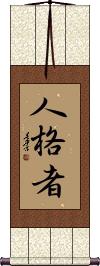
人格者 is a Japanese and Korean title that means “person of character.”
人格者 is unisex, so it can also be used to mean “man of character,” or “woman of character.”
Beauty / Beautiful / Handsome
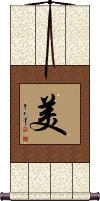
美 is often used to describe the beauty of a woman.
However, when applied to a man, it can mean handsome. It's also the first character in the word for “beauty salon” which you will see all over China and Japan.
This can be used as the given name for a girl (spell it or say it as “Mei” or “May”).
For a bit of trivia: The title for the “USA” in Chinese is “Mei Guo” which literally means “Beautiful Country.” This name was bestowed at a time before Chairman Mao came to power and decided that China didn't like the USA anymore (even though we fought together against the Japanese in WWII). But these days, Chinese people love Americans (but have a distaste for American politics and policy). But I digress...
美 is also how “Beautiful” is written in Japanese Kanji and Korean Hanja. 美 can also mean: very satisfactory; good; to be pleased with oneself; abbreviation for the USA; fine; handsome; admirable; madhura; sweet; and/or pleasant.
See Also: Beautiful Woman | Beautiful Girl
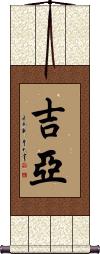
吉亞 is the transliteration to Mandarin Chinese for the name Gea in a neutral or unisex version.
Okay for a man or woman.
Love and Affection
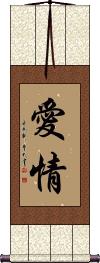
愛情 is a universal word in Japanese, Korean, and Chinese which means love and affection.
Some may translate this as “love between a man and a woman.”
Depending on the context, it can mean utter devotion or favorite.
Giant
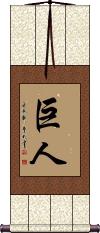
巨人 can mean giant or great person (great man or woman) in Chinese, Japanese Kanji, and old Korean Hanja.
巨人 is also the short name of the Tokyo Giants baseball team.
Sometimes the Japanese female name Mito.
Hua Mulan
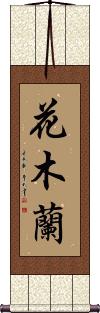
花木蘭 is the name of the famous Chinese woman warrior Hua Mulan.
She was made famous in the west by Disney's animated movie, “Mulan.”
Most of the historical information about her comes from an ancient poem. It starts with a concerned Mulan, as she is told a man from each family is to serve conscription in the army. Her father is too old, and her brother is too young. Mulan decides to take the place of her father. After twelve years of war, the army returns, and the best warriors are awarded great posts in the government and riches. Mulan turns down all offers and asks only for a good horse for the long trip home. When Mulan greets visiting comrades wearing her old clothes, they are shocked to find the warrior they rode into battle with for years is actually a woman.
I Love You / Aishiteru
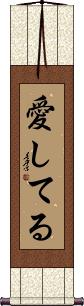
It's very uncommon (some will say taboo) to say “I love you” in Japanese culture. It's especially awkward for a man to tell a woman this in Japanese. Everyone is more likely to say “Watashi wa anata ga suki desu” or “I like you” (literally, “I regarding you, have like.”
If you have to say “I love you” in Japanese, 愛してる is a selection of Kanji and Hiragana that provide a way.
Note: Because this selection contains some special Japanese Hiragana characters, it should be written by a Japanese calligrapher.
Benevolence
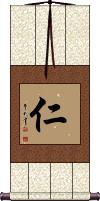
Beyond benevolence, 仁 can also be defined as “charity” or “mercy” depending on context.
The deeper meaning suggests that one should pay alms to the poor, care for those in trouble, and take care of his fellow man (or woman).
仁 is one of the five tenets of Confucius. In fact, it is a subject that Confucius spent a great deal of time explaining to his disciples.
I have also seen this benevolent-related word translated as perfect virtue, selflessness, love for humanity, humaneness, goodness, goodwill, or simply “love” in the non-romantic form.
This is also a virtue of the Samurai Warrior
See our page with just Code of the Samurai / Bushido here
Islam
(phonetic version)
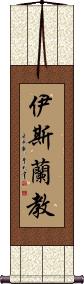
伊斯蘭教 both means and sounds like “Islam” in Mandarin Chinese.
The first three characters sound like the word “Islam,” and the last character means “religion” or “teaching.” It's the most general term for “Islam” in China. The highest concentration of Muslims in China is Xinjiang (the vast region in northwest China that was called The East Turkistan Republic until 1949 and is sometimes called Chinese Turkistan, Uyghuristan). Here you will find Uygurs, Kazakhs, Kyrgyz, and others that are descendants of Turkmen (possibly mixed with Persians and Arabs). Many of their ancestors were traders who traveled the silk road to buy and sell spices and silk and exchange other goods from the Orient and the Middle East.
I spent some time in Xinjiang and got to know this community. They are strong people who can endure much. They are friendly and love to have a good time. I was a stranger but was treated by villagers (near China's border with Afghanistan) as if I was a good friend.
However, I have heard that it's best not to cross them, as in this land, the law is the blade, and everything is “eye for an eye.” The Chinese government has little control in Xinjiang, with almost no police officers except in the capital of Urumqi (so it's a 60-hour roundtrip train ride to seek the aid of law enforcement in most cases).
While few seem devout, there are at least small mosques in every village. And you will never see a man or woman outside without a head covering.
It should be noted that these people are all citizens of China, but they are officially of the Caucasian race. A visit to Xinjiang will change your idea of what it means to be Chinese.
This in-stock artwork might be what you are looking for, and ships right away...
Gallery Price: $108.00
Your Price: $59.88
Gallery Price: $108.00
Your Price: $59.88

The following table may be helpful for those studying Chinese or Japanese...
| Title | Characters | Romaji (Romanized Japanese) | Various forms of Romanized Chinese | |
| Holy Man Saint | 聖人 圣人 | seijin | shèng rén sheng4 ren2 sheng ren shengren | sheng jen shengjen |
| Person of Character | 人格者 | jinkakusha | ||
| Beauty Beautiful Handsome | 美 | bi | měi / mei3 / mei | |
| Gea | 吉亞 吉亚 | jí yà / ji2 ya4 / ji ya / jiya | chi ya / chiya | |
| Love and Affection | 愛情 爱情 | aijou / aijo | ài qíng / ai4 qing2 / ai qing / aiqing | ai ch`ing / aiching / ai ching |
| Giant | 巨人 | kyojin | jù rén / ju4 ren2 / ju ren / juren | chü jen / chüjen |
| Hua Mulan | 花木蘭 花木兰 | huā mù lán hua1 mu4 lan2 hua mu lan huamulan | ||
| I Love You Aishiteru | 愛してる | ai shi te ru aishiteru | ||
| Benevolence | 仁 | jin | rén / ren2 / ren | jen |
| Islam | 伊斯蘭教 伊斯兰教 | yī sī lán jiào yi1 si1 lan2 jiao4 yi si lan jiao yisilanjiao | i ssu lan chiao issulanchiao |
|
| In some entries above you will see that characters have different versions above and below a line. In these cases, the characters above the line are Traditional Chinese, while the ones below are Simplified Chinese. | ||||

Successful Chinese Character and Japanese Kanji calligraphy searches within the last few hours...



