Many custom options...


And formats...



Not what you want?
Try other similar-meaning words, fewer words, or just one word.
Man Doing Qi Gong in Chinese / Japanese...
Buy a Man Doing Qi Gong calligraphy wall scroll here!
Personalize your custom “Man Doing Qi Gong” project by clicking the button next to your favorite “Man Doing Qi Gong” title below...
Switched to secondary search mode due to lack of results using primary.
These secondary results may not be very accurate. Try a different but similar meaning word or phrase for better results. Or...
Look up Man Doing Qi Gong in my Japanese Kanji & Chinese Character Dictionary(My dictionary is a different system then the calligraphy search you just tried)
If you want a special phrase, word, title, name, or proverb, feel free to contact me, and I will translate your custom calligraphy idea for you.
2. Flying Ace / Aviator / Bird Man
3. Adonis / Handsome Young Man
5. No man knows what he owes to his parents until he comes to have children of his own
6. Assassin
8. Beauty / Beautiful / Handsome
10. Benevolence
11. Bodhi - Awakening Enlightenment
12. The Tree of Enlightenment / The Bodhi Tree
13. Bodhidharma
14. Brave Warrior
15. Mark the boat to find the lost sword / Ignoring the changing circumstances of the world
16. Character
17. Do not shed a tear until you see the coffin
18. Confucius: Golden Rule / Ethic of Reciprocity
19. Collaboration / Cooperation / Synergy
21. Daoism / Taoism
22. Daodejing / Tao Te Ching - Chapter 81
23. Dignity / Honor / Sanctity / Integrity
24. Diligence
26. Enthusiasm
27. Eternal Love
28. Excellence
29. Fang
30. Fear No Man / Fear Nothing
31. Fighter
32. Fong
33. Fortitude / Strength of Character
34. Gea
35. Giant
36. Courage To Do What Is Right
39. Doing good is the greatest source of happiness
41. Guan Yu
42. Gung Ho
43. Hiding in the Leaves - Hagakure
45. Helpfulness
46. Hero
47. Man of Remarkable Character / Hero
48. Honor
49. Hua Mulan
51. Immortal
52. Intelligence / Information-Gathering
53. Ip Man
54. Iron Man
56. Islam
58. Jackie Chan
59. Three Treasures of Chinese Medicine
60. Jin Shin Jyutsu
61. Journey / Travel
62. Nobleman
63. Justice / Rectitude / Right Decision
64. Karate-Do
66. We are not born with knowledge, how does one achieve maturity?
67. Kung / Gong
69. Kung Fu San Soo / San Shou
70. Lao Tzu / Laozi
71. Lau Gar Kung Fu
72. Life Energy / Spiritual Energy
73. Listen to Both Sides and be Enlightened, Listen to One Side and be in the Dark
75. Luohan / Lohan
76. Man of Character
77. Men Die for Wealth, Birds Die for Food
78. If you have not been a monk, how can you know what it is like to be a vegetarian?
80. Where There is a Will, There is a Way
81. Nothing is Impossible with Persistence
82. Musashi
83. Neijia Fist
84. Neijing
85. No Fear
86. No Mind / Mushin
88. Old, But More Vigorous in Spirit
89. Oneness of Heaven and Humanity
90. Undaunted After Repeated Setbacks
92. Phuong
93. Power of Understanding and Wisdom
96. Protector
97. Push or Knock
99. Renni
Acceptance / Tolerate
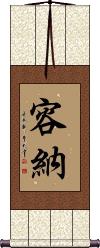
容納 speaks of being tolerant of other opinions or being accepting of other people's ideas or ways of doing things.
Other definitions of this word include having the capacity for, to accommodate, or to tolerate.
Flying Ace / Aviator / Bird Man
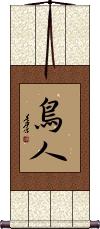
鳥人 means “bird man” or “bird person,” but it is used colloquially in Japanese to mean a flying ace or aviator.
Adonis / Handsome Young Man
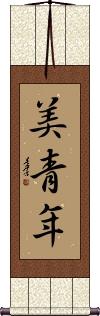
美青年 means handsome young man, or figuratively, Adonis, in Japanese.
Adventure Lover
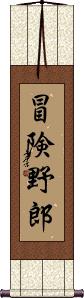
冒険野郎 is a Japanese title that means “adventure lover.”
This literally means something like “adventure wild man.”
This is a funny choice for a wall scroll, but it's a legitimate word in Japanese.
No man knows what he owes to his parents until he comes to have children of his own
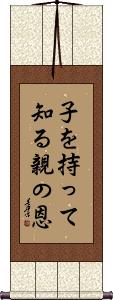
子を持って知る親の恩 literally translates as: Only after you have a baby, you would appreciate your parents (feel the way they do, etc).
This is a bit like the “walk a mile in another man's shoes” saying. Basically, it's about you cannot fully understand the plight of others until you experience it yourself. It also shows appreciation for the plight of parents.
This Japanese proverb can also be translated a few more ways:
No man knows what he owes to his parents till he comes to have children of his own.
One knows not what one owes to one's parents till one comes to have children of one's own.
Only after you have a baby, you will appreciate your parents or feel the way they do.
Only after becoming a parent yourself do you realize how much you owe [how indebted you are] to your own parents.
Note: Because this selection contains some special Japanese Hiragana characters, it should be written by a Japanese calligrapher.
Assassin
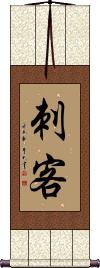
刺客 is the most sophisticated way to write “assassin” in Chinese, Korean and Japanese.
The unsophisticated way just means murderer.
Wisdom from Hard Knocks
The school of hard knocks
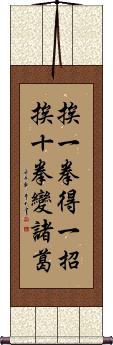
挨一拳得一招挨十拳變諸葛 is a Chinese proverb that literally translates as: Receive one blow, [and one] learns a lesson; Receive ten blows, [and one] becomes a great Zhuge [Liang].
You must first understand that a man named Zhuge Liang was one of the great strategists and philosophers in Chinese history. He's known as a man of great wisdom.
Figuratively, this phrase means:
One can learn much from failure or “hard knocks.”
Beauty / Beautiful / Handsome
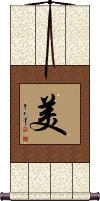
美 is often used to describe the beauty of a woman.
However, when applied to a man, it can mean handsome. It's also the first character in the word for “beauty salon” which you will see all over China and Japan.
This can be used as the given name for a girl (spell it or say it as “Mei” or “May”).
For a bit of trivia: The title for the “USA” in Chinese is “Mei Guo” which literally means “Beautiful Country.” This name was bestowed at a time before Chairman Mao came to power and decided that China didn't like the USA anymore (even though we fought together against the Japanese in WWII). But these days, Chinese people love Americans (but have a distaste for American politics and policy). But I digress...
美 is also how “Beautiful” is written in Japanese Kanji and Korean Hanja. 美 can also mean: very satisfactory; good; to be pleased with oneself; abbreviation for the USA; fine; handsome; admirable; madhura; sweet; and/or pleasant.
See Also: Beautiful Woman | Beautiful Girl
Belief / Trust
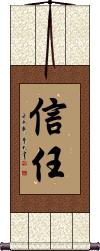
信任 means belief or trust in Chinese characters, old Korean Hanja, and Japanese Kanji.
It can also mean having confidence in or credence.
Benevolence
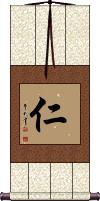
Beyond benevolence, 仁 can also be defined as “charity” or “mercy” depending on context.
The deeper meaning suggests that one should pay alms to the poor, care for those in trouble, and take care of his fellow man (or woman).
仁 is one of the five tenets of Confucius. In fact, it is a subject that Confucius spent a great deal of time explaining to his disciples.
I have also seen this benevolent-related word translated as perfect virtue, selflessness, love for humanity, humaneness, goodness, goodwill, or simply “love” in the non-romantic form.
This is also a virtue of the Samurai Warrior
See our page with just Code of the Samurai / Bushido here
Bodhi - Awakening Enlightenment
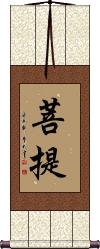
The Bodhi or 菩提 is the moment of completion in Buddhism.
It is when all things become known and you have completed your journey to enlightenment.
The reference is to the Bodhi tree where Siddhartha Gautama (the legendary man who established the Buddhist religion) achieved enlightenment. Sometimes this is referred to as “the tree of enlightenment,” but if you want the full version with the character for a tree at the end, please see the Bodhi Tree entry.
See Also: Buddhism | Buddha | Nirvana | Enlightenment
The Tree of Enlightenment / The Bodhi Tree
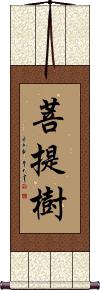
菩提樹 is the full title of the Bodhi tree (a fig tree) under which Siddhartha Gautama (the legendary man who established the Buddhist religion), achieved enlightenment.
Sometimes this is referred to as “the tree of enlightenment.” If you don't have a Bodhi tree to sit under, maybe you can achieve enlightenment under a wall scroll with this title.
Bodhidharma
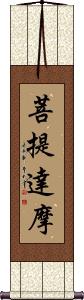
菩提達摩 is the Chinese Bodhidharma.
This refers to a man commonly known as Damo, reputed as the founder of Chan (Zen) Buddhism. His original name is believed to be Bodhitara (菩提多羅).
Note: Often, the last character is written as  versus
  .
.
Brave Warrior
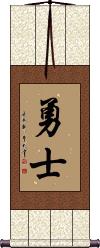
勇士 is the Chinese, Japanese Kanji, and old Korean Hanja for a brave warrior, a brave person, a hero, or a brave man.
In Japanese, this can be a given name, Yuuji.
Mark the boat to find the lost sword / Ignoring the changing circumstances of the world
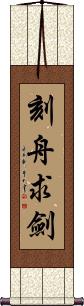
刻舟求劍 is an originally-Chinese proverb that serves as a warning to people that things are always in a state of change.
Thus, you must consider that and not depend on the old ways or a way that may have worked in the past but is no longer valid.
This idiom/proverb comes from the following story:
A man was traveling in a ferry boat across a river. With him, he carried a treasured sword. Along the way, the man became overwhelmed and intoxicated by the beautiful view and accidentally dropped his prized sword into the river. Thinking quickly, he pulled out a knife and marked on the rail of the boat where exactly he had lost his sword.
When the boat arrived on the other side of the river, the man jumped out of the boat and searched for his sword right under where he'd made the mark. Of course, the boat had moved a great distance since he made the mark, and thus, he could not find the sword.
While this man may seem foolhardy, we must take a great lesson from this parable: Circumstances change, so one should use methods to handle the change. In modern China, this is used in business to mean that one should not depend on old business models for a changing market.
This proverb dates back to the Spring and Autumn period (770–476 BC) of the territory now known as China. It has spread and is somewhat known in Japan and Korea.
Character
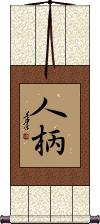
This Japanese word speaks of the quality of your personality, character, personal appearance, or gentility.
Do not shed a tear until you see the coffin
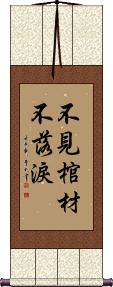
不見棺材不落淚 is a cautionary tale that suggests you are unknowingly (though it should be obvious)on a bad course.
It further suggests that you will not realize your folly until the worst has happened.
This can also be a warning of inaction until it's too late to take action. Again, not realizing your error until it's too late.
In an alternate interpretation, some will suggest this means doing something bad and not looking back - Then the worst happens.
It should be noted that this is one of the oddest selections for a wall scroll in our whole Asian calligraphy database. All of our translators are convinced that no Chinese person would ever hang this on their wall.
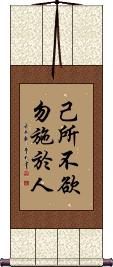
Confucius: Golden Rule / Ethic of Reciprocity
Do not do to others what you do not want done to yourself
Some may think of this as a “Christian trait,” but actually, it transcends many religions.
This Chinese teaching dates back to about 2,500 years ago in China. Confucius had always taught the belief in being benevolent (ren), but this idea was hard to grasp for some of his students, as benevolence could be kind-heartedness or an essence of humanity itself.
When answering Zhong Gong's question as to what "ren" actually meant, Confucius said:
己所不欲勿施于人 or "When you go out, you should behave as if you were in the presence of a distinguished guest; when people do favors for you, act as if a great sacrifice was made for you. Whatever you wouldn't like done to you, do not do that thing to others. Don't complain at work or home.”
Hearing this, Zhong Gong said humbly, “Although I am not clever, I will do what you say.”
From this encounter, the Chinese version of the “Golden Rule” or “Ethic of Reciprocity” came to be.
The characters you see above express, “Do not do to others whatever you do not want to be done to yourself.”
See Also: Confucius Teachings | Benevolence
Collaboration / Cooperation / Synergy
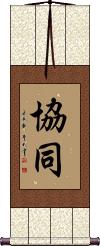
協同 is a Japanese, Chinese, and Korean word that means to cooperate, in coordination with, coordinated, collaborate, collaboration, collaborative, doing together (as equals).
Some will also use this as a short way to express the western idea of synergy (collaboration for a better result). There's a longer word, 協同作用, that adds “action” to this word and more directly means synergy.
Bravery / Courage
Courageous Energy
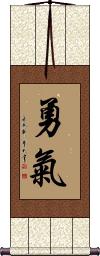
勇氣 is one of several ways to express bravery and courage in Chinese, Japanese, and Korean.
This version is the most spiritual. This is the essence of bravery from deep within your being. This is the mental state of being brave versus actual brave behavior. You'd more likely use this to say, “He is very courageous,” rather than “He fought courageously in the battle.”
The first character also means bravery or courage when it's seen alone. With the second character added, an element of energy or spirit is added. The second character is the same “chi” or “qi” energy that Kung Fu masters focus on when they strike. For this reason, you could say this means “spirit of courage” or “brave spirit.”
This is certainly a stronger word than just the first character alone.
Beyond bravery or courage, dictionaries also translate this word as valor/valour, nerve, audacity, daring, pluck, plucky, gallantry, guts, gutsy, and boldness.
This is also one of the 8 key concepts of tang soo do.
 While the version shown to the left is commonly used in Chinese and Korean Hanja (and ancient Japanese Kanji), please note that the second character is written with slightly fewer strokes in modern Japanese. If you want the modern Japanese version, please click on the character to the right. Both styles would be understood by native Chinese, Japanese, and many (but not all) Korean people. You should make your selection based on the intended audience for your calligraphy artwork. Or pick the single-character form of bravery/courage which is universal.
Daoism / Taoism
Literally: The Way or Road
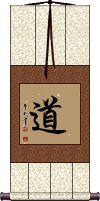
道 is the character “dao” which is sometimes written as “tao” but pronounced like “dow” in Mandarin.
道 is the base of what is known as “Taoism.” If you translate this literally, it can mean “the way” or “the path.”
Dao is believed to be that which flows through all things and keeps them in balance. It incorporates the ideas of yin and yang (e.g. there would be no love without hate, no light without dark, no male without female.)
The beginning of Taoism can be traced to a mystical man named
Lao Zi (604-531 BC), who followed, and added to the teachings of Confucius.
More about Taoism / Daoism here.
Note that this is pronounced “dou” and sometimes “michi” when written alone in Japanese but pronounced “do” in word compounds such as Karate-do and Bushido. It's also “do” in Korean.
Alternate translations and meanings: road, way, path; truth, principle province.
Important Japanese note: In Japanese, this will generally be read with the road, way, or path meaning. Taoism is not as popular or well-known in Japan so Daoist/Taoist philosophy is not the first thing a Japanese person will think of when they read this character.
See our Taoism Page
Daodejing / Tao Te Ching - Chapter 81
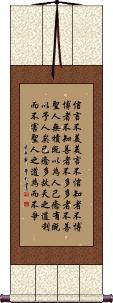
信言不美美言不信知者不博博者不知善者不多多者不善聖人無積既以為人己癒有既以予人矣已癒多故天之道利而不害聖人之道為而不爭 is the Mawangdui version of Daodejing chapter 81.
Credible words are not eloquent;
Eloquent words are not credible.
The wise are not erudite;
The erudite are not wise.
The adept are not all-around;
The all-around are not adept.
The sages do not accumulate things.
Yet the more they have done for others,
The more they have gained themselves;
The more they have given to others,
The more they have gotten themselves.
Thus, the way of tian (heaven) is to benefit without harming;
The way of sages is to do without contending.
Sincere words are not showy;
showy words are not sincere.
Those who know are not “widely learned";
those “widely learned” do not know.
The good do not have a lot;
Those with a lot are not good.
The Sage accumulates nothing.
Having used what he had for others,
he has even more.
Having given what he had to others,
what he has is even greater.
Therefore, the Way of Heaven is to benefit and not cause any harm,
The Way of Man is to act on behalf of others and not to compete with them.
True words aren't charming,
charming words aren't true.
Good people aren't contentious,
contentious people aren't good.
People who know aren't learned,
learned people don't know.
Wise souls don't hoard;
the more they do for others the more they have,
the more they give the richer they are.
The Way of heaven provides without destroying.
Doing without outdoing
is the Way of the wise.
Dignity / Honor / Sanctity / Integrity
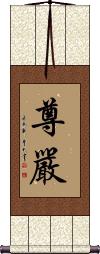
尊嚴 is a form of honor that means showing great respect for yourself, other people, and the rules you live by.
When you are honorable, you keep your word. You do the right thing regardless of what others are doing.
尊嚴 is the kind of personal honor or dignity that is of great value. If you lose this, you have lost yourself and perhaps the reputation of your family as well.
While this is not directly the same thing as “face” or “saving face” in Asian culture, it is associated with the same concept in China.
 In Japan, they currently use a more simplified second character for this word. The ancient Japanese form is the same as China but after WWII some Kanji were changed. If you want the modern Japanese version, just click on the Kanji image shown to the right, instead of the button above.
Diligence
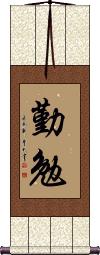
勤勉 can be translated as diligence, industrious, assiduity, assiduous, diligent, or sedulity.
Diligence is working hard and doing your absolute best. You take special care by doing things step by step. Diligence helps you to get things done with excellence and enthusiasm. Diligence leads to success.
See Also: Hard Work | Tenacity | Commitment | Passion for a Cause
Drunken Monkey Kung Fu
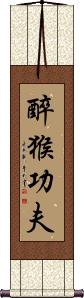
醉猴功夫 is the title for Drunken Monkey Kung Fu (Gong Fu).
The martial arts style was inspired by the novel, “Journey to the West.”
See Also: Monkey Fist
Enthusiasm
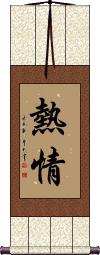
熱情 is a Chinese and Korean word for enthusiasm that can also be translated as passion (for a cause), ardency, ardor/ardour, enthusiasm, or zeal.
Enthusiasm is being warm, cheerful, happy, and full of spirit. It is doing something wholeheartedly and eagerly. When you are enthusiastic, you have a positive attitude.
In some contexts, this could mean being extremely fond of something or having a fondness for a cause or person.
This Chinese word can also be translated as "sincere and warm" or literally "warm sentiment / affection."
See Also: Motivation | Passion | Commitment | Tenacity
Eternal Love
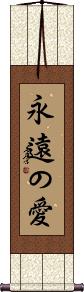
永遠の愛 is a great way to write “Eternal Love” in Japanese.
The first two characters mean eternal, eternity, perpetuity, forever, immortality, and permanence.
The third character is a possessive article which sort of makes this selection mean “Love, of the eternal kind.”
The last character is “love.”
Cultural note: Most of the time, it is taboo to use the word “love” in Japanese. For instance, a Japanese man will say, “I like you,” rather than, “I love you,” to his spouse/girlfriend. However, this entry for eternal love is acceptable because of the way it is composed.
This entry is only appropriate if your audience is Japanese. We also have a Chinese version of this eternal love.
Excellence
Fang
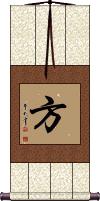
方 is the most common version of a Chinese surname that romanizes as Fong from Taiwan or Fang from mainland China.
The meaning of this character is square, upright, honest, fair and square, direction, place, or side. Sometimes 方 can refer to a method, prescription, or way of doing things.
In Japanese, this can be the given names Michi, Masani, Masashi,Tamotsu, Tadashi. It can also be Japanese surnames Hon, Hou, Ho, Fuon, Pan, Ban, Tokukata, or Kata.
Fear No Man / Fear Nothing
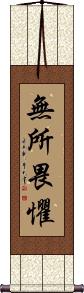
無所畏懼 means “fear nothing,” but it's the closest thing in Chinese to the phrase “fear no man” which many of you have requested.
This would also be the way to say “fear nobody” and can be translated simply as “undaunted.”
Fighter
Warrior / Soldier
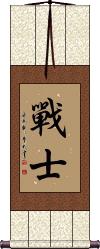
戰士 is how to write “fighter” in Chinese, ancient Japanese Kanji, and old Korean Hanja.
The first character means war, warfare, or battle.
The second character means soldier, officer, man, or pawn.
戰士 can also mean soldier or warrior. Usually this will be read as “fighter” or “one who fights.” 戰士 is an odd selection for a wall scroll unless you are a boxer, ultimate fighter, or otherwise participate in combat sports.
Other translations include combatant or champion.
 Note that after WWII, the first Kanji was reformed/simplified. This modern Japanese version is shown to the right. If you want this version, click on the Kanji to the right, instead of the button above.
Fong
方 is the most common version of a Chinese surname that romanizes as Fong from Taiwan or Fang from mainland China.
The meaning of this character is square, upright, honest, fair and square, direction, place, or side. Sometimes 方 can refer to a method, prescription, or way of doing things.
In Japanese, this can be the given names Michi, Masani, Masashi,Tamotsu, Tadashi. It can also be Japanese surnames Hon, Hou, Ho, Fuon, Pan, Ban, Tokukata, or Kata.
Fortitude / Strength of Character
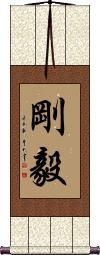
剛毅 is a Japanese and Chinese word that means resolute and firm, fortitude, firmness of character, hardihood, manliness, or macho.
See Also: Perseverance | Strength | Tenacity
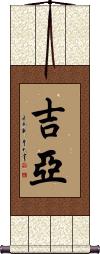
吉亞 is the transliteration to Mandarin Chinese for the name Gea in a neutral or unisex version.
Okay for a man or woman.
Giant
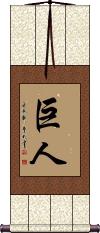
巨人 can mean giant or great person (great man or woman) in Chinese, Japanese Kanji, and old Korean Hanja.
巨人 is also the short name of the Tokyo Giants baseball team.
Sometimes the Japanese female name Mito.
Courage To Do What Is Right
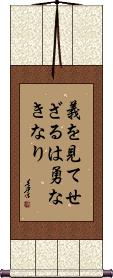
義を見てせざるは勇なきなり is a Japanese proverb that means “Knowing what is right and not doing is a want of courage.”
I've also seen it translated as:
To see what is right, yet fail to do so, is a lack of courage.
To know righteousness, but take no action is cowardice.
You are a coward if you knew what was the right thing to do, but you did not take action.
Knowing what is right without practicing it betrays one's cowardice.
Note: Because this selection contains some special Japanese Hiragana characters, it should be written by a Japanese calligrapher.
Kung / Gong / Mitsugi
Surname
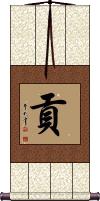
貢 is a Chinese surname that can romanize as Gong from Mandarin or Kung from Cantonese.
In Japan, this can be the surname or given name Mitsugi.
The meaning of this is tribute or gifts.
One Good Deed Each Day
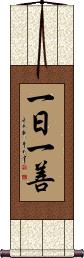
一日一善 is a Chinese, Japanese Kanji, and old Korean Hanja phrase that suggests doing a good deed each day or doing one good turn a day.
It literally reads, “One Day, One Good (Deed).”
Doing good is the greatest source of happiness
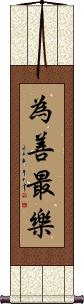
為善最樂 can be translated as “Doing good is the greatest source of happiness” or “doing good deeds brings the greatest joy.”
The origin is not known but is sometimes used in the context of Buddhism. However, this Chinese proverb or philosophy is a relatively mainstream idea of benevolence.
Guan Gong / Warrior Saint
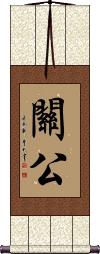
關公 is a Chinese title, Guan Gong, that means Lord Guan (The warrior saint of ancient China).
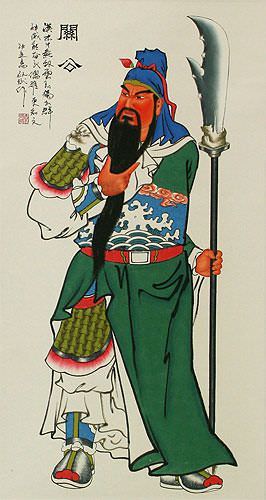 While his real name was Guan Yu / 關羽, he is commonly known by the title of Guan Gong (關公).
Some Chinese soldiers still pray to Guan Gong for protection. They would especially do this before going into battle. Statues of Guan Gong are seen throughout China.
Guan Yu
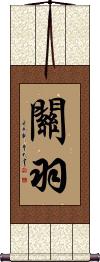
關羽 is the name Guan Yu, Army General for the Kingdom of Shu.
He is also known as Guan Gong (like saying Duke Guan or Sir Guan)
He was immortalized in the novel, “Romance of the Three Kingdoms.”
He was a fearsome fighter, also famous for his virtue and loyalty. He is worshiped by some modern-day soldiers and has the title “Warrior Saint” in China. Some believe he offers safety and protection for military servicemen.
Guan Yu lived until 219 A.D.
Gung Ho
Working Together
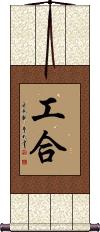
工合 is one of those Asian words that is used more in English than in the original Chinese.
Gung Ho was originally used to speak of Carlson's Raiders, a group of “Gung Ho” U.S. Marines who went on an island-hopping campaign of death during WWII.
A movie called Gung Ho came out in the mid-1940s and was later re-released in the 1950s depicting the 2nd Marine Raider Battalion, and brought this word to the mainstream.
It is still sometimes used today within the U.S. Marine Corps brotherhood to refer to a unit or group that works well together or is otherwise efficient and motivated (has good morals).
In 1986, there was a movie called Gung Ho about a Japanese company taking over an American automotive factory. They completely ignored the fact that this was a Chinese title.
It should be noted that this title actually means a condition, state, manner, or the health of something in Japanese.
Language and pronunciation notes:
Like many Asian words absorbed into common use in English, this one is drastically mispronounced. The official Romanization is “gong he” but that doesn't tell you enough. The vowel sound on the first character is like the English word “own,” now just add the g-sounds to the beginning and end. The second character is misleading, as you might think it is like the English word “he.” In reality, the vowel sound is more like the “u” in “up.”
It should also be noted that the current generation in China no longer uses or recognizes this as a common word or slogan.
Note: This can be pronounced and is a word in Japanese, though seldom used. Japanese will use a variation of "具合" instead. But still, not common.
Hiding in the Leaves - Hagakure
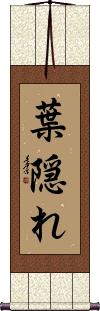
葉隠れ is the Japanese word hagakure, which means “hidden in the leaves.”
葉隠れ is also used as a semi-idiom to mean “doing good deeds without calling attention to oneself.”
Do No Harm / Harmless
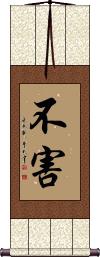
不害 is a Buddhist term that comes from the Sanskrit “ahiṃsā” meaning harmlessness, not injuring or doing harm to no one.
Helpfulness
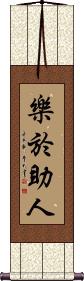
樂於助人 is about helpfulness, being of service to others, and doing thoughtful things that make a difference in their lives.
Offer your help without waiting to be asked. Ask for help when you need it. When we help each other, we get more done. We make our lives easier.
See Also: Caring | Charity | Benevolence
Hero
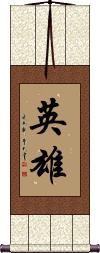
英雄 is the best way to write hero in Chinese and Japanese - especially for calligraphy.
英雄 is also the name of the Chinese movie titled Hero starring Jet Li.
The first character means brave (it can also mean British or English but not in this case).
The second character means heroic but also suggests a male person.
My Japanese dictionary also defines this as “a great man.”
Man of Remarkable Character / Hero
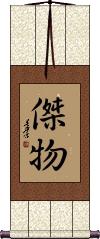
傑物 is a Japanese title that can mean “great man,” “heroic figure,” or “remarkable character.”
You would be giving someone a great honor by presenting this wall scroll to them as a gift.
Honor
(Modern Japanese version)
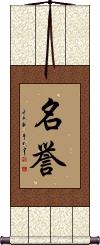
名譽 is a version of honor that is about having or earning the respect of others and about your reputation.
It is the status of being worthy of honor (not to be confused with doing honorable things or specific actions - see our other “honor” listing for that).
 Both modern Japanese and modern mainland Chinese use the same simplified version of the second character of honor. You can make a special request for the traditional second character as shown to the right (just click on that character to the right of you want to order that version). Before WWII, both Japan and China used the traditional form but modern Japanese and Chinese use this simplified form. Koreans still use the traditional form when they are not writing in their modern Hangul glyphs.
This is also a virtue of the Samurai Warrior
See our page with just Code of the Samurai / Bushido here
Hua Mulan
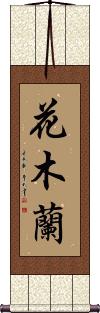
花木蘭 is the name of the famous Chinese woman warrior Hua Mulan.
She was made famous in the west by Disney's animated movie, “Mulan.”
Most of the historical information about her comes from an ancient poem. It starts with a concerned Mulan, as she is told a man from each family is to serve conscription in the army. Her father is too old, and her brother is too young. Mulan decides to take the place of her father. After twelve years of war, the army returns, and the best warriors are awarded great posts in the government and riches. Mulan turns down all offers and asks only for a good horse for the long trip home. When Mulan greets visiting comrades wearing her old clothes, they are shocked to find the warrior they rode into battle with for years is actually a woman.
I Love You / Aishiteru
It's very uncommon (some will say taboo) to say “I love you” in Japanese culture. It's especially awkward for a man to tell a woman this in Japanese. Everyone is more likely to say “Watashi wa anata ga suki desu” or “I like you” (literally, “I regarding you, have like.”
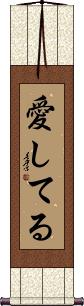
If you have to say “I love you” in Japanese, 愛してる is a selection of Kanji and Hiragana that provide a way.
Note: Because this selection contains some special Japanese Hiragana characters, it should be written by a Japanese calligrapher.
Immortal
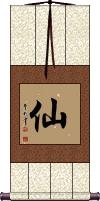
仙 means immortal (as in a being or person).
In some contexts, it can mean hermit, ascetic, man of the hills, or wizard. The Buddha is often put in this category.
In Chinese mythology and folklore, there is a famous group of eight immortals (八仙).
The 楞嚴經 (Śūraṅgama Sūtra) speaks of many kinds of immortals including walkers on the earth, fliers, wanderers at will (into space or into the deva heavens), beings with the ability to transform themselves into any form, etc.
Intelligence / Information-Gathering
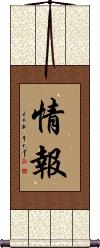
If you are a government spy, engaged in business espionage, or in some military intelligence department, 情報 is both the title of what you are doing and what you are collecting about your enemy.
It is suggestive by itself of military intelligence but applies to corporate intelligence if you are keeping an eye on your competition in business.
Ip Man
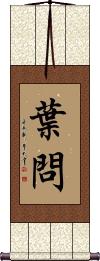
葉問 is the name of “Ip Man” or “Yip Man” (1893-1972).
He was a martial arts practitioner and master. He is perhaps most famous for being the master of Bruce Lee.
Iron Man
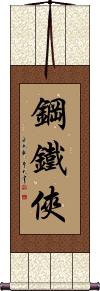
鋼鐵俠 is the Chinese title for Iron Man, the comic book superhero.
Ironman Triathlon Event
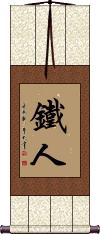
鐵人 is the Chinese name for the Ironman Triathlon Event.
The literal meaning of these characters is “iron person.”
This can also refer to a Japanese toy, Tetsujin (a big blue tin man).
Islam
(phonetic version)
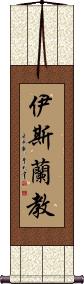
伊斯蘭教 both means and sounds like “Islam” in Mandarin Chinese.
The first three characters sound like the word “Islam,” and the last character means “religion” or “teaching.” It's the most general term for “Islam” in China. The highest concentration of Muslims in China is Xinjiang (the vast region in northwest China that was called The East Turkistan Republic until 1949 and is sometimes called Chinese Turkistan, Uyghuristan). Here you will find Uygurs, Kazakhs, Kyrgyz, and others that are descendants of Turkmen (possibly mixed with Persians and Arabs). Many of their ancestors were traders who traveled the silk road to buy and sell spices and silk and exchange other goods from the Orient and the Middle East.
I spent some time in Xinjiang and got to know this community. They are strong people who can endure much. They are friendly and love to have a good time. I was a stranger but was treated by villagers (near China's border with Afghanistan) as if I was a good friend.
However, I have heard that it's best not to cross them, as in this land, the law is the blade, and everything is “eye for an eye.” The Chinese government has little control in Xinjiang, with almost no police officers except in the capital of Urumqi (so it's a 60-hour roundtrip train ride to seek the aid of law enforcement in most cases).
While few seem devout, there are at least small mosques in every village. And you will never see a man or woman outside without a head covering.
It should be noted that these people are all citizens of China, but they are officially of the Caucasian race. A visit to Xinjiang will change your idea of what it means to be Chinese.
Isshin-Ryu / Isshin Style

一心流 is the title for Isshin-Ryu.
The literal meaning is “one heart method.” You could also translate it as “Unified Hearts Method,” “One-Mind School” or “One-Heart Style.”
It implies people doing things as if with one heart and mind.
As a style or lineage name, this phrase suggests a school founded on simplicity, unity of intent, and clarity of principle rather than excessive technical complexity.
The second Kanji can be defined as the heart, mind, or essence of your being. Clearly, there's a multitude of ways you can define this title in English.
See Also: Isshin-Kai
Jackie Chan
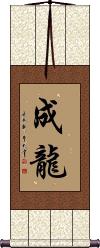
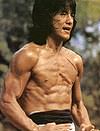 成龍 is the Chinese and Japanese stage name of Jackie Chan, a Kung Fu film and Cantonese pop star icon.
His birth name was 陳港生 (romanized as Chan Kong-sang or Can Gong-sang in Cantonese, or Chén Gǎng-shēng in Mandarin.
Three Treasures of Chinese Medicine
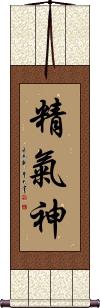
精, 氣, 神 are the characters jing, qi, and shen.
As a set, these three characters are known in English as the treasures of traditional Chinese medicine, the treasures of Qi Gong, or the three treasures of Taoism / Daoism.
Sometimes this set is titled 三寶 (sānbǎo) or “three treasures,” but here, we're writing each treasure out.
Here's how these characters are perceived in this context...
Jing: nutritive essence; refined; perfected; pure
Qi: vitality; energy; force; breath; vigor
Shen: spirit; soul; mind; being
To keep it simple, you can use “essence, vitality, and spirit” to define these.
Jin Shin Jyutsu
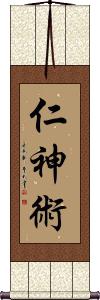
仁神術 is Jin Shin Jyutsu or Jin Shin Jutsu.
This is a practice of calming the mind and clearing the flow of Qi energy in the body. Jin Shin Jyutsu has some commonality with the practice of Reiki.
A good translation of 仁神術 would be “Benevolent Spirit Method.”
We can break that down into all of the possible meanings:
仁 = benevolence (esp. as a virtue of Confucianism), consideration, compassion, humanity, charity, kindness, or virtue.
神 = deity, soul, spirit, mysterious, psyche, god, divinity, spiritual powers, deva, divine, spiritual, or supernatural.
術 = way, method, means, art, trick, or plan. The correct romaji for this 術 Kanji should be “jutsu.” However, in martial arts, this is often written “jitsu” but in this case, “jyutsu” became common.
Journey / Travel
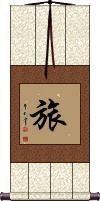
旅 is a single Chinese character, Japanese Kanji, and old Korean Hanja that means trip, travel, or journey.
In an older context, this could refer to an army brigade or a 500-man battalion from the Zhou-dynasty Chinese army.
Nobleman
Junzi / chun-tzu / gunja / kunshi
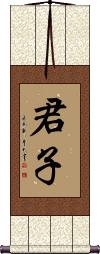
This means nobleman, person of noble character, man of virtue; wise man, or a true gentleman
君子 can be romanized as chün-tzu or jūnzǐ from Chinese and gunja from Korean. This has the same meaning in Japanese, but in another context, can be the female given name Kunshi.
Justice / Rectitude / Right Decision
Also means: honor loyalty morality righteousness
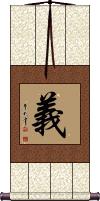
義 is about doing the right thing or making the right decision, not because it's easy but because it's ethically and morally correct.
No matter the outcome or result, one does not lose face if tempering proper justice.
義 can also be defined as righteousness, justice, morality, honor, or “right conduct.” In a more expanded definition, it can mean loyalty to friends, loyalty to the public good, or patriotism. This idea of loyalty and friendship comes from the fact that you will treat those you are loyal to with morality and justice.
義 is also one of the five tenets of Confucius's doctrine.
 There's also an alternate version of this character sometimes seen in Bushido or Korean Taekwondo tenets. It's just the addition of a radical on the left side of the character. If you want this version, click on the image to the right instead of the button above.
This is also a virtue of the Samurai Warrior
See our page with just Code of the Samurai / Bushido here
See Also: Judgment | Impartial | Confucius Tenets
Karate-Do
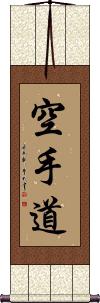
The literal meaning of 空手道 is “empty hand method” or “empty hand way.”
It is acknowledged that karate originated in China but migrated to Japan, where it was refined and became widely popular.
Karate is a martial art that uses no blades or weapons other than the “natural weapons” God gave to humans (fists and feet). The last character somehow became optional, but the meaning of that character is “method” or “the way” as in Taoism / Daoism.
Karate-Do reached Korea, where it is known as 공수도 which can be romanized as “Kong Soo Do” or “Gong Su Do.”
Kindness / Caring
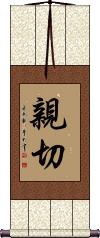
親切 is a Chinese/Japanese/Korean word that can also mean affectionate, cordial, warm, or close (emotionally).
Kindness shows you care and are doing some good to make life better for others. Be thoughtful about people's needs. Show love and compassion to someone who is sad or needs your help. When you are tempted to be cruel, to criticize or tease, decide to be kind instead.
See Also: Love | Caring | Benevolence
We are not born with knowledge, how does one achieve maturity?
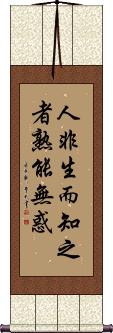
This figuratively means “Without a teacher, how can we learn/mature?”
人非生而知之者熟能無惑 is a philosophic pondering by Han Yu, a Tang Dynasty essayist, and philosopher (618-907 A.D.). This is a Chinese proverb that can be translated as “Knowledge is not innate to man, how can we overcome doubt?” or, “We are not born with knowledge, how does one achieve maturity?.”
This infers that we need the guidance of a teacher if we wish to learn, mature, and become better.
Kung / Gong
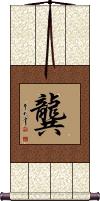
龔 is a Chinese surname that can be romanized as Gong or Kung.
From most of China, it would be Gong, but from Cantonese, it is often romanized as Kung.
In Korean, this could be a surname that romanizes as Gong or Kong and is now written as 공.
The original meaning of the character was something like, “to provide.”
Kung Fu / Gong Fu
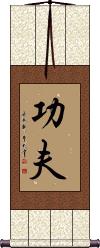
功夫 or Kung Fu is one of the most famous types of martial arts in the world - and not just because of Bruce Lee.
Some translate the meaning as “Accomplishment by Great Effort.” I think this is partially true, but directly translated, it literally means “Merit/Achievement/Accomplishment Man.” The word “fu” can sometimes mean “husband” or “porter,” but in this case, it can only mean “man.” However, few in China will think “man” when they hear the word “Gong Fu” spoken.
This term is also used for things other than martial arts. In fact, it's used to refer to a person with excellent skills in crafts that require a lot of effort to master, such as cooking, tea ceremonies, and calligraphy.
What a lot of people don't know is that the spelling of “Kung Fu” was actually taken from the old Wade Giles form of Romanization. Using this method, the sounds of the English “G” and “K” were both written as “K” and an apostrophe after the “K” told you it was supposed to sound like a “G.” Nobody in the west knew this rule, so most people pronounce it with a “K-sound.” And so, Gong Fu will always be Kung Fu for most westerners.
Also, just to educate you a little more, the “O” in “Gong” has a sound like the English word “oh.”
The popular Chinese dish “Kung Pao Chicken” suffers from the same problem. It should actually be “Gong Bao Chicken.”
Historical note: Many will claim that Kung Fu was invented by the monks of the Shaolin monastery. This fact is argued in both directions by scholars of Chinese history. Perhaps it is more accurate to say that the Shaolin Monks brought the original fame to Kung Fu many generations ago.
Japanese note: While most Japanese martial artists will recognize these characters, Katakana is more often used to approximate the pronunciation of "Kung Fu" with "カンフー." Some will argue as to whether this should be considered a Japanese word at all.
See Also: Bruce Lee
Kung Fu San Soo / San Shou
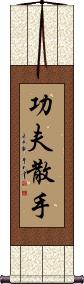
功夫散手 is a martial arts title.
Oddly, there are multiple ways two spell/romanize this in English, but in Chinese, it's written exactly the same.
Technically, the Mandarin romanizes as “gong fu san shou,” for which you'll sometimes see it written “kung fu san shou” (k'ung is an old romanization for a word that sounds like gong with a vowel sound like “oh”).
There is another martial arts style that spells this “Kung Fu San Soo.” I guess this was supposed to approximate Cantonese pronunciation for which the scholarly romanization is generally agreed to be “gung fu saan sau.”
Lao Tzu / Laozi
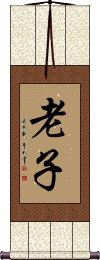
Depending on the romanization scheme you use, this man's name can be spelled Laozi, Lao Tzu, or Lao Tze. In older English usage, he was known as Laocius. He is believed to have lived around 500 B.C.
He was a Chinese philosopher, founder of Daoism/Taoism, credited with being the author of the sacred and wise book of Daoism/Taoism.
There is a theory that Lao Tzu's soul traveled to India and was reborn as the Buddha.
Lau Gar Kung Fu
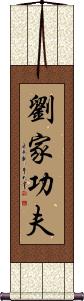
劉家功夫 are the characters for the Lau Gar Kung Fu style of martial arts.
The romanization of “Lau Gar” comes from Cantonese. “Kung Fu” is the common romanization for English from the Mandarin “Gōng Fu” or Cantonese “Gung Fu” pronunciations.
Lau gar = Lau family.
Life Energy / Spiritual Energy
Chi Energy: Essence of Life / Energy Flow
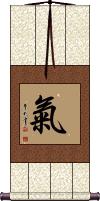
This 氣 energy flow is a fundamental concept of traditional Asian culture.
氣 is romanized as “Qi” or “Chi” in Chinese, “Gi” in Korean, and “Ki” in Japanese.
Chi is believed to be part of everything that exists, as in “life force” or “spiritual energy.” It is most often translated as “energy flow” or literally as “air” or “breath.” Some people will simply translate this as “spirit,” but you must consider the kind of spirit we're talking about. I think this is weighted more toward energy than spirit.
The character itself is a representation of steam (or breath) rising from rice. To clarify, the character for rice looks like this: 
Steam was apparently seen as visual evidence of the release of “life energy” when this concept was first developed. The Qi / Chi / Ki character is still used in compound words to mean steam or vapor.
The etymology of this character is a bit complicated. It's suggested that the first form of this character from bronze script (about 2500 years ago) looked like these samples: 

However, it was easy to confuse this with the character for the number three. So the rice radical was added by 221 B.C. (the exact time of this change is debated). This first version with the rice radical looks like this: 
The idea of Qi / Chi / Ki is really a philosophical concept. It's often used to refer to the “flow” of metaphysical energy that sustains living beings. Yet there is much debate that has continued for thousands of years as to whether Qi / Chi / Ki is pure energy or consists partially or fully of matter.
You can also see the character for Qi / Chi / Ki in common compound words such as Tai Chi / Tai Qi, Aikido, Reiki, and Qi Gong / Chi Kung.
In the modern Japanese Kanji, the rice radical has been changed into two strokes that form an X.
The original and traditional Chinese form is still understood in Japanese, but we can also offer that modern Kanji form in our custom calligraphy. If you want this Japanese Kanji, please click on the character to the right instead of the “Select and Customize” button above.
More language notes: This is pronounced like “chee” in Mandarin Chinese, and like “key” in Japanese.
This is also the same way to write this in Korean Hanja where it is Romanized as “gi” and pronounced like “gee” but with a real G-sound, not a J-sound.
Though Vietnamese no longer use Chinese characters in their daily language, this character is still widely known in Vietnam.
See Also: Energy | Life Force | Vitality | Life | Birth | Soul
Listen to Both Sides and be Enlightened, Listen to One Side and be in the Dark
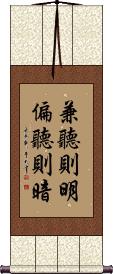
兼聽則明偏聽則暗 is an ancient Chinese proverb about getting all the information from all sides so that you truly understand a situation.
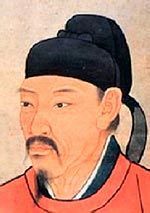
Wei Zheng
A man named Wei Zheng lived between 580-643 AD. He was a noble and wise historian and minister in the court of the early Tang Dynasty. The emperor once asked him, “What should an emperor do to understand the real-world situation, and what makes an emperor out-of-touch with reality?”
Wei Zheng replied, “Listen to both sides and you will be enlightened; listen to only one side and you will be left in the dark.”
Then Wei Zheng went on to cite examples of leaders in history that were victorious after heeding both sides of the story, and other leaders that met their doom because they believed one-sided stories which often came from flattering lips.
Please note that there is an unwritten rule when the same character appears twice in the same phrase, the calligrapher will alter the appearance so that no two characters are exactly alike in the same piece. This calligraphy has two repeating characters that will be written differently than they appear here.
Love and Affection
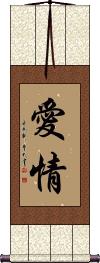
愛情 is a universal word in Japanese, Korean, and Chinese which means love and affection.
Some may translate this as “love between a man and a woman.”
Depending on the context, it can mean utter devotion or favorite.
Luohan / Lohan
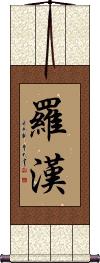
羅漢 is the title Lohan, achiever of Nirvana.
This can also be a place name and surname Rakan in Japanese.
In the Buddhist context, this can be arhan, arhat, saint, or perfect man of Hīnayāna. It can refer to the 16, 18, or 500 disciples appointed to witness Buddha's truth and save the world.
Man of Character
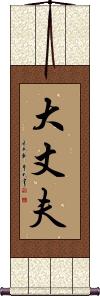
大丈夫 is a Chinese, Korean, and Japanese title that means a manly man, a man of character, a great man, or a fine figure of a man.
In Japanese, this can also be used to mean safe, all right, alright, OK, sure, or “no problem.” Used in Japanese for something that is undoubted or very acceptable.
Men Die for Wealth, Birds Die for Food
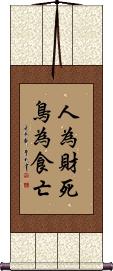
人為財死鳥為食亡 is a Chinese proverb that literally states that human beings will die for riches, just as birds will for food.
Figuratively it means that man will do anything in his means to become rich. Personally, I think dying for food is a more noble cause.
Often translated as “Men die in pursuit of wealth, birds die in pursuit of food. The 人 in this proverb just means human, so “men” is a placeholder for human with that translation - an English language problem that we have no easy gender-neutral nouns.
This proverb is meant to serve as a warning about the follies of greed.
If you have not been a monk, how can you know what it is like to be a vegetarian?
Only by experiencing hardship will allow you understand the plight of others
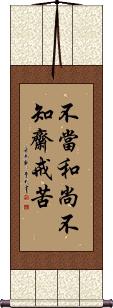
不當和尚不知齋戒苦 literally translates as:
[One who has] not been a monk [does not] know the suffering of [being on a] vegetarian diet.
This is a bit like the “walk a mile in another man's shoes” saying. Basically, it's about you cannot fully understand the plight of others until you experience it yourself.
Life is a Dew Drop
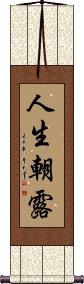
人生朝露 is a proverb that means “human life is like morning dew.”
Figuratively, this suggests the ephemeral and precarious nature of human existence.
Also translated as:
Man's life vanishes like a drop of dew.
A person's life is as fleeting as morning dew.
Life is as transient as morning due.
Where There is a Will, There is a Way
A determined effort can move a mountain
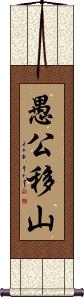
愚公移山 is the Chinese proverb (also somewhat known in Japan and Korea) for “the silly old man moves a mountain.”
Figuratively, this means “where there's a will, there's a way.”
Based on a fable of Lord Yu (愚公). He moved the soil of the mountain in front of his house. After years of effort, he finally moved the entire mountain (some versions of the story have God seeing how determined the man was, and sending two angels to whisk the mountains away).
The moral of the story: Anything can be accomplished if one works at it ceaselessly.
The Japanese version of this is 愚公山を移す (gu kou yama wo utsu su). But better to get the Chinese version, since this is originally a Chinese proverb.
See Also: Nothing is Impossible
Nothing is Impossible with Persistence
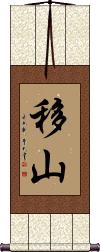
移山 is the Chinese, Japanese Kanji, and old Korean Hanja for “to remove mountains” or “to move a mountain.”
Figuratively, this means you can accomplish the impossible by sheer persistence.
移山 is the short form of a proverb about a man who had much persistence and could move a whole mountain (a bucket of soil at a time).
Musashi
The most famous Samurai
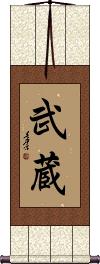
Miyamoto Musashi is probably the most famous Samurai in all of Japanese history.
武蔵 is the short title for a man long in legend. While coming from a lower class, his new sword and fighting techniques put him on par with the best that feudal Japan had to offer. His long career started with his first duel at age 13!
He is credited with using two swords at once and never losing a single battle in his career. After becoming a Buddhist, and getting older, like many old warriors, he took up a peaceful and solitary life until his death around 1645 A.D.
Note: Technically, Musashi is his given name, and Miyamoto is his surname. However, it's suggested that he assumed both of these names and had a few other names in childhood, as well as being given a Buddhist name. It's hard to know what to call him, as with most Kanji, there are multiple pronunciations. The characters for Musashi can also be pronounced Takezō. But everyone in modern times seems to know him by the name Musashi.
Neijia Fist
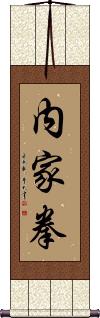
内家拳 is Neijia Fist or internal martial arts.
内家拳 is a Chinese martial arts style based on spiritual, mental, or qi-related aspects.
This style is somewhat known in martial arts circles in Japan as well.
Neijing
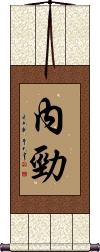
內勁 is Neijing or Nei Jing, the Kung Fu technique of using the conscious control of the practitioner's “qi” or “life energy” to gain advantages in combat.
No Fear
(2 characters)
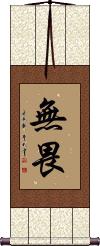
無畏 literally means “No Fear.” But perhaps not the most natural Chinese phrase (see our other “No Fear” phrase for a complete thought). However, this two-character version of “No Fear” seems to be a very popular way to translate this into Chinese when we checked Chinese Google.
Note: This also means “No Fear” in Japanese and Korean, but this character pair is not often used in Japan or Korea.
This term appears in various Chinese dictionaries with definitions like “without fear,” intrepidity, fearless, dauntless, and bold.
In the Buddhist context, this is a word derived from the word Abhaya, meaning: Fearless, dauntless, secure, nothing, and nobody to fear. Also, from vīra meaning: courageous, bold.
See Also: Never Give Up | No Worries | Undaunted | Bravery | Courage | Fear No Man
No Fear
(four-character version)
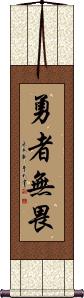
勇者無畏 is a complete sentence that means “Brave People Have No Fear” or “A Brave Person Has No Fear” (plural or singular is not implied).
We translated “No Fear” into the two variations that you will find on our website. Then we checked Chinese Google and found that others had translated “No Fear” in the exact same ways. Pick the one you like best. A great gift for your fearless friend.
See Also: Fear No Man
No Fear
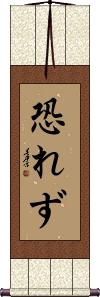
恐れず is probably the best way to express “No Fear” in Japanese.
The first Kanji and the following Hiragana character create a word that means: to fear, to be afraid of, frightened, or terrified.
The last Hiragana character serves to modify and negate the first word (put it in negative form). Basically, they carry a meaning like “without” or “keeping away.” 恐れず is almost like the English modifier “-less.”
Altogether, you get something like “Without Fear” or “Fearless.”
Here's an example of using this in a sentence: 彼女かのじょは思い切ったことを恐れずにやる。
Translation: She is not scared of taking big risks.
Note: Because this selection contains some special Japanese Hiragana characters, it should be written by a Japanese calligrapher.
No Mind / Mushin
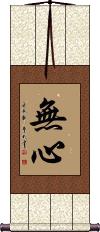
In Japanese, 無心 means innocent or without knowledge of good and evil. It literally means “without mind.”
無心 is one of the five spirits of the warrior (budo) and is often used as a Japanese martial arts tenet. Under that context, places such as the Budo Dojo define it this way: “No mind, a mind without ego. A mind like a mirror which reflects and dos not judge.” The original term was “mushin no shin,” meaning “mind of no mind.” It is a state of mind without fear, anger, or anxiety. Mushin is often described by the phrase “Mizu no Kokoro,” which means “mind like water.” The phrase is a metaphor describing the pond that clearly reflects its surroundings when calm but whose images are obscured once a pebble is dropped into its waters.
This has a good meaning in conjunction with Chan / Zen Buddhism in Japan. However, out of that context, it means mindlessness or absent-mindedness. To non-Buddhists in China, this is associated with doing something without thinking.
In Korean, this usually means indifference.
Use caution and know your audience before ordering this selection.
More info: Wikipedia: Mushin
The Old Way / Old School
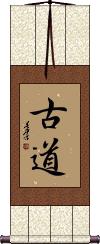
古道 is the Japanese word meaning “The Old Way.” The first character means old or ancient. The second character means “the way” and is the same character as used in Taoism / Daoism (Taoism literally means “the way”).
This second character can also be translated as “method,” as in a way of doing things.
古道 is sometimes Romanized as “Kodo,” though officially, the Romaji should be “Kodou.”
My Japanese-English dictionary further translates this word as the old road, ancient methods, ancient moral teachings, and the way of learning.
Note that this would be understood differently in Chinese. Most Chinese people would just read this as “The old road” without the other meanings derived in Japanese.
Old, But More Vigorous in Spirit
Age is just a number
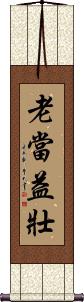
老當益壯 is a Chinese proverb that means “old but vigorous” or “hale and hearty despite the years.”
Said of someone who is more spirited when he/she grows older.
The story behind this Chinese proverb:
In the Eastern Han Dynasty, there was a man named Ma Yuan. He had been planning to herd animals on the frontier since he was young. When he grew up, Ma became a minor official of a county.
Once, he was sending some prisoners to another location. He felt pity for them, so he set them free, and then he fled to another county in the north. He herded animals there, and thus his dream came true. He always said: “If you want to be a great man, the poorer you are, the firmer in spirit you have to be; the older you are, the more spirited you should be.”
Later, when he was even older, Ma Yuan became a famous general of the Eastern Han Dynasty and contributed to many battles.
Oneness of Heaven and Humanity
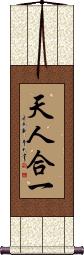
天人合一 is a title that represents the oneness of heaven and humanity. It conveys the idea that man is an integral part of nature.
You can also read this as “heaven and man in unity,” or “nature and man in unity.” The “man” is really “people” or “humans” and is not gender-specific in Chinese.
Undaunted After Repeated Setbacks
Persistence to overcome all challenges
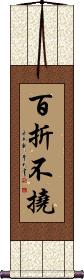
百折不撓 is a Chinese proverb that means “Be undaunted in the face of repeated setbacks.”
More directly translated, it reads, “[Overcome] a hundred setbacks, without flinching.” 百折不撓 is of Chinese origin but is commonly used in Japanese and somewhat in Korean (same characters, different pronunciation).
This proverb comes from a long, and occasionally tragic story of a man that lived sometime around 25-220 AD. His name was Qiao Xuan, and he never stooped to flattery but remained an upright person at all times. He fought to expose the corruption of higher-level government officials at great risk to himself.
Then when he was at a higher level in the Imperial Court, bandits were regularly capturing hostages and demanding ransoms. But when his own son was captured, he was so focused on his duty to the Emperor and the common good that he sent a platoon of soldiers to raid the bandits' hideout, and stop them once and for all even at the risk of his own son's life. While all of the bandits were arrested in the raid, they killed Qiao Xuan's son at first sight of the raiding soldiers.
Near the end of his career, a new Emperor came to power, and Qiao Xuan reported to him that one of his ministers was bullying the people and extorting money from them. The new Emperor refused to listen to Qiao Xuan and even promoted the corrupt Minister. Qiao Xuan was so disgusted that in protest, he resigned from his post as minister (something almost never done) and left for his home village.
His tombstone reads “Bai Zhe Bu Nao” which is now a proverb used in Chinese culture to describe a person of strong will who puts up stubborn resistance against great odds.
My Chinese-English dictionary defines these 4 characters as “keep on fighting despite all setbacks,” “be undaunted by repeated setbacks,” and “be indomitable.”
Our translator says it can mean “never give up” in modern Chinese.
Although the first two characters are translated correctly as “repeated setbacks,” the literal meaning is “100 setbacks” or “a rope that breaks 100 times.” The last two characters can mean “do not yield” or “do not give up.”
Most Chinese, Japanese, and Korean people will not take this absolutely literal meaning but will instead understand it as the title suggests above. If you want a single big word definition, it would be indefatigability, indomitableness, persistence, or unyielding.
See Also: Tenacity | Fortitude | Strength | Perseverance | Persistence
Person of Character
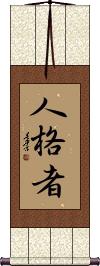
人格者 is a Japanese and Korean title that means “person of character.”
人格者 is unisex, so it can also be used to mean “man of character,” or “woman of character.”
Phuong
方 is the original Chinese character for the Vietnamese surname Phuong or Phương.
方 means square, upright, or side. In Vietnamese specifically, it can mean "direction" or "phoenix" (rebirth).
In Cambodian there is an unrelated surname, ភួង, meaning "garland necklace (of flowers)" which also romanizes as Phuong. This is probably not the character you want if your name is Cambodian (unless your ancestry is Chinese or you know what you are doing).
Power of Understanding and Wisdom
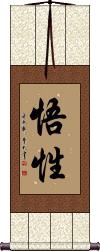
悟性 means the power of understanding and insight in Chinese.
It is often associated with Neo-Confucianism. In that regard, it means to realize, perceive, or have the perception of man's true nature. It can also mean finding your soul, the soul of others, or the soul of the world. Some will translate this simply as the state of being “savvy.”
In Japanese, this is often translated as wisdom and understanding.
Profound / Powerful Words
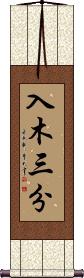
入木三分 is a four-character Chinese proverb that translates in English to a strong form of “profound” or “written with a forceful hand.”
But there is much more to the story...
The deep meaning behind this proverb comes from a man named Wan Xizhi, who lived in the third century.
He was a great writer and calligrapher whose writing style influenced generations of other writers and calligraphers.
He once wrote words on a piece of wood to be taken to an engraver.
When the engraver began to carve the characters into the wood, he found that Wang Xizhi's writing had penetrated the wood about 3/8 of an inch.
Thus people believed that his words were so powerful and profound that they caused the ink from his brush to penetrate the wood deeply.
The proverb literally means “penetrated wood three fen” (A fen is an ancient Chinese measurement of a little over 1/8 of an inch or almost 4mm).
Prosperous Business
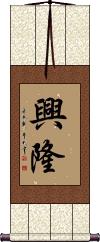
興隆 is a kind of prosperity that applies to a business. Something great to hang behind your desk if you are a small or large business owner. Doing so says that you either are a booming business or you wish success and prosperity for your business.
Can also be translated as thriving, flourishing, brisk business, and other words related to prosperity in business.
A good meaning in China but is a little antiquated in Japanese.
See Also: Prosperity
Protector
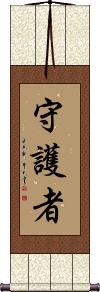
守護者 is a Chinese, Japanese Kanji, and old Korean Hanja title for a protector, watcher, or keeper.
The character breakdown:
守護 = to guard; to protect; protection; safeguard.
者 = person; someone of that nature; someone doing that work, the one [who, which].
From this breakdown, you can translate this as “The one who protects,” “Someone who safeguards,” or “guardian.”
Push or Knock
To weigh one's words
During the Tang Dynasty, a man named Jia Dao (born in the year 779), a well-studied scholar and poet, went to the capital to take the imperial examination.
One day as he rides a donkey through the city streets, a poem begins to form in his mind. A portion of the poem comes into his head like this:
“The bird sits on the tree branch near a pond,
A monk approaches and knocks at the gate...”
At the same time, he wondered if the word “push” would be better than “knock” in his poem.
As he rides down the street, he imagines the monk pushing or knocking. Soon he finds himself making motions of pushing and shaking a fist in a knocking motion as he debates which word to use. He is quite a sight as he makes his way down the street on his donkey with hands and fists flying about as the internal debate continues.
As he amuses people along the street, he becomes completely lost in his thoughts and does not see the mayor's procession coming in the opposite direction. Jia Bao is blocking the way for the procession to continue down the road, and the mayor's guards immediately decide to remove Jia Bao by force. Jia Bao, not realizing that he was in the way, apologizes, explains his poetic dilemma and awaits his punishment for blocking the mayor's way.
The mayor, Han Yu, a scholar and author of prose himself, finds himself intrigued by Jia Dao's poem and problem. Han Yu gets off his horse and addresses Jia Bao, stating, “I think knock is better.” The relieved Jia Bao raises his head and is invited by the mayor to join the procession, and are seen riding off together down the street, exchanging their ideas and love of poetry.
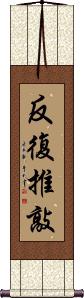
In modern Chinese, this 反復推敲 idiom is used when someone is trying to decide which word to use in their writing or when struggling to decide between two things when neither seems to have a downside.
Qi Gong / Chi Kung
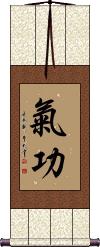
氣功 or Qigong is the title of a technique that is somewhere between medical practice, meditation, and in some cases, religion.
The definition is blurred depending on which school of Qigong you are following. In some cases, it is even incorporated with martial arts.
Some people (even Chinese people) mix this title with Tai Chi (Tai Qi) exercises.
Lately, in China, people will claim to practice Tai Chi rather than Qigong because the Qigong title was recently used as a cover for an illegal pseudo-religious movement in China with the initials F.G. or F.D. (I can not write those names here for fear of our website being banned in China).
You can learn those names and more here: Further info about Qigong
If you are wondering why I wrote “Qi Gong” and “Chi Kung” as the title of this calligraphy entry, I should teach you a little about the various ways in which Chinese can be Romanized. One form writes this as “Chi Kung” or “Chikung” (Taiwan). In the mainland and elsewhere, it is Romanized as “Qi Gong” or “Qigong.” The pronunciation is the same in Taiwan, mainland, and Singapore Mandarin. Neither Romanization is exactly like English. If you want to know how to say this with English rules, it would be something like “Chee Gong” (but the “gong” has a vowel sound like the “O” in “go”).
Romanization is a really confusing topic and has caused many Chinese words to be mispronounced in the west. One example is “Kung Pao Chicken,” which should actually be more like “Gong Bao” with the “O” sounding like “oh” for both characters. Neither the Romanization system in Taiwan nor the Mainland is perfect, in my opinion, and leads to many misunderstandings.
In modern Japan, you may see this written as 気功, but the original 氣功 is still recognized. If you need the Japanese version, please contact me.
Renni
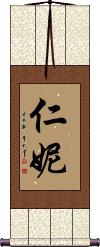
This is a name Renni in Mandarin Chinese. The name literally means “benevolent girl” in Chinese.
I kind of made up this name when my second daughter was born. The idea came for a feeling I got after performing a benevolent act for a poor family in Southern China. I want my daughter to follow that mode, and experience the same feeling one can only experience by doing benevolent acts.
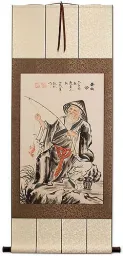
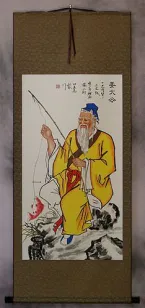
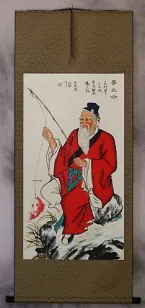
This in-stock artwork might be what you are looking for, and ships right away...
Gallery Price: $200.00
Your Price: $79.88

Gallery Price: $61.00
Your Price: $33.88

Successful Chinese Character and Japanese Kanji calligraphy searches within the last few hours...



