Many custom options...


And formats...



Not what you want?
Try other similar-meaning words, fewer words, or just one word.
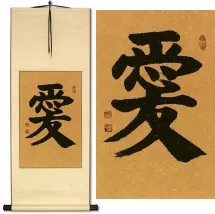
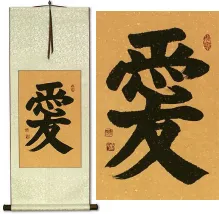
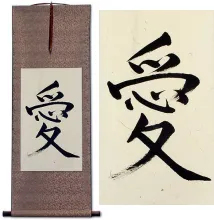
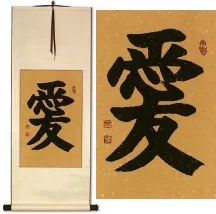
Love Lasts Forever in Chinese / Japanese...
Buy a Love Lasts Forever calligraphy wall scroll here!
Personalize your custom “Love Lasts Forever” project by clicking the button next to your favorite “Love Lasts Forever” title below...
Switched to secondary search mode due to lack of results using primary.
These secondary results may not be very accurate. Try a different but similar meaning word or phrase for better results. Or...
Look up Love Lasts Forever in my Japanese Kanji & Chinese Character Dictionary(My dictionary is a different system then the calligraphy search you just tried)
If you want a special phrase, word, title, name, or proverb, feel free to contact me, and I will translate your custom calligraphy idea for you.
2. Adoring Love
3. Aijou-Ryu
6. Passionate Love / Ardent Love and Devotion
8. Art of War: 5 Points of Analysis
9. Aysia
10. Beauty / Beautiful / Handsome
11. You are always a beauty in your lover’s eyes
12. Benevolence
14. Benevolent Heart
15. Best
16. Best Love / Most Sincere Love
18. Book
20. Broken Hearted
22. Brotherly and Sisterly Love
23. Butterfly
24. Caring
25. Cherish
29. Learning leads to Knowledge, Study leads to Benevolence, Shame leads to Courage
30. Corinthians 13:4
31. Crazy Love
32. Daisy
33. Dance / Dancing
34. Daoism / Taoism
35. Daodejing / Tao Te Ching - Excerpt
36. Predestined Love / Love by Fate
37. Brought Together from 1000 Miles Away by Fate
38. Divine Love
39. Family Love / Domestic Bliss
40. Drain the pond to get all the fish
41. Earth
42. Erin
43. Eternal Beauty
44. Eternal Friendship / Friends Forever
46. Eternal Love
48. Eternal Life / Everlasting Life / Immortality
52. Eternity / Always and Forever
53. Faith Hope Love
54. Faith Love Peace
55. Family Love
56. The Mysterious Bond Between People
57. A Father’s Love
58. Fear God
59. The one who retreats 50 paces mocks the one to retreats 100
60. First Love
62. Forbidden Love
66. Forever Love
67. Forever Young
68. Forever Young / Eternal Youth
70. Forever Family
71. Forever Sisters
72. Eternal Friendship / Friends Forever
74. Generosity
76. God is Love
77. Venus / Amor / God of Love
79. Greatest Love
82. Happy Birthday
83. Happy Family
86. Hebrews 13:8
87. Home is where the heart is
1 Corinthians 13:4-8
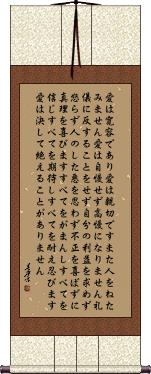
Here is 1st Corinthians 13:4-8 (just the first sentence of verse 8) in Japanese.
In the familiar NIV, this would read:
Love is patient, love is kind. It does not envy, it does not boast, it is not proud.
It does not dishonor others, it is not self-seeking, it is not easily angered, it keeps no record of wrongs.
Love does not delight in evil but rejoices with the truth.
It always protects, always trusts, always hopes, always perseveres.
Love never fails...
The Japanese text is from the 新改訳聖書 (Shinkaiyaku) or New Japanese Bible. Popular among most Protestant denominations in modern Japan.
Note: Because this selection contains some special Japanese Hiragana characters, it should be written by a Japanese calligrapher.
Adoring Love
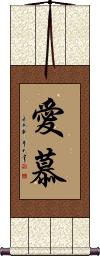
愛慕 means “adoring love” in Chinese, Japanese, and Korean.
I suppose this is the best kind of love to have. 愛慕 has the common character for love. But the second character modifies and reinforces the meaning to become adore, adoring love, or to love and adore.
Ancient Chinese warning:
Adoring someone is fine until you are in the shoes of the Prince of the Kingdom of Wu. This Prince adored a certain beautiful woman (Xi Shi) so much that he neglected his duties and soon let the kingdom fall into ruins.
Aijou-Ryu
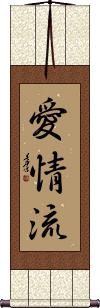
This is the title Aijō-Ryū, Aijou-Ryu or Aijou-Ryuu meaning “style of love and affection” or “flow of love” in Japanese.
Goddess of Love: Aphrodite
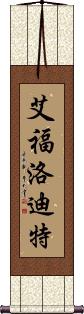
艾福洛迪特 is one of a couple of ways the name Aphrodite, Goddess of Love is written in Chinese characters.
Goddess Aphrodite
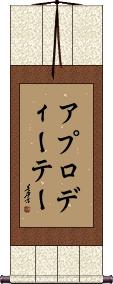
アプロディーテー is the Japanese title for Aphrodite (Greek goddess of love).
Note: Because this title is entirely Japanese Katakana, it should be written by a Japanese calligrapher.
Passionate Love / Ardent Love and Devotion
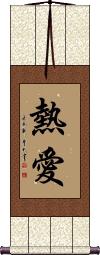
熱愛 means love passionately, ardent love, devotion, adoration.
The literal meaning is “hot love,” as the first character means heat, fervent, hot, and warm. Sometimes it can mean fever, restlessness, or zeal. The second character is, of course, love. If you adore and are devoted to someone with all your love, this is the title for you.
The Art of Love
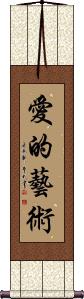
愛的藝術 means “art of love” or “art of loving” in Chinese.
This is also the Chinese title of the book “Art of Loving” by Erich Fromm.
Art of War: 5 Points of Analysis
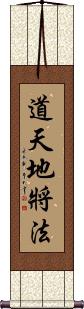
道天地將法 is a list of five key points to analyzing your situation from the first chapter of Sun Tzu's Art of War.
This reads like a 5-part military proverb. Sun Tzu says that to sharpen your skills, you must plan. To plan well, you must know your situation. Therefore, you must consider and discuss the following:
1. Philosophy and Politics: Make sure your way or your policy is agreeable among all of your troops (and the citizens of your kingdom as well). For when your soldiers believe in you and your way, they will follow you to their deaths without hesitation and will not question your orders.
2. Heaven/Sky: Consider climate / weather. This can also mean considering whether God is smiling upon you. In the modern military, this could be waiting for clear skies so that you can have air support for an amphibious landing.
3. Ground/Earth: Consider the terrain in which the battle will take place. This includes analyzing defensible positions, and exit routes, while using varying elevations to your advantage. When you plan an ambush, you must know your terrain and the best location from which to stage that ambush. This knowledge will also help you avoid being ambushed, as you will know where the likely places in which to expect an ambush from your enemy.
4. Leadership: This applies to you as the general and your lieutenants. A leader should be smart and be able to develop good strategies. Leaders should keep their word, and if they break a promise, they should punish themselves as harshly as they would punish subordinates. Leaders should be benevolent to their troops, with almost a fatherly love for them. Leaders must have the ability to make brave and fast decisions. Leaders must have steadfast principles.
5. [Military] Methods: This can also mean laws, rules, principles, models, or systems. You must have an efficient organization in place to manage both your troops and supplies. In the modern military, this would be a combination of how your unit is organized and your SOP (Standard Operating Procedure).
Notes: This is a simplistic translation and explanation. Much more is suggested in the actual text of the Art of War (Bing Fa). It would take a lot of study to master all of these aspects. In fact, these five characters can be compared to the modern military acronyms such as BAMCIS or SMEAC.
CJK notes: I have included the Japanese and Korean pronunciations but in Chinese, Korean and Japanese, this does not make a typical phrase (with subject, verb, and object) it is a list that only someone familiar with Sun Tzu’s writings would understand.
Aysia
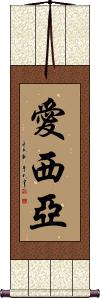
愛西亞 is the transliteration to Mandarin Chinese for the name Aysia.
The meaning is “Love West Asia,” although it will be read as a name, rather than this meaning by most.
Beauty / Beautiful / Handsome
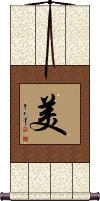
美 is often used to describe the beauty of a woman.
However, when applied to a man, it can mean handsome. It's also the first character in the word for “beauty salon” which you will see all over China and Japan.
This can be used as the given name for a girl (spell it or say it as “Mei” or “May”).
For a bit of trivia: The title for the “USA” in Chinese is “Mei Guo” which literally means “Beautiful Country.” This name was bestowed at a time before Chairman Mao came to power and decided that China didn't like the USA anymore (even though we fought together against the Japanese in WWII). But these days, Chinese people love Americans (but have a distaste for American politics and policy). But I digress...
美 is also how “Beautiful” is written in Japanese Kanji and Korean Hanja. 美 can also mean: very satisfactory; good; to be pleased with oneself; abbreviation for the USA; fine; handsome; admirable; madhura; sweet; and/or pleasant.
See Also: Beautiful Woman | Beautiful Girl
You are always a beauty in your lover’s eyes
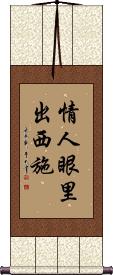
Any woman with affection for Asian art will love a gift of this Chinese proverb calligraphy on a wall scroll.
She will melt in your arms as you tell her the meaning of these characters.
Contained in this phrase is a reference to the most beautiful woman in Chinese history. Her name was Xi Shi, and she was known to have good looks that need not have fine robes or makeup. Her charms were so powerful that she brought down an entire kingdom (in a successful effort to bring honor and pride back to her people).
情人眼里出西施 is a great way to express that the woman in your life is your one love.
Benevolence
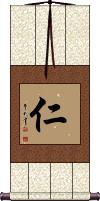
Beyond benevolence, 仁 can also be defined as “charity” or “mercy” depending on context.
The deeper meaning suggests that one should pay alms to the poor, care for those in trouble, and take care of his fellow man (or woman).
仁 is one of the five tenets of Confucius. In fact, it is a subject that Confucius spent a great deal of time explaining to his disciples.
I have also seen this benevolent-related word translated as perfect virtue, selflessness, love for humanity, humaneness, goodness, goodwill, or simply “love” in the non-romantic form.
This is also a virtue of the Samurai Warrior
See our page with just Code of the Samurai / Bushido here
Kindness / Benevolence
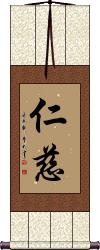
仁慈 word is used in Chinese, Korean, Japanese, and Asian Buddhism to relay the important idea of loving kindness.
仁慈 can also be defined as: benevolent; charitable; kind; merciful; kind-hearted; benevolence; kindness; humanity; mercy.
In Japanese, this can also be the given name Hitoji. This would also be a good Mandarin Chinese given name romanized as Jentzu (in Taiwan) or Renci (which sounds like ren-tsuh).
Benevolent Heart
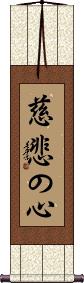
慈悲の心 means benevolent heart, compassionate heart, or merciful heart in Japanese.
This is a Japanese-only phrase and should be ordered from our Japanese master calligrapher. This is because the third character is unique Hiragana.
Chances are you are into Inuyasha and are seeking the title of chapter 471 which is often translated as “Merciful Heart.”
Best
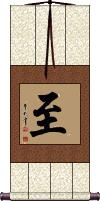
至 is a little strange as calligraphy, but 至 would be the character that means “best” or “extreme” in Chinese and Korean.
The problem is, this is seldom used alone. It's mostly used in combination with other characters to make words like “best friend,” “best food,” and “best love.”
I do not recommend this character for a wall scroll. It's better if you find a more specific term that fits your circumstances.
Note: This can be pronounced in Japanese and has a similar meaning but it is rarely if ever used in modern Japanese.
Best Love / Most Sincere Love
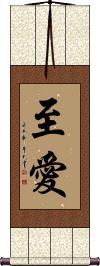
至愛 can mean the best love or most sincere love of your life.
This could be a romantic love such as your love for your spouse or a boyfriend/girlfriend.
It can also apply to the extreme love you have for your children or a parent and maybe a really good friend.
See Also: I Love You
Best Love / Most Sincere Love
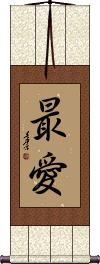
最愛 is a Japanese word that means the best love, beloved, or most sincere love of your life.
This could be a romantic love such as your love for your spouse or a boyfriend/girlfriend.
It can also apply to the extreme love you have for your children or a parent and maybe a really good friend.
Body and Earth in Unity
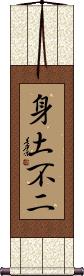
身土不二 (Shindofuni) is originally a Buddhist concept or proverb referring to the inseparability of body-mind and geographical circumstances.
This reads, “Body [and] earth [are] not two.”
Other translations or matching ideas include:
Body and land are one.
Body and earth can not be separated.
Body earth sensory curation.
You are what you eat.
Indivisibility of the body and the land (because the body is made from food and food is made from the land).
Going further, this speaks of our human bodies and the land from which we get our food being closely connected. This phrase is often used when talking about natural and organic vegetables coming directly from the farm to provide the healthiest foods in Japan.
Character notes: 身(shin) in this context does not just mean your physical body but a concept including both body and mind.
土 (do) refers to the soil, earth, clay, land, or in some cases, locality. It's not the proper name of Earth, the planet. However, it can refer to the land or realm we live in.
Japanese note: This has been used in Japan, on and off, since 1907 as a slogan for a governmental healthy eating campaign (usually pronounced as shindofuji instead of the original shindofuni in this context). It may have been hijacked from Buddhism for this propaganda purpose, but at least this is “healthy propaganda.”
Korean note: The phrase 身土不二 was in use by 1610 A.D. in Korea, where it can be found in an early medical journal.
In modern South Korea, it's written in Hangul as 신토불이. Korea used Chinese characters (same source as Japanese Kanji) as their only written standard form of the language until about a hundred years ago. Therefore, many Koreans will recognize this as a native phrase and concept.
See Also: Strength and Love in Unity
Book
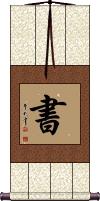
書 is the most simple way to say “book” in Chinese, Japanese, and Korean.
書 is usually read as “book” but can refer to a letter, or document.
In a certain context, it can refer to writing, penmanship, or handwriting. Especially in Chinese, it can be a short way to say calligraphy.
If you love books or want to write books, this is the simple, all-encompassing character for you.
Love Binds Us Together
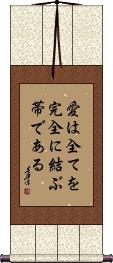
愛は全てを完全に結ぶ帯である is a Japanese phrase that suggests we (or a couple) are bound together by love.
I searched the web and found all of these English translation variations for this phrase:
Have love; The only way in which you may be completely joined together.
Love is the sash that perfectly binds us together.
Love is what binds us together
Love binds all things together in perfect unity.
This same Japanese phrase is used as part of Colossians 3:14 in at least one version of the Japanese Bible.
A few Biblical versions include:
...Charity, which is the bond of perfectness. (KJV)
...Love, which binds them all together in perfect unity. (NIV)
Note: Because this selection contains some special Japanese Hiragana characters, it should be written by a Japanese calligrapher.
Broken Hearted
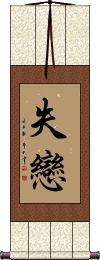
In Chinese, this can mean losing one's love; to breaking up (in a romantic relationship); to feel jilted.
In Japanese Kanji, this means disappointing love, broken heart, unrequited love, or being lovelorn.
失戀 is also valid in old Korean Hanja, which means unrequited love, unreturned love, a disappointment in love, or a broken heart.
Note: In modern Japan, they will tend to write the more simple 失恋 form instead of 失戀. If you order this from the Japanese master calligrapher, expect the more simple modern version to be written (unless you give us instructions to use the older or more traditional version).
Broken Mirror Rejoined
Used in modern times for divorced couples that come back together
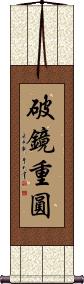
破鏡重圓 is about a husband and wife who were separated and reunited.
About 1500 years ago in China, there lived a beautiful princess named Le Chang. She and her husband Xu De Yan loved each other very much. But when the army of the Sui Dynasty was about to attack their kingdom, disposed of all of their worldly possessions and prepared to flee into exile.
They knew that in the chaos, they might lose track of each other, so the one possession they kept was a bronze mirror which is a symbol of unity for a husband and wife. They broke the mirror into two pieces, and each of them kept half of the mirror. They decided that if separated, they would try to meet at the fair during the 15th day of the first lunar month (which is the lantern festival). Unfortunately, the occupation was brutal, and the princess was forced to become the mistress of the new commissioner of the territory, Yang Su.
At the Lantern Festival the next year, the husband came to the fair to search for his wife. He carried with him his half of the mirror. As he walked through the fair, he saw the other half of the mirror for sale at a junk market by a servant of the commissioner. The husband recognized his wife's half of the mirror immediately, and tears rolled down his face as he was told by the servant about the bitter and loveless life that the princess had endured.
As his tears dripped onto the mirror, the husband scratched a poem into his wife's half of the mirror:
You left me with the severed mirror,
The mirror has returned, but absent are you,
As I gaze in the mirror, I seek your face,
I see the moon, but as for you, I see not a trace.
The servant brought the inscribed half of the mirror back to the princess. For many days, the princess could not stop crying when she found that her husband was alive and still loved her.
Commissioner Yang Su, becoming aware of this saga, realized that he could never obtain the princess's love. He sent for the husband and allowed them to reunite.
This proverb, 破鏡重圓, is now used to describe a couple who has been torn apart for some reason (usually divorce) but have come back together (or remarried).
It seems to be more common these days in America for divorced couples to reconcile and get married to each other again. This will be a great gift if you know someone who is about to remarry their ex.
Brotherly and Sisterly Love
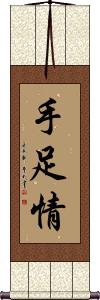
手足情 is the love between siblings.
When you love, protect, care for, and have a deep bond that only brothers or sisters can.
The actual translation is “Hand and Foot,” but the relationship between brothers or sisters is like that of hands and feet. They belong together and complete the body. Even though this says “hand and foot,” it will always be read with the brotherly and sisterly love meaning in Chinese.
Note: During the past 20 years, the “One child policy” in China is slowly making this term obsolete.
Butterfly
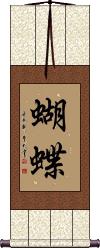
蝴蝶 is the long word for “butterfly” in Chinese.
If you love butterflies, this is the wall scroll for you.
Caring
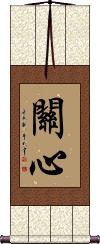
關心 means caring in Chinese.
Caring is giving love and attention to people and things that matter to you and anyone who needs help. When you care about people, you help them. You do a careful job, giving your very best effort. You treat people and things gently and respectfully. Caring makes the world a safer place.
Note: 關心 is also a word in Korean Hanja, but in Korean, it means taking interest or concern. In Korean, it's still a good word, but it doesn't quite have the “caring for a person” meaning that it does in Chinese.
See Also: Benevolence | Altruism
Cherish
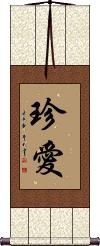
珍愛 means to cherish, to treasure, or to love dearly in Chinese.
Compassion / Kindness
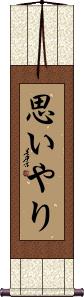
思いやり is compassion, kindness, or sympathy in Japanese.
The first part of this word suggests feelings, emotion, sentiment, love, affection, wish, and hope are connected with this idea of compassion and sympathy.
Note: Because this selection contains some special Japanese Hiragana characters, it should be written by a Japanese calligrapher.
Mercy / Compassion / Love
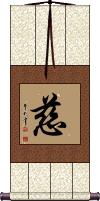
慈 is the simplest way to express the idea of compassion.
This can also mean love for your fellow humans, humanity, or living creatures. Sometimes this is extended to mean charity.
This term is often used in a Buddhist or Christian context. The concept was also spoken of by Laozi (Lao Tzu) in the Dao De Jing (Tao Te Ching).
慈 is considered the direct translation of the Sanskrit word मैत्री (maitrī) Pali word मेत्ता (mettā). In this context, it means benevolence, loving kindness, and goodwill.
This Chinese character is understood in Japanese but is usually used in compound words (not seen alone). Also used in old Korean Hanja, so it's very universal.
See Also: Mercy | Benevolence | Forgiveness | Kindness
The Ease of the Scholar
Quote from Confucius
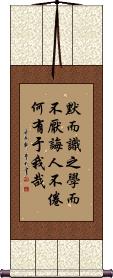
默而识之学而不厌诲人不倦何有于我哉 is a quote from the Analects of Confucius that translates as:
To quietly recite and memorize the classics,
to love learning without tiring of it,
never be bored with teaching,
How could these be difficult for me?
This is a suggestion that for a true scholar, all of these things come with ease.
This was written over 2500 years ago. The composition is in ancient Chinese grammar and phrasing. A modern Chinese person would need a background in Chinese literature to understand this without the aid of a reference.
Learning leads to Knowledge, Study leads to Benevolence, Shame leads to Courage
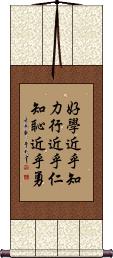
好學近乎知力行近乎仁知恥近乎勇 is a Saying from Confucius which relates certain actions to virtues.
A more verbose translation:
To love learning is akin to knowledge,
to study diligently is akin to benevolence,
to know shame is akin to courage.
Corinthians 13:4
All you need to know about LOVE
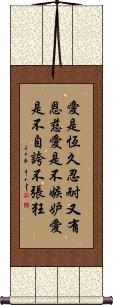
愛是恆久忍耐又有恩慈愛是不嫉妒愛是不自誇不張狂 is 1st Corinthians 13:4 in Chinese.
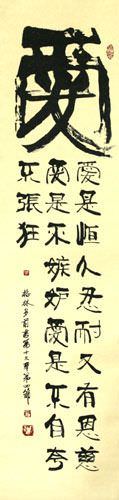
With large “love” character added.
In English, this reads:
1st Corinthians 13:4 (KJV) Charity suffereth long, and is kind; charity envieth not; charity vaunteth not itself, is not puffed up...
1st Corinthians 13:4 (NIV) Love is patient, love is kind. It does not envy, it does not boast, it is not proud.
1st Corinthians 13:4 (Basic English) Love is never tired of waiting; love is kind; love has no envy; love has no high opinion of itself, love has no pride.
The Chinese translation follows the love meaning, rather than the King James' use of “charity.” I was a little confused when writing this description with the significant differences between the NIV vs. KJV translations. After speaking to a Greek scholar about this, it would seem that the KJV has an almost errant translation with the use of “charity” in place of “love.”
We used the most popular Christian Chinese Bible, which is the Chinese Union Version (CUV). The CUV was first published in 1919. We use this so that the Chinese translation would be as accurate and standard as possible. Any Chinese Christian worth their salt will easily be able to identify this verse when they see these characters.
If you want a big “love” character written above the verse on your artwork, just make a note in the “special instructions” tab when you are customizing your artwork. There is no extra charge for that service on this special verse.
Corinthians 13:4

愛は忍耐強い。愛は情け深い。ねたまない。愛は自慢せず、高ぶらない。is 1st Corinthians 13:4 in Japanese.
In English, this reads:
1st Corinthians 13:4 (KJV) Charity suffereth long, and is kind; charity envieth not; charity vaunteth not itself, is not puffed up...
1st Corinthians 13:4 (NIV) Love is patient, love is kind. It does not envy, it does not boast, it is not proud.
1st Corinthians 13:4 (Basic English) Love is never tired of waiting; love is kind; love has no envy; love has no high opinion of itself, love has no pride.
If you want a big “love” character written above the verse on your artwork, just make a note in the “special instructions” tab when you are customizing your artwork. There is no extra charge for that service on this special verse.
Note: Because this selection contains some special Japanese Hiragana characters, it should be written by a Japanese calligrapher.
Crazy Love
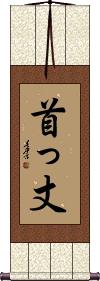
首っ丈 is a Japanese word that means “deeply in love with,” “madly in love with,” “heads over heels in love with,” or “to be crazy about.”
Daisy
The yellow flower
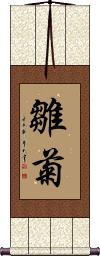
雛菊 is how they write “daisy” in Chinese and Japanese.
This is a good choice if you love daisies, or your name is Daisy. If you translated it directly, this means “chick flower” (as in baby chickens) or “baby chrysanthemum.” Of course, when an Asian person reads this, they just think “daisy.”
If you're into botany, this title represents “Bellis Perennis.”
In Japanese, this can be the female given name, Hinagiku.
Dance / Dancing
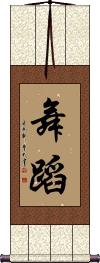
舞蹈 is the clearest way to express the art of dancing in Chinese, Japanese and Korean.
If you are a dancer or love the art of dance, this is the calligraphy selection for you.
Daoism / Taoism
Literally: The Way or Road
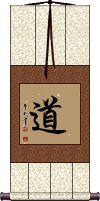
道 is the character “dao” which is sometimes written as “tao” but pronounced like “dow” in Mandarin.
道 is the base of what is known as “Taoism.” If you translate this literally, it can mean “the way” or “the path.”
Dao is believed to be that which flows through all things and keeps them in balance. It incorporates the ideas of yin and yang (e.g. there would be no love without hate, no light without dark, no male without female.)
The beginning of Taoism can be traced to a mystical man named
Lao Zi (604-531 BC), who followed, and added to the teachings of Confucius.
More about Taoism / Daoism here.
Note that this is pronounced “dou” and sometimes “michi” when written alone in Japanese but pronounced “do” in word compounds such as Karate-do and Bushido. It's also “do” in Korean.
Alternate translations and meanings: road, way, path; truth, principle province.
Important Japanese note: In Japanese, this will generally be read with the road, way, or path meaning. Taoism is not as popular or well-known in Japan so Daoist/Taoist philosophy is not the first thing a Japanese person will think of when they read this character.
See our Taoism Page
Daodejing / Tao Te Ching - Excerpt
Excerpt from Chapter 67
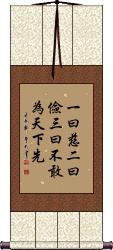
一曰慈二曰儉三曰不敢為天下先 is an excerpt from the 67th Chapter of Lao Tzu's (Lao Zi's) Te-Tao Ching (Dao De Jing).
This is the part where the three treasures are discussed. In English, we'd say these three treasures are compassion, frugality, and humility. Some may translate these as love, moderation, and lack of arrogance. I have also seen them translated as benevolence, modesty, and “Not presuming to be at the forefront in the world.” You can mix them up the way you want, as translation is not really a science but rather an art.
I should also explain that the first two treasures are single-character ideas, yet the third treasure was written out in six characters (there are also some auxiliary characters to number the treasures).
If Lao Tzu's words are important to you, then a wall scroll with this passage might make a great addition to your home.
Predestined Love / Love by Fate
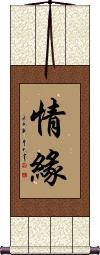
This Chinese word means predestined love or love affinity.
This can be fate, karma, or the bond that brings two lovers together.
Brought Together from 1000 Miles Away by Fate
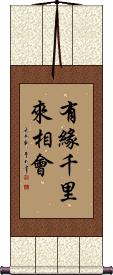
有緣千里來相會 means that fate or destiny has caused us to meet from a thousand miles away.
The 有緣 part suggests something that is connected as if by a thread due to fate, destiny, or karma.
This romantic phrase is seen in Chinese greeting cards. It relays the idea that your love was meant to be and that you were destined to meet (regardless of what distance or obstacles might have made such a meeting unlikely).
See Also: Red Thread
Divine Love
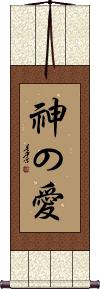
神の愛 is “divine love” in Japanese.
You could also translate it as “God's Love.”
Family Love / Domestic Bliss
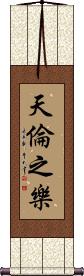
天倫之樂 means family love and joy, or domestic bliss.
The first two characters mean “the bonds of the family.”
The third character connects this to the fourth character which means happiness, joy, and cheerfulness.
Drain the pond to get all the fish
Kill the goose that lays the golden eggs
In 632 BC, Duke Wen of the Kingdom of Jin was about to lead an army against the forces of the Kingdom of Chu.
The Duke asked one of his advisers, Jiu Fan, how they could win the impending battle, as they were drastically outnumbered.
Jiu Fan said, “All is fair in war,” and suggested a plan of dishonorable tactics (cheating).
The Duke was unsure of this advice, so he asked another adviser, Yong Ji, who replied, “If you catch fish by draining the pond, you can certainly get all the fish. But there will be no fish the following year. You can cheat this one time in battle, but such tactics can only be used once, as the enemy will be wise in future encounters.”
The Duke heard the words of his wiser adviser but cheated to gain victory in the battle. However, he rewarded Yong Ji more than Jiu Fan at the victory celebration, stating that while Jiu Fan's advice gained one victory, the wise words of Yong Ji would last forever.
This Chinese idiom/proverb is still used, over 2600 years later to remind people not to burn bridges, cheat, or dishonor themselves in exchange for a short-term gain while sacrificing the future.
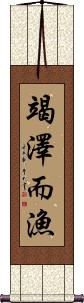
竭澤而漁 is very similar to the meaning of the English phrase, “Kill the goose that lays the golden eggs.”
Earth
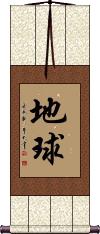
地球 is the name of the earth (our planet) in Chinese, old Korean Hanja and Japanese Kanji.
If you love the earth, or want to be reminded of where your home is in the solar system, this is the wall scroll for you.
Erin
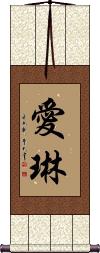
This is an alternate transliteration to Mandarin Chinese for the name Erin.
This version uses “love” as the first character. This is not the standard but popular, as the resulting meaning is “Love Gem.”
Eternal Beauty
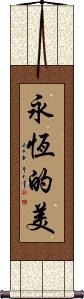
永恆的美 is how to write “Eternal Beauty” in Chinese.
Eternal Friendship / Friends Forever
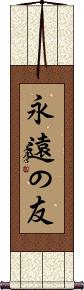
永遠の友 is a Japanese phrase about eternal friendship.
The first two characters mean eternal, eternity, perpetuity, forever, immortality, and permanence.
The third character is a possessive article which sort of makes this selection mean “Love, of the eternal kind.”
The last character is “friend” or “Friendship.”
See Also: Best Friends
Eternal Happiness
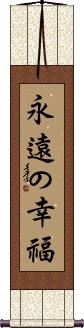
永遠の幸福 means “eternal happiness” in Japanese.
永遠 means eternal, eternity, perpetuity, forever, immortality, and permanence.
の is a possessive article which sort of makes this selection mean “happiness, of the eternal kind.”
幸福 means happiness, though this word can be translated as truly blessed, joy, happy, welfare, well-being, or fortunate.
Eternal Love
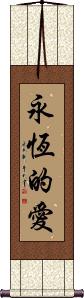
永恆的愛 is the best way to write “Eternal Love” in Chinese.
The first two characters mean eternal, eternally, everlasting, and/or perpetual.
The third character is a possessive article which sort of makes this selection mean “Love of the eternal kind.”
The last character is “love.”
This version is best if your audience is Chinese. We also have a Japanese version of eternal love.
See Also: Forever Love | Eternal Love (Japanese)
Eternal Love
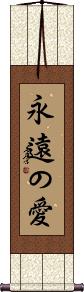
永遠の愛 is a great way to write “Eternal Love” in Japanese.
The first two characters mean eternal, eternity, perpetuity, forever, immortality, and permanence.
The third character is a possessive article which sort of makes this selection mean “Love, of the eternal kind.”
The last character is “love.”
Cultural note: Most of the time, it is taboo to use the word “love” in Japanese. For instance, a Japanese man will say, “I like you,” rather than, “I love you,” to his spouse/girlfriend. However, this entry for eternal love is acceptable because of the way it is composed.
This entry is only appropriate if your audience is Japanese. We also have a Chinese version of this eternal love.
Learning is Eternal
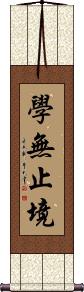
This Chinese philosophy tells of how we continue to learn throughout our lives.
This proverb can be translated in a few ways such as “Study has no end,” “Knowledge is infinite,” “No end to learning,” “There's always something new to study,” or “You live and learn.”
The deeper meaning: Even when we finish school we are still students of the world gaining more knowledge from our surroundings with each passing day.
See Also: An Open Book Benefits Your Mind | Wisdom | Learn From Wisdom
Eternal Life / Everlasting Life / Immortality
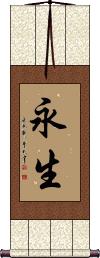
永生 are the last two words from John 3:16 in the Chinese Union Bible.
Although not specifically Christian, this is the way to express ever-lasting life or eternal life in Chinese.
In Japanese, this can either mean eternal life or immortality.
See Also: Eternity | Rebirth | Reincarnation | Immortality
Eternal Happiness
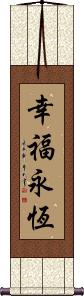
幸福永恆 is a short way to say eternal happiness in Chinese.
Breaking down the parts:
幸福 means happiness, happy, blessed, blessedness, joy, and/or well-being.
永恆 means eternal, everlasting, and/or forever.
Another way to write this is 永恆的幸福. It reverses the word order and adds a possessive article. I prefer the shorter version, which is slightly more natural in Chinese.
Eternal / Eternity
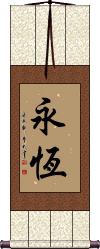
永恆 is the Chinese word for eternity.
The first character means always, forever, and perpetual. The second character holds the meaning of permanent. Together, they create a word that means eternal, eternally, or infinite time.
See Also: Immortality
Eternity / Forever
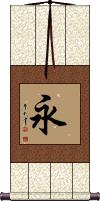
永 is the simplest form of eternity or “always and forever.”
永 can sometimes mean forever, always, perpetual, infinite, or “without end,” depending on context.
Note: Not often seen as a single Kanji in Japanese. Best if your audience is Chinese.
See Also: Forever | Ever Lasting
Eternity / Always and Forever
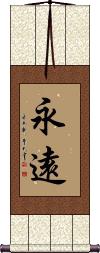
永遠 is the Chinese, Korean and Japanese word for forever.
If we take this word apart, the first character means always, forever, or perpetual. While the second character means far or distant.
See Also: Immortality
Faith Hope Love
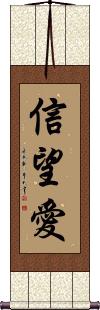
信望愛 is a Chinese list of words meaning faith, hope, and love.
This is not a typical phrase in Chinese but rather just random words strung together. There's no bad meaning, it's just not typical Chinese grammar.
Faith Hope Love
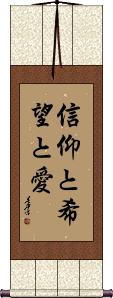
信仰と希望と愛 is a Japanese list of words (not really a phrase) meaning faith, hope, and love.
Some have associated this word list with Corinthians 13:13, though there are no specific religious connotations in this word list, and it's not directly from that Japanese Bible verse.
Note: Because this selection contains some special Japanese Hiragana characters, it should be written by a Japanese calligrapher.
Faith Love Peace
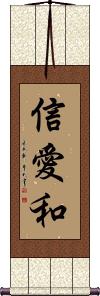
信愛和 is a word list that reads, “Faith Love Peace.”
This is not a natural phrase in Chinese or Japanese, as it lacks a subject, verb, or object. But if this is what you want, here it is.
Family Love
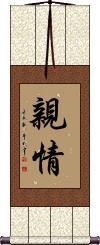
親情 means affection, especially for family members.
This can also be translated as “family love” or “love, especially within a married couple or between parents and children.”
Family Love
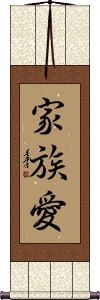
家族愛 is a Japanese title that means love of (one's) family, family love, or familial love.
The Mysterious Bond Between People
The invisible force that brings people together forever
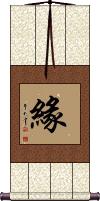
緣 represents the fate that brings and bonds people together.
緣 is a complicated single character. It can mean a lot of different things depending on how you read it.
In Japanese, it can mean fate, destiny, a mysterious force that binds two people together, a relationship between two people, bond, link, connection, family ties, affinity, opportunity, or chance (to meet someone and start a relationship). It can also mean “someone to rely on,” relative, reminder, memento, or the female given name, Yori.
It's the same in Chinese, where it's defined as cause, reason, karma, fate, or predestined affinity.
In the Buddhist context, it's Pratyaya. This is the concept of indirect conditions, as opposed to direct causes. It's when something happens (meeting someone) by circumstance or a contributing environment. Instead of a direct cause or act, it is a conditioning cause without direct input or action by the involved people.
Occasionally, this character is used in a facetious way to say hem, seam, or edge of clothing. In this case, it's the seam that brings or holds the clothing together.
 Note: Japanese will tend to use the variant of this Kanji shown to the right. If you want this version (and are ordering this from the Japanese master calligrapher), click on the Kanji at the right instead of the button above.
A Father’s Love
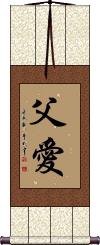
父愛 means “father's love” in Chinese.
A Father’s Love
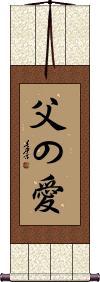
父の愛 means “father's love” in Japanese.
Fear God
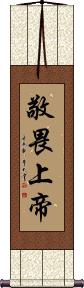
敬畏上帝 is probably the best way to translate the Christian English phrase “Fear God” into Chinese.
The first two characters mean to revere, be in awe of, or a general term of reverence. It can mean fear, but only in the context of respect or fear of authority.
The one who retreats 50 paces mocks the one to retreats 100
The pot calls the kettle black
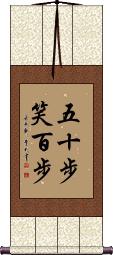
五十步笑百步 is a Chinese proverb that means the one who retreats 50 paces mocks the one who retreats 100 paces.
During the Warring States Period of what is now China (475 - 221 B.C.), the King of Wei was in love with war. He often fought with other kingdoms just for spite or fun.
One day, the King of Wei asked the philosopher Mencius, “I love my people, and all say I do the best for them. I move the people from famine-stricken areas to places of plenty and transport grains from rich areas to the poor. Nobody goes hungry in my kingdom, and I treat my people far better than other kings. But why does the population of my kingdom not increase, and why does the population of other kingdoms not decrease?”
Mencius answered, “Since you love war, I will make this example: When going to war, and the drums beat to start the attack, some soldiers flee for their lives in fear. Some run 100 paces in retreat, and others run 50 steps. Then the ones who retreated 50 paces laugh and taunt those who retreated 100 paces, calling them cowards mortally afraid of death. Do you think this is reasonable?
The King of Wei answered, “Of course not! Those who run 50 paces are just as timid as those who run 100 paces.”
Mencius then said, “You are a king who treats his subjects better than other kings treat their people, but you are so fond of war that your people suffer from great losses in battle. Therefore, your population does not grow. While other kings allow their people to starve to death, you send your people to die in war. Is there any difference?”
This famous conversation led to the six-character proverb shown here. It serves as a warning to avoid hypocrisy. It goes hand-in-hand with the western phrase, “The pot calls the kettle black,” or the Biblical phrase, “Before trying to remove a splinter from your neighbor's eye, first remove the plank from your own eye.”
First Love
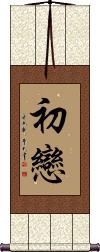
初戀 means “first love” in Chinese and Japanese.
You could also say that it means “first crush,” “first affection,” or “puppy love.”
 In Japanese and Simplified Chinese, they write the second character as shown to the right. If you want this version, click on the characters to the right instead of the Select and Customize button above.
The Five Fortunes

This is the title of “The Five Fortunes” in Chinese.
The implied five fortunes are as follows:
Longevity (壽)
Wealth (富)
Health & Composure (康寧)
Love of Virtue (攸好德)
A Peaceful Death (考終命)
Forbidden Love
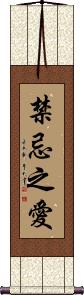
禁忌之愛 means “forbidden love” in Chinese.
The first two characters are a word that means forbidden, taboo, or “[something] to be avoided.”
The third character is a particle that connects forbidden to love.
The last character means love.
Forbidden Love
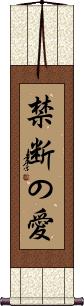
禁断の愛 means “forbidden love,” in Japanese.
Forever In My Heart
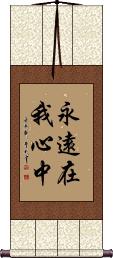
永远在我心中 means “forever in my heart” or “always in my heart” in Chinese.
Always in My Heart
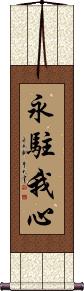
永駐我心 is one of a few ways to write “always in my heart” or “forever in my heart” in Chinese.
The first character means eternal, forever, or always.
The second character means resides, in, or stationed (in the case of troops).
The third character means me, my, or mine.
The last character means heart (but can also mean mind or soul).
Forever In My Heart
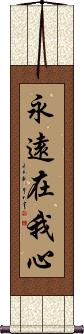
永遠在我心 means “forever in my heart” or “always in my heart” in Chinese.
This is the shorter, somewhat lyrical version of this phrase.
永遠 forever/eternal
在 at/in/exists
我 me/myself/my
心 heart/mind/soul
Forever In My Heart
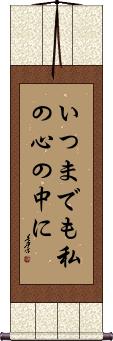
いつまでも私の心の中に means “forever in my heart” or “always in my heart” in Japanese.
Note: Because this selection contains some special Japanese Hiragana characters, it should be written by a Japanese calligrapher.
Forever In My Heart
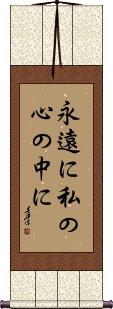
永遠に私の心の中に means “forever in my heart” or “always in my heart” in Japanese.
The character breakdown:
永遠 (eien) eternity; perpetuity; immortality; permanence.
に (ni) indicates the location of a person or thing.
私の (watashi no) my; mine.
心の中 (kokoro no naka) the middle of one's mind; the midst of one's heart.
に (ni) indicates the location of a person or thing (makes this “in” the middle of one's heart).
Note: There’s more than one way to say "Forever in My Heart" in Japanese, so you’ll find another version in our database. This is the very verbose version.
Note: Because this selection contains some special Japanese Hiragana characters, it should be written by a Japanese calligrapher.
Forever Love
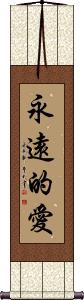
永遠的愛 refers to love that will last forever.
The first two characters mean forever, eternal, eternity, perpetuity, immortality, and/or permanence.
The third character is a possessive article which sort of makes this selection mean “The forever kind of love.”
The last character is “love.”
See Also: Eternal Love Always
Forever Young
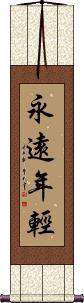
永遠年輕 is “forever young” in Chinese characters.
Forever Young / Eternal Youth
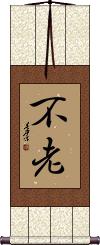
不老 is a Japanese word that means “perpetual youth” or “forever young.”
It contains the idea of never getting old. It literally means “never aging,” or “not [getting] old.”
Forever Young / Long Life
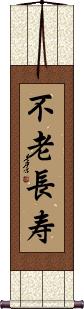
This Japanese phrase means “perpetual youth and longevity.”
It contains the ideas of never getting old and eternal life.
Forever Family
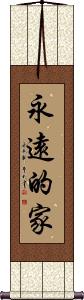
永遠的家 is a special phrase that we composed for a “family by adoption” or “adoptive family.”
It's the dream of every orphan and foster child to be formally adopted and find their “forever family.”
The first two characters mean forever, eternal, eternity, perpetuity, immortality, and/or permanence. The third character connects this idea with the last character which means “family” and/or “home.”
See Also: Family
Forever Sisters
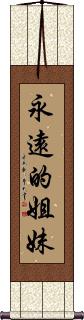
This literally means forever sisters in Chinese.
This is a weird phrase in Chinese, as by default, sisters are forever. I added this because people were searching for it.
Eternal Friendship / Friends Forever
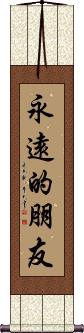
永遠的朋友 means friends that are eternal or a friendship that will last forever - you will remain the best of friends as long as you live.
The first two characters mean forever, eternal, eternity, perpetuity, immortality, and/or permanence.
The middle character links the words (it's a possessive article).
The last two characters represent friendship, or simply “friends.”
Galatians 5:22-23

Here is Galatians 5:22 and a bit of 23 in Chinese.
The text with punctuation:
圣灵所结的果子,就是仁爱,喜乐,和平,忍耐,恩慈,良善,信实,温柔,节制。
Hand-painted calligraphy does not retain punctuation.
This translation is from the Chinese Union Bible.
You may know it from the KJV as:
5:22 But the fruit of the Spirit is love, joy, peace, longsuffering, gentleness, goodness, faith,
5:23 Meekness, temperance...
Generosity
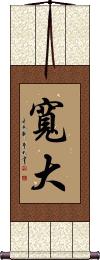
寬大 is a Chinese, Japanese, and Korean word that means Generosity.
Generosity is giving and sharing. You share freely, not with the idea of receiving something in return. You find ways to give others happiness and give just for the joy of giving. Generosity is one of the best ways to show love and friendship.
寬大 can also be translated as charitable, magnanimity, liberality, or in some contexts, broad-mindedness.
Note: There is a tiny deviation in the first character when written in Japanese. If you choose our Japanese master calligrapher, the little dot on the lower right of the first character will be omitted. With or without the dot, this can be read in Chinese, Japanese Kanji, and old Korean Hanja.
See Also: Benevolence | Altruism | Charity
God is Always With You
God is With Me Always
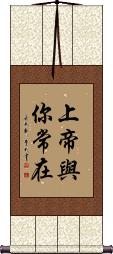
The direct translation of the Chinese characters, 上帝与你常在, is “God Together [with] You Always Exist.”
Keep in mind that Chinese grammar is sometimes very different from English. This makes perfect sense in Chinese.
Note: The title for God is the first two characters - the other words in the direct translation represent one character each.
God is Love
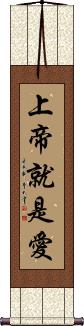
上帝就是愛 is a common way to express “God is Love” in Chinese.
God is Love
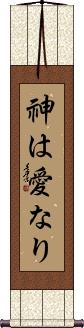
神は愛なり is a common way to express “God is Love” in Japanese.
Note: Because this selection contains some special Japanese Hiragana characters, it should be written by a Japanese calligrapher.
Venus / Amor / God of Love
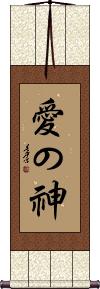
愛の神 is the Japanese title for Amor, Eros, Venus, or God of Love.
God Is With You Always
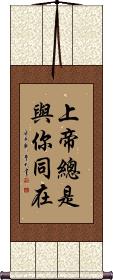
I was going to write this phrase as “God is with me always” but as a wall scroll, hanging in your room, it is talking to you (you're not talking), so it works better with you.
上帝總是與你同在 is a nice phrase that any Chinese Christian would enjoy on his/her wall.
If I annotate this, it sounds a little strange in English but it's perfectly natural in Chinese:
上帝 God | 总是 always | 与 and | 你 you | 同 together | 在 existing
Greatest Love
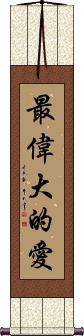
最偉大的愛 means “the greatest love” in Chinese.
Keeping in mind that Chinese is different than English, the first character is like “-est” or adding “the most” as a modifier to the next word.
The 2nd and 3rd characters mean great, mighty, and/or large.
The 4th is a possessive article.
The last is the character for love.
When you put it all together, you get a phrase that means the greatest love, enormous love, or the mightiest love.
Greatest Infinite Love
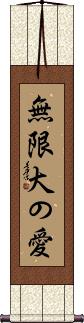
無限大の愛 is a Japanese title meaning infinite great love, unlimited great love, or eternal love.
無 means never, not, or like a prefix “un-.”
限 means limited, restricted, or bound.
大 means great or big.
の is a possessive article.
愛 means love or affection.
Love and Happiness
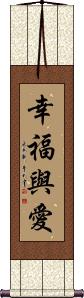
幸福與愛 is “happiness and love” in Chinese.
There is a suggestion of “good fortune” in the version of happiness used here.
Happy Birthday
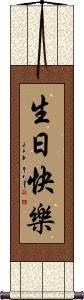
生日快樂 is how to write “Happy Birthday” in Chinese.
The first two characters mean “birthday,” and the second two characters mean “happiness,” or rather a wish for happiness.
Because a birthday only lasts one day per year, we strongly suggest that you find an appropriate and personal calligraphy gift that can be hung in the recipient's home year-round.
Happy Birthday
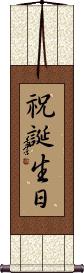
祝誕生日 is the shortest way to write “Happy Birthday” in Japanese.
The first Kanji means “wish” or “express good wishes,” and the last three characters mean “birthday.”
Because a birthday only lasts one day per year, we strongly suggest that you find an appropriate and personal calligraphy gift that can be hung in the recipient's home year-round.
Happy Family
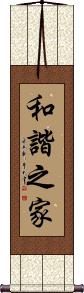
和諧之家 means “harmonious family” or “happy family” in Chinese.
The first two characters relay the idea of happiness and harmony.
The third character is a connecting or possessive article (connects harmony/happiness to family).
The last character means family but can also mean home or household.
Happy Family
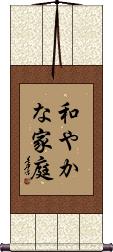
和やかな家庭 means “happy family” or “harmonious family” in Japanese.
The first three Kanji create a word that means mild, calm, gentle, quiet, or harmonious. After that is a connecting article. The last two Kanji mean family, home, or household.
Note: Because this selection contains some special Japanese Hiragana characters, it should be written by a Japanese calligrapher.
Eternal / Long-Lasting
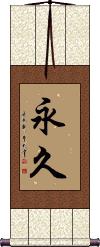
永久 is a Japanese, Chinese, and old Korean word that means everlasting, perpetual, lasting, forever, permanent, eternity, perpetuity, and/or immortality.
This can also be a female given name Haruku in Japan.
Soul Mates at Heart
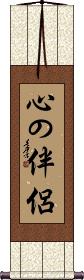
心の伴侶 is a Japanese-only title for soulmates.
心 means heart, soul, mind, core, or center. In ancient times, the heart was believed to be the mind or center of your soul and being.
の is a possessive article that connects everything here.
伴侶 means mates, companions, partners, and spouses.
This Japanese version of soulmates is about two partners, coupled or joined by their hearts.
Hebrews 13:8
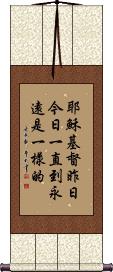
耶穌基督昨日今日一直到永遠是一樣的 is Hebrews 13:8 which reads, Jesus Christ the same yesterday, and today, and forever.
Home is where the heart is
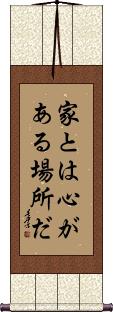
家とは心がある場所だ is, “Home is where the heart is,” in Japanese.
Most Japanese will take this to mean:
If you are with the person or at the place you love most, it becomes your true home.
Note: Because this selection contains some special Japanese Hiragana characters, it should be written by a Japanese calligrapher.
Love for Humanity / Brotherly Love
benevolence, love
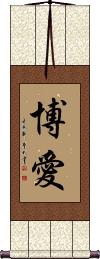
In Chinese and Korean, 博愛 means a universal fraternity, brotherhood, or universal love.
In Japanese, this means charity, benevolence, philanthropy, or love for humanity.
Please note these subtle differences and take that into account depending on your intended audience (Chinese, Korean or Japanese).
See Also: Benevolence | Altruism
The Whole Room Rocks With Laughter
The perfect scroll if you love humor or as a gift for the comedian in your life
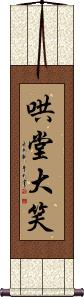
In China, 哄堂大笑 is a proverb that is used in response to a good joke or witty comment.
The story goes that Mr. Feng and Mr. He were both senior officials in the Song Dynasty (about a thousand years ago). One day, Mr. Feng walked into their shared office wearing a new pair of boots. The boots caught the eye of Mr. He who said, “New boots! - how much were they?.” Mr. Feng lifted one of the boots off the ground as if to show it off and responded, “900 coins.”
Astonished, Mr. Feng explained, “900? How can that be? - I paid 1800 coins for my boots!.” Mr. Feng then lifted his other foot off the ground and said, “This boot was also 900 coins.”
It is said that the whole room was shaking from the laughter of all that heard Mr. Feng's joke on Mr. He.
This in-stock artwork might be what you are looking for, and ships right away...

Gallery Price: $106.00
Your Price: $58.88
Gallery Price: $126.00
Your Price: $69.88

Gallery Price: $200.00
Your Price: $122.88
Gallery Price: $87.50
Your Price: $39.00
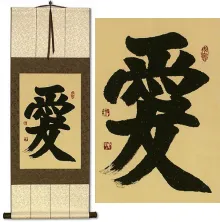


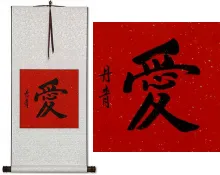
Gallery Price: $65.00
Your Price: $39.88
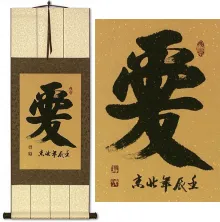
Gallery Price: $65.00
Your Price: $39.88

Successful Chinese Character and Japanese Kanji calligraphy searches within the last few hours...



