Many custom options...


And formats...



Live Your Life in Chinese / Japanese...
Buy a Live Your Life calligraphy wall scroll here!
Personalize your custom “Live Your Life” project by clicking the button next to your favorite “Live Your Life” title below...
3. A Life of Happiness and Prosperity
7. Life Goes On
8. Optimism / Happy With Your Fate
10. A Life of Happiness and Prosperity
11. Live For The Day / Seize The Day
12. No Regrets
13. Carpe Diem / Seize the Day
14. Live Laugh Love
16. Life Force
17. Birth / Life
18. Everyday Life
19. Alive
Living / Live Life
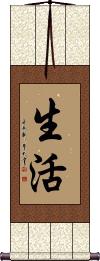
生活 means life, living, to live, or the state of being alive. It can also refer to your daily existence or livelihood. It can also be a suggestion to just “Live life.”
生活 is also the term used in other titles such as “healthy living” or Lance Armstrong's “Livestrong” campaign (Chinese title for Livestrong only).
If you need a reminder that you are alive and to take a breath, this might be the perfect wall scroll for you.
Live Without Regret
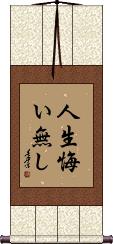
人生悔い無し is how to say “live without regrets” in Japanese.
Note: Because this selection contains some special Japanese Hiragana characters, it should be written by a Japanese calligrapher.
See Also: Live for Today
Live Without Regret
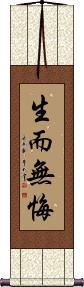
生而無悔 is how to say “live without regrets” in Mandarin Chinese.
Note: There is some debate about whether this makes sense in Japanese. It would be read, "nama ji mu ke," and be understood in Japanese. But, a Japanese person will probably think it’s Chinese (not Japanese).
See Also: Live for Today
A Life of Happiness and Prosperity
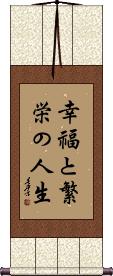
幸福と繁栄の人生 is a Japanese proverb that means “A life of happiness and prosperity” or “A life of happiness and success.”
Note: Because this selection contains some special Japanese Hiragana characters, it should be written by a Japanese calligrapher.
See Also: Prosperity
Live For The Day
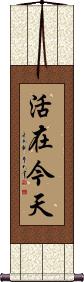
活在今天 is not an eastern concept, so it does not translate into a phrase that seems natural on a wall scroll.
However, if this is your philosophy, the characters shown here do capture your idea of living for today or living in the moment. 活在今天 says “Live in today,” and they are grammatically correct in Chinese.
Note: This kind of makes sense in Korean Hanja but the grammar is Chinese, so it’s not that natural in Korean.
Live Laugh Love
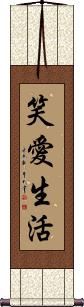
In English, the word order shown in the title is the most natural or popular. In Chinese, the natural order is a little different:
The first character means laugh (sometimes means smile).
The second character means love.
The last two characters mean “live” as in “to be alive” or “pursue life.”
Please note: 笑愛生活 is not a normal phrase in that it does not have a subject, verb, or object. It is a word list. Word lists are not common in Asian languages/grammar (at least not as normal as in English). We only added this entry because so many people requested it.
We put the characters in the order shown above, as it almost makes a single word with the meaning “A life of laughter and love.” It's a made-up word, but it sounds good in Chinese.
We removed the Japanese pronunciation guide from this entry, as the professional Japanese translator deemed it "near nonsense" from a Japanese perspective. Choose this only if your audience is Chinese and you want the fewest-possible characters to express this idea.
In Korean, this would be 소애생활 or "so ae saeng hwar" but I have not confirmed that this makes sense in Korean.
Life is Short
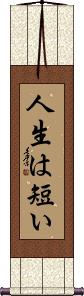
人生は短い is “life is short” in Japanese.
The character breakdown:
人生 (jinsei) life (i.e., conception to death); human life, living, lifetime.
は (ha/wa) particle (means “is” in this case).
短い (mijikai) short.
Note: Because this selection contains some special Japanese Hiragana characters, it should be written by a Japanese calligrapher.
Life is Short
A 100-year-old is but a traveler passing through this life
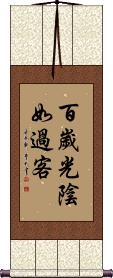
百歲光陰如過客 directly translates as: [Even a] hundred-year-old [person] is [just a] traveler passing by.
The simple message is, “Human life is short.” Of course, there is an unspoken suggestion that you should make the best of your time here on earth.
Life Goes On
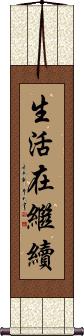
生活在繼續 means “No matter what happens, life goes on” or “For better or worse, life goes on.”
生活在繼續 is kind of modern Chinese proverb, but the meaning is generational.
生活 = to live; life; livelihood.
在 = (used before a verb to indicate an action in progress).
繼續 = to continue; to proceed with; to go on with.
Life Goes On
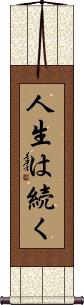
人生は続く is a Japanese phrase that expresses, “Life Goes On.”
The first two characters mean “life” (literally “human life”).
The third character is a particle that connects the ideas in this phrase.
The last two characters mean “to continue,” “to last,” “to go on,” and “to occur again and again.”
Note: Because this selection contains some special Japanese Hiragana characters, it should be written by a Japanese calligrapher.
Optimism / Happy With Your Fate
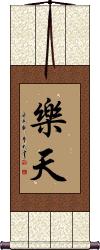
樂天 is about being optimistic and also making the best of whatever life throws at you.
This is hard to define. One dictionary defines this as “acceptance of fate and happy about it.” There is one English word equivalent, which is sanguinity or sanguinary.
You can also say that this means “Be happy with whatever Heaven provides,” or “Find happiness in whatever fate Heaven bestows upon you.” 樂天 suggests being an optimist in life.
Note: This is sometimes a given name in China.
 Please note that Japanese tend to write the first character in a slightly-different form (as seen to the right). Let us know if you have a preference when you place your order.
Life is a Journey
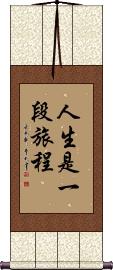
人生是一段旅程 is a proverb that means “Life is a Journey.”
If this matches your philosophy, this might be the perfect Chinese calligraphy for you.
A Life of Happiness and Prosperity
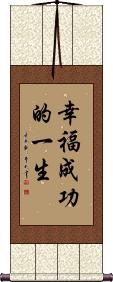
幸福成功的一生 means “A life of happiness and prosperity” or “A life of happiness and success.”
It's a very positive and inspirational wall scroll selection.
See Also: Prosperity
Live For The Day / Seize The Day
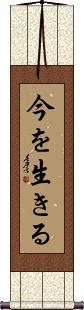
今を生きる is a Japanese phrase that can be translated as “live for the day,” “live for the moment,” “seize the day,” or “make the most of the present.”
You can think of this as the Japanese version of “Carpe Diem.”
Note: Because this selection contains some special Japanese Hiragana characters, it should be written by a Japanese calligrapher.
No Regrets
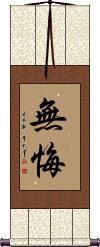
無悔 is how to say “no regrets” in Mandarin Chinese.
This also makes sense in Japanese, though not the most common way to express “no regrets” in Japanese.
See Also: Live for Today
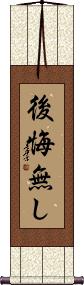
No Regrets
Carpe Diem / Seize the Day
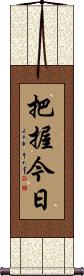
把握今日 is the closest and most natural way to express this proverb in Chinese.
The first two characters mean “to seize” but can also be translated as “take control of.”
The last two characters mean “today.”
Live Laugh Love
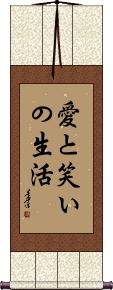
Because a word list of “Live Laugh Love” is not natural in Japanese, this takes the concept and incorporates it into a proper phrase.
愛と笑いの生活 can be translated as “A life of love and laughter” or “Live life with love and laughter.”
Note: Because this selection contains some special Japanese Hiragana characters, it should be written by a Japanese calligrapher.
Live for What You Love
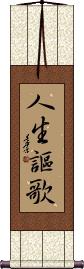
人生謳歌 means “live for what you love” in Japanese.
The first two characters mean “human life” or simply “living.” The last two characters mean “merit,” “prosperity,” or “what you enjoy.” This phrase can suggest working or staying busy for your own goals (in your career).
See Also: Prosperity
Life Force
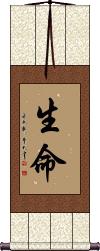
This Chinese, Korean and Japanese word means “life force” or simply “life.”
The first character means “life” or “birth.” The second means “life” or “fate.” Together they create the meaning of “life force,” though some will translate this as “existence” and sometimes “vitality.”
Birth / Life
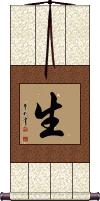
生 is a Chinese word that means “to be born” and “to give birth.”
Also, it's often used to refer to life itself, and sometimes “to grow.”
生 is used in a lot of compound words such as “yi sheng,” which means “doctor” (literally “healer of life”), “sheng ri” which means “birthday” (literally “birth-day”), and “xue sheng” which means student (literally “studying life” or “learner [about] life”). Few Chinese people will think of the literal meaning when this uses words like doctor and student - but it is interesting to note.
生 has the same root meaning in Korean Hanja and Japanese. However, in Japanese, there are many possible pronunciations, and this can be used to mean “raw” or “unprocessed” (as in draft beer). Therefore, not be the best if your audience is Japanese.
See Also: Vitality
Everyday Life
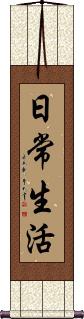
日常生活 simply means everyday life or regular life.
You can also translate it as “Living day to day.”
Alive
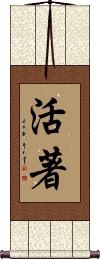
活著 is the word that means alive, as in the state of living or being alive (Chinese only).
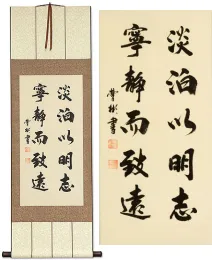
A Life of Serenity Yields Understanding
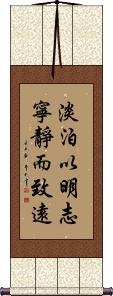
淡泊以明志寧靜而致遠 is a kind of complex ten-character proverb composed by Zhuge Liang about 1800 years ago.
淡泊以明志寧靜而致遠 is a Chinese proverb that means “Leading a simple life will yield a clear mind, and having inner peace will help you see far (into the world).”
What I have translated as “simple life” means NOT being materialistic and NOT competing in the rat race.
The last word means “far” but the deeper meaning is that you will surpass what you can currently see or understand. Perhaps even the idea of opening up vast knowledge and understanding of complex ideas.
The whole phrase has a theme that suggests that if you are NOT an aggressive, cut-throat person who fights their way to the top, no matter how many people they crush along the way, and instead seek inner peace, you will have a happier existence and be more likely to understand the meaning of life.
See Also: Serenity
Die Without Regret
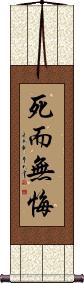
死而無悔 is how to say “die with no regrets” in Mandarin Chinese.
This proverb comes from the Analects of Confucius.
See Also: No Regrets
This in-stock artwork might be what you are looking for, and ships right away...

Gallery Price: $61.00
Your Price: $33.88
Gallery Price: $108.00
Your Price: $59.88

Gallery Price: $61.00
Your Price: $33.88

Gallery Price: $31.00
Your Price: $16.88
Gallery Price: $47.00
Your Price: $26.00

Gallery Price: $61.00
Your Price: $33.88


Gallery Price: $61.00
Your Price: $33.88

Gallery Price: $61.00
Your Price: $33.88

Gallery Price: $61.00
Your Price: $33.88
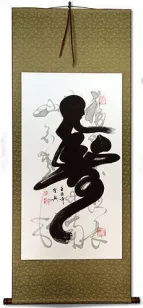
Gallery Price: $31.00
Your Price: $17.00
Gallery Price: $198.00
Your Price: $109.88

Gallery Price: $61.00
Your Price: $33.88

Gallery Price: $61.00
Your Price: $33.88
The following table may be helpful for those studying Chinese or Japanese...
| Title | Characters | Romaji (Romanized Japanese) | Various forms of Romanized Chinese | |
| Living Live Life | 生活 | sei katsu / seikatsu | shēng huó sheng1 huo2 sheng huo shenghuo | |
| Live Without Regret | 人生悔い無し | jinsei kui nashi jinseikuinashi | ||
| Live Without Regret | 生而無悔 生而无悔 | shēng ér wú huǐ sheng1 er2 wu2 hui3 sheng er wu hui shengerwuhui | sheng erh wu hui shengerhwuhui |
|
| A Life of Happiness and Prosperity | 幸福と繁栄の人生 | kou fuku to ha nei no jin sei koufukutohaneinojinsei ko fuku to ha nei no jin sei | ||
| Live For The Day | 活在今天 | huó zài jīn tiān huo2 zai4 jin1 tian1 huo zai jin tian huozaijintian | huo tsai chin t`ien huotsaichintien huo tsai chin tien |
|
| Live Laugh Love | 笑愛生活 笑爱生活 | xiào ài shēng huó xiao4 ai4 sheng1 huo2 xiao ai sheng huo xiaoaishenghuo | hsiao ai sheng huo hsiaoaishenghuo |
|
| Life is Short | 人生は短い | jinsei ha mijikai jinseihamijikai | ||
| Life is Short | 百歲光陰如過客 百岁光阴如过客 | bǎi suì guāng yīn rú guò kè bai3 sui4 guang1 yin1 ru2 guo4 ke4 bai sui guang yin ru guo ke baisuiguangyinruguoke | pai sui kuang yin ju kuo k`o paisuikuangyinjukuoko pai sui kuang yin ju kuo ko |
|
| Life Goes On | 生活在繼續 生活在继续 | shēng huó zài jì xù sheng1 huo2 zai4 ji4 xu4 sheng huo zai ji xu shenghuozaijixu | sheng huo tsai chi hsü shenghuotsaichihsü |
|
| Life Goes On | 人生は続く | jin sei ha tsudu ku jinseihatsuduku | ||
| Optimism Happy With Your Fate | 樂天 / 楽天 乐天 | raku ten / rakuten | lè tiān / le4 tian1 / le tian / letian | le t`ien / letien / le tien |
| Life is a Journey | 人生是一段旅程 | rén shēng shì yí duàn lǚ chéng ren2 sheng1 shi4 yi2 duan4 lv3 cheng2 ren sheng shi yi duan lv cheng renshengshiyiduanlvcheng | jen sheng shih i tuan lü ch`eng jen sheng shih i tuan lü cheng |
|
| A Life of Happiness and Prosperity | 幸福成功的一生 | xìng fú chéng gōng de yì shēng xing4 fu2 cheng2 gong1 de yi4 sheng1 xing fu cheng gong de yi sheng xingfuchenggongdeyisheng | hsing fu ch`eng kung te i sheng hsingfuchengkungteisheng hsing fu cheng kung te i sheng |
|
| Live For The Day Seize The Day | 今を生きる | ima wo i ki ru imawoikiru | ||
| No Regrets | 無悔 无悔 | mu ke / muke | wú huǐ / wu2 hui3 / wu hui / wuhui | |
| No Regrets | 後悔無し | kou kai na shi koukainashi ko kai na shi | ||
| Carpe Diem Seize the Day | 把握今日 | bǎ wò jīn rì ba3 wo4 jin1 ri4 ba wo jin ri bawojinri | pa wo chin jih pawochinjih |
|
| Live Laugh Love | 愛と笑いの生活 | ai to warai no seikatsu aitowarainoseikatsu | ||
| Live for What You Love | 人生謳歌 | jin sei ou ka jinseiouka jin sei o ka | ||
| Life Force | 生命 | seimei / inochi | shēng mìng sheng1 ming4 sheng ming shengming | |
| Birth Life | 生 | shou / iku / sho / iku | shēng / sheng1 / sheng | |
| Everyday Life | 日常生活 | nichi jou sei katsu nichijouseikatsu nichi jo sei katsu | rì cháng shēng huó ri4 chang2 sheng1 huo2 ri chang sheng huo richangshenghuo | jih ch`ang sheng huo jihchangshenghuo jih chang sheng huo |
| Alive | 活著 活着 | huó zhe / huo2 zhe / huo zhe / huozhe | huo che / huoche | |
| A Life of Serenity Yields Understanding | 淡泊以明志寧靜而致遠 淡泊以明志宁静而致远 | dàn bó yǐ míng zhì, níng jìng ér zhì yuǎn dan4 bo2 yi3 ming2 zhi4, ning2 jing4 er2 zhi4 yuan3 dan bo yi ming zhi, ning jing er zhi yuan | tan po i ming chih, ning ching erh chih yüan | |
| Die Without Regret | 死而無悔 死而无悔 | sǐ ér wú huǐ si3 er2 wu2 hui3 si er wu hui sierwuhui | ssu erh wu hui ssuerhwuhui |
|
| In some entries above you will see that characters have different versions above and below a line. In these cases, the characters above the line are Traditional Chinese, while the ones below are Simplified Chinese. | ||||

Successful Chinese Character and Japanese Kanji calligraphy searches within the last few hours...



