Many custom options...


And formats...



Not what you want?
Try other similar-meaning words, fewer words, or just one word.
Life is One Time in Chinese / Japanese...
Buy a Life is One Time calligraphy wall scroll here!
Personalize your custom “Life is One Time” project by clicking the button next to your favorite “Life is One Time” title below...
2. Each Time You Stumble and Fall, You Gain Experience and Wisdom
3. One Who Does Not Do Bad Things, Worries Not of Knocks at His Door
4. Ivy
Once in a Lifetime
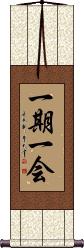
This Japanese title can be translated as “for this time only,” “chance meeting,” “one meeting, one opportunity,” “never again,” or “one chance in a lifetime.”
The characters literally mean “one time one meeting” - of course, the Kanji characters have meaning far beyond a direct translation like this.
Some might use this proverb to talk of an opportunity that presents itself just once in your life. It could also be a one-and-only chance meeting with your true soul mate. An expression of any event that might happen once in a lifetime.
This is primarily a Japanese title, however, there is also a Traditional Chinese (and old Korean) version of this proverb. Just the last character is different. The traditional form was used in Japan before WWII and in Korea prior to 1900. This title is somewhat known in China.
If you want the older traditional form, just click on the character to the right.
Each Time You Stumble and Fall, You Gain Experience and Wisdom
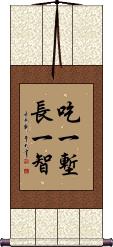
吃一塹長一智 is a Chinese proverb that means “Fall into a moat, and you will gain wisdom from the experience.”
It really suggests that the failures, troubles, frustrations, and setbacks that you encounter in your life are actually helping you to find wisdom. Some would also translate this proverb as “Learn from your mistakes” or “Learn from your experience.”
If you are studying Chinese, you will recognize the first character as “eat,” but in this case, it means to “experience” (as used in this proverb, it is suggesting that you have fallen into a moat and/or had a hard time crossing it).
Translated character by character, this whole proverb is, “Experience one moat, gain one wisdom/knowledge.”
Note: This can be pronounced in Korean, but it's not a commonly used phrase.
One Who Does Not Do Bad Things, Worries Not of Knocks at His Door
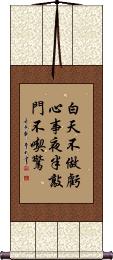
白天不做亏心事夜半敲门不吃惊 literally translates as: [If one does] not do bad things in the daytime, one need not be alarmed at knocks on the door in the middle of the night.
The meaning is something like, “A quiet conscience sleeps in thunder.” Basically, the message is, “don't commit crimes and you won't be jumpy every time the doorbell rings (so don't do anything wrong and your life will have fewer worries and you can sleep at night).”
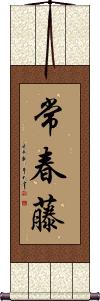
This is a common way to write “ivy” in Chinese.
There are varieties of ivy plant, and other ways to say ivy in Chinese but this version is probably the nicest. It's the one you would use if writing a poem about ivy etc.
If you want the actual meaning, this is, “Always Young Vine,” or “Ever Living Vine.” The literal meaning of the characters is more like, “Always Spring[time] Vine.” But Spring can have other representations in Chinese such as new life, youth, freshness, joyfulness, etc.
Year-In Year-Out Have Abundance
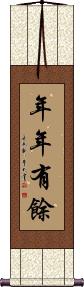
年年有餘 is a common proverb or wish of prosperity you'll hear around the time of Chinese New Year.
Directly translated character by character, it means “Year Year Have Surplus.” A more natural English translation including the deeper meaning would be “Every Year may you Have Abundance in your life.”
On a side note, this phrase often goes with a gift of something related to fish. This is because the last character, “yu” which means surplus or abundance, has exactly the same pronunciation in Mandarin as the word for “fish.”
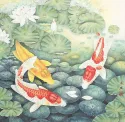
This is also one of the most common titles for traditional paintings that feature koi fish.
In China, this phrase might make an odd wall scroll - a customer asked especially for this common phrase which is why it appears here. See my other abundance-related words if you want a wall scroll that will seem more comfortable in Chinese culture.
Note: This can be pronounced in Korean, but it's not a commonly used term.
See Also: Prosperity | Good Fortune
Better Late Than Never
It's Never Too Late Too Mend
Long ago in what is now China, there were many kingdoms throughout the land. This time period is known as “The Warring States Period” by historians because these kingdoms often did not get along with each other.
Sometime around 279 B.C. the Kingdom of Chu was a large but not particularly powerful kingdom. Part of the reason it lacked power was the fact that the King was surrounded by “yes men” who told him only what he wanted to hear. Many of the King's court officials were corrupt and incompetent which did not help the situation.
The King was not blameless himself, as he started spending much of his time being entertained by his many concubines.
One of the King's ministers, Zhuang Xin, saw problems on the horizon for the Kingdom, and warned the King, “Your Majesty, you are surrounded by people who tell you what you want to hear. They tell you things to make you happy and cause you to ignore important state affairs. If this is allowed to continue, the Kingdom of Chu will surely perish, and fall into ruins.”
This enraged the King who scolded Zhuang Xin for insulting the country and accused him of trying to create resentment among the people. Zhuang Xin explained, “I dare not curse the Kingdom of Chu but I feel that we face great danger in the future because of the current situation.” The King was simply not impressed with Zhuang Xin's words.
Seeing the King's displeasure with him and the King's fondness for his court of corrupt officials, Zhuang Xin asked permission from the King that he may take leave of the Kingdom of Chu, and travel to the State of Zhao to live. The King agreed, and Zhuang Xin left the Kingdom of Chu, perhaps forever.
Five months later, troops from the neighboring Kingdom of Qin invaded Chu, taking a huge tract of land. The King of Chu went into exile, and it appeared that soon, the Kingdom of Chu would no longer exist.
The King of Chu remembered the words of Zhuang Xin and sent some of his men to find him. Immediately, Zhuang Xin returned to meet the King. The first question asked by the King was “What can I do now?”
Zhuang Xin told the King this story:
A shepherd woke one morning to find a sheep missing. Looking at the pen saw a hole in the fence where a wolf had come through to steal one of his sheep. His friends told him that he had best fix the hole at once. But the Shepherd thought since the sheep is already gone, there is no use fixing the hole.
The next morning, another sheep was missing. And the Shepherd realized that he must mend the fence at once. Zhuang Xin then went on to make suggestions about what could be done to reclaim the land lost to the Kingdom of Qin, and reclaim the former glory and integrity of the Kingdom of Chu.
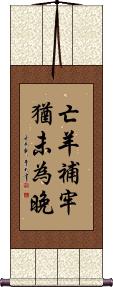
The Chinese idiom shown above came from this reply from Zhuang Xin to the King of Chu almost 2,300 years ago.
It translates roughly into English as...
“Even if you have lost some sheep, it's never too late to mend the fence.”
This proverb, 亡羊补牢犹未为晚, is often used in modern China when suggesting in a hopeful way that someone change their ways, or fix something in their life. It might be used to suggest fixing a marriage, quitting smoking, or getting back on track after taking an unfortunate path in life among other things one might fix in their life.
I suppose in the same way that we might say, “Today is the first day of the rest of your life” in our western cultures to suggest that you can always start anew.
Note: This does have Korean pronunciation but is not a well-known proverb in Korean (only Koreans familiar with ancient Chinese history would know it). Best if your audience is Chinese.
Fall Down Seven Times, Get Up Eight
Always rising after a fall or repeated failures
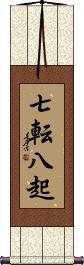
七転八起 is a Japanese proverb that relays the vicissitudes of life, with the meaning “seven times down eight times up.”
Some would more naturally translate it into English as “Always rising after a fall or repeated failures” or compare it to the English, “If at first, you don't succeed, try, try again.”
The first Kanji is literally “7.” The second means “fall down” (sometimes this Kanji means “turn around,” “revolve” or “turn over” but in this case, it holds the meaning of “fall”). The third is “8.” And the last is “get up,” “rouse,” or “rise.”
Basically, if you fail 7 times, you should recover from those events and be prepared to rise an 8th time. This also applies if it is the world or circumstances that knock you down seven times...
...just remember that you have the ability to bounce back from any kind of adversity.
Note: This can be pronounced in two ways. One is “shichi ten hakki” or “shichitenhakki.” The other is “nana korobi ya oki” also written, “nanakorobi-yaoki.”
Special Note: The second character is a Kanji that is not used in China. Therefore, please select a Japanese calligrapher for this title.
This in-stock artwork might be what you are looking for, and ships right away...

Gallery Price: $61.00
Your Price: $33.88

Gallery Price: $72.00
Your Price: $39.88

Gallery Price: $60.00
Your Price: $36.88
Gallery Price: $60.00
Your Price: $39.88

Gallery Price: $61.00
Your Price: $33.88


Gallery Price: $61.00
Your Price: $33.88

Gallery Price: $61.00
Your Price: $33.88

Gallery Price: $31.00
Your Price: $16.88

Gallery Price: $61.00
Your Price: $33.88
Gallery Price: $47.00
Your Price: $26.00

Gallery Price: $61.00
Your Price: $33.88

Gallery Price: $61.00
Your Price: $33.88

Gallery Price: $61.00
Your Price: $33.88
Not the results for Life is One Time that you were looking for?
Below are some entries from our dictionary that may match your Life is One Time search...
| Characters If shown, 2nd row is Simp. Chinese |
Pronunciation Romanization |
Simple Dictionary Definition |
佛 see styles |
fú fu2 fu hotoke ほとけ |
More info & calligraphy: Buddhism / Buddha(surname) Hotoke Buddha, from budh to "be aware of", "conceive", "observe", "wake"; also 佛陀; 浮圖; 浮陀; 浮頭; 浮塔; 勃陀; 勃馱; 沒馱; 母馱; 母陀; 部陀; 休屠. Buddha means "completely conscious, enlightened", and came to mean the enlightener. he Chinese translation is 覺 to perceive, aware, awake; and 智 gnosis, knowledge. There is an Eternal Buddha, see e.g. the Lotus Sutra, cap. 16, and multitudes of Buddhas, but the personality of a Supreme Buddha, an Ādi-Buddha, is not defined. Buddha is in and through all things, and some schools are definitely Pan-Buddhist in the pantheistic sense. In the triratna 三寳 commonly known as 三寳佛, while Śākyamuni Buddha is the first "person" of the Trinity, his Law the second, and the Order the third, all three by some are accounted as manifestations of the All-Buddha. As Śākyamuni, the title indicates him as the last of the line of Buddhas who have appeared in this world, Maitreya is to be the next. As such he is the one who has achieved enlightenment, having discovered the essential evil of existence (some say mundane existence, others all existence), and the way of deliverance from the constant round of reincarnations; this way is through the moral life into nirvana, by means of self-abnegation, the monastic life, and meditation. By this method a Buddha, or enlightened one, himself obtains Supreme Enlightenment, or Omniscience, and according to Māhāyanism leads all beings into the same enlightenment. He sees things not as they seem in their phenomenal but in their noumenal aspects, as they really are. The term is also applied to those who understand the chain of causality (twelve nidānas) and have attained enlightenment surpassing that of the arhat. Four types of the Buddha are referred to: (1) 三藏佛the Buddha of the Tripiṭaka who attained enlightenment on the bare ground under the bodhi-tree; (2) 通佛the Buddha on the deva robe under the bodhi-tree of the seven precious things; (3) 別佛the Buddha on the great precious Lotus throne under the Lotus realm bodhi-tree; and (4) 圓佛the Buddha on the throne of Space in the realm of eternal rest and glory where he is Vairocana. The Hīnayāna only admits the existence of one Buddha at a time; Mahāyāna claims the existence of many Buddhas at one and the same time, as many Buddhas as there are Buddha-universes, which are infinite in number. |
一期 see styles |
yī qí yi1 qi2 i ch`i i chi kazunori かずのり |
(1) one term; one period; (2) first term; first period; (given name) Kazunori A date, fixed time; a life time. |
一生 see styles |
yī shēng yi1 sheng1 i sheng motonaru もとなる |
all one's life; throughout one's life (n,adj-no,adv) (1) whole life; a lifetime; all through life; one existence; a generation; an age; the whole world; the era; (can be adjective with の) (2) (the only, the greatest, etc.) of one's life; (given name) Motonaru All one's life, a whole life time. |
万才 see styles |
manzai まんざい |
(out-dated kanji) two-person comedy act (usu. presented as a fast-paced dialogue, occ. presented as a skit); comic dialogue; (int,n) (1) crying "banzai" (or raising one's hands in the banzai gesture); (2) something worthy of celebration; (3) (archaism) long time; (4) (archaism) eternal life (and prosperity); (interjection) (5) banzai (a celebratory cheer); hurrah (hooray, hurray); (int,n) (1) crying "banzai" (or raising one's hands in the banzai gesture); (2) something worthy of celebration; (3) giving up; (4) (archaism) long time; (5) (archaism) eternal life (and prosperity); (interjection) (6) banzai (a celebratory cheer); hurrah (hooray, hurray); (place-name, surname) Manzai |
万歳 see styles |
manzai まんざい |
door-to-door comedic duo; (int,n) (1) crying "banzai" (or raising one's hands in the banzai gesture); (2) something worthy of celebration; (3) (archaism) long time; (4) (archaism) eternal life (and prosperity); (interjection) (5) banzai (a celebratory cheer); hurrah (hooray, hurray); (int,n) (1) crying "banzai" (or raising one's hands in the banzai gesture); (2) something worthy of celebration; (3) giving up; (4) (archaism) long time; (5) (archaism) eternal life (and prosperity); (interjection) (6) banzai (a celebratory cheer); hurrah (hooray, hurray); (surname) Manzai |
人生 see styles |
rén shēng ren2 sheng1 jen sheng hitoha ひとは |
life (one's time on earth) (one's) life; (female given name) Hitoha human birth |
余命 see styles |
yomei / yome よめい |
remainder of one's life; one's remaining days; time left (to live) |
劫波 see styles |
jié bō jie2 bo1 chieh po kōhi |
kalpa (loanword) (Hinduism) kalpa; also劫簸; 劫跛; v. 劫. Aeon, age. The period of time between the creation and recreation ofa world or universe; also the kalpas offormation, existence, destruction, and non-existence, which four as acomplete period are called mahākalpa 大劫. Eachgreat kalpa is subdivided into four asaṇkhyeya-kalpas (阿僧企耶 i.e. numberless,incalculable): (1) kalpa of destructionsaṃvarta; (2)kalpaof utter annihilation, or empty kalpa 増滅劫; 空劫 saṃvarta-siddha; (3) kalpa of formation 成劫 vivarta; (4) kalpa ofexistence 住劫 vivartasiddha; or they may betaken in the order 成住壤空. Each of the four kalpas is subdivided into twenty antara-kalpas, 小劫 or small kalpas, so that a mahākalpaconsists of eighty small kalpas. Each smallkalpa is divided into a period of 増 increaseand 減 decrease; the increase period is ruled over by the four cakravartīs in succession, i.e. the four ages of iron,copper, silver, gold, during which the length of human life increases by oneyear every century to 84,000 years, and the length of the human body to8,400 feet. Then comes the kalpa of decreasedivided into periods of the three woes, pestilence, war, famine, duringwhich the length of human life is gradually reduced to ten years and thehuman body to 1 foot in height. There are other distinctions of the kalpas. A small kalpa isrepresented as 16,800,000 years, a kalpa as336,000,000 years, and a mahākalpa as1,334,000,000 years. There are many ways of illustrating the length of akalpa, e.g. pass a soft cloth over a solid rock40 li in size once in a hundred years, whenfinally the rock has been thus worn away a kalpa will not yet have passed; or a city of 40 li, filled with mustard seeds, one being removed everycentury till all have gone, a kalpa will notyet have passed. Cf. 成劫. |
命数 see styles |
meisuu / mesu めいすう |
(1) span of life; one's term of existence; one's time (alive); one's days; (2) destiny; fate; (3) (See 命数法) assigning a name to a number |
年月 see styles |
nián yuè nian2 yue4 nien yüeh toshitsuki(p); nengetsu(p) としつき(P); ねんげつ(P) |
months and year; time; days of one's life months and years |
早う see styles |
hayou / hayo はよう |
(adverb) (1) (See 早く・1) early; right away; at once; (2) early time; early stage (in one's life, etc.) |
月日 see styles |
tsukihi つきひ |
(1) time; years; days; (one's) life; (2) (See 日月・1) the Moon and the Sun |
限り see styles |
kagiri かぎり |
(1) limit; limits; bounds; (2) degree; extent; scope; (n,n-suf) (3) the end; the last; (n,adv) (4) (after an adjective, verb, or noun) as long as ...; as far as ...; as much as ...; to the limits of ...; all of ...; (n,adv) (5) (after neg. verb) unless ...; (6) (usu. as 〜の限りではない) (not) included in ...; (not) part of ...; (7) (usu. adj+限り) being very much (in a certain state); extreme amount (of a feeling, etc.); (n-suf,n,adv) (8) ... only (e.g. "one time only", "today only"); (9) (archaism) end of one's life; final moments; death; (10) (archaism) funeral; burial |
餘生 余生 see styles |
yú shēng yu2 sheng1 yü sheng |
the remaining years of one's life; survival (after a disaster) See: 余生 another life[time] |
人生初 see styles |
jinseihatsu / jinsehatsu じんせいはつ |
(noun - becomes adjective with の) (for the) first time in one's life |
迎える see styles |
mukaeru むかえる |
(transitive verb) (1) to go out to meet; (2) to receive; to welcome; to greet; to salute; to hail; to reach; to approach; to enter (a phase, era, etc.); (3) to accept (e.g. as a member of a group or family); (4) to call for; to summon; to invite; (5) to approach (a certain time, a point in one's life, etc.) |
過去世 过去世 see styles |
guō qù shì guo1 qu4 shi4 kuo ch`ü shih kuo chü shih kakoze かこぜ |
{Buddh} (See 前世・ぜんせ) one's previous life The past, past time, past world or age. |
邀える see styles |
mukaeru むかえる |
(transitive verb) (1) to go out to meet; (2) to receive; to welcome; to greet; to salute; to hail; to reach; to approach; to enter (a phase, era, etc.); (3) to accept (e.g. as a member of a group or family); (4) to call for; to summon; to invite; (5) to approach (a certain time, a point in one's life, etc.) |
バンザイ see styles |
banzai バンザイ |
(int,n) (1) crying "banzai" (or raising one's hands in the banzai gesture); (2) something worthy of celebration; (3) (archaism) long time; (4) (archaism) eternal life (and prosperity); (interjection) (5) banzai (a celebratory cheer); hurrah (hooray, hurray) |
花天酒地 see styles |
huā tiān jiǔ dì hua1 tian1 jiu3 di4 hua t`ien chiu ti hua tien chiu ti |
to spend one's time in drinking and pleasure (idiom); to indulge in sensual pleasures; life of debauchery |
遵時養晦 遵时养晦 see styles |
zūn shí yǎng huì zun1 shi2 yang3 hui4 tsun shih yang hui |
to bide one's time, waiting for an opportunity to stage a comeback in public life (idiom) |
闘病生活 see styles |
toubyouseikatsu / tobyosekatsu とうびょうせいかつ |
one's life under medical treatment; (means and time spent) fighting against an illness |
その日暮し see styles |
sonohigurashi そのひぐらし |
(1) financially scraping by; meagre existence (meager); hand to mouth existence; (2) living one's life without plan; living life day-by-day; taking life one day at a time |
其の日暮し see styles |
sonohigurashi そのひぐらし |
(1) financially scraping by; meagre existence (meager); hand to mouth existence; (2) living one's life without plan; living life day-by-day; taking life one day at a time |
その日暮らし see styles |
sonohigurashi そのひぐらし |
(1) financially scraping by; meagre existence (meager); hand to mouth existence; (2) living one's life without plan; living life day-by-day; taking life one day at a time |
其の日暮らし see styles |
sonohigurashi そのひぐらし |
(1) financially scraping by; meagre existence (meager); hand to mouth existence; (2) living one's life without plan; living life day-by-day; taking life one day at a time |
後にも先にも see styles |
atonimosakinimo あとにもさきにも |
(adv,exp) before or since; neither before nor after; no other time in one's life; stressing a particular moment or event as being unique or most extreme |
生まれて初めて see styles |
umaretehajimete うまれてはじめて |
(expression) for the first time in one's life |
先天不足,後天失調 先天不足,后天失调 |
xiān tiān bù zú , hòu tiān shī tiáo xian1 tian1 bu4 zu2 , hou4 tian1 shi1 tiao2 hsien t`ien pu tsu , hou t`ien shih t`iao hsien tien pu tsu , hou tien shih tiao |
to be born with a weak constitution and suffer from ill health during one's life; (fig.) to be problematic from the start, and get even worse over time |
Variations: |
kurasu くらす |
(v5s,vi) (1) to live (on, by, etc.); to lead a life; to get along; to get by; (v5s,vi) (2) to make a living; to earn a livelihood; (v5s,vt,vi) (3) (dated) to spend one's time (doing); to pass one's days (doing); to live; to get on (doing); (suf,v5s) (4) (after the -masu stem of a verb) to do daily; to do all day long; to continue doing |
Click here for more Life is One Time results from our dictionary
The following table may be helpful for those studying Chinese or Japanese...
| Title | Characters | Romaji (Romanized Japanese) | Various forms of Romanized Chinese | |
| Once in a Lifetime | 一期一會 一期一会 | ichigo ichie ichigoichie | yī qī yī huì yi1 qi1 yi1 hui4 yi qi yi hui yiqiyihui | i ch`i i hui ichiihui i chi i hui |
| Each Time You Stumble and Fall, You Gain Experience and Wisdom | 吃一塹長一智 吃一堑长一智 | chī yí qiàn, zhǎng yí zhì chi1 yi2 qian4 zhang3 yi2 zhi4 chi yi qian zhang yi zhi chiyiqianzhangyizhi | ch`ih i ch`ien chang i chih chihichienchangichih chih i chien chang i chih |
|
| One Who Does Not Do Bad Things, Worries Not of Knocks at His Door | 白天不做虧心事夜半敲門不吃驚 白天不做亏心事夜半敲门不吃惊 | bái tiān bú zuò kuī xīn shì yè bàn qiāo mén bù chī jīng bai2 tian1 bu2 zuo4 kui1 xin1 shi4 ye4 ban4 qiao1 men2 bu4 chi1 jing1 bai tian bu zuo kui xin shi ye ban qiao men bu chi jing | pai t`ien pu tso k`uei hsin shih yeh pan ch`iao men pu ch`ih ching pai tien pu tso kuei hsin shih yeh pan chiao men pu chih ching |
|
| Ivy | 常春藤 | cháng chūn téng chang2 chun1 teng2 chang chun teng changchunteng | ch`ang ch`un t`eng changchunteng chang chun teng |
|
| Year-In Year-Out Have Abundance | 年年有餘 年年有馀 | nián nián yǒu yú nian2 nian2 you3 yu2 nian nian you yu niannianyouyu | nien nien yu yü niennienyuyü |
|
| Better Late Than Never | 亡羊補牢猶未為晚 亡羊补牢犹未为晚 | wáng yáng bǔ láo yóu wèi wéi wǎn wang2 yang2 bu3 lao2 you2 wei4 wei2 wan3 wang yang bu lao you wei wei wan | wang yang pu lao yu wei wei wan wangyangpulaoyuweiweiwan |
|
| Fall Down Seven Times, Get Up Eight | 七転八起 | shichi ten hakki / nana korobi ya oki shichi ten haki / nana korobi ya oki | ||
| In some entries above you will see that characters have different versions above and below a line. In these cases, the characters above the line are Traditional Chinese, while the ones below are Simplified Chinese. | ||||

Successful Chinese Character and Japanese Kanji calligraphy searches within the last few hours...



