Many custom options...


And formats...



Not what you want?
Try other similar-meaning words, fewer words, or just one word.
Life Now in Chinese / Japanese...
Buy a Life Now calligraphy wall scroll here!
Personalize your custom “Life Now” project by clicking the button next to your favorite “Life Now” title below...
Live In The Moment / Live In The Now
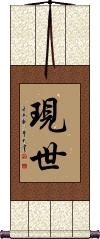
現世 is a very short way to write “live in the moment” or “live in the now” in Japanese.
This short word is open to interpretation. It's used in Japanese Buddhism to mean “the current epoch” or “the current age” (the current age is but a brief moment in the greater scope of existence). In that context, this is pronounced “utsushiyo” or “ustusiyo” in Japanese. Otherwise, it's pronounced “gensei” in Japanese.
Other translation possibilities include:
Earthly world
This world
This life
Present life
Present generation
Present incarnation
This existence
This (momentary) reality
Note: This is also a word in Chinese and old Korean Hanja. While the meaning is more or less the same, this is not recommended for a wall scroll if your audience is Chinese or Korean. This selection is best if your audience is Japanese.
New Beginning
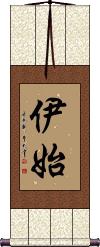
伊始 is a short version of “new beginning” or simply “beginning” in Chinese characters.
You can also translate this as “from this moment on,” “starting now,” or “henceforth.”
In the day-to-day speech, this word can apply to starting a new job, beginning a new career, entering a new chapter of your life, or taking a new position (in politics, scholarship, etc.).
Extreme Faithfulness
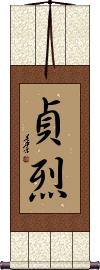
貞烈 is the Japanese Kanji for “Extreme Faithfulness.”
The first Kanji means “firm adherence to one's principles,” chastity (of a woman), chaste, etc.
The second Kanji means ardent, intense, fierce, stern, upright, to give one's life for a noble cause, exploits, achievements, virtuous, and in some contexts, heroic.
Now you get the idea why this refers to someone who is extremely faithful (to a cause, themselves, their religious beliefs, or their philosophy.
Reiki
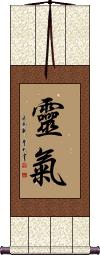
靈氣 is the title of a healing practice now found globally but with origins in Japan.
Special note: Outside of the context of the healing practice of Reiki, this means “aura” or “spiritual essence that surrounds all living things.” A Japanese person unfamiliar with the practice will take the “aura” meaning.
Reiki is a technique for stress reduction and relaxation that also heals. It can be compared to massage but is based on the idea that an unseen “life force energy” flows through us and is what causes us to be alive. If your life force energy is low, you'll be more likely to get sick or feel stressed. If your life force energy is abundant and flowing well, you become more capable of being happy and healthy.
There is a lot of information available if you want to Google this term - my job is to offer the calligraphy while you can decide if it is right for you.


Note: We are showing the ancient (traditional) form of the Reiki Kanji. I have seen Reiki written with the slightly simplified version and this more classic form. If you want the form of Reiki with the two strokes in the shape of an X on the second character and the modern first character, simply click on the Kanji characters to the right.
Note: 靈氣 is also a Chinese word, but in Chinese, these characters create a word that refers to a smart person or someone with high aspirations. It is not read as a healing method in Chinese.
In Korean Hanja, this can be read as a “mysterious atmosphere” by a Korean who is not familiar with the practice of Reiki (still has a cool meaning in Korean).
Empress
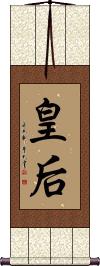
皇后 is the title of empress/emperess, the female form of the emperor.
皇后 is used in Chinese, Japanese Kanji, and old Korean Hanja.
While the emperor's reign was for life, if he died, his wife would hold his power. In this case, a woman was the ultimate ruler of the greater part of East Asia (now China) until her death and the succession of the emperor's firstborn son to lead the empire. Numerous times in various Chinese dynasties, an empress took power in this way.
The first character means emperor by itself.
The second character alone can mean “wife of an emperor or king” (the first character clarifies that we are talking about an empress and not a queen). It can also mean sovereign or last offspring, depending on context.
Note: In some books, this word is translated as queen. While only incorrect if you get technical (because an empress is theoretically a higher level than a queen), the meaning is very similar.
皇后 is sometimes used for the title of queen, but more technically, this is the wife of the emperor (a higher level than a queen).
Better Late Than Never
It's Never Too Late Too Mend
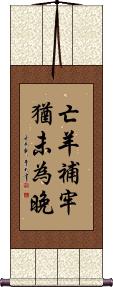
Long ago in what is now China, there were many kingdoms throughout the land. This time period is known as “The Warring States Period” by historians because these kingdoms often did not get along with each other.
Sometime around 279 B.C. the Kingdom of Chu was a large but not particularly powerful kingdom. Part of the reason it lacked power was the fact that the King was surrounded by “yes men” who told him only what he wanted to hear. Many of the King's court officials were corrupt and incompetent which did not help the situation.
The King was not blameless himself, as he started spending much of his time being entertained by his many concubines.
One of the King's ministers, Zhuang Xin, saw problems on the horizon for the Kingdom, and warned the King, “Your Majesty, you are surrounded by people who tell you what you want to hear. They tell you things to make you happy and cause you to ignore important state affairs. If this is allowed to continue, the Kingdom of Chu will surely perish, and fall into ruins.”
This enraged the King who scolded Zhuang Xin for insulting the country and accused him of trying to create resentment among the people. Zhuang Xin explained, “I dare not curse the Kingdom of Chu but I feel that we face great danger in the future because of the current situation.” The King was simply not impressed with Zhuang Xin's words.
Seeing the King's displeasure with him and the King's fondness for his court of corrupt officials, Zhuang Xin asked permission from the King that he may take leave of the Kingdom of Chu, and travel to the State of Zhao to live. The King agreed, and Zhuang Xin left the Kingdom of Chu, perhaps forever.
Five months later, troops from the neighboring Kingdom of Qin invaded Chu, taking a huge tract of land. The King of Chu went into exile, and it appeared that soon, the Kingdom of Chu would no longer exist.
The King of Chu remembered the words of Zhuang Xin and sent some of his men to find him. Immediately, Zhuang Xin returned to meet the King. The first question asked by the King was “What can I do now?”
Zhuang Xin told the King this story:
A shepherd woke one morning to find a sheep missing. Looking at the pen saw a hole in the fence where a wolf had come through to steal one of his sheep. His friends told him that he had best fix the hole at once. But the Shepherd thought since the sheep is already gone, there is no use fixing the hole.
The next morning, another sheep was missing. And the Shepherd realized that he must mend the fence at once. Zhuang Xin then went on to make suggestions about what could be done to reclaim the land lost to the Kingdom of Qin, and reclaim the former glory and integrity of the Kingdom of Chu.
The Chinese idiom shown above came from this reply from Zhuang Xin to the King of Chu almost 2,300 years ago.
It translates roughly into English as...
“Even if you have lost some sheep, it's never too late to mend the fence.”
This proverb, 亡羊补牢犹未为晚, is often used in modern China when suggesting in a hopeful way that someone change their ways, or fix something in their life. It might be used to suggest fixing a marriage, quitting smoking, or getting back on track after taking an unfortunate path in life among other things one might fix in their life.
I suppose in the same way that we might say, “Today is the first day of the rest of your life” in our western cultures to suggest that you can always start anew.
Note: This does have Korean pronunciation but is not a well-known proverb in Korean (only Koreans familiar with ancient Chinese history would know it). Best if your audience is Chinese.
Broken Mirror Rejoined
Used in modern times for divorced couples that come back together
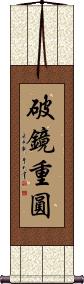
破鏡重圓 is about a husband and wife who were separated and reunited.
About 1500 years ago in China, there lived a beautiful princess named Le Chang. She and her husband Xu De Yan loved each other very much. But when the army of the Sui Dynasty was about to attack their kingdom, disposed of all of their worldly possessions and prepared to flee into exile.
They knew that in the chaos, they might lose track of each other, so the one possession they kept was a bronze mirror which is a symbol of unity for a husband and wife. They broke the mirror into two pieces, and each of them kept half of the mirror. They decided that if separated, they would try to meet at the fair during the 15th day of the first lunar month (which is the lantern festival). Unfortunately, the occupation was brutal, and the princess was forced to become the mistress of the new commissioner of the territory, Yang Su.
At the Lantern Festival the next year, the husband came to the fair to search for his wife. He carried with him his half of the mirror. As he walked through the fair, he saw the other half of the mirror for sale at a junk market by a servant of the commissioner. The husband recognized his wife's half of the mirror immediately, and tears rolled down his face as he was told by the servant about the bitter and loveless life that the princess had endured.
As his tears dripped onto the mirror, the husband scratched a poem into his wife's half of the mirror:
You left me with the severed mirror,
The mirror has returned, but absent are you,
As I gaze in the mirror, I seek your face,
I see the moon, but as for you, I see not a trace.
The servant brought the inscribed half of the mirror back to the princess. For many days, the princess could not stop crying when she found that her husband was alive and still loved her.
Commissioner Yang Su, becoming aware of this saga, realized that he could never obtain the princess's love. He sent for the husband and allowed them to reunite.
This proverb, 破鏡重圓, is now used to describe a couple who has been torn apart for some reason (usually divorce) but have come back together (or remarried).
It seems to be more common these days in America for divorced couples to reconcile and get married to each other again. This will be a great gift if you know someone who is about to remarry their ex.
Undaunted After Repeated Setbacks
Persistence to overcome all challenges
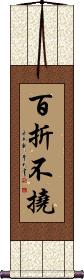
百折不撓 is a Chinese proverb that means “Be undaunted in the face of repeated setbacks.”
More directly translated, it reads, “[Overcome] a hundred setbacks, without flinching.” 百折不撓 is of Chinese origin but is commonly used in Japanese and somewhat in Korean (same characters, different pronunciation).
This proverb comes from a long, and occasionally tragic story of a man that lived sometime around 25-220 AD. His name was Qiao Xuan, and he never stooped to flattery but remained an upright person at all times. He fought to expose the corruption of higher-level government officials at great risk to himself.
Then when he was at a higher level in the Imperial Court, bandits were regularly capturing hostages and demanding ransoms. But when his own son was captured, he was so focused on his duty to the Emperor and the common good that he sent a platoon of soldiers to raid the bandits' hideout, and stop them once and for all even at the risk of his own son's life. While all of the bandits were arrested in the raid, they killed Qiao Xuan's son at first sight of the raiding soldiers.
Near the end of his career, a new Emperor came to power, and Qiao Xuan reported to him that one of his ministers was bullying the people and extorting money from them. The new Emperor refused to listen to Qiao Xuan and even promoted the corrupt Minister. Qiao Xuan was so disgusted that in protest, he resigned from his post as minister (something almost never done) and left for his home village.
His tombstone reads “Bai Zhe Bu Nao” which is now a proverb used in Chinese culture to describe a person of strong will who puts up stubborn resistance against great odds.
My Chinese-English dictionary defines these 4 characters as “keep on fighting despite all setbacks,” “be undaunted by repeated setbacks,” and “be indomitable.”
Our translator says it can mean “never give up” in modern Chinese.
Although the first two characters are translated correctly as “repeated setbacks,” the literal meaning is “100 setbacks” or “a rope that breaks 100 times.” The last two characters can mean “do not yield” or “do not give up.”
Most Chinese, Japanese, and Korean people will not take this absolutely literal meaning but will instead understand it as the title suggests above. If you want a single big word definition, it would be indefatigability, indomitableness, persistence, or unyielding.
See Also: Tenacity | Fortitude | Strength | Perseverance | Persistence
This in-stock artwork might be what you are looking for, and ships right away...

Gallery Price: $61.00
Your Price: $33.88

Gallery Price: $61.00
Your Price: $33.88


Gallery Price: $61.00
Your Price: $33.88

Gallery Price: $61.00
Your Price: $33.88
Gallery Price: $47.00
Your Price: $26.00

Gallery Price: $61.00
Your Price: $33.88

Gallery Price: $31.00
Your Price: $16.88
Gallery Price: $31.00
Your Price: $17.00
Gallery Price: $198.00
Your Price: $109.88

Gallery Price: $61.00
Your Price: $33.88

Gallery Price: $61.00
Your Price: $33.88

Gallery Price: $61.00
Your Price: $33.88
Gallery Price: $90.00
Your Price: $35.00
The following table may be helpful for those studying Chinese or Japanese...
| Title | Characters | Romaji (Romanized Japanese) | Various forms of Romanized Chinese | |
| Live In The Moment Live In The Now | 現世 现世 | gen sei / gensei | xiàn shì / xian4 shi4 / xian shi / xianshi | hsien shih / hsienshih |
| New Beginning | 伊始 | yī shǐ / yi1 shi3 / yi shi / yishi | i shih / ishih | |
| Extreme Faithfulness | 貞烈 | tei retsu / teiretsu | ||
| Reiki | 靈氣 灵气 霊気 | reiki | líng qì / ling2 qi4 / ling qi / lingqi | ling ch`i / lingchi / ling chi |
| Empress | 皇后 | kou gou / kougou / ko go | huáng hòu huang2 hou4 huang hou huanghou | |
| Better Late Than Never | 亡羊補牢猶未為晚 亡羊补牢犹未为晚 | wáng yáng bǔ láo yóu wèi wéi wǎn wang2 yang2 bu3 lao2 you2 wei4 wei2 wan3 wang yang bu lao you wei wei wan | wang yang pu lao yu wei wei wan wangyangpulaoyuweiweiwan |
|
| Broken Mirror Rejoined | 破鏡重圓 破镜重圆 | pò jìng chóng yuán po4 jing4 chong2 yuan2 po jing chong yuan pojingchongyuan | p`o ching ch`ung yüan pochingchungyüan po ching chung yüan |
|
| Undaunted After Repeated Setbacks | 百折不撓 百折不挠 | hyaku setsu su tou hyakusetsusutou hyaku setsu su to | bǎi zhé bù náo bai3 zhe2 bu4 nao2 bai zhe bu nao baizhebunao | pai che pu nao paichepunao |
| In some entries above you will see that characters have different versions above and below a line. In these cases, the characters above the line are Traditional Chinese, while the ones below are Simplified Chinese. | ||||

Successful Chinese Character and Japanese Kanji calligraphy searches within the last few hours...



