Many custom options...


And formats...



Lian in Chinese / Japanese...
Buy a Lian calligraphy wall scroll here!
Personalize your custom “Lian” project by clicking the button next to your favorite “Lian” title below...
1. Lotus
3. Skill Acquired Through Hard Training
4. Belen
5. Blue Lotus
7. Charlene
8. Elaine
9. Eleonora
10. First Love
11. Guylaine
12. Helene
14. Jolene
16. Lover / Beloved
17. Maylene
18. Miren
19. Sense of Shame / Sense of Honor / Integrity / Modesty
20. Mylene
21. Nichiren
22. Solene
23. Solenn
24. Solenne
25. Training / Drill
26. Unbroken
27. Uprightness
28. White Lotus
29. Willem
30. William
31. Willian
32. Yilian
33. Yolaine
34. Charlena
35. Darlene
36. Elena
37. Elenor
38. Ghislaine
39. Helena
40. Jolene
41. Karlene
42. Marilyn
43. Marjolaine
44. Marylin
45. Melinda
46. Mystic Lotus Wisdom of Amitabha
47. Homosexual / Gay
48. Star Lotus
49. Violaine
50. Williams
51. Williamson
52. Wisdom Lotus
53. Yelena
54. Yulianto
55. Discipline
56. Exercise
57. Marie-Helene
59. Homosexual Male / Gay Male
60. Wilhelmina
61. Isshin Alliance / Isshin Federation
62. Discipline / Training / Tempering Character
63. Gay Pride
64. United Kingdom
65. McWilliams
66. Tempering Makes Strong Steel
68. Great Lotus Wisdom - Samadhi Wisdom
69. Fierce and courageous training defeats the strong and protects the body.
70. Love the Flower, Love the Pot also
72. Namu Myoho Renge Kyo / Homage to Lotus Sutra
Lotus
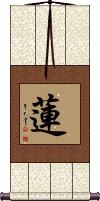
蓮 is another name for “lotus.”
This happens to be a single character that expresses “lotus” in Chinese, and the common name of “lotus” in Japanese and Korean (note that there are two ways to pronounce this character in Korean).
Practice / Train / Drill
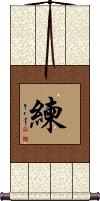
練 is a Chinese, Japanese, and Korean word that is the simplest way to say practice, train, drill, exercise, or to describe the effort taken to perfect one's skill.
Skill Acquired Through Hard Training
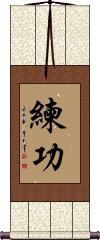
練功 is a martial arts term that can mean to practice and attain working skills, feats of practice/practise, or skills acquired through hard training.
練功 is often used as a martial arts term but can apply to other skills (or professions).
Belen
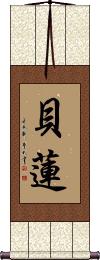
貝蓮 is the transliteration to Mandarin Chinese for the Latin / Spanish name Belén.
Blue Lotus
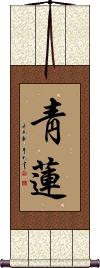
靑蓮 is a common title for Blue Lotus.
靑蓮 is often used in a Buddhist context for blue lotus from the Sanskrit “utpala.” This often refers to the clarity and purity of the lotus blue eyes possessed by a Living Buddha. It can also represent the purity of mind (without desire, suffering, fear, etc.).
Broken Hearted
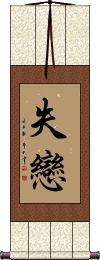
In Chinese, this can mean losing one's love; to breaking up (in a romantic relationship); to feel jilted.
In Japanese Kanji, this means disappointing love, broken heart, unrequited love, or being lovelorn.
失戀 is also valid in old Korean Hanja, which means unrequited love, unreturned love, a disappointment in love, or a broken heart.
Note: In modern Japan, they will tend to write the more simple 失恋 form instead of 失戀. If you order this from the Japanese master calligrapher, expect the more simple modern version to be written (unless you give us instructions to use the older or more traditional version).
Charlene
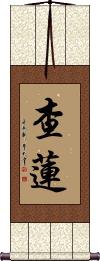
查蓮 is the name Charlene in Chinese (Mandarin).
Elaine
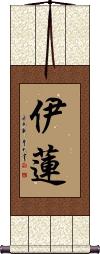
This is the most common transliteration to Mandarin Chinese for the name Elaine.
Eleonora
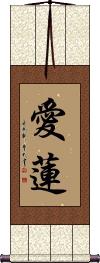
愛蓮 is the name Eleonora in Chinese (Mandarin).
First Love
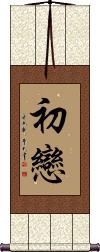
初戀 means “first love” in Chinese and Japanese.
You could also say that it means “first crush,” “first affection,” or “puppy love.”
 In Japanese and Simplified Chinese, they write the second character as shown to the right. If you want this version, click on the characters to the right instead of the Select and Customize button above.
Guylaine
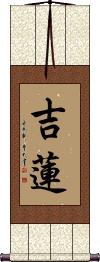
This is a common Mandarin Chinese transliteration for the female French name Guylaine.
Helene
This is the most common Mandarin Chinese transliteration for the female French name Hélène or Helene.
Integrity / Honesty
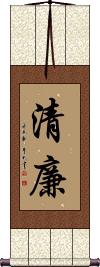
清廉 means honest, uncorrupted, honesty, integrity, purity, and unselfishness.
In Japanese, this can also be the given name Kiyoyuki.
Jolene
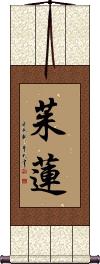
茱蓮 is one transliteration to Mandarin Chinese for the name Jolene.
This applies if you pronounce Jolene like “Joe-lean.”
Longing for Lover
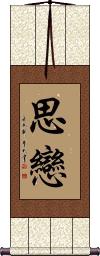
思戀 is a term used for when you miss a lover.
It suggests that you are separated (not by choice) and have longed for each other. It's a strong feeling of missing your lover.
Lover / Beloved
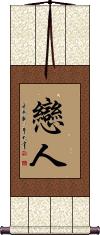
戀人 means lover, sweetheart, or beloved in Chinese, Japanese Kanji, and old Korean Hanja.
This term is gender-neutral, so that anyone can use it.
 In modern Japan and China, the first character has been simplified. We suggest the traditional version, as shown above if your audience is Chinese or Korean. However, this generation of Japanese are more likely to recognize the simplified version. If you want this simple (modern Japanese) version, please click on the image shown to the right, instead of the button above.
Maylene
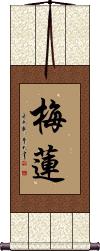
This is a common Mandarin Chinese transliteration for the female name Maylene.
Miren
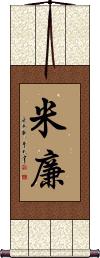
This is a common Mandarin Chinese transliteration for the male Spanish/Latin name Miren.
Sense of Shame / Sense of Honor / Integrity / Modesty (Korean)
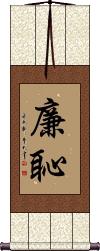
廉恥 simultaneously means “sense of honor” and “sense of shame” in Korean.
This term is often used as a tenet of Taekwondo, where the English terms “integrity” and “modesty” are applied.
廉恥 is also a Chinese word, though it is usually read with the “sense of shame” meaning, and is a poor choice for a wall scroll if your audience is Chinese.
Mylene
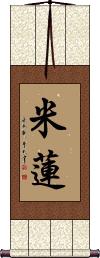
This is a common Mandarin Chinese transliteration for the female French name Mylène or Mylene.
Nichiren
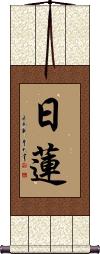
日蓮 is the title Nichiren.
This title refers to a Buddhist priest who lived from 1222 to 1282. He is the founder of the Nichiren sect of Buddhism.
According to historical documents, the Nichiren sect was established in 1252. Adding the character 宗 for sect, this would be 日蓮宗 (Nichiren sect), which is also known as the 法華宗 or Lotus sect.
According to Soothill-Hodous...
Nichiren's chief tenets are the three great mysteries 三大祕法, representing the trikāya:
1. 本尊 or chief object of worship, being the great maṇḍala of the worlds of the ten directions, or universe, i.e., the body or nirmāṇakāya of Buddha.
2. 題目 the title of the Lotus Sutra 妙法蓮華經 Myo-ho-ren-ge-kyo, preceded by Namo, or “Adoration to the scripture of the lotus of the wonderful law,” for it is Buddha's spiritual body.
3. 戒壇 the altar of the law, which is also the title of the Lotus as above; the believer, wherever he is, dwells in the Pure-land of calm light 寂光淨土, the saṃbhogakāya.
Solene
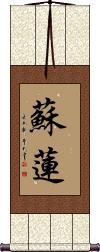
This is a common Mandarin Chinese transliteration for the female French name Solène or Solene.
Solenn
This is a common Mandarin Chinese transliteration for the female French name Solenn.
Solenne
蘇蓮 is the name Solenne in Chinese (Mandarin).
Training / Drill
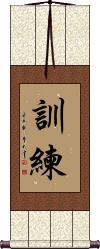
If training or drill is important to you (especially for military drill and training), 訓練 might be just the thing for a drill master to hang behind his/her desk.
This term is universal in Chinese, Japanese Kanji, and old Korean Hanja. It can also mean practice or exercise, depending on context.
Unbroken
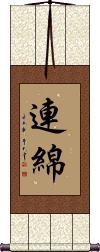
連綿 is a Chinese and Japanese Kanji word meaning: continuous; unbroken; uninterrupted; extending forever into the distance (of a mountain range, river, etc.).
Uprightness
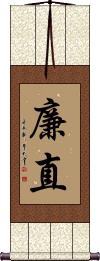
This Chinese and Japanese title means “upright and honest,” “incorruptible,” “squeaky clean,” “integrity,” or “uprightness.”
White Lotus
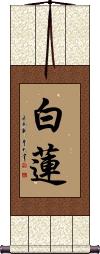
白蓮 is the title for the white lotus (flower) or a short name for the White Lotus society.
The white lotus represents purity or a pure heart and is often associated with Buddhism.
Notes: This can be the Japanese given name Byakuren. In the Buddhist context, the white lotus represented by these characters is originally puṇḍarīka in Sanskrit.
Willem
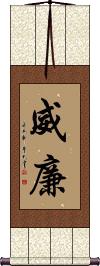
威廉 is the name Willem in Chinese (Mandarin).
William
威廉 is the name William in Chinese (Mandarin).
Willian
威廉 is the name Willian in Chinese (Mandarin).
Yilian
伊蓮 is the name Yilian in Chinese (Mandarin).
Yolaine
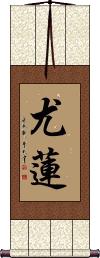
This is a common Mandarin Chinese transliteration for the female French name Yolaine.
Charlena
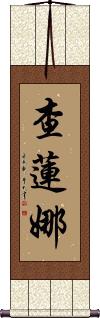
This is a common Mandarin Chinese transliteration for the female name Charlena.
Darlene
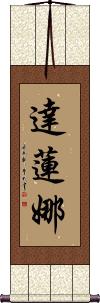
達蓮娜 is the name Darlene in Chinese (Mandarin).
Elena
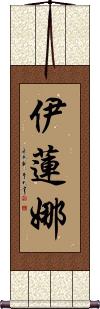
伊蓮娜 is the name Elena in Chinese (Mandarin).
Elenor
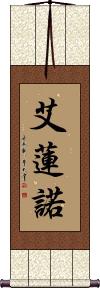
艾蓮諾 is the name Elenor in Chinese (Mandarin).
Ghislaine
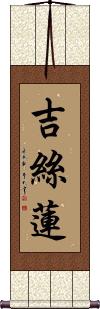
This is a common Mandarin Chinese transliteration for the female French name Ghislaine.
Helena
伊蓮娜 is the name Helena in Chinese (Mandarin).
Jolene
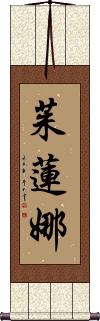
茱蓮娜 is another transliteration to Mandarin Chinese for the name Jolene.
This applies if you pronounce Jolene like “Joe-lean-ah.”
Karlene
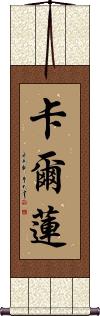
This is a common Mandarin Chinese transliteration for the male German name Karlene.
Marilyn
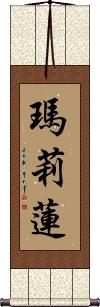
This is the most common transliteration to Mandarin Chinese for the name Marilyn.
Marjolaine
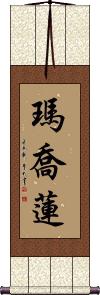
This is a common Mandarin Chinese transliteration for the female French name Marjolaine.
Marylin
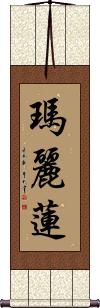
瑪麗蓮 is the name Marylin in Chinese (Mandarin).
Melinda
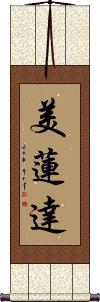
美蓮達 is the name Melinda in Chinese (Mandarin).
Mystic Lotus Wisdom of Amitabha
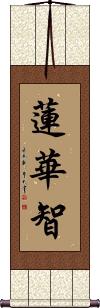
蓮華智 is the lotus or mystic wisdom of Amitābha.
It's one of the five kinds of wisdom in Buddhism.
Homosexual / Gay
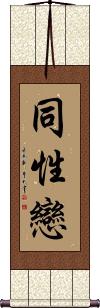
A great way to tell your Chinese friends about your lifestyle while keeping your Anglo friends in the dark.
Kind of a huge bold sign to say “I'm Gay” without anybody knowing.
同性戀 literally means “same-sex feeling” or “same-sex affection” in Chinese.
Star Lotus
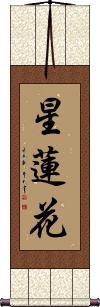
星蓮花 is the title Star Lotus in Chinese.
For star lotus, some may write 星荷 instead - especially in Taiwan for reasons I am not sure of. 星荷 is sometimes romanized as “sing he” or “sing ho” though it would be “xīng hé” in mainland pinyin romanization. If you need a particular version or more info, please get in touch with me.
Violaine
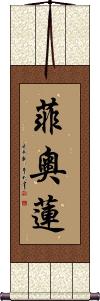
This is a common Mandarin Chinese transliteration for the female French name Violaine.
Williams
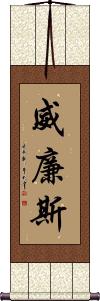
威廉斯 is the name Williams in Chinese (Mandarin).
Williamson

威廉森 is the name Williamson in Chinese (Mandarin).
Wisdom Lotus
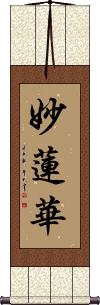
妙蓮華 means the wonderful lotus and the symbol of the pure wisdom of Buddha.
This lotus is unsullied in the midst of the impurity of the world.
Yelena
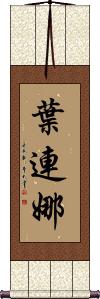
葉連娜 is the name Yelena in Chinese (Mandarin).
Yulianto
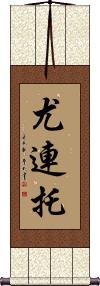
尤連托 is the name Yulianto in Chinese (Mandarin).
Discipline

鍛練 is the Japanese Kanji and Korean Hanja word used for discipline.
This has a meaning like “forging or creating something from lots of training and practice.” My Japanese dictionary translates this as “tempering, forging, hardening, disciplining, training.”
This is for Japanese and Korean only. In Chinese, these characters might be translated as (physical) “exercise.”


The modern form of the second Japanese Kanji looks like the first image to the right. There’s also an alternate modern form after that, and finally, an alternate traditional form. Because calligraphy is an art, the calligrapher could choose any of these possible forms. Let us know if you have a preference.
See Also: Self-Control | Will-Power
Exercise
(for body or mind)
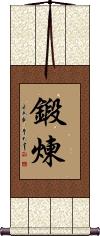
鍛煉/鍛鍊 means to exercise in much the same way we use the word exercise in English.
This can be exercising your body at the gym or exercising your mind in studies. Most of the time, this refers to physical exercise.
This can also be translated as to temper, to toughen, to train, to drill, to forge, or simply discipline.
Marie-Helene
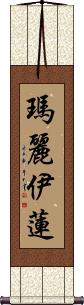
This is a common Mandarin Chinese transliteration for the female French name Marie-Hélène or Marie-Helene.
Misery Loves Company
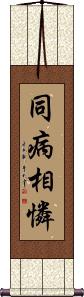
同病相憐 is a Chinese proverb that means “fellow sufferers empathize with each other” or to match it with a western idiom, “misery loves company.” This is also somewhat known in Korean Hanja.
This could be two people who were just dumped by a girlfriend/boyfriend or just divorced. They're drawn together either by their misery or because of the need to share their miserable experience with someone else.
同病相憐 is probably the saddest proverb in our collection.
Literally, the characters mean:
同 together with
病 illness, sickness, disease (in this case, just the mental anguish after some kind of event or life issue)
相 mutual, reciprocal, each other
憐 pity, sympathize
In Japanese, this is written with two extra Hiragana on the end like this: 同病相憐れむ
If you want the Japanese version,
don’t
use the button above but click here instead: Misery Loves Company in Japanese
Homosexual Male / Gay Male
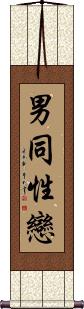
You need the male character in front of the word for homosexual in Chinese to create this word.
It's a much nicer way to say “Gay Male” than English words like Fag, Fairy, Sissy, Puff, Poof, Poofster, Swish, or Pansy. Although I suppose it could be used as a substitute for Nancy Boy, Queer, or Queen (for which, last time I checked, my gay friends said were OK in the right context).
For those of you who think China is a restrictive society - there are at least two gay discos in Beijing, the capital of China. It's at least somewhat socially acceptable to be a gay male in China. However, lesbians seem to be shunned a bit.
I think the Chinese government has realized that the 60% male population means not everybody is going to find a wife (every gay male couple that exists means two more women in the population are available for the straight guys), and the fact that it is biologically impossible for men to give birth, may be seen as helping to decrease the over-population in China.
Wilhelmina
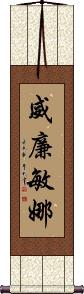
威廉敏娜 is the name Wilhelmina in Chinese (Mandarin).
Isshin Alliance / Isshin Federation

一心連盟 can be translated as “Isshin Federation.”
This term is commonly used for organizations or affiliations within martial arts communities. In calligraphy, it often conveys legitimacy, unity, and shared standards.
Cross-language note: while the core meaning is broadly shared across Chinese and Japanese usage, nuance and frequency can differ by tradition.
Discipline / Training / Tempering Character
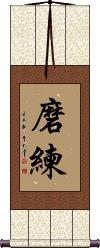
磨鍊 is a form of discipline which suggests training of the mind and character, aimed at producing self-control, obedience, etc.
One of my Chinese-English dictionaries even translates this as “tempering oneself” or turning yourself into hardened steel.
In old Korean Hanja, they use these characters in reverse order but with the same meaning. If you want the Korean version, please click this link instead of the button above: Korean version.
Gay Pride
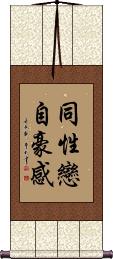
同性戀自豪感 or “Gay Pride” is a new idea in China. It's so new, that we may have just started the movement by translating this phrase.
If they ever do start having gay pride parades in China, my best guess is that these 6 characters will constitute the term they use to title the parade/movement.
Who knows, maybe in 10 years they will have a pride parade march straight past Tian'anmen Square on Chang An Street (the main drag in Beijing).
United Kingdom
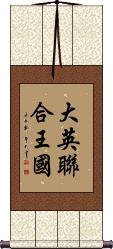
大英聯合王國 is the Chinese name for the United Kingdom.
See Also: Great Britain | England | Scotland | Ireland | Europe
McWilliams

麥克威廉姆斯 is the name McWilliams in Chinese (Mandarin).
Tempering Makes Strong Steel
Hardship Develops Strong Character
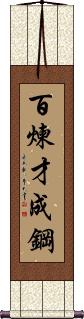
百煉才成鋼 / 百煉纔成鋼 literally translates as: Only after much tempering is steel produced.
Figuratively, this means: True character must be tested in hardship.
This is a mild form of saying, “Whatever doesn't kill me, makes me stronger.”
United Arab Emirates
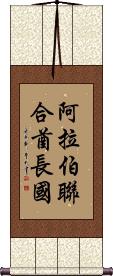
Great Lotus Wisdom - Samadhi Wisdom
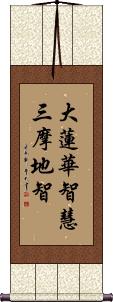
大蓮華智慧三摩地智 is the title for “The wisdom of the great lotus, samādhi-wisdom.”
This is also the penetrating wisdom of Amitābha.
Fierce and courageous training defeats the strong and protects the body.

This is a martial arts phrase that roughly translates as, “Fierce and courageous training defeats the strong and protects the body,” or “Brave and fierce training result in victory over the strong and defend the body.”
Love the Flower, Love the Pot also
Love Me, Love My Dog
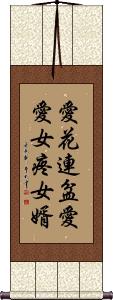
This proverb, 爱花连盆爱爱女疼女婿, literally translates as “If one loves a flower, [one will] love its pot; [if one really] loves [one's] daughter, [one will also] love [one's] son-in-law.”
Figuratively, is similar to the English proverbs:
Love me, love my dog.
Love for a person extends even to the crows on his roof.
Perseverance is the Key
Skills cannot be perfected without perseverance in practice
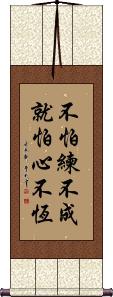
不怕练不成就怕心不恒 literally translates as: Do not worry about not being able to master [a skill]; What [one should] be concerned about is lack of perseverance.
Figuratively, this means: One's skills cannot be perfected without perseverance in practice.
For me, I've learned that you can only get so much from school or studying. You've really got to do “on-the-job training” to perfect your ability and skill.
For martial arts students: You can read about a kick in a book, or someone can tell you about a certain kick but until you practice the kick, there's no way you'll master it.
Namu Myoho Renge Kyo / Homage to Lotus Sutra
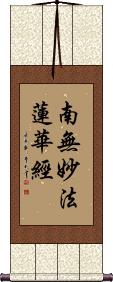
南無妙法蓮華經 is sometimes translated as the “Devotion to the Law of the Lotus Flower Scripture.”
This is a meditation chant and homage to the Lotus Sutra, used by Nichiren Buddhists in Japan.
This is also a chant used in China by certain sects of Buddhism that celebrate the deity Guanyin.
Also romanized as “Nam Myōhō Renge Kyō” or without accents as “Nam Myoho Renge Kyo.”


Original
Traditional
Version
The last character was originally written as seen on the left. Sometimes, you will see it written in the Japanese variant form as shown on the right. If you want this Japanese variant, click on the "Modern Japanese Variant" text instead of the button up by the main title of this entry.
Taekwondo Tenets / Spirit of Taekwon-do
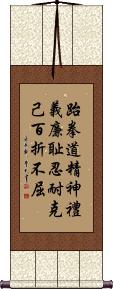
跆拳道精神禮義廉耻忍耐克己百折不屈 is General Choi's writing that is often called “The Tenets of Taekwon-do.”
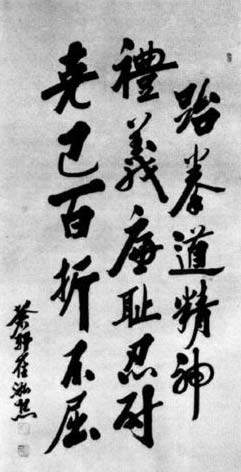
The actual title would be translated as “Taekwondo Spirit” or “The Spirit of Taekwondo.” It was originally written in Korean Hanja (Chinese characters used in Korea for about 1600 years).
General Choi's original calligraphy is shown to the right. Your custom calligraphy will be unique, and not an exact match, as each calligrapher has their own style.In modern times, the common form of written Korean is Hangul (a phonetic character set). The table below shows the text in Hangul and Hanja along with a pronunciation guide and a brief English translation:
| Traditional Korean Hanja | Modern Korean Hangul | Pronunciation | English |
| 跆拳道精神 | 태권도정신 | tae gweon do jeong sin | Taekwondo Spirit |
| 禮儀 | 예의 | ye yi | Courtesy / Etiquette / Propriety / Decorum / Formality |
| 廉耻 | 염치 | yeom ci | Integrity / Sense of Honor |
| 忍耐 | 인내 | in nae | Patience / Perseverance / Endurance |
| 克己 | 극기 | geug gi | Self-Control / Self-Denial / Self-Abnegation |
| 百折不屈 | 백절불굴 | baeg jeor bur gur | Indomitable Spirit (Undaunted even after repeated attacks from the opponent) |
| Note that the pronunciation is the official version now used in South Korea. However, it is different than what you may be used to. For instance, “Taekwon-do” is “tae gweon do.” This new romanization is supposed to be closer to actual Korean pronunciation. | |||
Tang Soo Do Tenets
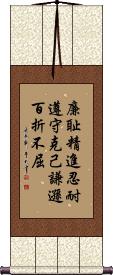
廉耻精進忍耐遵守克己謙遜百折不屈 are the tenets of Tang Soo Do.
| English | Old Hanja | Modern Hangul | Pronunciation |
| 1. Integrity | 廉耻 | 렴치 or 염치 | yeom ci |
| 2. Concentration | 精進 | 정진 | jeong jin |
| 3. Perseverance | 忍耐 | 인내 | in nae |
| 4. Respect & Obedience | 遵守 | 준수 | jun su |
| 5. Self-Control | 克己 | 극기 | geug gi |
| 6. Humility | 謙遜 | 겸손 | gyeom son |
| 7. Indomitable Spirit | 百折不屈 | 백절불굴 | baeg jeor bur gur |
After some research, it appears this list was compiled in English based on Taekwondo tenets. We filled in a few of the words that did not have a corresponding Hanja or Hangul. If someone else has a better list with characters included, please contact me.
Return to Dwell in Gardens and Fields Poem

This is Tao Yuanming's poem, “Returning to Dwell in Gardens and Fields.”
少無適俗韻 性本愛丘山。
誤落塵網中 一去三十年。
羈鳥戀舊林 池魚思故淵。
開荒南野際 抱拙歸園田。
方宅十餘畝 草屋八九間。
榆柳蔭後簷 桃李羅堂前。
暖暖遠人村 依依墟裡煙。
狗吠深巷中 雞鳴桑樹顛。
戶庭無塵雜 虛室有餘閒。
久在樊籠裡 復得返自然。
Not the results for Lian that you were looking for?
Below are some entries from our dictionary that may match your Lian search...
| Characters If shown, 2nd row is Simp. Chinese |
Pronunciation Romanization |
Simple Dictionary Definition |
練 练 see styles |
liàn lian4 lien ren れん |
More info & calligraphy: Practice / Train / Drill(surname) Ren To train, practise, drill, exercise. |
蓮 莲 see styles |
lián lian2 lien ren れん |
More info & calligraphy: Lotus(out-dated or obsolete kana usage) (1) (kana only) sacred lotus (Nelumbo nucifera); Indian lotus; lotus; (2) rose of Sharon (Hibiscus syriacus); (kana only) sacred lotus (Nelumbo nucifera); Indian lotus; lotus; (f,m,s) Ren puṇḍarīka, the lotus, especially the white lotus, Numphoea alba; padma, especially the Nelumbium speciosum; utpala, the Nymphoea coerulea, the blue lotus; kumuda, Nymphoea esculenta, white lotus, or N. rubra, red lotus; nīlotpala, N. cyanea, a blue lotus. The first four are called white, red, blue, and yellow lotuses; but the white lotus is generally meant unless otherwise specified. |
初戀 初恋 see styles |
chū liàn chu1 lian4 ch`u lien chu lien hatsukohi はつこひ |
More info & calligraphy: First Love(surname) Hatsukohi |
失戀 失恋 see styles |
shī liàn shi1 lian4 shih lien |
More info & calligraphy: Broken HeartedSee: 失恋 |
威廉 see styles |
wēi lián wei1 lian2 wei lien |
More info & calligraphy: Willian |
廉恥 廉耻 see styles |
lián chǐ lian2 chi3 lien ch`ih lien chih renchi れんち |
More info & calligraphy: Sense of Shame / Sense of Honor / Integrity / Modesty (Korean)sense of honour (honor) |
廉直 see styles |
lián zhí lian2 zhi2 lien chih kiyonao きよなお |
More info & calligraphy: Uprightness(noun or adjectival noun) integrity; uprightness; (personal name) Kiyonao |
思戀 思恋 see styles |
sī liàn si1 lian4 ssu lien |
More info & calligraphy: Longing for Lover |
戀人 恋人 see styles |
liàn rén lian4 ren2 lien jen |
More info & calligraphy: Lover / BelovedSee: 恋人 |
日蓮 日莲 see styles |
rì lián ri4 lian2 jih lien nichiren にちれん |
More info & calligraphy: NichirenNichiren, the Japanese founder, in A. D. 1252, of the 日蓮宗 Nichiren sect, which is also known as the 法華宗 or Lotus sect. Its chief tenets are the three great mysteries 三大祕法, representing the trikāya: (1) 本尊 or chief object of worship, being the great maṇḍala of the worlds of the ten directions, or universe, i. e. the body or nirmāṇakāya of Buddha; (2) 題目 the title of the Lotus Sutra 妙法蓮華經 Myo-ho-ren-gwe-kyo, preceded by Namo, or, 'Adoration to the scripture of the lotus of the wonderful law, ' for it is Buddha's spiritual body; (3) 戒壇 the altar of the law, which is also the title of the Lotus as above; the believer, wherever he is, dwells in the Pure-land of calm light 寂光淨土, the saṃbhogakāya. |
清廉 see styles |
qīng lián qing1 lian2 ch`ing lien ching lien kiyoyuki きよゆき |
More info & calligraphy: Integrity / Honesty(noun or adjectival noun) honest; upright; cleanhanded; unselfish; (given name) Kiyoyuki |
白蓮 白莲 see styles |
bái lián bai2 lian2 pai lien byakuren びゃくれん |
More info & calligraphy: White Lotus(1) white lotus; (2) purity; pure heart; (given name) Byakuren (白蓮華); 分陀利 puṇḍarīka, the white lotus. |
練功 练功 see styles |
liàn gōng lian4 gong1 lien kung renkou / renko れんこう |
More info & calligraphy: Skill Acquired Through Hard Training{MA} skills acquired through hard training; feats of practice |
訓練 训练 see styles |
xùn liàn xun4 lian4 hsün lien kunren くんれん |
More info & calligraphy: Training / Drill(noun, transitive verb) training; drill; practice; discipline |
連綿 连绵 see styles |
lián mián lian2 mian2 lien mien renmen れんめん |
More info & calligraphy: Unbroken(adj-t,adv-to) unbroken; uninterrupted; on and on; continuous to bind on |
靑蓮 靑莲 see styles |
qīng lián qing1 lian2 ch`ing lien ching lien |
More info & calligraphy: Blue Lotus |
同性戀 同性恋 see styles |
tóng xìng liàn tong2 xing4 lian4 t`ung hsing lien tung hsing lien |
More info & calligraphy: Homosexual / Gay |
妙蓮華 妙莲华 see styles |
miào lián huá miao4 lian2 hua2 miao lien hua myō renge |
More info & calligraphy: Wisdom Lotus |
蓮華智 莲华智 see styles |
lián huá zhì lian2 hua2 zhi4 lien hua chih renge chi |
More info & calligraphy: Mystic Lotus Wisdom of Amitabha |
亷 廉 see styles |
lián lian2 lien |
old variant of 廉[lian2] See: 廉 |
匲 奁 see styles |
lián lian2 lien |
variant of 奩|奁[lian2] |
匳 奁 see styles |
lián lian2 lien |
variant of 奩|奁[lian2] |
嗹 see styles |
lián lian2 lien |
chattering |
奩 奁 see styles |
lián lian2 lien |
bridal trousseau |
帘 see styles |
lián lian2 lien |
flag used as a shop sign; variant of 簾|帘[lian2] |
廉 see styles |
lián lian2 lien ren れん |
incorruptible; honest; inexpensive; to investigate (old); side wall of a traditional Chinese house (old) (noun or adjectival noun) (1) (obsolete) cheap; inexpensive; (noun or adjectival noun) (2) (obsolete) pure; honest; upright; (surname, female given name) Ren |
憐 怜 see styles |
lián lian2 lien ren れん |
to pity (female given name) Ren Commiserate, pity, sympathize, charitable. |
戀 恋 see styles |
liàn lian4 lien ren こい |
to feel attached to; to long for; to love (out-dated kanji) (romantic) love To be fond of, hanker after, cleave to; 戀慕. |
摙 see styles |
liǎn lian3 lien |
to transport; to remove to take |
斂 敛 see styles |
liàn lian4 lien ren れん |
variant of 殮|殓[lian4] (given name) Ren |
Click here for more Lian results from our dictionary
The following table may be helpful for those studying Chinese or Japanese...
| Title | Characters | Romaji (Romanized Japanese) | Various forms of Romanized Chinese | |
| Lotus | 蓮 莲 | hasu | lián / lian2 / lian | lien |
| Practice Train Drill | 練 练 | ren | liàn / lian4 / lian | lien |
| Skill Acquired Through Hard Training | 練功 练功 | renkou / renko | liàn gōng lian4 gong1 lian gong liangong | lien kung lienkung |
| Belen | 貝蓮 贝莲 | bèi lián / bei4 lian2 / bei lian / beilian | pei lien / peilien | |
| Blue Lotus | 靑蓮 靑莲 | seiren | qing lián / qing lian2 / qing lian / qinglian | ch`ing lien / chinglien / ching lien |
| Broken Hearted | 失戀 失恋 | shitsuren | shī liàn / shi1 lian4 / shi lian / shilian | shih lien / shihlien |
| Charlene | 查蓮 查莲 | chá lián / cha2 lian2 / cha lian / chalian | ch`a lien / chalien / cha lien | |
| Elaine | 伊蓮 伊莲 | yī lián / yi1 lian2 / yi lian / yilian | i lien / ilien | |
| Eleonora | 愛蓮 爱莲 | ài lián / ai4 lian2 / ai lian / ailian | ai lien / ailien | |
| First Love | 初戀 初恋 | hatsukohi / hatsukoi | chū liàn / chu1 lian4 / chu lian / chulian | ch`u lien / chulien / chu lien |
| Guylaine | 吉蓮 吉莲 | jí lián / ji2 lian2 / ji lian / jilian | chi lien / chilien | |
| Helene | 伊蓮 伊莲 | yī lián / yi1 lian2 / yi lian / yilian | i lien / ilien | |
| Integrity Honesty | 清廉 | sei ren / seiren | qīng lián qing1 lian2 qing lian qinglian | ch`ing lien chinglien ching lien |
| Jolene | 茱蓮 茱莲 | zhū lián / zhu1 lian2 / zhu lian / zhulian | chu lien / chulien | |
| Longing for Lover | 思戀 思恋 | sī liàn / si1 lian4 / si lian / silian | ssu lien / ssulien | |
| Lover Beloved | 戀人 恋人 | koi bito / koibito | liàn rén / lian4 ren2 / lian ren / lianren | lien jen / lienjen |
| Maylene | 梅蓮 梅莲 | méi lián / mei2 lian2 / mei lian / meilian | mei lien / meilien | |
| Miren | 米廉 | mǐ lián / mi3 lian2 / mi lian / milian | mi lien / milien | |
| Sense of Shame Sense of Honor Integrity Modesty (Korean) | 廉恥 廉耻 | ren chi / renchi | lián chǐ / lian2 chi3 / lian chi / lianchi | lien ch`ih / lienchih / lien chih |
| Mylene | 米蓮 米莲 | mǐ lián / mi3 lian2 / mi lian / milian | mi lien / milien | |
| Nichiren | 日蓮 日莲 | nichi ren / nichiren | rì lián / ri4 lian2 / ri lian / rilian | jih lien / jihlien |
| Solene | 蘇蓮 苏莲 | sū lián / su1 lian2 / su lian / sulian | su lien / sulien | |
| Solenn | 蘇蓮 苏莲 | sū lián / su1 lian2 / su lian / sulian | su lien / sulien | |
| Solenne | 蘇蓮 苏莲 | sū lián / su1 lian2 / su lian / sulian | su lien / sulien | |
| Training Drill | 訓練 训练 | kunren | xùn liàn / xun4 lian4 / xun lian / xunlian | hsün lien / hsünlien |
| Unbroken | 連綿 连绵 | ren men / renmen | lián mián lian2 mian2 lian mian lianmian | lien mien lienmien |
| Uprightness | 廉直 | kiyonao / kiyotada | lián zhí / lian2 zhi2 / lian zhi / lianzhi | lien chih / lienchih |
| White Lotus | 白蓮 白莲 | byakuren | bái lián / bai2 lian2 / bai lian / bailian | pai lien / pailien |
| Willem | 威廉 | wēi lián / wei1 lian2 / wei lian / weilian | wei lien / weilien | |
| William | 威廉 | wēi lián / wei1 lian2 / wei lian / weilian | wei lien / weilien | |
| Willian | 威廉 | wēi lián / wei1 lian2 / wei lian / weilian | wei lien / weilien | |
| Yilian | 伊蓮 伊莲 | yī lián / yi1 lian2 / yi lian / yilian | i lien / ilien | |
| Yolaine | 尤蓮 尤莲 | yóu lián / you2 lian2 / you lian / youlian | yu lien / yulien | |
| Charlena | 查蓮娜 查莲娜 | chá lián nà cha2 lian2 na4 cha lian na chalianna | ch`a lien na chalienna cha lien na |
|
| Darlene | 達蓮娜 达莲娜 | dá lián nà da2 lian2 na4 da lian na dalianna | ta lien na talienna |
|
| Elena | 伊蓮娜 伊莲娜 | yī lián nà yi1 lian2 na4 yi lian na yilianna | i lien na ilienna |
|
| Elenor | 艾蓮諾 艾莲诺 | ài lián nuò ai4 lian2 nuo4 ai lian nuo ailiannuo | ai lien no ailienno |
|
| Ghislaine | 吉絲蓮 吉丝莲 | jí sī lián ji2 si1 lian2 ji si lian jisilian | chi ssu lien chissulien |
|
| Helena | 伊蓮娜 伊莲娜 | yī lián nà yi1 lian2 na4 yi lian na yilianna | i lien na ilienna |
|
| Jolene | 茱蓮娜 茱莲娜 | zhū lián nà zhu1 lian2 na4 zhu lian na zhulianna | chu lien na chulienna |
|
| Karlene | 卡爾蓮 卡尔莲 | kǎ ěr lián ka3 er3 lian2 ka er lian kaerlian | k`a erh lien kaerhlien ka erh lien |
|
| Marilyn | 瑪莉蓮 玛莉莲 | mǎ lì lián ma3 li4 lian2 ma li lian malilian | ma li lien malilien |
|
| Marjolaine | 瑪喬蓮 玛乔莲 | mǎ qiáo lián ma3 qiao2 lian2 ma qiao lian maqiaolian | ma ch`iao lien machiaolien ma chiao lien |
|
| Marylin | 瑪麗蓮 玛丽莲 | mǎ lì lián ma3 li4 lian2 ma li lian malilian | ma li lien malilien |
|
| Melinda | 美蓮達 美莲达 | měi lián dá mei3 lian2 da2 mei lian da meilianda | mei lien ta meilienta |
|
| Mystic Lotus Wisdom of Amitabha | 蓮華智 莲华智 | renge chi / rengechi | lián huá zhì lian2 hua2 zhi4 lian hua zhi lianhuazhi | lien hua chih lienhuachih |
| Homosexual Gay | 同性戀 同性恋 | tóng xìng liàn tong2 xing4 lian4 tong xing lian tongxinglian | t`ung hsing lien tunghsinglien tung hsing lien |
|
| Star Lotus | 星蓮花 星莲花 | xīng lián huā xing1 lian2 hua1 xing lian hua xinglianhua | hsing lien hua hsinglienhua |
|
| Violaine | 菲奧蓮 菲奥莲 | fēi ào lián fei1 ao4 lian2 fei ao lian feiaolian | fei ao lien feiaolien |
|
| Williams | 威廉斯 | wēi lián sī wei1 lian2 si1 wei lian si weiliansi | wei lien ssu weilienssu |
|
| Williamson | 威廉森 | wēi lián sēn wei1 lian2 sen1 wei lian sen weiliansen | wei lien sen weiliensen |
|
| Wisdom Lotus | 妙蓮華 妙莲华 | myō renge / myōrenge | miào lián huá miao4 lian2 hua2 miao lian hua miaolianhua | miao lien hua miaolienhua |
| Yelena | 葉連娜 叶连娜 | yè lián nà ye4 lian2 na4 ye lian na yelianna | yeh lien na yehlienna |
|
| Yulianto | 尤連托 尤连托 | yóu lián tuō you2 lian2 tuo1 you lian tuo youliantuo | yu lien t`o yuliento yu lien to |
|
| Discipline | 鍛練 / 鍛錬 锻练 | tan ren / tanren | duàn liàn duan4 lian4 duan lian duanlian | tuan lien tuanlien |
| Exercise | 鍛煉 / 鍛鍊 锻炼 | duàn liàn duan4 lian4 duan lian duanlian | tuan lien tuanlien |
|
| Marie-Helene | 瑪麗伊蓮 玛丽伊莲 | mǎ lì yī lián ma3 li4 yi1 lian2 ma li yi lian maliyilian | ma li i lien maliilien |
|
| Misery Loves Company | 同病相憐 同病相怜 | doubyou shou awaremu doubyoushouawaremu dobyo sho awaremu | tóng bìng xiāng lián tong2 bing4 xiang1 lian2 tong bing xiang lian tongbingxianglian | t`ung ping hsiang lien tungpinghsianglien tung ping hsiang lien |
| Homosexual Male Gay Male | 男同性戀 男同性恋 | nán tóng xìng liàn nan2 tong2 xing4 lian4 nan tong xing lian nantongxinglian | nan t`ung hsing lien nantunghsinglien nan tung hsing lien |
|
| Wilhelmina | 威廉敏娜 | wēi lián mǐn nà wei1 lian2 min3 na4 wei lian min na weilianminna | wei lien min na weilienminna |
|
| Isshin Alliance Isshin Federation | 一心連盟 | isshin-renmei ishin-renmei | yī xīn lián méng yi1 xin1 lian2 meng2 yi xin lian meng yixinlianmeng | i hsin lien meng ihsinlienmeng |
| Discipline Training Tempering Character | 磨練 / 磨鍊 / 磨鍊 磨练 | mó liàn / mo2 lian4 / mo lian / molian | mo lien / molien | |
| Gay Pride | 同性戀自豪感 同性恋自豪感 | tóng xìng liàn zì háo gǎn tong2 xing4 lian4 zi4 hao2 gan3 tong xing lian zi hao gan tongxinglianzihaogan | t`ung hsing lien tzu hao kan tunghsinglientzuhaokan tung hsing lien tzu hao kan |
|
| United Kingdom | 大英聯合王國 大英联合王国 | dài yīng lián hé wáng guó dai4 ying1 lian2 he2 wang2 guo2 dai ying lian he wang guo daiyinglianhewangguo | tai ying lien ho wang kuo taiyinglienhowangkuo |
|
| McWilliams | 麥克威廉姆斯 麦克威廉姆斯 | mài kè wēi lián mǔ sī mai4 ke4 wei1 lian2 mu3 si1 mai ke wei lian mu si maikeweilianmusi | mai k`o wei lien mu ssu maikoweilienmussu mai ko wei lien mu ssu |
|
| Tempering Makes Strong Steel | 百煉才成鋼 / 百煉纔成鋼 百炼才成钢 | bǎi liàn cái chéng gāng bai3 lian4 cai2 cheng2 gang1 bai lian cai cheng gang bailiancaichenggang | pai lien ts`ai ch`eng kang pailientsaichengkang pai lien tsai cheng kang |
|
| United Arab Emirates | 阿拉伯聯合酋長國 阿拉伯联合酋长国 | ā lā bó lián hé qiú cháng guó a1 la1 bo2 lian2 he2 qiu2 chang2 guo2 a la bo lian he qiu chang guo alabolianheqiuchangguo | a la po lien ho ch`iu ch`ang kuo alapolienhochiuchangkuo a la po lien ho chiu chang kuo |
|
| Great Lotus Wisdom - Samadhi Wisdom | 大蓮華智慧三摩地智 大莲华智慧三摩地智 | dai renge chie sanmajichi dairengechiesanmajichi | dà lián huá zhì huì sān mó dì zhì da4 lian2 hua2 zhi4 hui4 san1 mo2 di4 zhi4 da lian hua zhi hui san mo di zhi | ta lien hua chih hui san mo ti chih |
| Fierce and courageous training defeats the strong and protects the body. | 剛勇之猛練勝強而保體 刚勇之猛练胜强而保体 | gāng yǒng zhī měng liàn shèng qiáng ér bǎo tǐ gang1 yong3 zhi1 meng3 lian4 sheng4 qiang2 er2 bao3 ti3 gang yong zhi meng lian sheng qiang er bao ti | kang yung chih meng lien sheng ch`iang erh pao t`i kang yung chih meng lien sheng chiang erh pao ti |
|
| Love the Flower, Love the Pot also | 愛花連盆愛愛女疼女婿 爱花连盆爱爱女疼女婿 | ài huā lián pén ài ài nǚ téng nǚ xù ai4 hua1 lian2 pen2 ai4 ai4 nv3 teng2 nv3 xu4 ai hua lian pen ai ai nv teng nv xu | ai hua lien p`en ai ai nü t`eng nü hsü ai hua lien pen ai ai nü teng nü hsü |
|
| Perseverance is the Key | 不怕練不成就怕心不恆 不怕练不成就怕心不恒 | bú pà liàn bù chéng jiù pà xīn bù héng bu2 pa4 lian4 bu4 cheng2 jiu4 pa4 xin1 bu4 heng2 bu pa lian bu cheng jiu pa xin bu heng | pu p`a lien pu ch`eng chiu p`a hsin pu heng pu pa lien pu cheng chiu pa hsin pu heng |
|
| Namu Myoho Renge Kyo Homage to Lotus Sutra | 南無妙法蓮華經 / 南無妙法蓮華経 南无妙法莲华经 | na mu myou hou ren ge kyou namumyouhourengekyou na mu myo ho ren ge kyo | nán wú miào fǎ lián huá jīng nan2 wu2 miao4 fa3 lian2 hua2 jing1 nan wu miao fa lian hua jing nanwumiaofalianhuajing | nan wu miao fa lien hua ching nanwumiaofalienhuaching |
| Taekwondo Tenets Spirit of Taekwon-do | 跆拳道精神禮義廉耻忍耐克己百折不屈 跆拳道精神礼义廉耻忍耐克己百折不屈 | tái quán dào jīng shén lǐ yì lián chǐ rěn nài kè jǐ bǎi zhé bù qū tai2 quan2 dao4 jing1 shen2 li3 yi4 lian2 chi3 ren3 nai4 ke4 ji3 bai3 zhe2 bu4 qu1 tai quan dao jing shen li yi lian chi ren nai ke ji bai zhe bu qu | t`ai ch`üan tao ching shen li i lien ch`ih jen nai k`o chi pai che pu ch`ü tai chüan tao ching shen li i lien chih jen nai ko chi pai che pu chü |
|
| Tang Soo Do Tenets | 廉耻精進忍耐遵守克己謙遜百折不屈 / 廉恥精進忍耐遵守克己謙遜百折不屈 廉耻精进忍耐遵守克己谦逊百折不屈 | lián chǐ jīng jìn rěn nài zūn shǒu kè jǐ qiān xùn bǎi zhé bù qū lian2 chi3 jing1 jin4 ren3 nai4 zun1 shou3 ke4 ji3 qian1 xun4 bai3 zhe2 bu4 qu1 lian chi jing jin ren nai zun shou ke ji qian xun bai zhe bu qu | lien ch`ih ching chin jen nai tsun shou k`o chi ch`ien hsün pai che pu ch`ü lien chih ching chin jen nai tsun shou ko chi chien hsün pai che pu chü |
|
| Return to Dwell in Gardens and Fields Poem | 少無適俗韻性本愛丘山誤落塵網中一去三十年羈鳥戀舊林池魚思故淵開荒南野際抱拙歸園田方宅十余畝草屋八九間榆柳蔭后檐桃李羅堂前暖暖遠人村依依墟里煙狗吠深巷中雞鳴桑樹顛戶庭無塵雜虛室有余閑久在樊籠里復得返自然 少无适俗韵性本爱丘山误落尘网中一去三十年羁鸟恋旧林池鱼思故渊开荒南野际抱拙归园田方宅十余亩草屋八九间榆柳荫后檐桃李罗堂前暖暖远人村依依墟里烟狗吠深巷中鸡鸣桑树颠户庭无尘杂虚室有余闲久在樊笼里复得返自然 | shào wú shì sú yùn xìng běn ài qiū shān wù luò chén wǎng zhōng yī qù sān shí nián jī niǎo liàn jiù lín chí yú sī gù yuān kāi huāng nán yě jì bào zhuō guī yuán tián fāng zhái shí yú mǔ cǎo wū bā jiǔ jiān yú liǔ yīn hòu yán táo lǐ luó táng qián nuǎn nuǎn yuǎn rén cūn yī yī xū lǐ yān gǒu fèi shēn xiàng zhōng jī míng sāng shù diān hù tíng wú chén zá xū shì yǒu yú xián jiǔ zài fán lóng lǐ fù dé fǎn zì rán shao4 wu2 shi4 su2 yun4 xing4 ben3 ai4 qiu1 shan1 wu4 luo4 chen2 wang3 zhong1 yi1 qu4 san1 shi2 nian2 ji1 niao3 lian4 jiu4 lin2 chi2 yu2 si1 gu4 yuan1 kai1 huang1 nan2 ye3 ji4 bao4 zhuo1 gui1 yuan2 tian2 fang1 zhai2 shi2 yu2 mu3 cao3 wu1 ba1 jiu3 jian1 yu2 liu3 yin1 hou4 yan2 tao2 li3 luo2 tang2 qian2 nuan3 nuan3 yuan3 ren2 cun1 yi1 yi1 xu1 li3 yan1 gou3 fei4 shen1 xiang4 zhong1 ji1 ming2 sang1 shu4 dian1 hu4 ting2 wu2 chen2 za2 xu1 shi4 you3 yu2 xian2 jiu3 zai4 fan2 long2 li3 fu4 de2 fan3 zi4 ran2 shao wu shi su yun xing ben ai qiu shan wu luo chen wang zhong yi qu san shi nian ji niao lian jiu lin chi yu si gu yuan kai huang nan ye ji bao zhuo gui yuan tian fang zhai shi yu mu cao wu ba jiu jian yu liu yin hou yan tao li luo tang qian nuan nuan yuan ren cun yi yi xu li yan gou fei shen xiang zhong ji ming sang shu dian hu ting wu chen za xu shi you yu xian jiu zai fan long li fu de fan zi ran | shao wu shih su yün hsing pen ai ch`iu shan wu lo ch`en wang chung i ch`ü san shih nien chi niao lien chiu lin ch`ih yü ssu ku yüan k`ai huang nan yeh chi pao cho kuei yüan t`ien fang chai shih yü mu ts`ao wu pa chiu chien yü liu yin hou yen t`ao li lo t`ang ch`ien nuan nuan yüan jen ts`un i i hsü li yen kou fei shen hsiang chung chi ming sang shu tien hu t`ing wu ch`en tsa hsü shih yu yü hsien chiu tsai fan lung li fu te fan tzu jan shao wu shih su yün hsing pen ai chiu shan wu lo chen wang chung i chü san shih nien chi niao lien chiu lin chih yü ssu ku yüan kai huang nan yeh chi pao cho kuei yüan tien fang chai shih yü mu tsao wu pa chiu chien yü liu yin hou yen tao li lo tang chien nuan nuan yüan jen tsun i i hsü li yen kou fei shen hsiang chung chi ming sang shu tien hu ting wu chen tsa hsü shih yu yü hsien chiu tsai fan lung li fu te fan tzu jan |
|
| In some entries above you will see that characters have different versions above and below a line. In these cases, the characters above the line are Traditional Chinese, while the ones below are Simplified Chinese. | ||||

Successful Chinese Character and Japanese Kanji calligraphy searches within the last few hours...



