Many custom options...


And formats...



Not what you want?
Try other similar-meaning words, fewer words, or just one word.
Kung Fu Wu Su in Chinese / Japanese...
Buy a Kung Fu Wu Su calligraphy wall scroll here!
Personalize your custom “Kung Fu Wu Su” project by clicking the button next to your favorite “Kung Fu Wu Su” title below...
See also: Martial Arts Words and Phrases
Switched to secondary search mode due to lack of results using primary.
These secondary results may not be very accurate. Try a different but similar meaning word or phrase for better results. Or...
Look up Kung Fu Wu Su in my Japanese Kanji & Chinese Character Dictionary(My dictionary is a different system then the calligraphy search you just tried)
If you want a special phrase, word, title, name, or proverb, feel free to contact me, and I will translate your custom calligraphy idea for you.
1. Adoring Love
4. Black Belt
6. Bruce Lee
7. Chong
9. Choy Li Fut
11. Crouching Tiger Hidden Dragon
12. The Great Path has No Gate
13. The Five Animals
14. Drunken Monkey
16. Drunken Fist
17. Five Elements Tai Chi Fist
18. Five Elements
19. Five Families / Tsoi Li Hoi Fut Hung
21. Fu Dog / Foo Dog
22. Fu Lu Shou
24. Happu Fudo
25. Hou De Zai Wu
26. Hung Gar
27. Infinity / Infinite / Unlimited / Unbounded
28. Inner Strength
29. Jackie Chan
32. Kajukenbo Slogan
33. Tang Soo Do / Tang Hand Way
34. Karate-Do
35. Kenpo / Kempo / Quan Fa / Chuan Fa
36. Kung / Gong
37. Kung Fu Panda
39. Kung Fu San Soo / San Shou
40. Lau Gar Kung Fu
42. Life Energy / Spiritual Energy
43. Lim
45. Fatherly Master / Sifu / Shi Fu / Shifu
47. Sensei / Master / Teacher / Mister
48. Monkey Fist
49. Morality of Deed
50. Morality of Mind
51. Neijing
52. Ng
55. San Soo Kung Fu
56. Sariputra
57. Shaolin
59. Shaolin Kung Fu
60. Shaolin Chuan / Shao Lin Quan
61. Shaolin Temple
64. Strong bones come from hard knocks
65. Sword
68. Unselfish: Perfectly Impartial
69. Warrior Essence / Warrior Spirit / Martial
71. A Wise Man Changes His Mind
72. Woo
73. Wu Chi / Wuji
74. Wudang Fist
76. Wu Xing Fist
77. Xishi / Xi Shi
Adoring Love
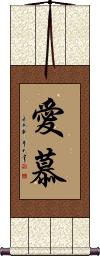
愛慕 means “adoring love” in Chinese, Japanese, and Korean.
I suppose this is the best kind of love to have. 愛慕 has the common character for love. But the second character modifies and reinforces the meaning to become adore, adoring love, or to love and adore.
Ancient Chinese warning:
Adoring someone is fine until you are in the shoes of the Prince of the Kingdom of Wu. This Prince adored a certain beautiful woman (Xi Shi) so much that he neglected his duties and soon let the kingdom fall into ruins.
Wu Ming / Anonymous
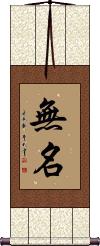
無名 is a Chinese, Japanese and Korean word that means nameless, obscure, unnamed, anonymous, unsigned, unknown, not famous, and sometimes unjustifiable.
The romanized title, Wu Ming, has been used for several different things such as a group of Italian writers, and even as the Chinese name of the infamous hackers.
Unmoved by the Eight Winds

八風吹不動 is an ancient Buddhist phrase from about 1000 years ago.
Literal meaning: “The Eight Winds cannot move [me].”
The original famous anecdote is from Song Dynasty China, involving the poet-official 蘇東坡 (Su Dongpo / Su Shi, 1037–1101) and Zen master 佛印 (Foyin).
Su Dongpo wrote 八風吹不動,一屁打過江
“The Eight Winds cannot move me; Yet one fart blows me across the river.”
Foyin’s irreverent reply exposed Su Dongpo’s ego, which is kind of a classic Zen/Chan teaching story.
利 gain
衰 loss
毀 disgrace
譽 praise
稱 honor
譏 ridicule
苦 suffering
樂 pleasure
“The Eight Winds cannot move [him / the mind].”
“Unmoved by the Eight Winds.”
“The Eight Winds do not move me.”
“Not moved by the Eight Winds.”
“Unshaken by the Eight Winds.”
“Unaffected by the Eight Winds.”
“Unmoved by worldly forces.”
“Steadfast against the Eight Winds.”
“Remaining unmoved amid the Eight Winds.”
There is a shorter Japanese Zen version, 八風不動, which drops the middle character. Often romanized as happū fudō. The romanization of 八風吹不動 is arguably happū fukedomo ugokazu or happū sui fudō.
Black Belt
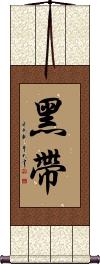
黑帶 is “black belt” in Chinese.
Many will argue whether rank systems that include a “black belt” are used in pure Chinese martial arts systems. The argument goes that it's more a Japanese idea merged into the western versions of Chinese martial arts. However, in Wushu (often referred to as Kung Fu), it's said that all students started with white belts. Over the years of training, the white belt would get dirty until finally appearing black with filth. Thus, more advanced students had darker belts.
If you want this title in Chinese, this would be the form.
 Often, the second character is written like the image to the right. If you like this version, click on this character instead of the button above.
Broken Mirror Rejoined
Used in modern times for divorced couples that come back together
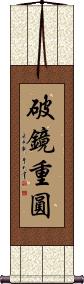
破鏡重圓 is about a husband and wife who were separated and reunited.
About 1500 years ago in China, there lived a beautiful princess named Le Chang. She and her husband Xu De Yan loved each other very much. But when the army of the Sui Dynasty was about to attack their kingdom, disposed of all of their worldly possessions and prepared to flee into exile.
They knew that in the chaos, they might lose track of each other, so the one possession they kept was a bronze mirror which is a symbol of unity for a husband and wife. They broke the mirror into two pieces, and each of them kept half of the mirror. They decided that if separated, they would try to meet at the fair during the 15th day of the first lunar month (which is the lantern festival). Unfortunately, the occupation was brutal, and the princess was forced to become the mistress of the new commissioner of the territory, Yang Su.
At the Lantern Festival the next year, the husband came to the fair to search for his wife. He carried with him his half of the mirror. As he walked through the fair, he saw the other half of the mirror for sale at a junk market by a servant of the commissioner. The husband recognized his wife's half of the mirror immediately, and tears rolled down his face as he was told by the servant about the bitter and loveless life that the princess had endured.
As his tears dripped onto the mirror, the husband scratched a poem into his wife's half of the mirror:
You left me with the severed mirror,
The mirror has returned, but absent are you,
As I gaze in the mirror, I seek your face,
I see the moon, but as for you, I see not a trace.
The servant brought the inscribed half of the mirror back to the princess. For many days, the princess could not stop crying when she found that her husband was alive and still loved her.
Commissioner Yang Su, becoming aware of this saga, realized that he could never obtain the princess's love. He sent for the husband and allowed them to reunite.
This proverb, 破鏡重圓, is now used to describe a couple who has been torn apart for some reason (usually divorce) but have come back together (or remarried).
It seems to be more common these days in America for divorced couples to reconcile and get married to each other again. This will be a great gift if you know someone who is about to remarry their ex.
Bruce Lee
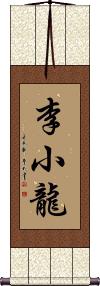
李小龍 is the real full name of Bruce Lee.
 Many people have no idea that Bruce Lee had a “real” Chinese name. In Mandarin and Cantonese, he is known as “Lǐ XiǎoLóng” and “Léi SíuLùng” respectively.
He kept his family name pronunciation (Li = Lee). 李 is a common family name that also means “plum.”
His given name 小龍 (Xiao-Long), literally means “little dragon.” 李小龍 is why you often see the character for dragon associated with Bruce Lee on various posters etc.
For a pronunciation lesson, the “X” in Romanized Mandarin is pronounced like a “sh” sound but with your tongue at the bottom of your mouth. The vowel sound in “Long” is like the English “oh,” not like the “ah” sound in the English word “long.”
If you are a big Bruce Lee fan, you should know this information, and you should have this wall scroll hanging in your room or martial arts studio.
Note: Japanese use these same Chinese characters / Kanji to write Bruce Lee's real name (with different pronunciation - which is a bit like how the name “Bruce Lee” sounds in English).
See Also: Kung Fu | Martial Arts
Chong
Surname
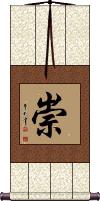
This is the surname “Chong” or “Zhong” in Mandarin Chinese, “Sung” in Cantonese and Korean, and Su in Japanese.
崇 is used in other Chinese words and other Asian languages with the following meanings:
high; sublime; lofty; to esteem; to worship; eminent; honorable; honourable; reverence; adore/adoration.
Chop Wood, Carry Water
Before enlightenment or after, chores remain.
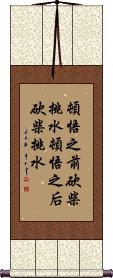
頓悟之前砍柴挑水; 頓悟之後砍柴挑水 means “Before enlightenment, chop wood, carry water; After enlightenment, chop wood, carry water.
This is a Chinese proverb that is attributed to 吴力 (Wú Lì) who lived between 1632 and 1718 - living part of his life as a devout Buddhist, and many years as a Catholic Jesuit Priest in China - what an interesting life!
This has been explained many times in many ways. I am a Buddhist, and here is my brief take on this proverb...
Before enlightenment, one may find daily chores mundane, tedious, and boring. However, upon reaching enlightenment one is not relieved of the details of daily life. An enlightened person will, however, see such chores as a joy, and do them mindfully.
There is another version floating around, which is 在你領悟之前砍柴、運水。在你領悟之後,砍柴、運水。
If you want this other version, just contact me. The meaning is the same, just different phrasing.
Choy Li Fut

蔡李彿 is Choy Li Fut, a Chinese martial arts that combines Northern and Southern Kung Fu styles.
Choy Li Fut is also known as Choy Lay Fut, Choy Lee Fut, Tsai Li Fo and Cai Li Fo, Choy Li Fut, Choi Lei Fut, Choy Lai Fut, Choy Ley Fut, Choi Lei Faht, Choi Leih Faht. These all come from the same 蔡李彿 characters, but different dialects have different pronunciations and romanization schemes for Chinese vary.
Some will write the third character 佛, others will write 彿 (note subtle extra stoke on left side). If you have a preference, place make a note when you place your order.
Bravery / Courage
Courageous Energy
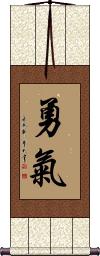
勇氣 is one of several ways to express bravery and courage in Chinese, Japanese, and Korean.
This version is the most spiritual. This is the essence of bravery from deep within your being. This is the mental state of being brave versus actual brave behavior. You'd more likely use this to say, “He is very courageous,” rather than “He fought courageously in the battle.”
The first character also means bravery or courage when it's seen alone. With the second character added, an element of energy or spirit is added. The second character is the same “chi” or “qi” energy that Kung Fu masters focus on when they strike. For this reason, you could say this means “spirit of courage” or “brave spirit.”
This is certainly a stronger word than just the first character alone.
Beyond bravery or courage, dictionaries also translate this word as valor/valour, nerve, audacity, daring, pluck, plucky, gallantry, guts, gutsy, and boldness.
This is also one of the 8 key concepts of tang soo do.
 While the version shown to the left is commonly used in Chinese and Korean Hanja (and ancient Japanese Kanji), please note that the second character is written with slightly fewer strokes in modern Japanese. If you want the modern Japanese version, please click on the character to the right. Both styles would be understood by native Chinese, Japanese, and many (but not all) Korean people. You should make your selection based on the intended audience for your calligraphy artwork. Or pick the single-character form of bravery/courage which is universal.
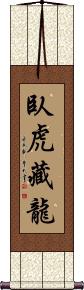
臥虎藏龍 is the movie title of the Kung Fu epic that was very popular in the west a few years back.
This is a re-ordering of an ancient Chinese proverb that refers to undiscovered talents.
The movie was one of the most popular Chinese foreign films to ever debut in the USA but received a lukewarm reception in China.
Note: This can be pronounced in Korean, but it's not a commonly used term.
The Great Path has No Gate
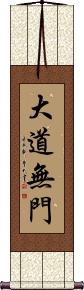
大道無門 is a Buddhist proverb that means “The Great Way has no entrance,” “The Great Way is gateless,” or “The Great Path lacks a gate.”
This can be translated in many other ways.
This concept was authored within a long sacred text by 無門慧開 (known as Wúmén Huìkāi in Chinese or Mumon Ekai in Japanese). He was a Chinese Chan Master (in Japanese, a Zen Master) who lived between 1183 and 1260 AD. His most famous work was a 48-koan collection titled “The Gateless Barrier” or “The Gateless Gate” (無門關 Wú Mén Guān in Chinese, or 無門関 Mu Mon Kan in Japanese). This calligraphy title is a notable line from this collection.
I like this reference to the source of this proverb: The Gateless Gate 無門關
The Five Animals
Dragon Snake Tiger Leopard Crane
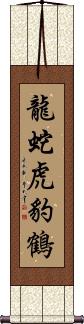
龍蛇虎豹鶴 is a list of the Chinese characters for the five animals of Shaolin Kung Fu in a comfortable order (meaning that they are in the proper order and will “feel right” to a Chinese person who views this arrangement).
Drunken Monkey
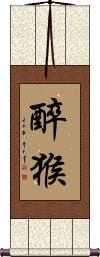
醉猴 is the short title for Drunken Monkey (often used as a title for a style of martial arts or kung fu which mimics the movements of a drunk monkey).
This martial arts style was inspired by the novel, “Journey to the West.”
See Also: Monkey Fist
Drunken Monkey Kung Fu
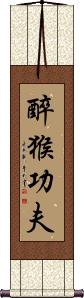
醉猴功夫 is the title for Drunken Monkey Kung Fu (Gong Fu).
The martial arts style was inspired by the novel, “Journey to the West.”
See Also: Monkey Fist
Drunken Fist
(A legitimate style of Kung Fu)
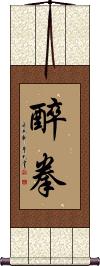
醉拳 is Drunken Fist, a traditional Chinese martial art/technique of Kung Fu.
It is a northern style of martial art that imitates a drunk person in its movements. Many staggering movements serve to deceive the opponent and keep them off-balance.
Some consider Drunken Fist to be among the more complex styles of martial arts due to the need for robust joints and fingers.
See Also: Drunken Monkey
Five Elements Tai Chi Fist
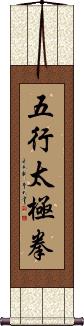
五行太極拳 is a certain school or style of Tai Chi (Taiji).
The characters literally mean “Five Elements Tai Chi Fist.”
Notes:
In Taiwan, it would be Romanized as “Wu Hsing Tai Chi Chuan” - see the standard Mandarin method above in the gray box (used in mainland China and the official Romanization used by the Library of Congress).
The last three characters are sometimes translated as “Grand Ultimate Fist,” so the whole thing can be “Five Elements Grand Ultimate Fist” if you wish.
I have not confirmed the use of this title in Korean but if it is used, it's probably only by martial arts enthusiasts. The pronunciation is correct, as shown above for Korean.
Five Elements
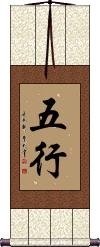
五行 is the title of the five elements: wood, fire, water, earth, and metal.
The first character means five, and the second character is simply element(s).
According to ancient Chinese science, all matter in the world is comprised of these elements. One idea presented with the five elements is that when energy is added, the matter is believed to expand. When energy is removed, matter contracts. Oddly, this concept is not far from Einstein's theories and modern science. Just a few thousand years before Einstein.
More info: Wikipedia - Five Elements (Wu Xing).
See Also: Wood | Fire | Water | Earth | Metal | Five Elements
Five Families / Tsoi Li Hoi Fut Hung
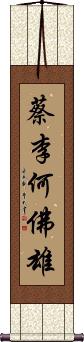
蔡李何佛雄 is the five families associated with San Soo Kung Fu.
The characters are always the same, but there are several ways these are romanized from Cantonese, Mandarin, and other dialects. Some common ones include Tsoi Li Hoi Fut Hung and Choi Li Ho Fut Hung.
If you are using a different romanization, that does not mean it's wrong. It might just be that your school is using a different dialect or romanization scheme.
Good Luck / Good Fortune
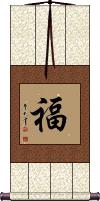
福 is pronounced “fu” in Chinese.
The character “fu” is posted by virtually all Chinese people on the doors of their homes during the Spring Festival (closely associated with the Chinese New Year).
One tradition from the Zhou Dynasty (beginning in 256 B.C.) holds that putting a fu symbol on your front door will keep the goddess of poverty away.
福 literally means good fortune, prosperity, blessed, blessedness, happiness, and fulfillment.
You'll also see this character in Vietnam (where Chinese characters were the written form until a romanization reform) where it is pronounced Phúc - a word commonly used in Vietnamese names because of its good meaning.
See Also: Lucky
Fu Dog / Foo Dog
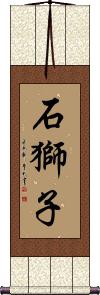
While known in the west as fu dogs or foo dogs, these are actually guardian lions.
These are the lion statues traditionally placed at the entrance of Chinese imperial palaces, imperial tombs, temples, and high-ranking officials' homes. These days, you are more likely to see them at the entrance to a fancy Chinese restaurant.
石獅子 means “stone lion(s).”
Fu Lu Shou
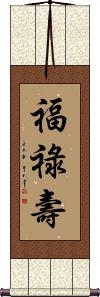
These are the short titles for Sanxing or 三星 (Three Stars).
福祿壽 are the gods of Jupiter, Ursa Major, and Sirius. Fu, Lu, and Shou represent fortune (福), presiding over the planet Jupiter, prosperity (祿), presiding over Ursa Major, and longevity (壽), presiding over Sirius.
In old Chinese folk religion, they are often represented as three old bearded wise men.
Kung / Gong / Mitsugi
Surname
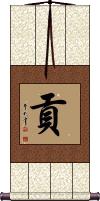
貢 is a Chinese surname that can romanize as Gong from Mandarin or Kung from Cantonese.
In Japan, this can be the surname or given name Mitsugi.
The meaning of this is tribute or gifts.
Happu Fudo
Unmoved by the Eight Winds

八風不動 is the short version, popularized in Japanese Zen Buddhism, of the original Chinese phrase 八風吹不動.
Literal meaning: “Unmoved by the Eight Winds”
The origin is Chinese, but it was later adopted into Japanese Zen. Here’s a little backstory:
The original famous anecdote is from Song Dynasty China, involving the poet-official 蘇東坡 (Su Dongpo / Su Shi, 1037–1101) and Zen master 佛印 (Foyin).
Su Dongpo wrote 八風吹不動,一屁打過江
“The Eight Winds cannot move me; Yet one fart blows me across the river.”
Foyin’s irreverent reply exposed Su Dongpo’s ego, which is kind of a classic Zen teaching story.
Hou De Zai Wu
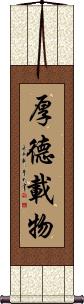
厚德載物 is a Chinese proverb that means “With great virtue, one can take charge of the world.”
Known sometimes by the romanization Hou De Zai Wu, this famous phrase suggests that being ethical is the bridge to leadership. I wish our world leaders followed this.
Hung Gar
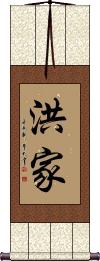
洪家 is the martial arts title Hung Ga or Hung Gar.
The first character means flood, big, immense, or great but it can also be the surname, Hong or Hung.
The last character means family or home.
This can also be read as “The Hung Family” or “The Hung Household.” This title is mostly associated with a style of Kung Fu.
Infinity / Infinite / Unlimited / Unbounded
Japanese = Infinity / Chinese = No limits
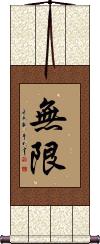
無限 is the Chinese and Japanese word meaning infinity, unlimited or unbounded.
無限 literally translates as “without limits” or “without [being] bound.”
The first character means “never” or “not,” like the prefix “un-.”
The second means “limited,” “restricted,” or “bound.”
Please note that the Japanese definition leans more toward “infinity” and the Chinese is more about being “boundless” or “without limits.”
In Korean, this means infinity, infinitude, or boundlessness. But in Korean, this term has many interpretations or contexts, so your intended meaning might be vague or ambiguous.
Inner Strength
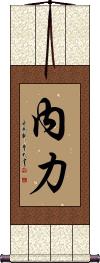
內力 is the shorter version of inner strength (can also be translated as “internal force”). The first character holds the meaning of “inner” or “internal.” The second character means “power,” “force,” or “strength.”
內力 is a Kung Fu way of talking about an inner power or strength from within. This is a way to express “inner chi.” This is something that you might hear in a real Chinese Kung Fu movie.
While understood in Chinese and Japanese, this can have a secondary meaning of “inner stress” in Japanese.
Jackie Chan
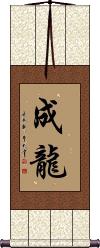
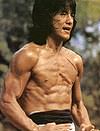 成龍 is the Chinese and Japanese stage name of Jackie Chan, a Kung Fu film and Cantonese pop star icon.
His birth name was 陳港生 (romanized as Chan Kong-sang or Can Gong-sang in Cantonese, or Chén Gǎng-shēng in Mandarin.
Jing Mo / Jing Wu
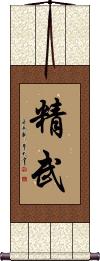
精武 is the title used for a certain type of martial arts. You can translate this roughly as “Excellent Martial Arts” or “Excellence in Martial Arts.” You will notice that the second character is “wu” as in wushu (martial arts) and wushi (warrior).
More information can be found at the Jing Mo website. You should probably only order this if you are a member of this association.
Note that “jing mo” is the Cantonese pronunciation of these characters. In Mandarin, they are “jing wu.”
Also used in Korean but only by those involved with martial arts who can also read Korean Hanja (a small percentage of the population).
Journey to the West
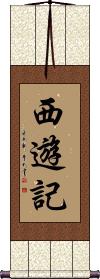
西遊記 is the original title of the novel Journey to the West.
Written during the Ming dynasty, this novel by Wu Cheng'en (吳承恩) is one of the four classic stories of Chinese literature.
Sometimes this book is titled, Pilgrimage to the West, Monkey King, or Magic Monkey.
Many movies and TV series depict or adapt portions of this story.
Kajukenbo Slogan
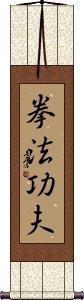
拳法功夫 is the Japanese slogan associated with Kajukenbo.
There is no way to write Kajukenbo in Japanese (as the “ka” for karate cannot be separated from the “kara” character it is supposed to represent - among a few other language issues). This slogan which reads, “fist law, kung fu” is often written on banners and patches for Kajukenbo clubs or dojos.
Tang Soo Do / Tang Hand Way
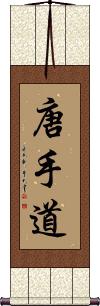
唐手道 is the alternate title for Karate-do.
This title uses a character, 唐, which represents the Tang Dynasty of China. Thus, this is often translated as the “Tang Hand Way” or incorrectly, “Tang Fist Way.”
I have also seen some call it “China Hand Way.”
Many in Korea refer to and romanize these characters as “Tang Soo Do” (당수도) where these characters refer to a kind of Korean style of Karate.
There is not a lot of information on this title but some believe that a simplified form of Kung Fu that started in China and ended up very popular in Japan used this title initially. It was later changed in Japan to a different Karate title which means “Empty Hand” (as in, without weapons).
Note: When used in Korean, this is pronounced 당수도. This title is often romanized as “Tang Soo Do,” “Tangsudo,” “Dang Su Do,” or “Dangsudo.” The last two romanizations on that list are the official Korean government romanization, though martial arts schools tend to use other non-standard versions.
Karate-Do
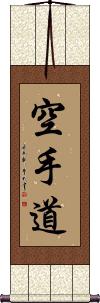
The literal meaning of 空手道 is “empty hand method” or “empty hand way.”
It is acknowledged that karate originated in China but migrated to Japan, where it was refined and became widely popular.
Karate is a martial art that uses no blades or weapons other than the “natural weapons” God gave to humans (fists and feet). The last character somehow became optional, but the meaning of that character is “method” or “the way” as in Taoism / Daoism.
Karate-Do reached Korea, where it is known as 공수도 which can be romanized as “Kong Soo Do” or “Gong Su Do.”
Kenpo / Kempo / Quan Fa / Chuan Fa
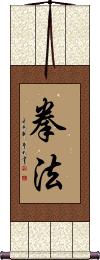
拳法 is a form of martial arts that can be translated in several ways.
Some will call it “fist principles,” “the way of the fist,” or even “law of the fist.” The first character literally means fist. The second can mean law, method, way, principle, or Buddhist teaching.
Kempo is really a potluck of martial arts. Often a combination of Chinese martial arts such as Shaolin Kung Fu with Japanese martial arts such as Karate, Jujutsu (Jujitsu), Aikido, and others. You may see the term “Kempo Karate,” which basically means Karate with other disciplines added. In this way, Kempo becomes an adjective rather than a title or school of martial arts.
These facts will long be argued by various masters and students of Kempo. Even the argument as to whether it should be spelled “kenpo” or “Kempo” ensues at dojos around the world (the correct Romaji should actually be “kenpou” if you precisely follow the rules).
The benefit of Kempo is that the techniques are easier to learn and master than pure Kung Fu (wu shu). Students are often taught basic Karate moves, kicks, and punches before augmenting the basic skills with complex Kung Fu techniques. This allows students of Kempo to achieve a level where they can defend themselves or fight in a relatively short amount of time (a few years rather than a decade or more).
Because the definition of this word is so fluid, I should make some notes here:
1. Purists in Okinawa will claim that “Okinawa Kenpo” or “Ryukyu Hon Kenpo” is the original and true version of this martial art from the old kingdom. It is actually little or no connection between Okinawa Kenpo and the way the word is used elsewhere.
2. In Chinese, where these characters are pronounced “quan fa” (sometimes Romanized as “chuan fa” because the Chinese-pinyin “q” actually sounds like an English “ch” sound), these characters do not hold the connotation of being a mixed martial art. It is simply defined as “the law of the fist.”
3. My Japanese dictionary oddly defines Kenpo as the “Chinese art of self-defense.” I personally don't feel this is the most common way that people perceive the word but just something you should know.
Kung / Gong
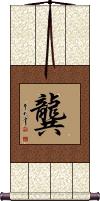
龔 is a Chinese surname that can be romanized as Gong or Kung.
From most of China, it would be Gong, but from Cantonese, it is often romanized as Kung.
In Korean, this could be a surname that romanizes as Gong or Kong and is now written as 공.
The original meaning of the character was something like, “to provide.”
Kung Fu Panda
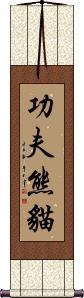
This is the title Kung Fu Panda in Chinese.
Kung Fu / Gong Fu
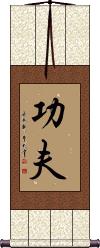
功夫 or Kung Fu is one of the most famous types of martial arts in the world - and not just because of Bruce Lee.
Some translate the meaning as “Accomplishment by Great Effort.” I think this is partially true, but directly translated, it literally means “Merit/Achievement/Accomplishment Man.” The word “fu” can sometimes mean “husband” or “porter,” but in this case, it can only mean “man.” However, few in China will think “man” when they hear the word “Gong Fu” spoken.
This term is also used for things other than martial arts. In fact, it's used to refer to a person with excellent skills in crafts that require a lot of effort to master, such as cooking, tea ceremonies, and calligraphy.
What a lot of people don't know is that the spelling of “Kung Fu” was actually taken from the old Wade Giles form of Romanization. Using this method, the sounds of the English “G” and “K” were both written as “K” and an apostrophe after the “K” told you it was supposed to sound like a “G.” Nobody in the west knew this rule, so most people pronounce it with a “K-sound.” And so, Gong Fu will always be Kung Fu for most westerners.
Also, just to educate you a little more, the “O” in “Gong” has a sound like the English word “oh.”
The popular Chinese dish “Kung Pao Chicken” suffers from the same problem. It should actually be “Gong Bao Chicken.”
Historical note: Many will claim that Kung Fu was invented by the monks of the Shaolin monastery. This fact is argued in both directions by scholars of Chinese history. Perhaps it is more accurate to say that the Shaolin Monks brought the original fame to Kung Fu many generations ago.
Japanese note: While most Japanese martial artists will recognize these characters, Katakana is more often used to approximate the pronunciation of "Kung Fu" with "カンフー." Some will argue as to whether this should be considered a Japanese word at all.
See Also: Bruce Lee
Kung Fu San Soo / San Shou
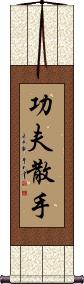
功夫散手 is a martial arts title.
Oddly, there are multiple ways two spell/romanize this in English, but in Chinese, it's written exactly the same.
Technically, the Mandarin romanizes as “gong fu san shou,” for which you'll sometimes see it written “kung fu san shou” (k'ung is an old romanization for a word that sounds like gong with a vowel sound like “oh”).
There is another martial arts style that spells this “Kung Fu San Soo.” I guess this was supposed to approximate Cantonese pronunciation for which the scholarly romanization is generally agreed to be “gung fu saan sau.”
Lau Gar Kung Fu
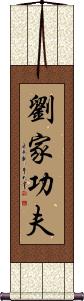
劉家功夫 are the characters for the Lau Gar Kung Fu style of martial arts.
The romanization of “Lau Gar” comes from Cantonese. “Kung Fu” is the common romanization for English from the Mandarin “Gōng Fu” or Cantonese “Gung Fu” pronunciations.
Lau gar = Lau family.
Laughing Dragon Kung Fu
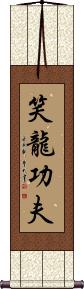
笑龍功夫 is the title for a Martial Arts studio (custom-made at by request of the owner of the studio).
Life Energy / Spiritual Energy
Chi Energy: Essence of Life / Energy Flow
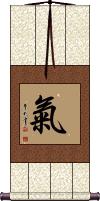
This 氣 energy flow is a fundamental concept of traditional Asian culture.
氣 is romanized as “Qi” or “Chi” in Chinese, “Gi” in Korean, and “Ki” in Japanese.
Chi is believed to be part of everything that exists, as in “life force” or “spiritual energy.” It is most often translated as “energy flow” or literally as “air” or “breath.” Some people will simply translate this as “spirit,” but you must consider the kind of spirit we're talking about. I think this is weighted more toward energy than spirit.
The character itself is a representation of steam (or breath) rising from rice. To clarify, the character for rice looks like this: 
Steam was apparently seen as visual evidence of the release of “life energy” when this concept was first developed. The Qi / Chi / Ki character is still used in compound words to mean steam or vapor.
The etymology of this character is a bit complicated. It's suggested that the first form of this character from bronze script (about 2500 years ago) looked like these samples: 

However, it was easy to confuse this with the character for the number three. So the rice radical was added by 221 B.C. (the exact time of this change is debated). This first version with the rice radical looks like this: 
The idea of Qi / Chi / Ki is really a philosophical concept. It's often used to refer to the “flow” of metaphysical energy that sustains living beings. Yet there is much debate that has continued for thousands of years as to whether Qi / Chi / Ki is pure energy or consists partially or fully of matter.
You can also see the character for Qi / Chi / Ki in common compound words such as Tai Chi / Tai Qi, Aikido, Reiki, and Qi Gong / Chi Kung.
In the modern Japanese Kanji, the rice radical has been changed into two strokes that form an X.
The original and traditional Chinese form is still understood in Japanese, but we can also offer that modern Kanji form in our custom calligraphy. If you want this Japanese Kanji, please click on the character to the right instead of the “Select and Customize” button above.
More language notes: This is pronounced like “chee” in Mandarin Chinese, and like “key” in Japanese.
This is also the same way to write this in Korean Hanja where it is Romanized as “gi” and pronounced like “gee” but with a real G-sound, not a J-sound.
Though Vietnamese no longer use Chinese characters in their daily language, this character is still widely known in Vietnam.
See Also: Energy | Life Force | Vitality | Life | Birth | Soul
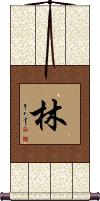
林 is the Chinese character for the surname Lim.
The meaning is small forest.
林 is a surname in many dialects but with varying romanizations:
Lín (Mandarin)
Lam, Lum, Lem (Cantonese)
Hayashi (Japanese)
Lim (Thai)
Lâm (Vietnamese)
Ling (Eastern Min, Northern Min, Wu Chinese)
Lim, Liem (Min Nan or Hokkien, Teochew, Korean, Taiwanese Minnan, Indonesian)
Martial Arts / Wushu
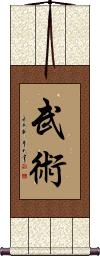
武術 is Wushu or Wu Shu, the very Chinese way to express “Martial Arts.”
Some even use this word to describe Kung Fu directly. But this is a label that fits all disciplines from Karate to Kung Fu to Taekwondo.
Note: This also means Martial Arts with the same appearance as old Korean Hanja characters and is pronounced “musul” or “musur” in Korean.
While this is best if your audience is Chinese or Korean, this also means “martial arts” in Japanese, where the popularity of this term is growing (romanized as Bujutsu or Bujitsu) in Japanese martial arts circles.
Fatherly Master / Sifu / Shi Fu / Shifu
Martial Arts Teacher
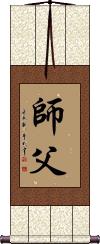
師父 means master in Chinese (occasionally used in Korean Hanja and Japanese). In the context of Martial Arts, this is the master and teacher who instructs students.
The second character by itself means father. Thus, you get the “Fatherly Master” translation. There's an old Chinese saying that goes something like, “One who is your teacher for one day is your father for life.”
Language notes: I've often seen this romanized as “sifu,” this is actually the Cantonese romanization. In Mandarin Chinese, it's “Shifu.” The pronunciation in Mandarin is actually like “sure foo” (using typical English pronunciation). There's an “R-sound” in there, which is not obvious from the romanization. Many martial arts studios incorrectly pronounce this like “she foo” (which is actually the Japanese pronunciation). In Cantonese, it sounds like “Sea foo” (almost like “seafood,” minus the “d” at the end).
師父 is kind of a weird selection for a calligraphy wall scroll; this entry is more for educational purposes. But you are welcome to buy it if it suits your circumstances.
Master / Skilled Worker
Secondary version of Sifu
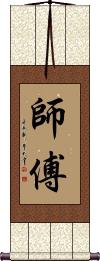
師傅 is “sifu” as in the “master” in the context of martial arts.
But two sifu titles are floating around. This one can simply mean “skilled worker.”
Historically, this term has been used for many things, such as “The tutor of a king or emperor.” But now it's more commonly used to mean master worker or qualified worker.
Currently, within the field of skilled labor, a master (Shifu) is higher than a journeyman and is considered to be one worthy of teaching others.
Note: In the 1970s and 1980s, this term was used as a common form of polite address between people. You might say, “master, do you know where Tian'anmen Square is?” to a person on the street at that time. This usage has almost passed; however, for some reason, people still often refer to taxi cab drivers as “master” in China (though I think/hope this is fading).
In Mandarin Chinese, this is pronounced like “Sure Foo,” and in Cantonese, like “See Foo.”
The second character is the difference between this sifu and the other. In this case, the second character by itself means tutor, instructor, or teacher.
Sensei / Master / Teacher / Mister
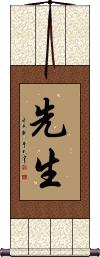
先生 is sensei, which is associated in the west with a master or instructor of karate, aikido, judo, and other Japanese martial arts.
In reality, this is a term of respect for almost any professional or skilled person (doctor, lawyer, teacher, etc.). Sometimes, it is used for musicians and artists who have achieved a certain level of fame, skill, or accomplishment.
It should be noted that this is also a courtesy title in Chinese but more like calling someone “mister” or “gentleman.” It doesn't have the “master” or “teacher” meaning in Chinese - see our Chinese “Master / Sifu / Shi Fu” entry if your audience is Chinese.
In Korean Hanja, this means teacher, instructor, schoolmaster, or schoolmistress.
This entry is for educational purposes. 先生 is kind of a strange thing to put on a wall scroll. It's a title that is used more orally to show respect rather than something written in calligraphy. If you feel it is appropriate in your circumstances, we will create a piece of sensei Japanese calligraphy artwork for you.
Monkey Fist
Saruken
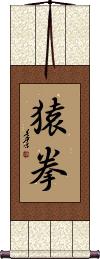
猿拳 is the Japanese martial arts title, “Monkey Fist,” referring to Monkey-Style Kung Fu.
猿拳 is very similar to a Chinese term that uses a different first character (the characters for ape and monkey were reversed when Japan borrowed Chinese characters, so this would be “Ape Fist” if a Chinese person read it).
Monkey Fist
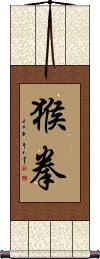
猴拳 literally means what you think, it's the “Monkey Fist” school of Kung Fu. A style that mimics the punches and movements of monkeys and apes.
Becoming popular during the Qing Dynasty, this style can trace its origins back to as early as the Song Dynasty. Some of the romance and popularity of this style comes from the novel “Journey to the West” which features the Monkey King and his fighting skills.
This novel and martial arts style has spawned a stream of Hong Kong movies featuring the Monkey King and other Kung Fu style variations such as “Drunken Monkey” and “Monkey Stealing Peaches” (a technique of disabling your opponent by grabbing and yanking on his testicles).
Note: This kind of makes sense in Korean Hanja and Japanese Kanji but probably unknown by all Koreans and Japanese except those who have an interest in this form of Kung Fu.
Morality of Deed
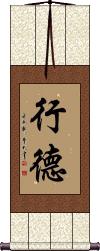
The idea of “morality of deed” goes along with 行德 or “wu de” (martial morality or virtues of the warrior).
Here, the first character is a representation of the actions or deeds that you engage in.
The second character refers to morality or virtue.
This translates better in English in the opposite order, as the Chinese order is literally “deed morality.”
See Also: Morality of Mind | Martial Morality
Morality of Mind
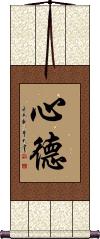
The idea of 心德 or “morality of mind” goes along with 行德 or “wu de” (martial morality or virtues of the warrior).
Here, the first character is a representation of your heart or mind.
The second character refers to morality or virtue.
This can also be translated as “morality of heart,” “virtue of heart,” or “virtue of the mind.”
Since ancient times in Asia, the idea of your mind (where your soul resides and your thought originates) has been associated with the heart. Just as in western culture, where we say “it comes from the heart” or “heartfelt emotions,” there is a belief that your heart and mind are one and the same (medical science now begs to differ).
See Also: Morality of Deed | Martial Morality
Neijing
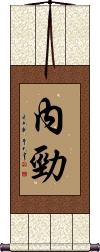
內勁 is Neijing or Nei Jing, the Kung Fu technique of using the conscious control of the practitioner's “qi” or “life energy” to gain advantages in combat.
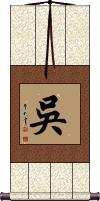
This is the surname Ng in Chinese.
吳 is sometimes romanized as Ang, Eng, Ing and Ong in the United States and Ung in Australia. In Mandarin, 吳 is usually romanized as Wu, but sometimes Woo. In Vietnamese, 吳 can be the Ngô surname.
Be careful, as 黃/黄 is another surname character that also romanizes as Ng and other variants noted above.
Northern Praying Mantis
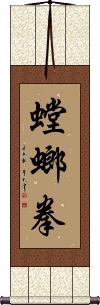
This can be translated literally as “Praying Mantis Fist.”
螳螂拳 is sometimes called Shandong Praying Mantis after its place of origin. It was created by Wang Lang and was named after the praying mantis, an insect, the aggressiveness of which inspired the style.
Shaolin records document that Wang Lang was one of the 18 masters gathered by the Shaolin Abbot Fu Ju, which dates him and Northern Praying Mantis style to the Song Dynasty (960-1279 A.D.).
The fact that the word “Northern” is used in the English title has more to do with where this style came from (Shandong is in northern China), but “north” is absent from this Chinese title.
Note: 螳螂拳 is also a title in Japanese - however, only a Japanese person who practices or is familiar with the “Praying Mantis Fist” style would recognize it.
Qi Gong / Chi Kung
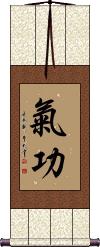
氣功 or Qigong is the title of a technique that is somewhere between medical practice, meditation, and in some cases, religion.
The definition is blurred depending on which school of Qigong you are following. In some cases, it is even incorporated with martial arts.
Some people (even Chinese people) mix this title with Tai Chi (Tai Qi) exercises.
Lately, in China, people will claim to practice Tai Chi rather than Qigong because the Qigong title was recently used as a cover for an illegal pseudo-religious movement in China with the initials F.G. or F.D. (I can not write those names here for fear of our website being banned in China).
You can learn those names and more here: Further info about Qigong
If you are wondering why I wrote “Qi Gong” and “Chi Kung” as the title of this calligraphy entry, I should teach you a little about the various ways in which Chinese can be Romanized. One form writes this as “Chi Kung” or “Chikung” (Taiwan). In the mainland and elsewhere, it is Romanized as “Qi Gong” or “Qigong.” The pronunciation is the same in Taiwan, mainland, and Singapore Mandarin. Neither Romanization is exactly like English. If you want to know how to say this with English rules, it would be something like “Chee Gong” (but the “gong” has a vowel sound like the “O” in “go”).
Romanization is a really confusing topic and has caused many Chinese words to be mispronounced in the west. One example is “Kung Pao Chicken,” which should actually be more like “Gong Bao” with the “O” sounding like “oh” for both characters. Neither the Romanization system in Taiwan nor the Mainland is perfect, in my opinion, and leads to many misunderstandings.
In modern Japan, you may see this written as 気功, but the original 氣功 is still recognized. If you need the Japanese version, please contact me.
San Soo Kung Fu
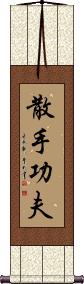
散手功夫 is San Soo Kung Fu.
Sometimes you will see this in the order 功夫散手 (Kung Fu San Soo). Either version is OK.
It's like “Kung Fu of San Soo” vs. “San Soo Kung Fu” if you put it in English terms. San Soo is the adjective either way in Chinese.
Sariputra
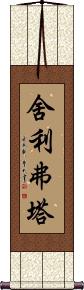
舍利弗塔 is the name Sariputra or Śāriputra in Chinese (Mandarin).
Often written in a shorter form as 舍利弗 (shě lì fú). This name comes from the Sanskrit शारिपुत्र or Śāriputra, and from Pali as Sāriputta.
This name comes from the closest disciple of the Buddha, Śāriputra, who helped establish the legacy of the Sangha (community of monks).
Shaolin
Little Forest
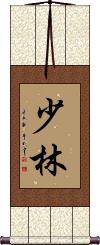
The 少林 or Shaolin monks of China have been practicing the art of Kung Fu for thousands of years. While there are many schools of Kung Fu in China, Shaolin are one of the more religiously devout and disciplined.
The title of Shaolin actually refers to a specific Buddhist monastery. It should be noted that the Shaolin were famous in China long before the Kung Fu TV show. Their fame in China is due to the monks' heroic and swift rescue of an emperor during the Tang Dynasty. Most Chinese people are not keenly aware of the Kung Fu TV show and have no idea who David Carradine is or anything about his character, Kwai Chang Caine.
Note: The literal meaning of 少林 is “little forest.”
The fame of the Shaolin has spread all over Asia, as even though this is a Chinese title, the same characters are used in Japanese with the same meaning.
Shaolin Generational Poem
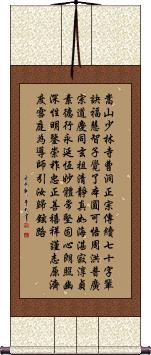
This is a poem, including a title, that celebrates the tactics and virtues of the Shaolin Kung Fu Monks for future generations.
Shaolin Kung Fu
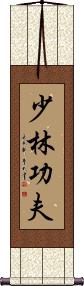
The Shaolin monks of China have been practicing the art of Kung Fu for thousands of years.
少林功夫 is the full title, “Shao Lin Kung Fu.”
Shaolin Chuan / Shao Lin Quan
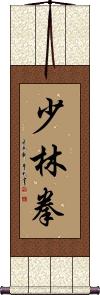
少林拳 is the title of the martial art (style of Kung Fu) that is taught to the monks and students in the Shaolin Buddhist Monastery.
The addition of Chuan or Quan, which means fist is what signifies that you are talking about this school or form of martial arts.
Shaolin Temple
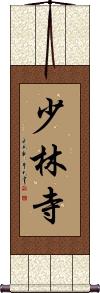
少林寺 is the full title of the Shaolin Temple.
This refers to the Buddhist monastery famous for its kung fu monks.
少林寺 is also known in Japanese, where they use the same characters but romanize them as Shourinji or Shōrinji.
Some believe this monastery and temple represent where Bodhidharma sat with his face to a wall for nine years, leading to his discovery of enlightenment and the establishment of Buddhism in China.
Shaolin Martial Arts
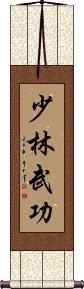
少林武功 is the title for “Shaolin Wu Gong” or “Shaolin martial arts.”
Shorinji Kempo / Kenpo
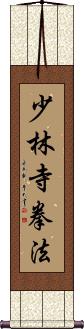
少林寺拳法 is a specific type of martial art in Japan that claims origins in the Kung Fu practiced in the original Shaolin Monastery of China.
The first three characters mean “Shaolin Monastery,” and you might notice the Japanese is pronounced in a very similar way. The reason is, many words were “borrowed” from the original Chinese when Japan did not have a written language and simply absorbed Chinese characters into their language around the 5th century. When a Japanese word did not exist, the Chinese pronunciation was often absorbed as well as the written form.
The last two characters mean “fist law” or “method of the fist.” It has long been argued as to whether the Japanese for these characters should be Romanized as “kempo” or “kenpo.” The official method should be “kenpou” but it's common to drop the “u” that comes after the “o.”
I imagine if you are looking for this title, you already know what it means, so the above is simply extra information that a student of Shorinji Kempo might want to know.
Strong bones come from hard knocks
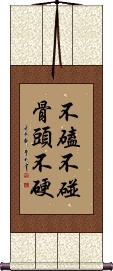
不磕不碰骨頭不硬 is a Chinese proverb that literally translates as: Without being knocked around a bit, [one's] bones won't become hard.
Figuratively, this means: One can't become strong without first being tempered by “hard knocks.”
While true for everyone, this sounds like the “Iron Body” form of Kung Fu, where practitioners' bodies are beaten (and often bone fractured) in order to become stronger.
For the rest of us, this is just about how we can be tempered and build character through the hardships in our lives.
This is not a common title for a wall scroll in China.
Sword
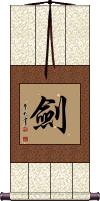
劍 is pronounced “jian” in Chinese. When you say it, imagine that you are making the sound of a sword as it clashes with a metal shield. This might get you closer to the correct pronunciation in Chinese.
I actually wonder if this word came from the metallic ringing sounds of a sword in battle - but such knowledge is lost in history.
The sword is a symbol of a warrior. The one thing that a soldier in ancient China lived and died by. A warrior with his skills and sword proves himself of great value. A warrior who losses his sword instantly becomes worthless.
劍 is an excellent scroll for someone in the military (especially officers of all services - as well as enlisted NCO Marines since they still carry swords even if mainly for ceremonial purposes). Or perhaps someone who practices variations of kung fu or tai chi that involve weapons.
Please note that while this character is understood with the sword meaning in Japanese, you might be looking for the word “katana” which also means sword in Japanese but means “knife” in Chinese.
There are other ways to write sword, and here are a few...


If you are particular about the version you receive, please let me know when you place your order (Note: Special styles are only available from one of our master calligraphers).
Tai Chi Wing Chun Kung Fu
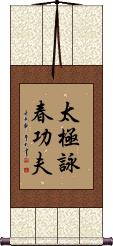
太極詠春功夫 is the title Tai Chi Wing Chun Kung Fu.
Please note that it can be romanized in a variety of ways such as:
Tai Chi Ving Tsun Kung Fu
Tai Qi Yong Chun Gong Fu
Taai Gik Wing Ceon Gung Fu
Be sure this is the right title for what you are looking for before you order.
Tang Soo Do Tenets
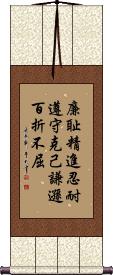
廉耻精進忍耐遵守克己謙遜百折不屈 are the tenets of Tang Soo Do.
| English | Old Hanja | Modern Hangul | Pronunciation |
| 1. Integrity | 廉耻 | 렴치 or 염치 | yeom ci |
| 2. Concentration | 精進 | 정진 | jeong jin |
| 3. Perseverance | 忍耐 | 인내 | in nae |
| 4. Respect & Obedience | 遵守 | 준수 | jun su |
| 5. Self-Control | 克己 | 극기 | geug gi |
| 6. Humility | 謙遜 | 겸손 | gyeom son |
| 7. Indomitable Spirit | 百折不屈 | 백절불굴 | baeg jeor bur gur |
After some research, it appears this list was compiled in English based on Taekwondo tenets. We filled in a few of the words that did not have a corresponding Hanja or Hangul. If someone else has a better list with characters included, please contact me.
Unselfish: Perfectly Impartial
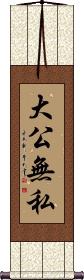
大公無私 is a Chinese proverb that comes from an old story from some time before 476 BC. About a man named Qi Huangyang, who was commissioned by the king to select the best person for a certain job in the Imperial Court.
Qi Huangyang selected his enemy for the job. The king was very confused by the selection, but Qi Huangyang explained that he was asked to find the best person for the job, not necessarily someone that he liked or had a friendship with.
Later, Confucius commented on how unselfish and impartial Qi Huangyang was by saying, “Da Gong Wu Si” which, if you look it up in a Chinese dictionary, is generally translated as “Unselfish” or “Just and Fair.”
If you translate each character, you'd have something like
“Big/Deep Justice Without Self.”
Direct translations like this leave out a lot of what the Chinese characters really say. Use your imagination, and suddenly you realize that “without self” means “without thinking about yourself in the decision” - together, these two words mean “unselfish.” The first two characters serve to drive the point home that we are talking about a concept that is similar to “blind justice.”
One of my Chinese-English dictionaries translates this simply as “just and fair.” So that is the short and simple version.
Note: This can be pronounced in Korean, but it's not a commonly used term.
See Also: Selflessness | Work Unselfishly for the Common Good | Altruism
Warrior Essence / Warrior Spirit / Martial
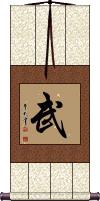
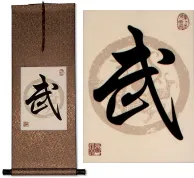
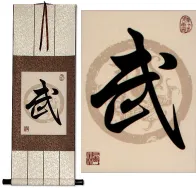
武 is the essence or spirit of a warrior. 武 is part of the word “wu shu” which is sometimes translated as “martial arts” or “kung fu.”
In more modern speech and another context, this can mean military, martial, warlike, fierce, and perhaps violent but usually as a prefix for a longer word or phrase.
Wing Chun Kung Fu
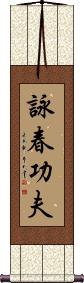
詠春功夫 is Wing Chun Kung Fu.
The first two characters literally mean “Singing Spring” (as in springtime).
The last two are “Kung Fu” (high skill).
A Wise Man Changes His Mind (but a fool never will)
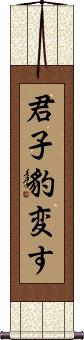
君子豹変す is a Japanese proverb that suggests that a wise man is willing to change his mind, but a fool will stubbornly never change his.
The first word is 君子 (kunshi), a man of virtue, a person of high rank, a wise man.
The second word is 豹変 (hyouhen), sudden change, complete change.
The last part, す (su), modifies the verb to a more humble form.
The “fool” part is merely implied or understood. So if wise and noble people are willing to change their minds, it automatically says that foolish people are unwilling to change.

伍 is a Cantonese surname that can romanize as Woo.
There is more than one Woo: The surname "Woo" (우/吳/胡/禹/武) is common in East Asia, primarily Chinese and Korean, stemming from various characters with different origins, often romanized from Cantonese (like 吳 Wú or 胡 Hú) or Korean (like 禹), meaning leadership, history, or related to ancient states and figures like Yu the Great, symbolizing diligence and heritage.
Wu Chi / Wuji
Without Limit
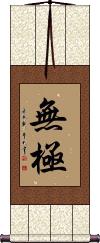
This is Wu Chi or Wuji in Chinese characters.
Wu Chi as a philosophy is often associated with Tai Chi (Taiji).
Wudang Fist
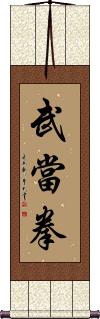
武當拳 means Wudang Quan or Wudang Fist.
Wudang (sometimes romanized as Wutang or Wu Tang) refers to a Mountain range in northwest Hubei. The Wudang martial arts style refers to a version of Shaolin Kung Fu.
Wu Wei / Without Action
Daoist / Taoist Tenet
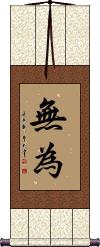
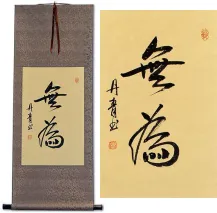
無為 or “Wu Wei” is a Daoist (Taoist) tenet that speaks to the idea of letting nature take its course.
Some will say it's about knowing when to take action and when not to. In reality, it's more about not going against the flow. What will happen is controlled by the Dao (Tao), for which one who follows the Dao will not resist or struggle against.
You can think of 無為 as the Chinese way to express “laissez-faire.”
There is a lot more to this concept, but if you are looking for this entry, you already know the expanded concept.
Warning: Outside of the Daoist context, this means idleness or inactivity (especially in Japanese, where not everyone knows this as a Daoist concept, though it does pair well with the Japanese concept of Wabi-Sabi).
Wu Xing Fist
Five Forms Fist of Kung Fu
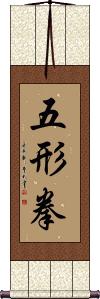
五形拳 is “Wu Xing Fist” or “Five Form Fist.”
The forms refer to Dragon, Snake, Tiger, Crane, and Leopard.
This term is used in Kung Fu, and is recognized by both Chinese and Japanese practitioners of martial arts.
Xishi / Xi Shi
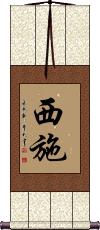
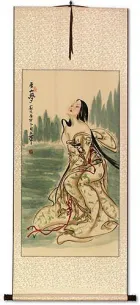
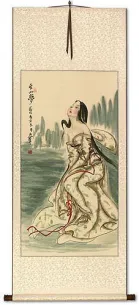
西施 is the Chinese title for Xishi, who lived around 450 BC. She was a famous Chinese beauty, perhaps the foremost of the Four Beauties (四大美女). She was given by King Gou Jian of the Yue Kingdom as a concubine to the King of Wu. This was part of an elaborate plan to destroy the Wu Kingdom - and it worked.
Note: In Japanese, this can be an unrelated given name, Seishi. Though the Xishi story is somewhat known in Japan.
Xuan Wu / Genbu / Black Tortoise God
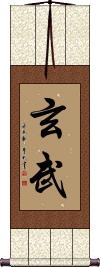
玄武 can refer to the Black Tortoise (an ancient Chinese constellation of stars- part of the seven mansions of the north sky).
In Daoism, this is the God of the North sky.
This also refers to a Black Tortoise god, said to rule over the northern heavens in Japanese. Can also be pronounced/romanized as genmu or when used as a personal name, Hirotake in Japanese.
This in-stock artwork might be what you are looking for, and ships right away...

Gallery Price: $200.00
Your Price: $79.88
Gallery Price: $200.00
Your Price: $79.88

Gallery Price: $168.00
Your Price: $92.88
Gallery Price: $90.00
Your Price: $49.88
Gallery Price: $79.00
Your Price: $43.88

Gallery Price: $31.00
Your Price: $16.88
The following table may be helpful for those studying Chinese or Japanese...
| Title | Characters | Romaji (Romanized Japanese) | Various forms of Romanized Chinese | |
| Adoring Love | 愛慕 爱慕 | ai bou / aibou / ai bo | ài mù / ai4 mu4 / ai mu / aimu | |
| Wu Ming Anonymous | 無名 无名 | mu mei / mumei | wú míng / wu2 ming2 / wu ming / wuming | |
| Unmoved by the Eight Winds | 八風吹不動 八风吹不动 | happuu sui fudou happuusuifudou hapu sui fudo | bā fēng chuī bù dòng ba1 feng1 chui1 bu4 dong4 ba feng chui bu dong bafengchuibudong | pa feng ch`ui pu tung pafengchuiputung pa feng chui pu tung |
| Black Belt | 黑帶 黑带 | hēi dài / hei1 dai4 / hei dai / heidai | hei tai / heitai | |
| Broken Mirror Rejoined | 破鏡重圓 破镜重圆 | pò jìng chóng yuán po4 jing4 chong2 yuan2 po jing chong yuan pojingchongyuan | p`o ching ch`ung yüan pochingchungyüan po ching chung yüan |
|
| Bruce Lee | 李小龍 李小龙 | bu ruu su ri buruusuri bu ru su ri | lǐ xiǎo lóng li3 xiao3 long2 li xiao long lixiaolong | li hsiao lung lihsiaolung |
| Chong | 崇 | sū | chóng / chong2 / chong | ch`ung / chung |
| Chop Wood, Carry Water | 頓悟之前砍柴挑水頓悟之后砍柴挑水 顿悟之前砍柴挑水顿悟之后砍柴挑水 | dùn wù zhī qián kǎn chái tiāo shuǐ dùn wù zhī hòu kǎn chái tiāo shuǐ dun4 wu4 zhi1 qian2 kan3 chai2 tiao1 shui3 dun4 wu4 zhi1 hou4 kan3 chai2 tiao1 shui3 dun wu zhi qian kan chai tiao shui dun wu zhi hou kan chai tiao shui | tun wu chih ch`ien k`an ch`ai t`iao shui tun wu chih hou k`an ch`ai t`iao shui tun wu chih chien kan chai tiao shui tun wu chih hou kan chai tiao shui |
|
| Choy Li Fut | 蔡李彿 蔡李佛 | cài lǐ fó cai4 li3 fo2 cai li fo cailifo | ts`ai li fo tsailifo tsai li fo |
|
| Bravery Courage | 勇氣 勇气 / 勇気 | yuuki / yuki | yǒng qì / yong3 qi4 / yong qi / yongqi | yung ch`i / yungchi / yung chi |
| Crouching Tiger Hidden Dragon | 臥虎藏龍 卧虎藏龙 | wò hǔ cáng lóng wo4 hu3 cang2 long2 wo hu cang long wohucanglong | wo hu ts`ang lung wohutsanglung wo hu tsang lung |
|
| The Great Path has No Gate | 大道無門 大道无门 | dai dou mu mon daidoumumon dai do mu mon | dà dào wú mén da4 dao4 wu2 men2 da dao wu men dadaowumen | ta tao wu men tataowumen |
| The Five Animals | 龍蛇虎豹鶴 龙蛇虎豹鹤 | ryuu hebi tora hyou tsuru ryuuhebitorahyoutsuru ryu hebi tora hyo tsuru | lóng shé hǔ bào hè long2 she2 hu3 bao4 he4 long she hu bao he longshehubaohe | lung she hu pao ho lungshehupaoho |
| Drunken Monkey | 醉猴 | zuì hóu / zui4 hou2 / zui hou / zuihou | tsui hou / tsuihou | |
| Drunken Monkey Kung Fu | 醉猴功夫 / 醉猴功伕 醉猴功夫 | zuì hóu gōng fu zui4 hou2 gong1 fu zui hou gong fu zuihougongfu | tsui hou kung fu tsuihoukungfu |
|
| Drunken Fist | 醉拳 | suiken | zuì quán / zui4 quan2 / zui quan / zuiquan | tsui ch`üan / tsuichüan / tsui chüan |
| Five Elements Tai Chi Fist | 五行太極拳 五行太极拳 | go gyou tai kyoku ken gogyoutaikyokuken go gyo tai kyoku ken | wǔ xíng tài jí quán wu3 xing2 tai4 ji2 quan2 wu xing tai ji quan wuxingtaijiquan | wu hsing t`ai chi ch`üan wuhsingtaichichüan wu hsing tai chi chüan |
| Five Elements | 五行 | gogyou / gogyo | wǔ xíng / wu3 xing2 / wu xing / wuxing | wu hsing / wuhsing |
| Five Families Tsoi Li Hoi Fut Hung | 蔡李何佛雄 | cài lǐ hé fú xióng cai4 li3 he2 fu2 xiong2 cai li he fu xiong cailihefuxiong | ts`ai li ho fu hsiung tsailihofuhsiung tsai li ho fu hsiung |
|
| Good Luck Good Fortune | 福 | fuku | fú / fu2 / fu | |
| Fu Dog Foo Dog | 石獅子 石狮子 | shí shī zi shi2 shi1 zi5 shi shi zi shishizi | shih shih tzu shihshihtzu |
|
| Fu Lu Shou | 福祿壽 | fú lù shòu fu2 lu4 shou4 fu lu shou fulushou | ||
| Kung Gong Mitsugi | 貢 贡 | mitsugi | gòng / gong4 / gong | kung |
| Happu Fudo | 八風不動 八风不动 | happuu fudou happuufudou hapu fudo | bā fēng bù dòng ba1 feng1 bu4 dong4 ba feng bu dong bafengbudong | pa feng pu tung pafengputung |
| Hou De Zai Wu | 厚德載物 厚德载物 | hòu dé zài wù hou4 de2 zai4 wu4 hou de zai wu houdezaiwu | hou te tsai wu houtetsaiwu |
|
| Hung Gar | 洪家 | hóng jiā / hong2 jia1 / hong jia / hongjia | hung chia / hungchia | |
| Infinity Infinite Unlimited Unbounded | 無限 无限 | mu gen / mugen | wú xiàn / wu2 xian4 / wu xian / wuxian | wu hsien / wuhsien |
| Inner Strength | 內力 内力 | nai ryoku / nairyoku | nèi lì / nei4 li4 / nei li / neili | |
| Jackie Chan | 成龍 成龙 | jakkii chiin jakkiichiin jaki chin | chéng lóng cheng2 long2 cheng long chenglong | ch`eng lung chenglung cheng lung |
| Jing Mo Jing Wu | 精武 | jīng wǔ / jing1 wu3 / jing wu / jingwu | ching wu / chingwu | |
| Journey to the West | 西遊記 西游记 | sei yuu ki / seiyuuki / sei yu ki | xī yóu jì xi1 you2 ji4 xi you ji xiyouji | hsi yu chi hsiyuchi |
| Kajukenbo Slogan | 拳法功夫 | kenpo kunfu kenpokunfu | ||
| Tang Soo Do Tang Hand Way | 唐手道 | kara te do / karatedo | táng shǒu dào tang2 shou3 dao4 tang shou dao tangshoudao | t`ang shou tao tangshoutao tang shou tao |
| Karate-Do | 空手道 | kara te dou karatedou kara te do | kōng shǒu dào kong1 shou3 dao4 kong shou dao kongshoudao | k`ung shou tao kungshoutao kung shou tao |
| Kenpo Kempo Quan Fa Chuan Fa | 拳法 | kenpou / kenpo | quán fǎ / quan2 fa3 / quan fa / quanfa | ch`üan fa / chüanfa / chüan fa |
| Kung Gong | 龔 龚 | gōng / gong1 / gong | kung | |
| Kung Fu Panda | 功夫熊貓 功夫熊猫 | gōng fú xióng māo gong1 fu2 xiong2 mao1 gong fu xiong mao gongfuxiongmao | kung fu hsiung mao kungfuhsiungmao |
|
| Kung Fu Gong Fu | 功夫 | kan fu / ku fu kanfu / kufu | gōng fu / gong1 fu / gong fu / gongfu | kung fu / kungfu |
| Kung Fu San Soo San Shou | 功夫散手 | gōng fu sǎn shǒu gong1 fu san3 shou3 gong fu san shou gongfusanshou | kung fu san shou kungfusanshou |
|
| Lau Gar Kung Fu | 劉家功夫 刘家功夫 | liú jiā gōng fu liu2 jia1 gong1 fu liu jia gong fu liujiagongfu | liu chia kung fu liuchiakungfu |
|
| Laughing Dragon Kung Fu | 笑龍功夫 笑龙功夫 | xiào lóng gōng fu xiao4 long2 gong1 fu xiao long gong fu xiaolonggongfu | hsiao lung kung fu hsiaolungkungfu |
|
| Life Energy Spiritual Energy | 氣 气 / 気 | ki | qì / qi4 / qi | ch`i / chi |
| Lim | 林 | lín / lin2 / lin | ||
| Martial Arts Wushu | 武術 武术 | bujutsu | wǔ shù / wu3 shu4 / wu shu / wushu | |
| Fatherly Master Sifu Shi Fu Shifu | 師父 师父 | shi fu / shifu | shī fù / shi1 fu4 / shi fu / shifu | shih fu / shihfu |
| Master Skilled Worker | 師傅 师傅 | shī fu / shi1 fu / shi fu / shifu | shih fu / shihfu | |
| Sensei Master Teacher Mister | 先生 | sen sei / sensei | xiān shēng xian1 sheng1 xian sheng xiansheng | hsien sheng hsiensheng |
| Monkey Fist | 猿拳 | saruken | ||
| Monkey Fist | 猴拳 | hóu quán / hou2 quan2 / hou quan / houquan | hou ch`üan / houchüan / hou chüan | |
| Morality of Deed | 行德 | xíng dé / xing2 de2 / xing de / xingde | hsing te / hsingte | |
| Morality of Mind | 心德 | xīn dé / xin1 de2 / xin de / xinde | hsin te / hsinte | |
| Neijing | 內勁 内劲 | nèi jìng / nei4 jing4 / nei jing / neijing | nei ching / neiching | |
| Ng | 吳 吴 | wú / wu2 / wu | ||
| Northern Praying Mantis | 螳螂拳 | tou rou ken tourouken to ro ken | táng láng quán tang2 lang2 quan2 tang lang quan tanglangquan | t`ang lang ch`üan tanglangchüan tang lang chüan |
| Qi Gong Chi Kung | 氣功 气功 | ki kou / kikou / ki ko | qì gōng / qi4 gong1 / qi gong / qigong | ch`i kung / chikung / chi kung |
| San Soo Kung Fu | 散手功夫 | sǎn shǒu gōng fu san3 shou3 gong1 fu san shou gong fu sanshougongfu | san shou kung fu sanshoukungfu |
|
| Sariputra | 舍利弗塔 | shě lì fú tǎ she3 li4 fu2 ta3 she li fu ta shelifuta | she li fu t`a shelifuta she li fu ta |
|
| Shaolin | 少林 | sho rin / shorin | shǎo lín / shao3 lin2 / shao lin / shaolin | |
| Shaolin Generational Poem | 嵩山少林寺曹洞正宗傳續七十字輩訣福慧智子覺了本圓可悟周洪普廣宗道慶同玄祖清靜真如海湛寂淳貞素德行永延恆妙體常堅固心朗照幽深性明鑒崇祚忠正善禧祥謹志原濟度雪庭為導師引汝歸鉉路 嵩山少林寺曹洞正宗传续七十字辈诀福慧智子觉了本圆可悟周洪普广宗道庆同玄祖清静真如海湛寂淳贞素德行永延恒妙体常坚固心朗照幽深性明鉴崇祚忠正善禧祥谨志原济度雪庭为导师引汝归铉路 | sōng shān shào lín sì cáo dòng zhèng zōng chuán xù qī shí zì bèi jué fú huì zhì zǐ jiào le běn yuán kě wù zhōu hóng pǔ guǎng zōng dào qìng tóng xuán zǔ qīng jìng zhēn rú hǎi zhàn jì chún zhēn sù dé xíng yong song1 shan1 shao4 lin2 si4 cao2 dong4 zheng4 zong1 chuan2 xu4 qi1 shi2 zi4 bei4 jue2 fu2 hui4 zhi4 zi3 jiao4 le5 ben3 yuan2 ke3 wu4 zhou1 hong2 pu3 guang3 zong1 dao4 qing4 tong2 xuan2 zu3 qing1 jing4 zhen1 ru2 hai3 zhan4 ji4 chun2 zhen1 su4 de2 xing2 yong song shan shao lin si cao dong zheng zong chuan xu qi shi zi bei jue fu hui zhi zi jiao le ben yuan ke wu zhou hong pu guang zong dao qing tong xuan zu qing jing zhen ru hai zhan ji chun zhen su de xing yong | sung shan shao lin ssu ts`ao tung cheng tsung ch`uan hsü ch`i shih tzu pei chüeh fu hui chih tzu chiao le pen yüan k`o wu chou hung p`u kuang tsung tao ch`ing t`ung hsüan tsu ch`ing ching chen ju hai chan chi ch`un chen su te hsing yung sung shan shao lin ssu tsao tung cheng tsung chuan hsü chi shih tzu pei chüeh fu hui chih tzu chiao le pen yüan ko wu chou hung pu kuang tsung tao ching tung hsüan tsu ching ching chen ju hai chan chi chun chen su te hsing yung |
|
| Shaolin Kung Fu | 少林功夫 | sho rin kan fu shorinkanfu | shǎo lín gōng fu shao3 lin2 gong1 fu shao lin gong fu shaolingongfu | shao lin kung fu shaolinkungfu |
| Shaolin Chuan Shao Lin Quan | 少林拳 | shǎo lín quán shao3 lin2 quan2 shao lin quan shaolinquan | shao lin ch`üan shaolinchüan shao lin chüan |
|
| Shaolin Temple | 少林寺 | shou rin ji shourinji sho rin ji | shào lín sì shao4 lin2 si4 shao lin si shaolinsi | shao lin ssu shaolinssu |
| Shaolin Martial Arts | 少林武功 | shǎo lín wǔ gōng shao3 lin2 wu3 gong1 shao lin wu gong shaolinwugong | shao lin wu kung shaolinwukung |
|
| Shorinji Kempo Kenpo | 少林寺拳法 | shourinji kenpou shourinjikenpou shorinji kenpo | shào lín sì quán fǎ shao4 lin2 si4 quan2 fa3 shao lin si quan fa shaolinsiquanfa | shao lin ssu ch`üan fa shaolinssuchüanfa shao lin ssu chüan fa |
| Strong bones come from hard knocks | 不磕不碰骨頭不硬 不磕不碰骨头不硬 | bù kē bù pèng gǔ tóu bù yìng bu4 ke1 bu4 peng4 gu3 tou2 bu4 ying4 bu ke bu peng gu tou bu ying bukebupenggutoubuying | pu k`o pu p`eng ku t`ou pu ying pukopupengkutoupuying pu ko pu peng ku tou pu ying |
|
| Sword | 劍 剑 | ken / tsurugi | jiàn / jian4 / jian | chien |
| Tai Chi Wing Chun Kung Fu | 太極詠春功夫 太极咏春功夫 | tài jí yǒng chūn gōng fu tai4 ji2 yong3 chun1 gong1 fu tai ji yong chun gong fu taijiyongchungongfu | t`ai chi yung ch`un kung fu taichiyungchunkungfu tai chi yung chun kung fu |
|
| Tang Soo Do Tenets | 廉耻精進忍耐遵守克己謙遜百折不屈 / 廉恥精進忍耐遵守克己謙遜百折不屈 廉耻精进忍耐遵守克己谦逊百折不屈 | lián chǐ jīng jìn rěn nài zūn shǒu kè jǐ qiān xùn bǎi zhé bù qū lian2 chi3 jing1 jin4 ren3 nai4 zun1 shou3 ke4 ji3 qian1 xun4 bai3 zhe2 bu4 qu1 lian chi jing jin ren nai zun shou ke ji qian xun bai zhe bu qu | lien ch`ih ching chin jen nai tsun shou k`o chi ch`ien hsün pai che pu ch`ü lien chih ching chin jen nai tsun shou ko chi chien hsün pai che pu chü |
|
| Unselfish: Perfectly Impartial | 大公無私 大公无私 | dà gōng wú sī da4 gong1 wu2 si1 da gong wu si dagongwusi | ta kung wu ssu takungwussu |
|
| Warrior Essence Warrior Spirit Martial | 武 | bu | wǔ / wu3 / wu | |
| Wing Chun Kung Fu | 詠春功夫 咏春功夫 | yǒng chūn gōng fu yong3 chun1 gong1 fu yong chun gong fu yongchungongfu | yung ch`un kung fu yungchunkungfu yung chun kung fu |
|
| A Wise Man Changes His Mind (but a fool never will) | 君子豹変す | kun shi hyou hen su kunshihyouhensu kun shi hyo hen su | ||
| Woo | 伍 | wǔ / wu3 / wu | ||
| Wu Chi Wuji | 無極 无极 | wú jí / wu2 ji2 / wu ji / wuji | wu chi / wuchi | |
| Wudang Fist | 武當拳 武当拳 | wǔ dāng quán wu3 dang1 quan2 wu dang quan wudangquan | wu tang ch`üan wutangchüan wu tang chüan |
|
| Wu Wei Without Action | 無為 无为 | mui | wú wéi / wu2 wei2 / wu wei / wuwei | |
| Wu Xing Fist | 五形拳 | gokeiken | wǔ xíng quán wu3 xing2 quan2 wu xing quan wuxingquan | wu hsing ch`üan wuhsingchüan wu hsing chüan |
| Xishi Xi Shi | 西施 | sei shi / seishi | xī shī / xi1 shi1 / xi shi / xishi | hsi shih / hsishih |
| Xuan Wu Genbu Black Tortoise God | 玄武 | genbu | xuán wǔ / xuan2 wu3 / xuan wu / xuanwu | hsüan wu / hsüanwu |
| In some entries above you will see that characters have different versions above and below a line. In these cases, the characters above the line are Traditional Chinese, while the ones below are Simplified Chinese. | ||||

Successful Chinese Character and Japanese Kanji calligraphy searches within the last few hours...



