Many custom options...


And formats...



Not what you want?
Try other similar-meaning words, fewer words, or just one word.
King of My Kingdom in Chinese / Japanese...
Buy a King of My Kingdom calligraphy wall scroll here!
Personalize your custom “King of My Kingdom” project by clicking the button next to your favorite “King of My Kingdom” title below...
Animal Kingdom
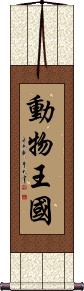
動物王國 is literally what it says.
There is even a TV show in China that is similar to Wild Kingdom or what you would currently see on the Discovery Channel that has this same title.
For your information: In the Chinese way of thinking, the Tiger is the king of the animal kingdom (lions are not native to China, so the tiger took the role that we have given to the lion in our western way of thinking).
The modern Japanese version has a slight variation on the last character (国 instead of 國). Let me know if you want the modern Japanese version (國 would be considered the old or traditional version).
Xishi / Xi Shi
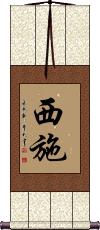
西施 is the Chinese title for Xishi, who lived around 450 BC. She was a famous Chinese beauty, perhaps the foremost of the Four Beauties (四大美女). She was given by King Gou Jian of the Yue Kingdom as a concubine to the King of Wu. This was part of an elaborate plan to destroy the Wu Kingdom - and it worked.
Note: In Japanese, this can be an unrelated given name, Seishi. Though the Xishi story is somewhat known in Japan.
Tiger Rumor
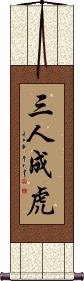
These four characters together relay the meaning that can be expressed in English as “When three people say there's a tiger running in the street, you believe it.”
Of course, there is an ancient story behind this idiom...
三人成虎 is actually a proverb that resulted from a conversation that occurred around 300 B.C.
The conversation was between the king of the Wei kingdom and one of the king's ministers named Pang Cong.
It was near the end of one of many wars, this time with the Zhao kingdom. Pang Cong was to be sent by the king to the Zhao kingdom with the king's son, who was to be held hostage. It was common at the time for a king to make his son a hostage to secure stable peace between warring kingdoms.
Before minister Pang Cong departed, he asked his king, “If one person told you a tiger was running in the street, would you believe it?.”
“No,” the king said.
The minister continued, “What if two people told you?”
The king replied, “Well, I would have my doubts but I might believe it.”
The minister continued, “So, what if three people told you that a tiger is running in the streets?”
The king replied, “Yes, I would believe it. It must be true if three people say it.”
The minister then reminded the king, “Your son and I are now traveling far away to live in the distant Zhao kingdom - much farther from your palace than the street. Rumors may fly about me in my absence, so I hope your majesty will weight such rumors appropriately.”
The king replied, “I have every trust in you, do not worry”
While the minister was gone, the king's enemies gossiped about minister Pang Cong on many occasions. At first, the king thought nothing of these comments and rumors. But slowly, as the rumors mounted, the king began to suspect ill of his minister.
Sometime later, when peace was well-established, the minister and prince were freed and returned to the kingdom of Wei. The king received his son BUT DID NOT EVEN SUMMON MINISTER PANG CONG TO THE PALACE!
Hopefully, this story will help you see how dangerous words can be when used to promote rumors or create ill will. And perhaps will inspire you not to believe everything you hear.
There is also a secondary suggestion in this idiom that gossip is as ferocious as a tiger. Some Chinese people who don't know the ancient story above may believe that this scroll means that rumors are as vicious as three tigers.
Note: This proverb appears in my Korean dictionary but is not well-known in Korea.
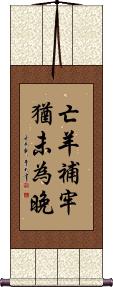
Better Late Than Never
It's Never Too Late Too Mend
Long ago in what is now China, there were many kingdoms throughout the land. This time period is known as “The Warring States Period” by historians because these kingdoms often did not get along with each other.
Sometime around 279 B.C. the Kingdom of Chu was a large but not particularly powerful kingdom. Part of the reason it lacked power was the fact that the King was surrounded by “yes men” who told him only what he wanted to hear. Many of the King's court officials were corrupt and incompetent which did not help the situation.
The King was not blameless himself, as he started spending much of his time being entertained by his many concubines.
One of the King's ministers, Zhuang Xin, saw problems on the horizon for the Kingdom, and warned the King, “Your Majesty, you are surrounded by people who tell you what you want to hear. They tell you things to make you happy and cause you to ignore important state affairs. If this is allowed to continue, the Kingdom of Chu will surely perish, and fall into ruins.”
This enraged the King who scolded Zhuang Xin for insulting the country and accused him of trying to create resentment among the people. Zhuang Xin explained, “I dare not curse the Kingdom of Chu but I feel that we face great danger in the future because of the current situation.” The King was simply not impressed with Zhuang Xin's words.
Seeing the King's displeasure with him and the King's fondness for his court of corrupt officials, Zhuang Xin asked permission from the King that he may take leave of the Kingdom of Chu, and travel to the State of Zhao to live. The King agreed, and Zhuang Xin left the Kingdom of Chu, perhaps forever.
Five months later, troops from the neighboring Kingdom of Qin invaded Chu, taking a huge tract of land. The King of Chu went into exile, and it appeared that soon, the Kingdom of Chu would no longer exist.
The King of Chu remembered the words of Zhuang Xin and sent some of his men to find him. Immediately, Zhuang Xin returned to meet the King. The first question asked by the King was “What can I do now?”
Zhuang Xin told the King this story:
A shepherd woke one morning to find a sheep missing. Looking at the pen saw a hole in the fence where a wolf had come through to steal one of his sheep. His friends told him that he had best fix the hole at once. But the Shepherd thought since the sheep is already gone, there is no use fixing the hole.
The next morning, another sheep was missing. And the Shepherd realized that he must mend the fence at once. Zhuang Xin then went on to make suggestions about what could be done to reclaim the land lost to the Kingdom of Qin, and reclaim the former glory and integrity of the Kingdom of Chu.
The Chinese idiom shown above came from this reply from Zhuang Xin to the King of Chu almost 2,300 years ago.
It translates roughly into English as...
“Even if you have lost some sheep, it's never too late to mend the fence.”
This proverb, 亡羊补牢犹未为晚, is often used in modern China when suggesting in a hopeful way that someone change their ways, or fix something in their life. It might be used to suggest fixing a marriage, quitting smoking, or getting back on track after taking an unfortunate path in life among other things one might fix in their life.
I suppose in the same way that we might say, “Today is the first day of the rest of your life” in our western cultures to suggest that you can always start anew.
Note: This does have Korean pronunciation but is not a well-known proverb in Korean (only Koreans familiar with ancient Chinese history would know it). Best if your audience is Chinese.
The one who retreats 50 paces mocks the one to retreats 100
The pot calls the kettle black
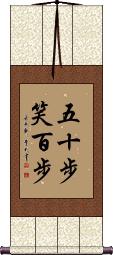
五十步笑百步 is a Chinese proverb that means the one who retreats 50 paces mocks the one who retreats 100 paces.
During the Warring States Period of what is now China (475 - 221 B.C.), the King of Wei was in love with war. He often fought with other kingdoms just for spite or fun.
One day, the King of Wei asked the philosopher Mencius, “I love my people, and all say I do the best for them. I move the people from famine-stricken areas to places of plenty and transport grains from rich areas to the poor. Nobody goes hungry in my kingdom, and I treat my people far better than other kings. But why does the population of my kingdom not increase, and why does the population of other kingdoms not decrease?”
Mencius answered, “Since you love war, I will make this example: When going to war, and the drums beat to start the attack, some soldiers flee for their lives in fear. Some run 100 paces in retreat, and others run 50 steps. Then the ones who retreated 50 paces laugh and taunt those who retreated 100 paces, calling them cowards mortally afraid of death. Do you think this is reasonable?
The King of Wei answered, “Of course not! Those who run 50 paces are just as timid as those who run 100 paces.”
Mencius then said, “You are a king who treats his subjects better than other kings treat their people, but you are so fond of war that your people suffer from great losses in battle. Therefore, your population does not grow. While other kings allow their people to starve to death, you send your people to die in war. Is there any difference?”
This famous conversation led to the six-character proverb shown here. It serves as a warning to avoid hypocrisy. It goes hand-in-hand with the western phrase, “The pot calls the kettle black,” or the Biblical phrase, “Before trying to remove a splinter from your neighbor's eye, first remove the plank from your own eye.”
Past experience is the teacher for the future
Past events not forgotten serve as teachers for later events.
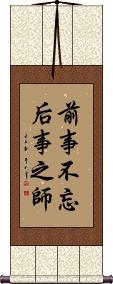
The most literal translation to English of this ancient 前事不忘后事之师 Chinese proverb is:
“Past events not forgotten serve as teachers for later events.”
However, it's been translated several ways:
Don't forget past events, they can guide you in the future.
Benefit from past experience.
Past experience, if not forgotten, is a guide for the future.
Past calamity is my teacher.
A good memory for the past is a teacher for the future.
The remembrance of the past is the teacher of the future.
If one remembers the lessons of the past; They will serve as a guide to avoid mistakes in the future.
The origin:
This proverb comes from the 5th century B.C., just before the Warring States Period in the territory now known as China.
The head of the State of Jin, Zhi Bo, seized power in a coup. He did this with help from the armies of the State of Han and Wei. Instead of being grateful for the help from Han and Wei, he treacherously took the land of Han and Wei. Never satisfied, Zhi Bo employed the armies of Han and Wei to attack and seize the State of Zhao.
The king of Zhao took advice from his minister Zhang Mengtan and secretly contacted the Han and Wei armies to reverse their plans and attack the army of Zhi Bo instead. The plan was successful, and the State of Zhao was not only saved but was set to become a powerful kingdom in the region.
Zhang Mengtan immediately submitted his resignation to a confused king of Zhao. When asked why, Zhang Mengtan said, “I've done my duty to save my kingdom, but looking back at past experience, I know sovereign kings are never satisfied with the power or land at hand. They will join others and fight for more power and more land. I must learn from past experiences, as those experiences are the teachers of future events.”
The king could not dispute the logic in that statement and accepted Zhang Mengtan's resignation.
For generations, the State of Zhao continued to fight for power and land until finally defeated and decimated by the State of Qin (which led to the birth of the Qin Dynasty in 221 B.C.).
This in-stock artwork might be what you are looking for, and ships right away...

Gallery Price: $200.00
Your Price: $79.88
Gallery Price: $286.00
Your Price: $158.88

Gallery Price: $40.00
Your Price: $16.88
Not the results for King of My Kingdom that you were looking for?
Below are some entries from our dictionary that may match your King of My Kingdom search...
| Characters If shown, 2nd row is Simp. Chinese |
Pronunciation Romanization |
Simple Dictionary Definition |
王 see styles |
wàng wang4 wang wan わん |
More info & calligraphy: King(n,n-suf) (1) king; ruler; sovereign; monarch; (n,n-suf) (2) tycoon; magnate; champion; master; (n,n-suf) (3) (abbreviation) {shogi} (See 王将・おうしょう・1) king (of the senior player); (surname) Wan rāja, king, prince, royal; to rule. |
武寧 武宁 see styles |
wǔ níng wu3 ning2 wu ning bunei / bune ぶねい |
see 武寧縣|武宁县[Wu3 ning2 Xian4] (person) Bunei (last King of the Chuuzan Kingdom) (1356-1406) |
聖神 圣神 see styles |
shèng shén sheng4 shen2 sheng shen maria まりあ |
feudal term of praise for ruler, king or emperor; general term for saint in former times; term for God during the Taiping Heavenly Kingdom 太平天國|太平天国; Holy Spirit (in Christian Trinity) (female given name) Maria |
賴吒 赖咤 see styles |
lài zhà lai4 zha4 lai cha raita |
(賴吒啝羅) rāṣṭrapāla, protector of a kingdom, king. |
天羅國 天罗国 see styles |
tiān luó guó tian1 luo2 guo2 t`ien lo kuo tien lo kuo Tenra koku |
The kingdom of the king with kalmā-ṣapāda, i. e. spotted, or striped feet 斑定王; cf. 仁王經. |
師子國 师子国 see styles |
shī zǐ guó shi1 zi3 guo2 shih tzu kuo Shishikoku |
Siṃhala, Ceylon, the kingdom reputed to be founded by Siṃha, first an Indian merchant, later king of the country, who overcame the 'demons' of Ceylon and conquered the island. |
曲女城 see styles |
qǔ nǚ chéng qu3 nv3 cheng2 ch`ü nü ch`eng chü nü cheng Kyōkunyo jō |
The city of hunchback women, said to be Kanyākubja, an ancient kingdom and capital of Central India, 'Canouge Lat. 27° 3 N., Long. 79° 50 E.' Eitel. The legend in the 西域記 Record of Western Lands is that ninety-nine of King Brahmadatta's daughters were thus deformed by the ṛṣi Mahāvṛkṣa whom they refused to marry. |
都貨羅 都货罗 see styles |
dū huò luó du1 huo4 luo2 tu huo lo Tokara |
Tukhāra, the 月支 Yuezhi country; '(1) A topographical term designating a country of ice and frost (tukhāra), and corresponding to the present Badakchan which Arab geographers still call Tokharestan. (2) An ethnographical term used by the Greeks to designate the Tocharoi or Indo-Scythians, and likewise by Chinese writers applied to the Tochari Tartars who driven on by the Huns (180 B.C.) conquered Trans-oxania, destroyed the Bactrian kingdom (大夏) 126 B.C., and finally conquered the Pundjab, Cashmere, and the greater part of India. Their greatest king was Kanichka.' Eitel. |
羯若鞠闍 羯若鞠阇 see styles |
jier uo jú shé jier2 uo4 ju2 she2 jier uo chü she Kanyakikuja |
Kanyakubja, 'hump-backed maidens.' An ancient city and kingdom of Central India. In antiquity this city ranks next to Ayodhyā in Oudh. It is known to classical geography as Canogyza. The etymology refers to the legend of the hundred daughters of Kuśanābha its king, who refused the licentious desires of Vāyu (Mahāvṛkṣa 大樹仙) and were turned by him into hunchbacks. M.W. Eitel says 'the modem Canouge'. |
The following table may be helpful for those studying Chinese or Japanese...
| Title | Characters | Romaji (Romanized Japanese) | Various forms of Romanized Chinese | |
| Animal Kingdom | 動物王國 动物王国 | doubutsu oukoku doubutsuoukoku dobutsu okoku | dòng wù wáng guó dong4 wu4 wang2 guo2 dong wu wang guo dongwuwangguo | tung wu wang kuo tungwuwangkuo |
| Xishi Xi Shi | 西施 | sei shi / seishi | xī shī / xi1 shi1 / xi shi / xishi | hsi shih / hsishih |
| Tiger Rumor | 三人成虎 | sān rén chéng hǔ san1 ren2 cheng2 hu3 san ren cheng hu sanrenchenghu | san jen ch`eng hu sanjenchenghu san jen cheng hu |
|
| Better Late Than Never | 亡羊補牢猶未為晚 亡羊补牢犹未为晚 | wáng yáng bǔ láo yóu wèi wéi wǎn wang2 yang2 bu3 lao2 you2 wei4 wei2 wan3 wang yang bu lao you wei wei wan | wang yang pu lao yu wei wei wan wangyangpulaoyuweiweiwan |
|
| The one who retreats 50 paces mocks the one to retreats 100 | 五十步笑百步 | wù shí bù xiào bǎi bù wu4 shi2 bu4 xiao4 bai3 bu4 wu shi bu xiao bai bu wushibuxiaobaibu | wu shih pu hsiao pai pu wushihpuhsiaopaipu |
|
| Past experience is the teacher for the future | 前事不忘后事之師 前事不忘后事之师 | qián shì bú wàng hòu shí zhī shī qian2 shi4 bu2 wang4 hou4 shi2 zhi1 shi1 qian shi bu wang hou shi zhi shi | ch`ien shih pu wang hou shih chih shih chien shih pu wang hou shih chih shih |
|
| In some entries above you will see that characters have different versions above and below a line. In these cases, the characters above the line are Traditional Chinese, while the ones below are Simplified Chinese. | ||||

Successful Chinese Character and Japanese Kanji calligraphy searches within the last few hours...



