Many custom options...


And formats...



Not what you want?
Try other similar-meaning words, fewer words, or just one word.
Karma Name in Chinese / Japanese...
Buy a Karma Name calligraphy wall scroll here!
Personalize your custom “Karma Name” project by clicking the button next to your favorite “Karma Name” title below...
If you would like your name in Chinese calligraphy and it does not appear below, please contact me, and I'll transliterate and add your name to our website database for you.
Karma
Transliterated personal name
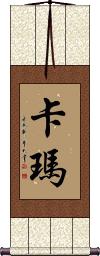
卡瑪 is the most common transliteration to Mandarin Chinese for the name Karma.
Note: This sounds like Karma but does not have the meaning of Karma in Chinese. See our other entry if you are looking for the Buddhist idea of Karma.
In fact, if your name is Karma, I strongly suggest that you use a word that means Karma, rather than this one that sounds like Karma (meaning is more important and universal in Chinese/Japanese/Korean).
The Mysterious Bond Between People
The invisible force that brings people together forever
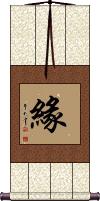
緣 represents the fate that brings and bonds people together.
緣 is a complicated single character. It can mean a lot of different things depending on how you read it.
In Japanese, it can mean fate, destiny, a mysterious force that binds two people together, a relationship between two people, bond, link, connection, family ties, affinity, opportunity, or chance (to meet someone and start a relationship). It can also mean “someone to rely on,” relative, reminder, memento, or the female given name, Yori.
It's the same in Chinese, where it's defined as cause, reason, karma, fate, or predestined affinity.
In the Buddhist context, it's Pratyaya. This is the concept of indirect conditions, as opposed to direct causes. It's when something happens (meeting someone) by circumstance or a contributing environment. Instead of a direct cause or act, it is a conditioning cause without direct input or action by the involved people.
Occasionally, this character is used in a facetious way to say hem, seam, or edge of clothing. In this case, it's the seam that brings or holds the clothing together.
 Note: Japanese will tend to use the variant of this Kanji shown to the right. If you want this version (and are ordering this from the Japanese master calligrapher), click on the Kanji at the right instead of the button above.
Optimism / Happy With Your Fate
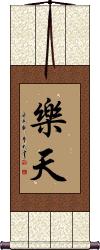
樂天 is about being optimistic and also making the best of whatever life throws at you.
This is hard to define. One dictionary defines this as “acceptance of fate and happy about it.” There is one English word equivalent, which is sanguinity or sanguinary.
You can also say that this means “Be happy with whatever Heaven provides,” or “Find happiness in whatever fate Heaven bestows upon you.” 樂天 suggests being an optimist in life.
Note: This is sometimes a given name in China.
 Please note that Japanese tend to write the first character in a slightly-different form (as seen to the right). Let us know if you have a preference when you place your order.
You may want to check our...
Your name on a Chinese calligraphy scroll page
Your name on a Japanese calligraphy scroll page
...for a list of almost 5000 names.
This in-stock artwork might be what you are looking for, and ships right away...
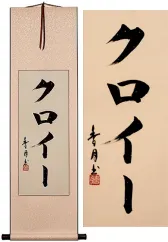
Gallery Price: $107.00
Your Price: $59.00
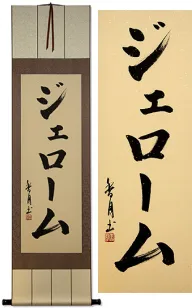
Not the results for Karma Name that you were looking for?
Below are some entries from our dictionary that may match your Karma Name search...
| Characters If shown, 2nd row is Simp. Chinese |
Pronunciation Romanization |
Simple Dictionary Definition |
助業 助业 see styles |
zhù yè zhu4 ye4 chu yeh jogou / jogo じょごう |
{Buddh} (See 浄土宗) auxiliary actions (in Jodo: recitation, observation, worship, praise and offering) Auxiliary karma, i.e. deeds or works, e.g. reciting the sutras about the Pure Land, worship, praise, and offering, as additional to direct karma 正業, i.e. faith in Amitābha, expressed by constant thought of him and calling on his name. |
法界 see styles |
fǎ jiè fa3 jie4 fa chieh hokkai; houkai / hokkai; hokai ほっかい; ほうかい |
(1) {Buddh} universe; (2) {Buddh} realm of thought; (3) {Buddh} underlying principle of reality; manifestation of true thusness; (4) (ほうかい only) (abbreviation) (See 法界悋気) being jealous of things that have nothing to do with one; being jealous of others who are in love with each other dharmadhātu, 法性; 實相; 達磨馱都 Dharma-element, -factor, or-realm. (1) A name for "things" in general, noumenal or phenomenal; for the physical universe, or any portion or phase of it. (2) The unifying underlying spiritual reality regarded as the ground or cause of all things, the absolute from which all proceeds. It is one of the eighteen dhātus. These are categories of three, four, five, and ten dharmadhātus; the first three are combinations of 事 and 理 or active and passive, dynamic and static; the ten are: Buddha-realm, Bodhisattva-realm, pratyekabuddha-realm, śrāvaka, deva, Human, asura, Demon, Animal, and Hades realms-a Huayan category. Tiantai has ten for meditaton, i.e. the realms of the eighteen media of perception (the six organs, six objects, and six sense-data or sensations), of illusion, sickness, karma, māra, samādhi, (false) views, pride, the two lower Vehicles, and the Bodhisattva Vehicle. |
滅羯磨 灭羯磨 see styles |
miè jié mó mie4 jie2 mo2 mieh chieh mo metsu konma |
The extinguishing karma, or the blotting out of the name of a monk and his expulsion. |
阿陀那 see styles |
ā tuó nà a1 tuo2 na4 a t`o na a to na adana |
ādāna, intp. by 執持 holding on to, maintaining; holding together the karma, good or evil, maintaining the sentient organism, or the germ in the seed or plant. It is another name for the ālaya-vijñāna, and is known as the 阿陀那識 ādānavijñāna. |
十二因緣 十二因缘 see styles |
shí èr yīn yuán shi2 er4 yin1 yuan2 shih erh yin yüan jūni innen |
Dvādaśaṅga pratītyasamutpāda; the twelve nidānas; v. 尼 and 因; also 十二緣起; 因緣有支; 因緣率連; 因緣棘園; 因緣輪; 因緣重城; 因緣觀; 支佛觀. They are the twelve links in the chain of existence: (1) 無明avidyā, ignorance, or unenlightenment; (2) 行 saṃskāra, action, activity, conception, "dispositions," Keith; (3) 識 vijñāna, consciousness; (4) 名色 nāmarūpa, name and form; (5) 六入 ṣaḍāyatana, the six sense organs, i.e. eye, ear, nose, tongue, body, and mind; (6) 觸 sparśa, contact, touch; (7) 受 vedanā, sensation, feeling; (8) 愛 tṛṣṇā, thirst, desire, craving; (9) 取 upādāna, laying hold of, grasping; (10) 有 bhava, being, existing; (11) 生 jāti, birth; (12) 老死 jarāmaraṇa, old age, death. The "classical formula" reads "By reason of ignorance dispositions; by reason of dispositions consciousness", etc. A further application of the twelve nidānas is made in regard to their causaton of rebirth: (1) ignorance, as inherited passion from the beginningless past ; (2) karma, good and evil, of past lives; (3) conception as a form of perception; (4) nāmarūpa, or body and mind evolving (in the womb); (5) the six organs on the verge of birth; (6) childhood whose intelligence is limited to sparśa, contact or touch; (7) receptivity or budding intelligence and discrimination from 6 or 7 years; (8) thirst, desire, or love, age of puberty; (9) the urge of sensuous existence; (10) forming the substance, bhava, of future karma; (11) the completed karma ready for rebirth; (12) old age and death. The two first are associated with the previous life, the other ten with the present. The theory is equally applicable to all realms of reincarnation. The twelve links are also represented in a chart, at the centre of which are the serpent (anger), boar (ignorance, or stupidity), and dove (lust) representing the fundamental sins. Each catches the other by the tail, typifying the train of sins producing the wheel of life. In another circle the twelve links are represented as follows: (1) ignorance, a blind woman; (2) action, a potter at work, or man gathering fruit; (3) consciousness, a restless monkey; (4) name and form, a boat; (5) sense organs, a house; (6) contact, a man and woman sitting together; (7) sensation, a man pierced by an arrow; (8) desire, a man drinking wine; (9) craving, a couple in union; (10) existence through childbirth; (11) birth, a man carrying a corpse; (12) disease, old age, death, an old woman leaning on a stick. v. 十二因緣論 Pratītya-samutpāda śāstra. |
The following table may be helpful for those studying Chinese or Japanese...
| Title | Characters | Romaji (Romanized Japanese) | Various forms of Romanized Chinese | |
| Karma | 卡瑪 卡玛 | kǎ mǎ / ka3 ma3 / ka ma / kama | k`a ma / kama / ka ma | |
| The Mysterious Bond Between People | 緣 / 縁 缘 | en | yuán / yuan2 / yuan | yüan |
| Optimism Happy With Your Fate | 樂天 / 楽天 乐天 | raku ten / rakuten | lè tiān / le4 tian1 / le tian / letian | le t`ien / letien / le tien |
| In some entries above you will see that characters have different versions above and below a line. In these cases, the characters above the line are Traditional Chinese, while the ones below are Simplified Chinese. | ||||

Successful Chinese Character and Japanese Kanji calligraphy searches within the last few hours...



