Many custom options...


And formats...



Not what you want?
Try other similar-meaning words, fewer words, or just one word.
Kanji Symbol Joy in Chinese / Japanese...
Buy a Kanji Symbol Joy calligraphy wall scroll here!
Personalize your custom “Kanji Symbol Joy” project by clicking the button next to your favorite “Kanji Symbol Joy” title below...
See also: Selections of just Japanese Kanji Calligraphy
2. Joy
4. Family Love / Domestic Bliss
6. Brahmavihara - The Four Immeasurables
8. Doing good is the greatest source of happiness
12. Inner Bliss and Peace from Meditation
15. You must endure a harsh winter to appreciate the warmth of springtime
16. Le
17. Radiance
18. Generosity
Happiness / Joyful / Joy
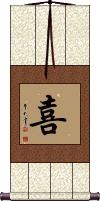
喜 is the Chinese, Japanese Kanji, and Korean Hanja for the kind of happiness known in the west as “joy.”
喜 can also be translated as rejoice, enjoyment, delighted, pleased, or “take pleasure in.” Sometimes it can mean “to be fond of” (in a certain context).
If you write two of these happiness/joy characters side by side, you create another character known in English as “double happiness,” which is a symbol associated with weddings and happy marriages.
There is another version of this character that you will find on our website with an additional radical on the left side (exactly same meaning, just an alternate form). The version of happiness shown here is the commonly written form in China, Japan and South Korea (banned in North Korea).
See Also: Contentment | Happiness | Joy
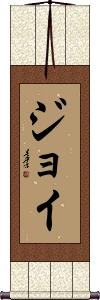
ジョイ is the name Joy in Japanese.
If your name is Joy, I recommend that you pick a character that means “joy” rather than this version which only sounds like “Joy.”
Note: Because this title is entirely Japanese Katakana, it should be written by a Japanese calligrapher.
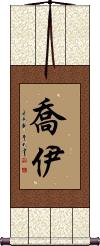
喬伊 is the transliteration to Mandarin Chinese for the name Joy.
If your name is Joy, I recommend that you pick a character that means “joy” rather than this version which only sounds like “Joy.”
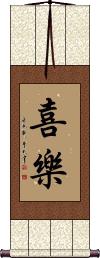
Happiness / Joy
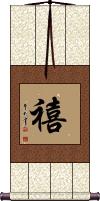
禧 is the type of happiness known in the west as “joy.”
The radical on the right side of this character is often seen alone (with the same meaning - and we do recommend that version because it's more universal).
Family Love / Domestic Bliss
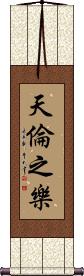
天倫之樂 means family love and joy, or domestic bliss.
The first two characters mean “the bonds of the family.”
The third character connects this to the fourth character which means happiness, joy, and cheerfulness.
Ten perfect Mahayana rules
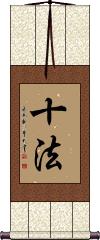
十法 is the title of the ten perfect or perfecting Mahāyāna rules.
The order of rules is as follows:
1. right belief.
2. right conduct.
3. right spirit.
4. the joy of the bodhi mind.
5. joy in the dharma.
6. joy in meditation.
7. pursuing the correct dharma.
8. obedience to, or accordance with dharma.
9. departing from pride, desire, etc.
10. comprehending the inner teaching of Buddha and taking no pleasure in attaining such knowledge or noting the ignorance of others.
This title is only used in the context of Buddhism. Japanese and Chinese people who are not familiar with Buddhism will not recognize this title.
Brahmavihara - The Four Immeasurables
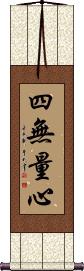
四無量心 is the cattāri brahmavihārā or catvāri apramāṇāni.
The four immeasurables, or infinite Buddha-states of mind. These four dhyānas include:
1. 慈無量心 boundless kindness, maitrī, or bestowing of joy or happiness.
2. 悲無量心 boundless pity, karuṇā, to save from suffering.
3. 喜無量心 boundless joy, muditā, on seeing others rescued from suffering.
4. 捨無量心 limitless indifference, upekṣā, i.e., rising above these emotions or giving up all things.
Pleasant Feeling
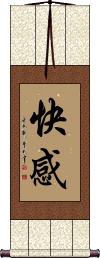
快感 is a Chinese, Japanese, and old Korean word meaning pleasure, thrill, delight, joy, pleasurable sensation, or pleasant feeling.
Doing good is the greatest source of happiness
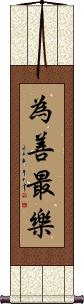
為善最樂 can be translated as “Doing good is the greatest source of happiness” or “doing good deeds brings the greatest joy.”
The origin is not known but is sometimes used in the context of Buddhism. However, this Chinese proverb or philosophy is a relatively mainstream idea of benevolence.
Pursuit of Happiness
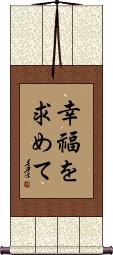
幸福を求めて is “Pursuit of Happiness” or “In Search of Happiness” in Japanese.
Here's how the characters break down:
幸福 (koufuku) happiness; blessedness; joy; well-being.
を (o) particle
求め (motome) to want; to seek; to pursue; to request
て (te) particle
Note: Because this selection contains some special Japanese Hiragana characters, it should be written by a Japanese calligrapher.
See Also: Follow Your Dreams
School of Happiness
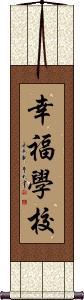
幸福學校 means “School of Happiness” or “Happiness School” in Chinese.
幸福 means happiness, happy, blessed, blessedness, joy, and/or well-being.
學校 means school or college.
Eternal Happiness
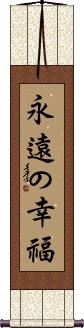
永遠の幸福 means “eternal happiness” in Japanese.
永遠 means eternal, eternity, perpetuity, forever, immortality, and permanence.
の is a possessive article which sort of makes this selection mean “happiness, of the eternal kind.”
幸福 means happiness, though this word can be translated as truly blessed, joy, happy, welfare, well-being, or fortunate.
Eternal Happiness
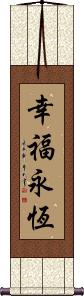
幸福永恆 is a short way to say eternal happiness in Chinese.
Breaking down the parts:
幸福 means happiness, happy, blessed, blessedness, joy, and/or well-being.
永恆 means eternal, everlasting, and/or forever.
Another way to write this is 永恆的幸福. It reverses the word order and adds a possessive article. I prefer the shorter version, which is slightly more natural in Chinese.
Inner Bliss and Peace from Meditation
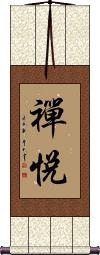
禪悅 is a title that refers to the inner bliss and peace you can achieve from meditation.
This term transcends a few religions, including Taoism and Buddhism. It can also be translated as “joy of the mystic trance” or simply “meditative bliss.”
Amazing that such a complex idea can be expressed in just two Chinese characters. Note that the first character is Chan/Zen (Chinese/Japanese), which means “meditation” in both languages.
Joyfulness / Happiness
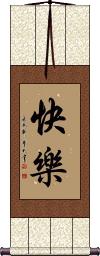
快樂 or joyfulness is an inner sense of peace and happiness.
You appreciate the gifts each day brings. Without joyfulness, when the fun stops, our happiness stops. Joy can carry us through hard times even when we are feeling very sad.
快樂 can also mean pleasure, enjoyment, delight, cheerfulness, or merry. In some ways, this is the essence that makes someone perceived as a charming person.
See Also: Happiness
Galatians 5:22-23

Here is Galatians 5:22 and a bit of 23 in Chinese.
The text with punctuation:
圣灵所结的果子,就是仁爱,喜乐,和平,忍耐,恩慈,良善,信实,温柔,节制。
Hand-painted calligraphy does not retain punctuation.
This translation is from the Chinese Union Bible.
You may know it from the KJV as:
5:22 But the fruit of the Spirit is love, joy, peace, longsuffering, gentleness, goodness, faith,
5:23 Meekness, temperance...
You must endure a harsh winter to appreciate the warmth of springtime
You must know hardship to appreciate happiness
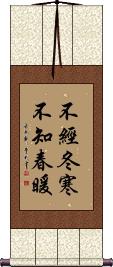
This literally translates as: Without having experienced the cold of winter, one cannot appreciate the warmth of spring.
Figuratively, this means: One cannot truly appreciate happiness without having gone through hardship.
There are many contrasts in life. One simply cannot fully know what joy is without having experienced misery, difficulty, and pain. How could you explain “light” if you did not have “darkness” to compare it to?
Embrace hardship, as it makes the good times seem even better.
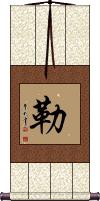
勒 is a Chinese surname that romanizes as Le or Lè and comes from ancient place names (Shu-Le) or ethnic groups like the Huns.
Use caution: There are other surnames in Asia that romanize as Le; here are a few:
Vietnamese (Lê): Most common usage, from Chinese 黎 (Lí), signifying a major royal family like the Lê Dynasty (1428–1788).
Chinese (樂 - Lè): Means "happiness" or "joy," from historical figures or noble lineages.
Korean: Can be a variant of Li or Lee, representing different Chinese characters (e.g., 黎, 呂).
Radiance
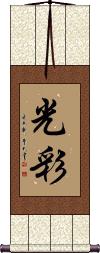
光彩 is the Chinese, Japanese Kanji, and old Korean Hanja for radiance.
Other meanings include luster, splendor/splendour, and brilliance.
光彩 is the radiance you see when a person's arrival brings happiness and joy to the room. Or the radiance on the face of a new bride etc.
If you delve into the dictionary, other forms of radiance will refer to isotopes emitting radiation. 光彩 is not related to radiation and is not the kind that causes cancer.
In Japanese, this can be several female given names such as Misa, Hikari, Hiiro, Teresa, or Arisa. And a more unisex given name of Kousai or Kosai.
Generosity
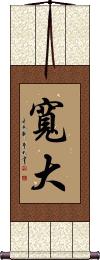
寬大 is a Chinese, Japanese, and Korean word that means Generosity.
Generosity is giving and sharing. You share freely, not with the idea of receiving something in return. You find ways to give others happiness and give just for the joy of giving. Generosity is one of the best ways to show love and friendship.
寬大 can also be translated as charitable, magnanimity, liberality, or in some contexts, broad-mindedness.
Note: There is a tiny deviation in the first character when written in Japanese. If you choose our Japanese master calligrapher, the little dot on the lower right of the first character will be omitted. With or without the dot, this can be read in Chinese, Japanese Kanji, and old Korean Hanja.
See Also: Benevolence | Altruism | Charity
Chop Wood, Carry Water
Before enlightenment or after, chores remain.
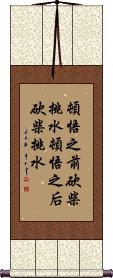
頓悟之前砍柴挑水; 頓悟之後砍柴挑水 means “Before enlightenment, chop wood, carry water; After enlightenment, chop wood, carry water.
This is a Chinese proverb that is attributed to 吴力 (Wú Lì) who lived between 1632 and 1718 - living part of his life as a devout Buddhist, and many years as a Catholic Jesuit Priest in China - what an interesting life!
This has been explained many times in many ways. I am a Buddhist, and here is my brief take on this proverb...
Before enlightenment, one may find daily chores mundane, tedious, and boring. However, upon reaching enlightenment one is not relieved of the details of daily life. An enlightened person will, however, see such chores as a joy, and do them mindfully.
There is another version floating around, which is 在你領悟之前砍柴、運水。在你領悟之後,砍柴、運水。
If you want this other version, just contact me. The meaning is the same, just different phrasing.
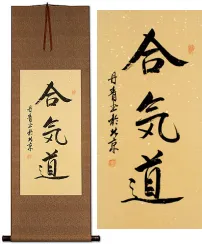
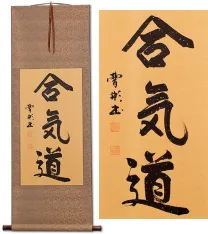
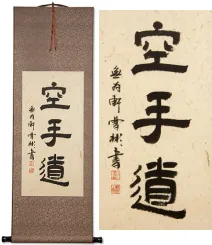
This in-stock artwork might be what you are looking for, and ships right away...

Gallery Price: $200.00
Your Price: $118.88
Gallery Price: $268.00
Your Price: $148.77
Gallery Price: $268.00
Your Price: $148.77
Gallery Price: $72.00
Your Price: $39.88





Gallery Price: $200.00
Your Price: $124.88

Gallery Price: $200.00
Your Price: $98.88
The following table may be helpful for those studying Chinese or Japanese...
| Title | Characters | Romaji (Romanized Japanese) | Various forms of Romanized Chinese | |
| Happiness Joyful Joy | 喜 | ki / yorokobi | xǐ / xi3 / xi | hsi |
| Joy | ジョイ | joi | ||
| Joy | 喬伊 乔伊 | qiáo yī / qiao2 yi1 / qiao yi / qiaoyi | ch`iao i / chiaoi / chiao i | |
| Joy | 喜樂 喜乐 | kiraku | xǐ lè / xi3 le4 / xi le / xile | hsi le / hsile |
| Happiness Joy | 禧 | xǐ / xi3 / xi | hsi | |
| Family Love Domestic Bliss | 天倫之樂 天伦之乐 | tiān lún zhī lè tian1 lun2 zhi1 le4 tian lun zhi le tianlunzhile | t`ien lun chih le tienlunchihle tien lun chih le |
|
| Ten perfect Mahayana rules | 十法 | jippou / jipo | shí fǎ / shi2 fa3 / shi fa / shifa | shih fa / shihfa |
| Brahmavihara - The Four Immeasurables | 四無量心 四无量心 | shi mur you shin shimuryoushin shi mur yo shin | sì wú liàng xīn si4 wu2 liang4 xin1 si wu liang xin siwuliangxin | ssu wu liang hsin ssuwulianghsin |
| Pleasant Feeling | 快感 | kaikan | kuài gǎn / kuai4 gan3 / kuai gan / kuaigan | k`uai kan / kuaikan / kuai kan |
| Doing good is the greatest source of happiness | 為善最樂 为善最乐 | wéi shàn zuì lè wei2 shan4 zui4 le4 wei shan zui le weishanzuile | wei shan tsui le weishantsuile |
|
| Pursuit of Happiness | 幸福を求めて | koufuku o motome te koufukuomotomete kofuku o motome te | ||
| School of Happiness | 幸福學校 幸福学校 | xìng fú xué xiào xing4 fu2 xue2 xiao4 xing fu xue xiao xingfuxuexiao | hsing fu hsüeh hsiao hsingfuhsüehhsiao |
|
| Eternal Happiness | 永遠の幸福 | ei en no kou fuku eiennokoufuku ei en no ko fuku | ||
| Eternal Happiness | 幸福永恆 幸福永恒 | xìng fú yǒng héng xing4 fu2 yong3 heng2 xing fu yong heng xingfuyongheng | hsing fu yung heng hsingfuyungheng |
|
| Inner Bliss and Peace from Meditation | 禪悅 禅悦 | chán yuè / chan2 yue4 / chan yue / chanyue | ch`an yüeh / chanyüeh / chan yüeh | |
| Joyfulness Happiness | 快樂 快乐 | kai raku / kairaku | kuài lè / kuai4 le4 / kuai le / kuaile | k`uai le / kuaile / kuai le |
| Galatians 5:22-23 | 聖靈所結的果子就是仁愛喜樂和平忍耐恩慈良善信實溫柔節制 圣灵所结的果子就是仁爱喜乐和平忍耐恩慈良善信实温柔节制 | shèng líng suǒ jié de guǒ zi jiù shì rén ài xǐ lè he píng rěn nài ēn cí liáng shàn xìn shí wēn róu jié zhì sheng4 ling2 suo3 jie2 de guo3 zi jiu4 shi4 ren2 ai4 xi3 le4 he ping2 ren3 nai4 en1 ci2 liang2 shan4 xin4 shi2 wen1 rou2 jie2 zhi4 sheng ling suo jie de guo zi jiu shi ren ai xi le he ping ren nai en ci liang shan xin shi wen rou jie zhi | sheng ling so chieh te kuo tzu chiu shih jen ai hsi le ho p`ing jen nai en tz`u liang shan hsin shih wen jou chieh chih sheng ling so chieh te kuo tzu chiu shih jen ai hsi le ho ping jen nai en tzu liang shan hsin shih wen jou chieh chih |
|
| You must endure a harsh winter to appreciate the warmth of springtime | 不經冬寒不知春暖 不经冬寒不知春暖 | bù jīng dōng hán bù zhī chūn nuǎn bu4 jing1 dong1 han2 bu4 zhi1 chun1 nuan3 bu jing dong han bu zhi chun nuan | pu ching tung han pu chih ch`un nuan pu ching tung han pu chih chun nuan |
|
| Le | 勒 | lè / le4 / le | ||
| Radiance | 光彩 | kousai / kosai | guāng cǎi guang1 cai3 guang cai guangcai | kuang ts`ai kuangtsai kuang tsai |
| Generosity | 寬大 宽大 | kandai | kuān dà / kuan1 da4 / kuan da / kuanda | k`uan ta / kuanta / kuan ta |
| Chop Wood, Carry Water | 頓悟之前砍柴挑水頓悟之后砍柴挑水 顿悟之前砍柴挑水顿悟之后砍柴挑水 | dùn wù zhī qián kǎn chái tiāo shuǐ dùn wù zhī hòu kǎn chái tiāo shuǐ dun4 wu4 zhi1 qian2 kan3 chai2 tiao1 shui3 dun4 wu4 zhi1 hou4 kan3 chai2 tiao1 shui3 dun wu zhi qian kan chai tiao shui dun wu zhi hou kan chai tiao shui | tun wu chih ch`ien k`an ch`ai t`iao shui tun wu chih hou k`an ch`ai t`iao shui tun wu chih chien kan chai tiao shui tun wu chih hou kan chai tiao shui |
|
| In some entries above you will see that characters have different versions above and below a line. In these cases, the characters above the line are Traditional Chinese, while the ones below are Simplified Chinese. | ||||

Successful Chinese Character and Japanese Kanji calligraphy searches within the last few hours...



