Many custom options...


And formats...



Not what you want?
Try other similar-meaning words, fewer words, or just one word.
Kanji Symbol James in Chinese / Japanese...
Buy a Kanji Symbol James calligraphy wall scroll here!
Personalize your custom “Kanji Symbol James” project by clicking the button next to your favorite “Kanji Symbol James” title below...
See also: Selections of just Japanese Kanji Calligraphy
James
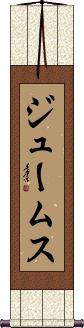
ジュームス is the name James in Japanese.
Note: Because this title is entirely Japanese Katakana, it should be written by a Japanese calligrapher.
James
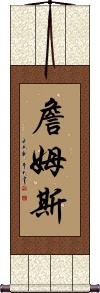
詹姆斯 is the name James in Chinese (Mandarin).
Live and Let Die
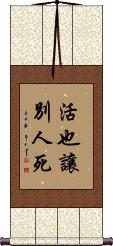
活也讓別人死 means “live and let die” in Chinese.
This is the Chinese translation of the song lyric by Guns 'n Roses for the James Bond 007 movie of the same name.
Live and Let Die
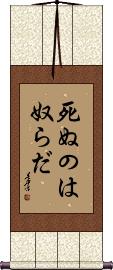
死ぬのは奴らだ means “live and let die,” in Japanese.
死ぬのは奴らだ is the Japanese title of the James Bond 007 movie of the same name.
Note: Because this selection contains some special Japanese Hiragana characters, it should be written by a Japanese calligrapher.
John 14:15
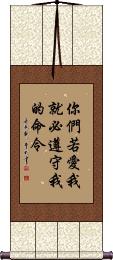
你們若愛我就必遵守我的命令 is the translation of John 14:15 into Chinese.
This comes from the Chinese Union Bible which comes from a revised King James version. This Chinese Bible was originally translated and printed in 1919 (several revisions since then).
Because of the origin being the KJV, I'll say that in English, this would be, “If ye love me, keep my commandments...”
In basic English, this would be, “If you have love for me, you will keep my laws.”
John 14:18
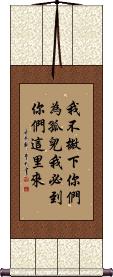
我不撇下你們為孤兒我必到你們這里來 is the translation of John 14:18 into Chinese.
This comes from the Chinese Union Bible which comes from a revised version of the King James. This Chinese Bible was originally translated and printed in 1919 (several revisions since then).
Because of the origin being the KJV, I'll say that in English, this would be, “I will not leave you comfortless: I will come to you...”
In basic English, this would be, “I will not let you be without a friend: I am coming to you.”
John 3:16

神愛世人甚至將他的獨生子賜給他們叫一切信他的不至滅亡反得永生 is the full translation of John 3:16 into Chinese.
This is from the Chinese Union Bible which comes from a revised version of the King James. This Chinese Bible was originally translated and printed in 1919 (several revisions since then).
Because of the origin being the KJV, I'll say that in English, this would be, “For God so loved the world, that he gave his only begotten Son, that whosoever believeth in him should not perish but have everlasting life.”
As with any translation, there are interesting cultural and linguistic issues. For instance, the word used for “world” in Chinese can also mean “common people.” So you could say that it means “For God so loved the common people...”
This does not take away from the text, as it will be understood with the same meaning and connotation.
There is no direct Greek-to-Chinese translation in print (that I know of), so this is the best available. Of course, you can ask any Greek person of faith, and they will claim that a bit is lost from the original Greek of the New Testament to any of the English versions of the Bible in print.
Appreciation and Love for Your Parents
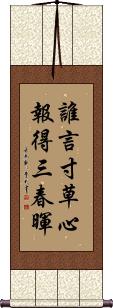
誰言寸草心報得三春暉 is the last line of a famous poem. It is perceived as a tribute or ode to your parents or mother from a child or children that have left home.
The poem was written by Meng Jiao during the Tang Dynasty (about 1200 years ago). The Chinese title is “You Zi Yin” which means “The Traveler's Recite.”
The last line as shown here speaks of the generous and warm spring sunlight which gives the grass far beyond what the little grass can could ever give back (except perhaps by showing its lovely green leaves and flourishing). The metaphor is that the sun is your mother or parents, and you are the grass. Your parents raise you and give you all the love and care you need to prepare you for the world. A debt that you can never repay, nor is repayment expected.
The first part of the poem (not written in the characters to the left) suggests that the thread in a loving mother's hands is the shirt of her traveling offspring. Vigorously sewing while wishing them to come back sooner than they left.
...This part is really hard to translate into English that makes any sense but maybe you get the idea. We are talking about a poem that is so old that many Chinese people would have trouble reading it (as if it was the King James Version of Chinese).
Corinthians 13:4
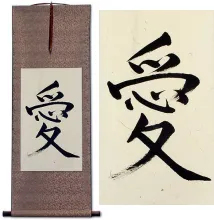
All you need to know about LOVE
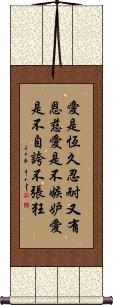
愛是恆久忍耐又有恩慈愛是不嫉妒愛是不自誇不張狂 is 1st Corinthians 13:4 in Chinese.
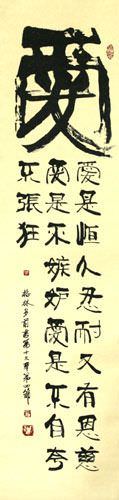
With large “love” character added.
In English, this reads:
1st Corinthians 13:4 (KJV) Charity suffereth long, and is kind; charity envieth not; charity vaunteth not itself, is not puffed up...
1st Corinthians 13:4 (NIV) Love is patient, love is kind. It does not envy, it does not boast, it is not proud.
1st Corinthians 13:4 (Basic English) Love is never tired of waiting; love is kind; love has no envy; love has no high opinion of itself, love has no pride.
The Chinese translation follows the love meaning, rather than the King James' use of “charity.” I was a little confused when writing this description with the significant differences between the NIV vs. KJV translations. After speaking to a Greek scholar about this, it would seem that the KJV has an almost errant translation with the use of “charity” in place of “love.”
We used the most popular Christian Chinese Bible, which is the Chinese Union Version (CUV). The CUV was first published in 1919. We use this so that the Chinese translation would be as accurate and standard as possible. Any Chinese Christian worth their salt will easily be able to identify this verse when they see these characters.
If you want a big “love” character written above the verse on your artwork, just make a note in the “special instructions” tab when you are customizing your artwork. There is no extra charge for that service on this special verse.
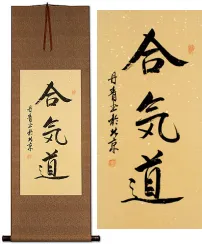
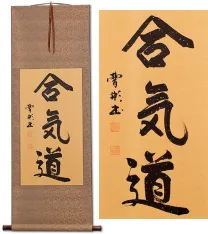
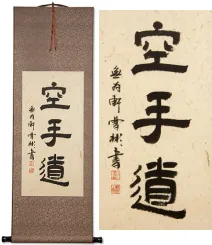
This in-stock artwork might be what you are looking for, and ships right away...

Gallery Price: $200.00
Your Price: $118.88
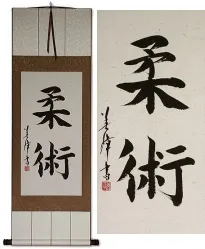
Gallery Price: $268.00
Your Price: $148.77
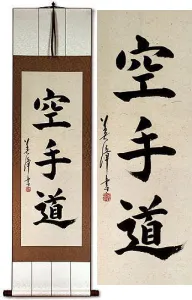
Gallery Price: $268.00
Your Price: $148.77
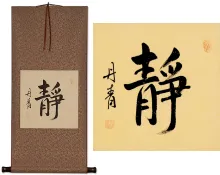
Gallery Price: $72.00
Your Price: $39.88

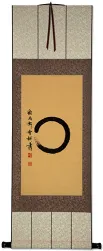



Gallery Price: $200.00
Your Price: $124.88

Gallery Price: $200.00
Your Price: $98.88
The following table may be helpful for those studying Chinese or Japanese...
| Title | Characters | Romaji (Romanized Japanese) | Various forms of Romanized Chinese | |
| James | ジュームス | juumusu / jumusu | ||
| James | 詹姆斯 | zhān mǔ sī zhan1 mu3 si1 zhan mu si zhanmusi | chan mu ssu chanmussu |
|
| Live and Let Die | 活也讓別人死 活也让别人死 | huó yě ràng bié rén sǐ huo2 ye3 rang4 bie2 ren2 si3 huo ye rang bie ren si huoyerangbierensi | huo yeh jang pieh jen ssu huoyehjangpiehjenssu |
|
| Live and Let Die | 死ぬのは奴らだ | shinu no wa yatsuradesu shinunowayatsuradesu | ||
| John 14:15 | 你們若愛我就必遵守我的命令 你们若爱我就必遵守我的命令 | nǐ mén ruò ài wǒ jiù bì zūn shǒu wǒ de mìng lìng ni3 men2 ruo4 ai4 wo3 jiu4 bi4 zun1 shou3 wo3 de ming4 ling4 ni men ruo ai wo jiu bi zun shou wo de ming ling | ni men jo ai wo chiu pi tsun shou wo te ming ling | |
| John 14:18 | 我不撇下你們為孤兒我必到你們這里來 我不撇下你们为孤儿我必到你们这里来 | wǒ bù piě xià nǐ mén wéi gū ér wǒ bì dào nǐ mén zhè lǐ lái wo3 bu4 pie3 xia4 ni3 men2 wei2 gu1 er2 wo3 bi4 dao4 ni3 men2 zhe4 li3 lai2 wo bu pie xia ni men wei gu er wo bi dao ni men zhe li lai | wo pu p`ieh hsia ni men wei ku erh wo pi tao ni men che li lai wo pu pieh hsia ni men wei ku erh wo pi tao ni men che li lai |
|
| John 3:16 | 神愛世人甚至將他的獨生子賜給他們叫一切信他的不至滅亡反得永生 神爱世人甚至将他的独生子赐给他们叫一切信他的不至灭亡反得永生 | shén ài shì rén shèn zhì jiāng tā de dú shēng zǐ cì gè tā mén jiào yí qiè xìn tā de bú zhì miè wáng fǎn dé yǒng shēng shen2 ai4 shi4 ren2 shen4 zhi4 jiang1 ta1 de du2 sheng1 zi3 ci4 gei3 ta1 men2 jiao4 yi2 qie4 xin4 ta1 de bu2 zhi4 mie4 wang2 fan3 de2 yong3 sheng1 shen ai shi ren shen zhi jiang ta de du sheng zi ci gei ta men jiao yi qie xin ta de bu zhi mie wang fan de yong sheng | shen ai shih jen shen chih chiang t`a te tu sheng tzu tz`u kei t`a men chiao i ch`ieh hsin t`a te pu chih mieh wang fan te yung sheng shen ai shih jen shen chih chiang ta te tu sheng tzu tzu kei ta men chiao i chieh hsin ta te pu chih mieh wang fan te yung sheng |
|
| Appreciation and Love for Your Parents | 誰言寸草心報得三春暉 谁言寸草心报得三春晖 | shuí yán cùn cǎo xīn bào dé sān chūn huī shui2 yan2 cun4 cao3 xin1 bao4 de2 san1 chun1 hui1 shui yan cun cao xin bao de san chun hui | shui yen ts`un ts`ao hsin pao te san ch`un hui shui yen tsun tsao hsin pao te san chun hui |
|
| Corinthians 13:4 | 愛是恆久忍耐又有恩慈愛是不嫉妒愛是不自誇不張狂 爱是恒久忍耐又有恩慈爱是不嫉妒爱是不自夸不张狂 | ài shì héng jiǔ rěn nài yòu yǒu én cí ài shì bú jì dù ài shì bú zì kuā bù zhāng kuáng ai4 shi4 heng2 jiu3 ren3 nai4 you4 you3 en2 ci2 ai4 shi4 bu2 ji4 du4 ai4 shi4 bu2 zi4 kua1 bu4 zhang1 kuang2 ai shi heng jiu ren nai you you en ci ai shi bu ji du ai shi bu zi kua bu zhang kuang | ai shih heng chiu jen nai yu yu en tz`u ai shih pu chi tu ai shih pu tzu k`ua pu chang k`uang ai shih heng chiu jen nai yu yu en tzu ai shih pu chi tu ai shih pu tzu kua pu chang kuang |
|
| In some entries above you will see that characters have different versions above and below a line. In these cases, the characters above the line are Traditional Chinese, while the ones below are Simplified Chinese. | ||||

Successful Chinese Character and Japanese Kanji calligraphy searches within the last few hours...



