Many custom options...


And formats...



Intellect in Chinese / Japanese...
Buy an Intellect calligraphy wall scroll here!
Personalize your custom “Intellect” project by clicking the button next to your favorite “Intellect” title below...
2. Wisdom
3. Wisdom comes from Experience
4. Each Time You Stumble and Fall, You Gain Experience and Wisdom
Intelligence / Intellect
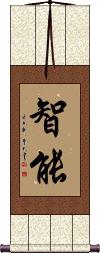
These two characters mean intelligence or intelligent.
The first character means wisdom, intellect, or knowledge.
The second means ability, talent, skill, capacity, capable, able, and can even mean competent.
Together, 知能 can mean “capacity for wisdom,” “useful knowledge,” or even “mental power.” Obviously, this translates more clearly into English as “intelligence.”
Note: This is not the same word used to mean “military intelligence.” See our other entry for that.
 In modern Japan, they tend to use a version of the first character without the bottom radical. If your audience for this artwork is Japanese, please click on the Kanji to the right instead of the button above.
Wisdom
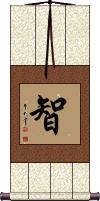
智 is the simplest way to write wisdom in Chinese, Korean Hanja, and Japanese Kanji.
Being a single character, the wisdom meaning is open to interpretation, and can also mean intellect, knowledge or reason, resourcefulness, or wit.
智 is also one of the five tenets of Confucius.
智 is sometimes included in the Bushido code but is usually not considered part of the seven key concepts of the code.
See our Wisdom in Chinese, Japanese and Korean page for more wisdom-related calligraphy.
See Also: Learn From Wisdom | Confucius
Wisdom comes from Experience
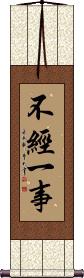
不經一事 means “You can't gain knowledge without practical experience.”
This is the short form (first half) of a longer Chinese proverb. These 4 characters remind you that wisdom only comes from experience.
Each Time You Stumble and Fall, You Gain Experience and Wisdom
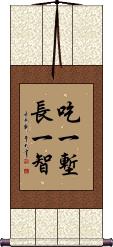
吃一塹長一智 is a Chinese proverb that means “Fall into a moat, and you will gain wisdom from the experience.”
It really suggests that the failures, troubles, frustrations, and setbacks that you encounter in your life are actually helping you to find wisdom. Some would also translate this proverb as “Learn from your mistakes” or “Learn from your experience.”
If you are studying Chinese, you will recognize the first character as “eat,” but in this case, it means to “experience” (as used in this proverb, it is suggesting that you have fallen into a moat and/or had a hard time crossing it).
Translated character by character, this whole proverb is, “Experience one moat, gain one wisdom/knowledge.”
Note: This can be pronounced in Korean, but it's not a commonly used phrase.
Thinking Heart
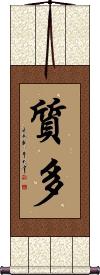
質多 is a Buddhist term that means “the heart considered as the seat of intellect” and “the thinking and reflecting mind.”
Wisdom comes from Experience
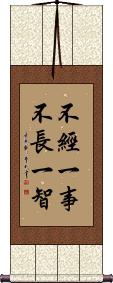
You can translate this 不经一事不长一智 Chinese proverb in a couple of ways.
The first is: You cannot gain knowledge without practice.
The second, and perhaps more popular way is: Wisdom comes from experience.
It literally means if you are inattentive to your affairs or situations you encounter, you will not gain or grow any wisdom or intellect.
Idea / Thought / Meaning
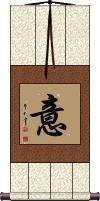
意 is the Chinese, Japanese Kanji, and old Korean Hanja for an idea, intention, meaning, thought, wish, desire, intention, feelings, and thoughts.
In Buddhism, this is the last of the six means of perception (the others are sight, hearing, smell, taste, and touch, and this one represents the mind). It does not literally mean “mind,” but rather something more like mental powers, intellect, intelligence, faculty of thought, or understanding in the Buddhist context.
This in-stock artwork might be what you are looking for, and ships right away...
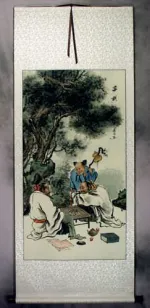
Gallery Price: $200.00
Your Price: $88.88
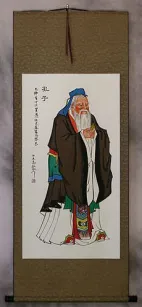
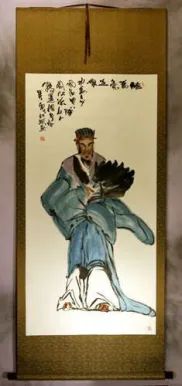
Gallery Price: $71.00
Your Price: $39.00
Not the results for Intellect that you were looking for?
Below are some entries from our dictionary that may match your Intellect search...
| Characters If shown, 2nd row is Simp. Chinese |
Pronunciation Romanization |
Simple Dictionary Definition |
意 see styles |
yì yi4 i kokoro こころ |
More info & calligraphy: Idea / Thought / Meaning(1) feelings; thoughts; (2) meaning; (personal name) Kokoro Manas, the sixth of the ṣaḍāyatanas or six means of perception, i.e. sight, hearing, smell, taste, touch, and mind. Manas means "mind (in its widest sense as applied to all the mental powers), intellect, intelligence, understanding, perception, sense, conscience, will". M.W. It is "the intellectual function of consciousness", Keith. In Chinese it connotes thought, idea, intention, meaning, will; but in Buddhist terminology its distinctive meaning is mind, or the faculty of thought. |
三魂 see styles |
sān hún san1 hun2 san hun |
More info & calligraphy: Three Souls |
智能 see styles |
zhì néng zhi4 neng2 chih neng chinou / chino ちのう |
More info & calligraphy: Intelligence / Intellectintelligence; intellect; brains |
質多 质多 see styles |
zhí duō zhi2 duo1 chih to chitta |
More info & calligraphy: Thinking Heart |
主知 see styles |
yukitomo ゆきとも |
(See 主知主義) prioritizing of reason or intellect (over emotion); (personal name) Yukitomo |
人智 see styles |
jinchi じんち |
human intellect; knowledge |
人知 see styles |
hitoji ひとじ |
human intellect; knowledge; (place-name) Hitoji |
八識 八识 see styles |
bā shì ba1 shi4 pa shih hasshiki; hachishiki はっしき; はちしき |
{Buddh} eight consciousnesses (one for each of the five senses, consciousness of the mind, self-consciousness and store consciousness) The eight parijñāna, or kinds of cognition, perception, or consciousness. They are the five senses of cakṣur-vijñāna, śrotra-v., ghrāna-v., jihvā-v., and kāya-v., i.e. seeing, hearing, smelling, tasting, and touch. The sixth is mano-vijñāna, the mental sense, or intellect, v. 末那. It is defined as 意 mentality, apprehension, or by some as will. The seventh is styled kliṣṭa-mano-vijñāna 末那識 discriminated from the last as 思量 pondering, calculating; it is the discriminating and constructive sense, more than the intellectually perceptive; as infected by the ālaya-vijñāna., or receiving "seeds" from it, it is considered as the cause of all egoism and individualizing, i.e. of men and things, therefore of all illusion arising from assuming the seeming as the real. The eighth is the ālaya-vijñāna, 阿頼耶識 which is the storehouse, or basis from which come all "seeds"of consciousness. The seventh is also defined as the ādāna 阿陀那識 or "laying hold of" or "holding on to" consciousness. |
叡智 see styles |
ruì zhì rui4 zhi4 jui chih eichi / echi えいち |
wisdom; intelligence; intellect; (female given name) Eichi wise |
叡知 see styles |
eichi / echi えいち |
wisdom; intelligence; intellect; (personal name) Eichi |
大乘 see styles |
dà shèng da4 sheng4 ta sheng oonori おおのり |
Mahayana, the Great Vehicle; Buddhism based on the Mayahana sutras, as spread to Central Asia, China and beyond; also pr. [Da4 cheng2] (surname) Oonori Mahāyāna; also called 上乘; 妙乘; 勝乘; 無上乘; 無上上乘; 不惡乘; 無等乘, 無等等乘; 摩訶衍 The great yāna, wain, or conveyance, or the greater vehicle in comparison with the 小乘 Hīnayāna. It indicates universalism, or Salvation for all, for all are Buddha and will attain bodhi. It is the form of Buddhism prevalent in Tibet, Mongolia, China, Korea, Japan, and in other places in the Far East. It is also called Northern Buddhism. It is interpreted as 大教 the greater teaching as compared with 小教 the smaller, or inferior. Hīnayāna, which is undoubtedly nearer to the original teaching of the Buddha, is unfairly described as an endeavour to seek nirvana through an ash-covered body, an extinguished intellect, and solitariness; its followers are sravakas and pratyekabuddhas (i.e. those who are striving for their own deliverance through ascetic works). Mahāyāna, on the other hand, is described as seeking to find and extend all knowledge, and, in certain schools, to lead all to Buddhahood. It has a conception of an Eternal Buddha, or Buddhahood as Eternal (Adi-Buddha), but its especial doctrines are, inter alia, (a) the bodhisattvas 菩薩 , i.e. beings who deny themselves final Nirvana until, according to their vows, they have first saved all the living; (b) salvation by faith in, or invocation of the Buddhas or bodhisattvas; (c) Paradise as a nirvana of bliss in the company of Buddhas, bodhisattvas, saints, and believers. Hīnayāna is sometimes described as 自利 self-benefiting, and Mahāyāna as 自利利他 self-benefit for the benefit of others, unlimited altruism and pity being the theory of Mahāyāna. There is a further division into one-yana and three-yanas: the trīyāna may be śrāvaka, pratyeka-buddha, and bodhisattva, represented by a goat, deer, or bullock cart; the one-yāna is that represented by the Lotus School as the one doctrine of the Buddha, which had been variously taught by him according to the capacity of his hearers, v. 方便. Though Mahāyāna tendencies are seen in later forms of the older Buddhism, the foundation of Mahāyāna has been attributed to Nāgārjuna 龍樹. "The characteristics of this system are an excess of transcendental speculation tending to abstract nihilism, and the substitution of fanciful degrees of meditation and contemplation (v. Samādhi and Dhyāna) in place of the practical asceticism of the Hīnayāna school."[Eitel 68-9.] Two of its foundation books are the 起信論and the 妙法蓮華經 but a larnge numberof Mahāyāna sutras are ascribed to the Buddha。. |
意三 see styles |
yì sān yi4 san1 i san shinzou / shinzo しんぞう |
(personal name) Shinzou The three evils which belong to intellect — lobha, dveṣa, moha, i.e. desire, dislike, delusion. |
慧敏 see styles |
waiman わいまん |
(noun or adjectival noun) (rare) clever; of quick intellect; (given name) Waiman |
智力 see styles |
zhì lì zhi4 li4 chih li chiriki ちりき |
intelligence; intellect (noun - becomes adjective with の) wisdom; intellectual power; intelligence; mental capacity; brains; (given name) Chiriki Knowledge and supernatural power; power of knowledge; the efficient use of mystic knowledge. |
理智 see styles |
lǐ zhì li3 zhi4 li chih richi りち |
reason; intellect; rationality; rational intellect; intelligence; (female given name) Richi Principle and gnosis (or reason); the noumenal in essence and in knowledge; the truth in itself and in knowledge; li is also the fundamental principle of the phenomenon under observation, chih the observing wisdom; one is reality, the other the knower or knowing; one is the known object, the other the knower, the knowing, or what is known; each is dependent on the other, chih depends on lili is revealed by chih. Also knowledge or enlightenment in its essence or purity, free from incarnational influences. |
理知 see styles |
richi りち |
intellect; intelligence; (female given name) Richi |
益智 see styles |
yì zhì yi4 zhi4 i chih yakuchi やくち |
to grow the intellect; Alpinia oxyphylla, a type of ginger (Chinese medicine) bitter seeded cardamon |
睿智 see styles |
ruì zhì rui4 zhi4 jui chih eichi / echi えいち |
wise and farsighted wisdom; intelligence; intellect |
知能 see styles |
chino ちの |
intelligence; intellect; brains; (surname) Chino |
英智 see styles |
hidenori ひでのり |
wisdom; intelligence; intellect; (personal name) Hidenori |
英知 see styles |
hidetomo ひでとも |
wisdom; intelligence; intellect; (given name) Hidetomo |
識主 识主 see styles |
shì zhǔ shi4 zhu3 shih chu shikishu |
The lord of the intellect, the mind, the ālaya-vijñāna as discriminator. |
識牛 识牛 see styles |
shì niú shi4 niu2 shih niu shikigo |
Intellect the motive power of the body, as the ox is of the cart. |
頭脳 see styles |
zunou / zuno ずのう |
(1) head; brains; (2) intellect; understanding |
五利使 see styles |
wǔ lì shǐ wu3 li4 shi3 wu li shih go rishi |
Five of the ten 'runners 'or lictors, i. e. delusions; the ten are divided into five 鈍 dull, or stupid, and five 利 sharp or keen, appealing to the intellect; the latter are 身見, 邊見, 邪見, 見取見, 戒禁取見. |
毘闍那 毘阇那 see styles |
pí shén à pi2 shen2 a4 p`i shen a pi shen a bijana |
vijñāna, 毘若南 'consciousness or intellect', knowledge, perception, understanding, v. 識. |
知情意 see styles |
chijoui / chijoi ちじょうい |
emotion and volition; intellect |
胎藏界 see styles |
tāi zàng jiè tai1 zang4 jie4 t`ai tsang chieh tai tsang chieh taizō kai |
Garbhadhātu, or Garbhakośa-(dhātu), the womb treasury, the universal source from which all things are produced; the matrix; the embryo; likened to a womb in which all of a child is conceived— its body, mind, etc. It is container and content; it covers and nourishes; and is the source of all supply. It represents the 理性 fundamental nature, both material elements and pure bodhi, or wisdom in essence or purity; 理 being the garbhadhātu as fundamental wisdom, and 智 acquired wisdom or knowledge, the vajradhātu. It also represents the human heart in its innocence or pristine purity, which is considered as the source of all Buddha-pity and moral knowledge. And it indicates that from the central being in the maṇḍala, viz. the Sun as symbol of Vairocana, there issue all the other manifestations of wisdom and power, Buddhas, bodhisattvas, demons, etc. It is 本覺 original intellect, or the static intellectuality, in contrast with 始覺 intellection, the initial or dynamic intellectuality represented in the vajradhātu; hence it is the 因 cause and vajradhātu the 果 effect; though as both are a unity, the reverse may be the rule, the effect being also the cause; it is also likened to 利他 enriching others, as vajradhātu is to 自利 enriching self. Kōbō Daishi, founder of the Yoga or Shingon 眞言 School in Japan, adopted the representation of the ideas in maṇḍalas, or diagrams, as the best way of revealing the mystic doctrine to the ignorant. The garbhadhātu is the womb or treasury of all things, the universe; the 理 fundamental principle, the source; its symbols are a triangle on its base, and an open lotus as representing the sun and Vairocana. In Japan this maṇḍala is placed on the east, typifying the rising sun as source, or 理. The vajradhātu is placed west and represents 智 wisdom or knowledge as derived from 理 the underlying principle, but the two are essential one to the other, neither existing apart. The material and spiritual; wisdom-source and intelligence; essence and substance; and similar complementary ideas are thus portrayed; the garbhadhātu may be generally considered as the static and the vajradhātu as the dynamic categories, which are nevertheless a unity. The garbhadhātu is divided into 三部 three sections representing samādhi or quiescence, wisdom-store, and pity-store, or thought, knowledge, pity; one is called the Buddha-section, the others the Vajra and Lotus sections respectively; the three also typify vimokṣa, prajñā, and dharmakāya, or freedom, understanding, and spirituality. There are three heads of these sections, i. e. Vairocana, Vajrapāṇi, and Avalokiteśvara; each has a mother or source, e. g. Vairocana from Buddha's-eye; and each has a 明王 or emanation of protection against evil; also a śakti or female energy; a germ-letter, etc. The diagram of five Buddhas contains also four bodhisattvas, making nine in all, and there are altogether thirteen 大院 or great courts of various types of ideas, of varying numbers, generally spoken of as 414. Cf. 金剛界; 大日; 兩部. |
才気溌剌 see styles |
saikihatsuratsu さいきはつらつ |
(adj-t,adv-to) resourceful and quick-witted; showing a flash of brilliance; having a keen (sparkling) intellect |
才知縦横 see styles |
saichijuuou / saichijuo さいちじゅうおう |
(adj-no,n) (rare) resourceful and quick-witted; showing a flash of brilliance; having a keen intellect |
Click here for more Intellect results from our dictionary
The following table may be helpful for those studying Chinese or Japanese...
| Title | Characters | Romaji (Romanized Japanese) | Various forms of Romanized Chinese | |
| Intelligence Intellect | 智能 / 知能 智能 | chinou / chino | zhì néng / zhi4 neng2 / zhi neng / zhineng | chih neng / chihneng |
| Wisdom | 智 | chi / tomo | zhì / zhi4 / zhi | chih |
| Wisdom comes from Experience | 不經一事 不经一事 | bù jīng yī shì bu4 jing1 yi1 shi4 bu jing yi shi bujingyishi | pu ching i shih puchingishih |
|
| Each Time You Stumble and Fall, You Gain Experience and Wisdom | 吃一塹長一智 吃一堑长一智 | chī yí qiàn, zhǎng yí zhì chi1 yi2 qian4 zhang3 yi2 zhi4 chi yi qian zhang yi zhi chiyiqianzhangyizhi | ch`ih i ch`ien chang i chih chihichienchangichih chih i chien chang i chih |
|
| Thinking Heart | 質多 质多 | chitta | zhí duō / zhi2 duo1 / zhi duo / zhiduo | chih to / chihto |
| Wisdom comes from Experience | 不經一事不長一智 不经一事不长一智 | bù jīng yī shì bù zhǎng yī zhì bu4 jing1 yi1 shi4 bu4 zhang3 yi1 zhi4 bu jing yi shi bu zhang yi zhi bujingyishibuzhangyizhi | pu ching i shih pu chang i chih puchingishihpuchangichih |
|
| Idea Thought Meaning | 意 | kokoro | yì / yi4 / yi | i |
| In some entries above you will see that characters have different versions above and below a line. In these cases, the characters above the line are Traditional Chinese, while the ones below are Simplified Chinese. | ||||

Successful Chinese Character and Japanese Kanji calligraphy searches within the last few hours...



