Many custom options...


And formats...



Imper in Chinese / Japanese...
Buy an Imper calligraphy wall scroll here!
Personalize your custom “Imper” project by clicking the button next to your favorite “Imper” title below...
Switched to secondary search mode due to lack of results using primary.
These secondary results may not be very accurate. Try a different but similar meaning word or phrase for better results. Or...
Look up Imper in my Japanese Kanji & Chinese Character Dictionary(My dictionary is a different system then the calligraphy search you just tried)
If you want a special phrase, word, title, name, or proverb, feel free to contact me, and I will translate your custom calligraphy idea for you.
Impermanence
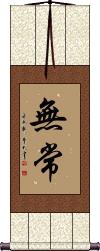
無常 is the state of being “not permanent,” “not enduring,” transitory, or evolving.
It can also mean variable or changeable. In some contexts, it can refer to a ghost that is supposed to take a soul upon death. Following that, this term can also mean to pass away or die.
In the Buddhist context, this is a reminder that everything in this world is ever-changing, and all circumstances of your life are temporary.
If you take the Buddhist philosophy further, none of these circumstances are real, and your existence is an illusion. Thus, the idea of the eternal soul is perhaps just your attachment to your ego. Once you release your attachment to all impermanent things, you will be on your way to enlightenment and Buddhahood.
Language notes for this word when used outside the context of Buddhism:
In Korean Hanja, this means uncertainty, transiency, mutability, or evanescent.
In Japanese, the definition orbits closer to the state of being uncertain.
Mujo no Kaze / Wind of Impermanence
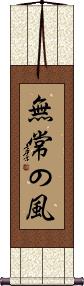
無常の風 is an old Japanese proverb that means the wind of impermanence or the wind of change in Japanese.
This can refer to the force that ends life, like the wind scattering a flower's petals. Life is yet another impermanent existence that is fragile, blown out like a candle.
The first two characters mean uncertainty, transiency, impermanence, mutability, variable, and/or changeable.
In some Buddhist contexts, 無常 can be analogous to a spirit departing at death (with a suggestion of the impermanence of life).
The last two characters mean “of wind” or a possessive like “wind of...” but Japanese grammar will have the wind come last in the phrase.
The following table may be helpful for those studying Chinese or Japanese...
| Title | Characters | Romaji (Romanized Japanese) | Various forms of Romanized Chinese | |
| Impermanence | 無常 无常 | mujou / mujo | wú cháng / wu2 chang2 / wu chang / wuchang | wu ch`ang / wuchang / wu chang |
| Mujo no Kaze Wind of Impermanence | 無常の風 | mu jou no kaze mujounokaze mu jo no kaze | ||
| In some entries above you will see that characters have different versions above and below a line. In these cases, the characters above the line are Traditional Chinese, while the ones below are Simplified Chinese. | ||||

Successful Chinese Character and Japanese Kanji calligraphy searches within the last few hours...



