Many custom options...


And formats...



Not what you want?
Try other similar-meaning words, fewer words, or just one word.
I Will Be in Touch in Chinese / Japanese...
Buy an I Will Be in Touch calligraphy wall scroll here!
Personalize your custom “I Will Be in Touch” project by clicking the button next to your favorite “I Will Be in Touch” title below...
A Traditional Warm Welcome
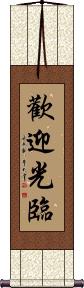
歡迎光臨 would be the ultimate Chinese “welcome mat.” Except it will be on your wall, and people will not step on it.
In a somewhat literal translation, you could say it means “I feel happy as I welcome you, as you have brought a shining light to this place with your arrival,” or more simply, “I am happy you've come as your presents brightens up the place.”
It has become common for this greeting to be announced by the staff upon the arrival of any customer into a fancy store in China. You will also see these characters on the “welcome mats” in front of 4 and 5-star hotels in China.
Having this on a wall scroll is an extra nice touch. I have seen a few horizontal scrolls with this phrase on the wall behind the reception desk of better hotels or near the front door of fine shops. At the fanciest department stores and restaurants in China, several greeters (almost always young women) will stand by the front door, all wearing sashes with this phrase embroidered. As you walk in, they will bow and say “huan ying guang lin” to welcome you to the establishment.
Note: The first two and last two characters do make words in Korean Hanja but are seldom used as a sentence like this in Korean.
Listen to Both Sides and be Enlightened, Listen to One Side and be in the Dark
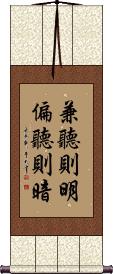
兼聽則明偏聽則暗 is an ancient Chinese proverb about getting all the information from all sides so that you truly understand a situation.
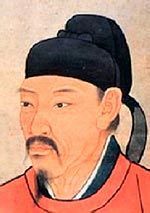
Wei Zheng
A man named Wei Zheng lived between 580-643 AD. He was a noble and wise historian and minister in the court of the early Tang Dynasty. The emperor once asked him, “What should an emperor do to understand the real-world situation, and what makes an emperor out-of-touch with reality?”
Wei Zheng replied, “Listen to both sides and you will be enlightened; listen to only one side and you will be left in the dark.”
Then Wei Zheng went on to cite examples of leaders in history that were victorious after heeding both sides of the story, and other leaders that met their doom because they believed one-sided stories which often came from flattering lips.
Please note that there is an unwritten rule when the same character appears twice in the same phrase, the calligrapher will alter the appearance so that no two characters are exactly alike in the same piece. This calligraphy has two repeating characters that will be written differently than they appear here.
Inspiration
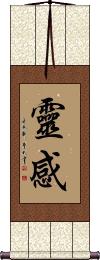
靈感 is the Chinese word closest to hitting the mark for the English word inspiration.
In a more extended context, I have even seen this translated as “brain wave.”
The first character means alert, departed soul, efficacious, quick, effective, or intelligent.
The second character means to feel, to move, to touch, or to affect.
The combined meaning of these two characters changes a bit, but I think it's nice to know the individual meanings to give you a better understanding of where a word comes from.
You could describe this word as “the thought that pops into your head just before you patent the greatest widget ever invented that everyone in the world will want.”
At least, that's the idea.
This term can also mean “intelligent thought” if you translate it directly from each character. If you are looking for inspiration or need to be inspired, this is the word for you.
 When the first character was absorbed into Japanese from Chinese, an alternate form became the standard in Japan. The Kanji shown to the right is the form currently used in Japan. This is still considered an alternate form in China to this day.
it’s
readable by both Chinese and Japanese people but if your audience is Japanese, I recommend the Kanji shown to the right - just click on that Kanji to order that version.
When the first character was absorbed into Japanese from Chinese, an alternate form became the standard in Japan. The Kanji shown to the right is the form currently used in Japan. This is still considered an alternate form in China to this day.
it’s
readable by both Chinese and Japanese people but if your audience is Japanese, I recommend the Kanji shown to the right - just click on that Kanji to order that version.
This in-stock artwork might be what you are looking for, and ships right away...

Gallery Price: $61.00
Your Price: $33.88

Gallery Price: $61.00
Your Price: $33.88

Gallery Price: $61.00
Your Price: $33.88

Gallery Price: $61.00
Your Price: $33.88


Gallery Price: $322.00
Your Price: $178.88

Gallery Price: $65.00
Your Price: $36.00
Not the results for I Will Be in Touch that you were looking for?
Below are some entries from our dictionary that may match your I Will Be in Touch search...
| Characters If shown, 2nd row is Simp. Chinese |
Pronunciation Romanization |
Simple Dictionary Definition |
意 see styles |
yì yi4 i kokoro こころ |
More info & calligraphy: Idea / Thought / Meaning(1) feelings; thoughts; (2) meaning; (personal name) Kokoro Manas, the sixth of the ṣaḍāyatanas or six means of perception, i.e. sight, hearing, smell, taste, touch, and mind. Manas means "mind (in its widest sense as applied to all the mental powers), intellect, intelligence, understanding, perception, sense, conscience, will". M.W. It is "the intellectual function of consciousness", Keith. In Chinese it connotes thought, idea, intention, meaning, will; but in Buddhist terminology its distinctive meaning is mind, or the faculty of thought. |
塵 尘 see styles |
chén chen2 ch`en chen chiri ちり |
dust; dirt; earth (1) dust; (2) trash; garbage; rubbish; dirt; (3) (usu. as 塵ほども...ない) negligible amount; tiny bit; (4) hustle and bustle (of life); worldly cares; impurities of the world; (5) (abbreviation) {sumo} (See 塵手水) ritual gestures indicating that a fight will be clean guṇa, in Sanskrit inter alia means 'a secondary element', 'a quality', 'an attribute of the five elements', e.g. 'ether has śabda or sound for its guṇa and the ear for its organ'. In Chinese it means 'dust, small particles; molecules, atoms, exhalations'. It may be intp. as an atom, or matter, which is considered as defilement; or as an active, conditioned principle in nature, minute, subtle, and generally speaking defiling to pure mind; worldly, earthly, the world. The six guṇas or sensation-data are those of sight, sound, smell, taste, touch, and thought. |
八識 八识 see styles |
bā shì ba1 shi4 pa shih hasshiki; hachishiki はっしき; はちしき |
{Buddh} eight consciousnesses (one for each of the five senses, consciousness of the mind, self-consciousness and store consciousness) The eight parijñāna, or kinds of cognition, perception, or consciousness. They are the five senses of cakṣur-vijñāna, śrotra-v., ghrāna-v., jihvā-v., and kāya-v., i.e. seeing, hearing, smelling, tasting, and touch. The sixth is mano-vijñāna, the mental sense, or intellect, v. 末那. It is defined as 意 mentality, apprehension, or by some as will. The seventh is styled kliṣṭa-mano-vijñāna 末那識 discriminated from the last as 思量 pondering, calculating; it is the discriminating and constructive sense, more than the intellectually perceptive; as infected by the ālaya-vijñāna., or receiving "seeds" from it, it is considered as the cause of all egoism and individualizing, i.e. of men and things, therefore of all illusion arising from assuming the seeming as the real. The eighth is the ālaya-vijñāna, 阿頼耶識 which is the storehouse, or basis from which come all "seeds"of consciousness. The seventh is also defined as the ādāna 阿陀那識 or "laying hold of" or "holding on to" consciousness. |
仏の顔も三度 see styles |
hotokenokaomosando ほとけのかおもさんど |
(expression) (proverb) even the patience of a saint eventually runs out; (if you touch) the Buddha's face three times (he will get annoyed) |
The following table may be helpful for those studying Chinese or Japanese...
| Title | Characters | Romaji (Romanized Japanese) | Various forms of Romanized Chinese | |
| A Traditional Warm Welcome | 歡迎光臨 欢迎光临 | huān yíng guāng lín huan1 ying2 guang1 lin2 huan ying guang lin huanyingguanglin | huan ying kuang lin huanyingkuanglin |
|
| Listen to Both Sides and be Enlightened, Listen to One Side and be in the Dark | 兼聽則明偏聽則暗 兼听则明偏听则暗 | jiān tīng zé míng, piān tīng zé àn jian1 ting1 ze2 ming2, pian1 ting1 ze2 an4 jian ting ze ming, pian ting ze an | chien t`ing tse ming, p`ien t`ing tse an chien ting tse ming, pien ting tse an |
|
| Inspiration | 靈感 灵感 | reikan | líng gǎn / ling2 gan3 / ling gan / linggan | ling kan / lingkan |
| In some entries above you will see that characters have different versions above and below a line. In these cases, the characters above the line are Traditional Chinese, while the ones below are Simplified Chinese. | ||||

Successful Chinese Character and Japanese Kanji calligraphy searches within the last few hours...



