Many custom options...


And formats...



Not what you want?
Try other similar-meaning words, fewer words, or just one word.
I Want Some More in Chinese / Japanese...
Buy an I Want Some More calligraphy wall scroll here!
Personalize your custom “I Want Some More” project by clicking the button next to your favorite “I Want Some More” title below...
1. Old, But More Vigorous in Spirit
2. Life in Harmony / Balanced Life
3. I Need You
4. Kansei Engineering / Sense Engineering
5. One
8. Guanxi
Old, But More Vigorous in Spirit
Age is just a number
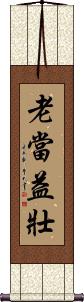
老當益壯 is a Chinese proverb that means “old but vigorous” or “hale and hearty despite the years.”
Said of someone who is more spirited when he/she grows older.
The story behind this Chinese proverb:
In the Eastern Han Dynasty, there was a man named Ma Yuan. He had been planning to herd animals on the frontier since he was young. When he grew up, Ma became a minor official of a county.
Once, he was sending some prisoners to another location. He felt pity for them, so he set them free, and then he fled to another county in the north. He herded animals there, and thus his dream came true. He always said: “If you want to be a great man, the poorer you are, the firmer in spirit you have to be; the older you are, the more spirited you should be.”
Later, when he was even older, Ma Yuan became a famous general of the Eastern Han Dynasty and contributed to many battles.
Life in Harmony / Balanced Life
Harmonious Life
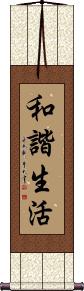
This 和諧生活 title suggests that you have, or want to get your life in balance.
The first two characters regard the idea of balance, harmony, and peace.
The second two characters mean “life.” More specifically this refers to your livelihood, career, and the daily activities that comprise your life or living. Some would translate those two characters as “one's daily existence.”
Note: We have a couple of titles for this idea. This version is more of a noun, thus "The Balanced Life" verses a verb form like "Balancing [Your] Life."
I Need You
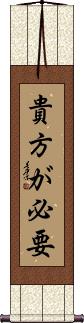
Some people like to say, “I love you” but others might want to say “I need you.” 貴方が必要 is “I need you” in Japanese.
The first two characters mean “You.”
The middle character is a connecting particle. In this case, it more or less means “are.”
The last two characters mean necessary, needed, essential, indispensable, or necessity.
The “I” in the title is implied. Effectively this means “I need you.”
Kansei Engineering / Sense Engineering
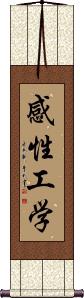
In short, 感性工學 or Kansei engineering involves collecting data on human experiences with a product and then designing or engineering improvements based on those experiences or “senses.”
Some may define Kansei as “engineering around the human experience.”
There is a lot more to know about Kansei, but if you are looking for this word, you probably already know the big picture.
Note: This term is very new in China and is only used by businesses, factories, and engineers that are implementing TQM principles. While the characters have the same base meaning in both languages, this is a Japanese title that flows back into the Chinese language (in history, most things flowed from China to Japan). To a Chinese person unfamiliar with this concept, they may interpret this as “sense vocational studies,” which doesn't make much sense. You may have to explain the intended meaning to some Chinese viewers. But that can make it a great conversation piece.
Kansei is also a newer term in Korean and is only used in certain parts of the industry, with the definition of “Sensory Engineering.” Not yet in widespread use in Korea.
Above is the modern Japanese version of this title. The last character has a Traditional Chinese version, making this 感性工學 instead of 感性工学. If you want the Traditional Chinese version, please include special instructions or email me so that I make sure the calligrapher writes the version you want.
See Also: Kaizen
One
The number one
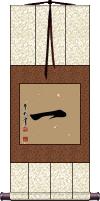
一 is “one” or “1” in Chinese, Japanese Kanji, and old Korean Hanja.
People keep searching for “one” but I'm not sure what you want. This would be a strange selection for a wall scroll, so please don't order it. Post a request on our forum if you want a phrase with “one” in it that you can't find on our site.
The “one” character is really simple, it's just one stroke. Two is two strokes and three is three strokes, from four and above, the characters get more complicated.
In some ways, the “one” character is too simple, it could be a stray mark, or added to a banking document. Therefore, the following banking anti-fraud character for “one” has developed over the last 1500 years in China and Japan:


Family / Household
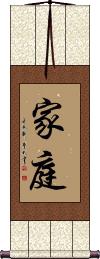
家庭/傢庭 is a common way to express family, household, or home in Chinese, Japanese Kanji, and old Korean Hanja.
However, for a wall scroll, we recommend the single-character form (which is just the first character of this two-character word). If you want that, just click here: Family Single-Character
The first character means “family” or “home.” The second means “courtyard” or “garden.” When combined, the meaning is a bit different, as it becomes “household” or “family.” The home and/or property traditionally has a strong relationship with family in Asia. Some Chinese, Korean, and Japanese families have lived in the same house for 7 or more generations!
Qi Gong / Chi Kung
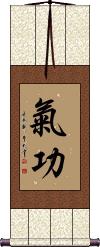
氣功 or Qigong is the title of a technique that is somewhere between medical practice, meditation, and in some cases, religion.
The definition is blurred depending on which school of Qigong you are following. In some cases, it is even incorporated with martial arts.
Some people (even Chinese people) mix this title with Tai Chi (Tai Qi) exercises.
Lately, in China, people will claim to practice Tai Chi rather than Qigong because the Qigong title was recently used as a cover for an illegal pseudo-religious movement in China with the initials F.G. or F.D. (I can not write those names here for fear of our website being banned in China).
You can learn those names and more here: Further info about Qigong
If you are wondering why I wrote “Qi Gong” and “Chi Kung” as the title of this calligraphy entry, I should teach you a little about the various ways in which Chinese can be Romanized. One form writes this as “Chi Kung” or “Chikung” (Taiwan). In the mainland and elsewhere, it is Romanized as “Qi Gong” or “Qigong.” The pronunciation is the same in Taiwan, mainland, and Singapore Mandarin. Neither Romanization is exactly like English. If you want to know how to say this with English rules, it would be something like “Chee Gong” (but the “gong” has a vowel sound like the “O” in “go”).
Romanization is a really confusing topic and has caused many Chinese words to be mispronounced in the west. One example is “Kung Pao Chicken,” which should actually be more like “Gong Bao” with the “O” sounding like “oh” for both characters. Neither the Romanization system in Taiwan nor the Mainland is perfect, in my opinion, and leads to many misunderstandings.
In modern Japan, you may see this written as 気功, but the original 氣功 is still recognized. If you need the Japanese version, please contact me.
Guanxi
The Chinese Concept of Relationship and Exchange of Favors
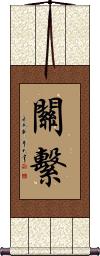
The dictionary definition is:
Relations/relationship, to concern, to affect, to have to do with, or connection.
But there's more to it...
In China, the relationship that you have with certain people can open doors for you. Having guanxi with someone also means they would never defraud you but are honor-bound to treat you fairly (of course, this goes both ways). Sometimes it is suggested that guanxi is the exchange of favors. 關繫 / 関繫 / 關係 is more about having a relationship that allows you to ask for and expect favors without shame.
There is no concept in western culture that exactly matches guanxi, but perhaps having a social or professional network is similar.
Note that there are some variations common within Chinese, Japanese Kanji, and Korean Hanja for this word... Japanese tend to use a Chinese alternate form as shown to the right for
the first character.
 There's also another alternate form of that first character (currently used as the official Simplified form in mainland China) which looks like the character shown to the right. It's basically the central radical of the alternate version shown above but without the “door radical” around it. In more free-flowing calligraphy styles, this version would be the likely choice for a calligrapher.
 In Modern Japanese, they use the character shown to the right.
They also tend to use this same form in Korean Hanja (I've only checked this word in my Korean dictionary, but it has not been confirmed by a translator's review).
 If that was not confusing enough, there is another alternate form of that second character. See right.
An Asian calligrapher of any nationality may use these forms at their discretion. However, They would tend to stick to the most common form used in their respective languages.
If you have any preference on any of these issues, please give us a special note with your order, and we'll make sure it's done the way you want.
Indomitable / Unyielding
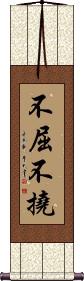
不屈不撓 means “Indomitable” or “Unyielding.”
不屈不撓 is a long word by Chinese standards. At least, it is often translated as a single word into English. It's actually a proverb in Chinese.
If you want to break it down, you can see that the first and third characters are the same. Both mean “not” (they work as a suffix to make a negative or opposite meaning to whatever character follows).
The second character means “bendable.”
The last means “scratched” or “bothered.”
So this really means “Won't be bent, can't be bothered.” I have also seen it written as “Will not crouch, will not submit.” This comes from the fact that the second character can mean “to crouch” and the last can mean “to submit” (as in “to give in” such as “submitting to the rule of someone else”). This may explain better why these four characters mean “indomitable.”
Notes:
Some will translate this as “indomitable spirit”; however, technically, there is no character to suggest the idea of “spirit” in this word.
Other translations include indefatigability, indomitableness, or unremitting tenacity.
The first two characters can be stand-alone words in Chinese.
In Japanese, this is considered two words (with very similar meanings). It's more common to see the word order flipped to 不撓不屈 in Japanese.
The same characters are used in old Korean Hanja. Just like in Japanese, the words are swapped to 不撓不屈 creating a word pronounced “불요불굴” in Korean.
See 不撓不屈
Crisis equals Danger plus Opportunity?
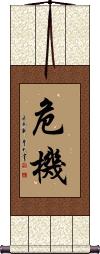
危機 means crisis in Chinese and Japanese.
Separately, the first character here does mean “danger” or “to endanger,” and the second character can mean “opportunity.”
However, I want to debunk a myth that was propagated by some westerners who did not have a clear understanding of Asian languages...
While often, Chinese/Japanese/Korean compound words (words of two or more characters) are the sum of their parts, this is not always the case. The compound is often understood with a completely different meaning than the two characters individually.
Many have said that the Chinese/Japanese/Korean word for Crisis is made up of the characters for “danger” and “opportunity.” 危機 is true when phrased this way.
However, it's not absolutely correct to say that “danger + opportunity = crisis” in Asian cultures.
English example:
If I tell you that...
Bovine creature + Guy behind the plate in baseball = Locomotive train protection

...you would think I was mad. But consider that “cow + catcher = cowcatcher,” which is the device that used to be found on steam engines to protect them if they hit an animal on the tracks. When we hear the word “cowcatcher,” we don't separate the words into their individual meanings (necessarily).
The same is true with the word for crisis in Chinese/Japanese/Korean. While you can separate the characters, few Asian people would automatically do so in their minds.
The final answer:
It is a half-truth to say, “danger plus opportunity equals crisis” in Chinese/Japanese/Korean. Use this statement and concept with caution.
Also, the second character can mean “secret” or “machine,” depending on context so I guess you have to say “a dangerous machine = crisis” or “danger + a secret = crisis.” Both of these are only slightly more ridiculous than the first premise.
PS: 危機 is probably not a great word for a scroll unless you have a special use for it.
Life Energy / Spiritual Energy
Chi Energy: Essence of Life / Energy Flow
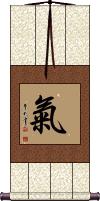
This 氣 energy flow is a fundamental concept of traditional Asian culture.
氣 is romanized as “Qi” or “Chi” in Chinese, “Gi” in Korean, and “Ki” in Japanese.
Chi is believed to be part of everything that exists, as in “life force” or “spiritual energy.” It is most often translated as “energy flow” or literally as “air” or “breath.” Some people will simply translate this as “spirit,” but you must consider the kind of spirit we're talking about. I think this is weighted more toward energy than spirit.
The character itself is a representation of steam (or breath) rising from rice. To clarify, the character for rice looks like this: 
Steam was apparently seen as visual evidence of the release of “life energy” when this concept was first developed. The Qi / Chi / Ki character is still used in compound words to mean steam or vapor.
The etymology of this character is a bit complicated. It's suggested that the first form of this character from bronze script (about 2500 years ago) looked like these samples: 

However, it was easy to confuse this with the character for the number three. So the rice radical was added by 221 B.C. (the exact time of this change is debated). This first version with the rice radical looks like this: 
The idea of Qi / Chi / Ki is really a philosophical concept. It's often used to refer to the “flow” of metaphysical energy that sustains living beings. Yet there is much debate that has continued for thousands of years as to whether Qi / Chi / Ki is pure energy or consists partially or fully of matter.
You can also see the character for Qi / Chi / Ki in common compound words such as Tai Chi / Tai Qi, Aikido, Reiki, and Qi Gong / Chi Kung.
In the modern Japanese Kanji, the rice radical has been changed into two strokes that form an X.
 The original and traditional Chinese form is still understood in Japanese, but we can also offer that modern Kanji form in our custom calligraphy. If you want this Japanese Kanji, please click on the character to the right instead of the “Select and Customize” button above.
More language notes: This is pronounced like “chee” in Mandarin Chinese, and like “key” in Japanese.
This is also the same way to write this in Korean Hanja where it is Romanized as “gi” and pronounced like “gee” but with a real G-sound, not a J-sound.
Though Vietnamese no longer use Chinese characters in their daily language, this character is still widely known in Vietnam.
See Also: Energy | Life Force | Vitality | Life | Birth | Soul
This in-stock artwork might be what you are looking for, and ships right away...
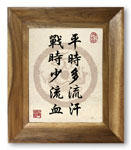
Gallery Price: $106.00
Your Price: $58.88
Gallery Price: $220.00
Your Price: $112.88
Gallery Price: $120.00
Your Price: $61.88
Gallery Price: $72.00
Your Price: $39.88
Gallery Price: $220.00
Your Price: $99.88
Gallery Price: $120.00
Your Price: $61.88
Gallery Price: $220.00
Your Price: $99.88

Gallery Price: $90.00
Your Price: $45.00

Gallery Price: $61.00
Your Price: $33.88

Gallery Price: $71.00
Your Price: $39.00
The following table may be helpful for those studying Chinese or Japanese...
| Title | Characters | Romaji (Romanized Japanese) | Various forms of Romanized Chinese | |
| Old, But More Vigorous in Spirit | 老當益壯 老当益壮 | lǎo dāng yì zhuàng lao3 dang1 yi4 zhuang4 lao dang yi zhuang laodangyizhuang | lao tang i chuang laotangichuang |
|
| Life in Harmony Balanced Life | 和諧生活 和谐生活 | hé xié shēng huó he2 xie2 sheng1 huo2 he xie sheng huo hexieshenghuo | ho hsieh sheng huo hohsiehshenghuo |
|
| I Need You | 貴方が必要 | ana ta ga hitsu you anatagahitsuyou ana ta ga hitsu yo | ||
| Kansei Engineering Sense Engineering | 感性工學 感性工学 | kansei kougaku kanseikougaku kansei kogaku | gǎn xìng gōng xué gan3 xing4 gong1 xue2 gan xing gong xue ganxinggongxue | kan hsing kung hsüeh kanhsingkunghsüeh |
| One | 一 | ichi | yī / yi1 / yi | i |
| Family Household | 家庭 / 傢庭 家庭 | ka tei / katei | jiā tíng / jia1 ting2 / jia ting / jiating | chia t`ing / chiating / chia ting |
| Qi Gong Chi Kung | 氣功 气功 | ki kou / kikou / ki ko | qì gōng / qi4 gong1 / qi gong / qigong | ch`i kung / chikung / chi kung |
| Guanxi | 關繫 / 関繫 / 關係 关系 / 関係 | kankei | guān xì / guan1 xi4 / guan xi / guanxi | kuan hsi / kuanhsi |
| Indomitable Unyielding | 不屈不撓 不屈不挠 | fu kutsu fu tou fukutsufutou fu kutsu fu to | bù qū bù náo bu4 qu1 bu4 nao2 bu qu bu nao buqubunao | pu ch`ü pu nao puchüpunao pu chü pu nao |
| Crisis equals Danger plus Opportunity? | 危機 危机 | kiki | wēi jī / wei1 ji1 / wei ji / weiji | wei chi / weichi |
| Life Energy Spiritual Energy | 氣 气 / 気 | ki | qì / qi4 / qi | ch`i / chi |
| In some entries above you will see that characters have different versions above and below a line. In these cases, the characters above the line are Traditional Chinese, while the ones below are Simplified Chinese. | ||||

Successful Chinese Character and Japanese Kanji calligraphy searches within the last few hours...



