Many custom options...


And formats...



Not what you want?
Try other similar-meaning words, fewer words, or just one word.
Feel free to email me with your request. If it's easy, I'll translate it for free and add it to this database of calligraphy for you.
I Survived in Chinese / Japanese...
Buy an I Survived calligraphy wall scroll here!
Return From Death’s Door
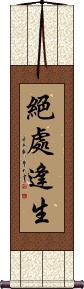
絕處逢生 is a Chinese proverb/idiom that talks of coming back from death's door or an unexpected rescue from danger.
Figuratively, this can be to recover from a seemingly impossible situation or to find a way out of a predicament.
If you have survived a near-death experience or severe illness, this might be an appropriate wall scroll for you.
Not the results for I Survived that you were looking for?
Below are some entries from our dictionary that may match your I Survived search...
| Characters If shown, 2nd row is Simp. Chinese |
Pronunciation Romanization |
Simple Dictionary Definition |
囘鶻 囘鹘 see styles |
huí gú hui2 gu2 hui ku Ekotsu |
高車; 高昌. M067729彝 Uighurs, M067729胡; A branch of the Turks first heard of in the seventh century in the Orkhon district where they remained until A. D. 840, when they were defeated and driven out by the Kirghiz; one group went to Kansu, where they remained until about 1020; another group founded a kingdom in the Turfan country which survived until Mongol times. They had an alphabet which was copied from the Soghdian. Chingis Khan adopted it for writing Mongolian. A. D. 1294 the whole Buddhist canon was translated into Uighur. |
遺存 遗存 see styles |
yí cún yi2 cun2 i ts`un i tsun |
historical remains; things that have survived since ancient times; (of such things) to survive |
自死遺児 see styles |
jishiiji / jishiji じしいじ |
child who has survived the suicide of a parent; child of a person who committed suicide |
The following table may be helpful for those studying Chinese or Japanese...
| Title | Characters | Romaji (Romanized Japanese) | Various forms of Romanized Chinese | |
| Return From Death’s Door | 絕處逢生 绝处逢生 | jué chǔ féng shēng jue2 chu3 feng2 sheng1 jue chu feng sheng juechufengsheng | chüeh ch`u feng sheng chüehchufengsheng chüeh chu feng sheng |
|
| In some entries above you will see that characters have different versions above and below a line. In these cases, the characters above the line are Traditional Chinese, while the ones below are Simplified Chinese. | ||||

Successful Chinese Character and Japanese Kanji calligraphy searches within the last few hours...



